Reverse-Chronological Resume Writing Guide [+ Examples]
This complete guide with detailed explanations and expert tips will teach you how to write an acting resume in record time!
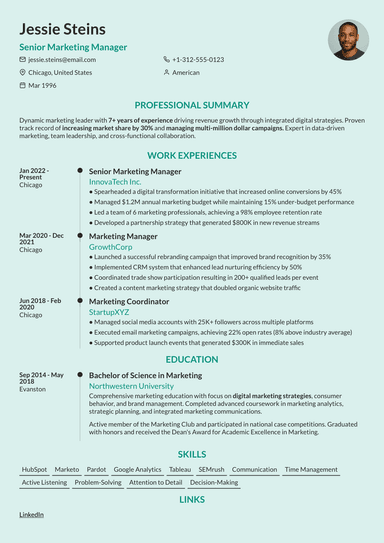
Edit this resume![Reverse-Chronological Resume Writing Guide [+ Examples]](/_next/image?url=https%3A%2F%2Fcdn.sanity.io%2Fimages%2Fbcftoxbw%2Fproduction%2Fbd6e32cd2887a53ce0f7ae8064a0def1ab585d64-1190x1683.png&w=1080&q=75)
The reverse-chronological resume stands as the gold standard in the job market, with over 90% of hiring managers preferring this time-tested format. This straightforward approach lists your work experience from most recent to oldest, creating a clear narrative of your professional journey.
So, regardless of whether you're climbing the corporate ladder or seeking new opportunities, our guide can help you master this format. Additionally, it will improve your chances of landing interviews and securing your dream position, so keep reading to learn more about this topic.
- The reverse-chronological resume format is the most widely accepted one, preferred by recruiters and ATS systems alike.
- It showcases career progression by listing work experience from the newest to the oldest position.
- Such a resume format is best suited for professionals with consistent work history and clear career advancement, as well as for traditional industries like finance, healthcare, law, and corporate environments.
- This option isn’t recommended for career changers, recent graduates, or those with significant employment gaps.
What Is a Reverse-Chronological Resume?
A reverse-chronological resume is a format that lists your most recent position first, then working backward through your career history. In other words, it’s similar to telling your professional story in reverse, starting with where you are now and explaining how you got there.
This popular resume format differs significantly from its alternatives. While functional resumes emphasize skills over work history and combination resumes blend both approaches, the reverse-chronological format puts your career progression front and center.
Pros and Cons of Reverse-Chronological Resume Format
The reverse-chronological resume format offers distinct advantages and some limitations worth considering before you commit to this approach. Let’s analyze them in more detail:
- Is preferred by most recruiters
- Shows clear career progression and growth
- Is ATS-friendly and easily parsed by systems
- Is a familiar format that's quick to scan
- Highlights recent, relevant experience first
- Demonstrates stability and commitment
Cons
- Highlights employment gaps
- Is less effective for career changers
- May not suit entry-level candidates
- Can emphasize job-hopping patterns
- Has limited space for skills showcase
- May not work for freelancers or consultants
Who Should Use the Reverse-Chronological Resume Format?
Here’s who should use the reverse-chronological resume format:
- Experienced professionals with 3+ years of consistent work history in their field
- Career climbers who've experienced promotions, increased responsibilities, or salary growth
- Industry veterans applying for roles similar to their current or previous positions
- Traditional sector professionals in finance, healthcare, law, education, or government roles
- Corporate employees seeking positions in structured, hierarchical organizations
Who Shouldn’t Use the Reverse-Chronological Resume Format?
Here’s how should avoid chronological resumes:
- Career changers transitioning between unrelated industries or fields
- Recent graduates with limited professional experience but strong academic credentials
- Gap-year professionals who have taken extended breaks for personal, family, or health reasons
- Freelancers or consultants with diverse project-based work that doesn't follow traditional employment patterns
- Military veterans transitioning to a civilian career where their service experience needs translation
Therefore, it’s safe to say that the best resume format for your experience depends on your career stage and professional background.
When to Use the Reverse-Chronological Resume Format
You should use the reverse-chronological resume format if your last 2-3 roles demonstrate clear relevance and career growth that might look good to the recruiters for the new role.
It's particularly effective for internal promotions, lateral moves within your industry, or positions with similar job titles to ones you've held recently. Additionally, the format is also suitable for traditional corporate job applications, where hiring managers expect to see a conventional career trajectory.
How to Write a Reverse-Chronological Resume
To write an effective reverse-chronological resume layout, you need strategic organization and attention to detail. Here, each section serves a specific purpose in building your professional narrative, and the order is important for both human readers and applicant tracking systems.
Let's break down each essential component:
#1. Header
Your header creates the first impression and provides essential contact information recruiters need to reach you. Therefore, you should keep it clean, professional, and prominently placed at the top of your resume.
Here’s what to include in the header of this common resume format:
- Full name in large font (18-22 pts)
- Professional email address, phone number, and city/state
- LinkedIn profile URL and portfolio website (if relevant to your field).
Avoid including your full street address; city and state provide sufficient location information while maintaining privacy.
Sarah Mitchell
Digital Marketing Manager
(555) 123-4567
sarah.mitchell@email.com
Denver, CO
linkedin.com/in/sarahmitchell
#2. Summary/Objective
Your professional resume summary or objective provides context for everything that follows.
Experienced professionals should use a 2-3 sentence summary highlighting their years of experience, key achievements, and career focus. On the other hand, entry-level candidates should use a resume objective to express their career goals and relevant qualifications.
Here, you should make every word count by including specific numbers, industry terminology, and skills mentioned in the job posting. This section often determines whether a recruiter continues reading or moves to the next candidate.
Here’s an example of a resume summary:
Result-driven marketing professional with 8+ years of experience developing integrated digital campaigns that increased brand awareness by 40% and generated $2M+ in revenue. Proven expertise in SEO, social media strategy, and marketing automation platforms, with a track record of leading cross-functional teams to exceed performance targets.
Meanwhile, this is what a resume objective can look like:
Motivated and quick-learning graduate with a strong foundation in content creation, editing, and digital communication. Eager to apply academic knowledge and hands-on internship experience to support a dynamic editorial team. Known for strong attention to detail, clear writing, and a proactive attitude toward learning and growth.
#3. Work Experience
The work experience section forms the backbone of your reverse-chronological resume. In this part, you should list positions from your current or most recent role, including job title, company name, location, and employment dates.
For each position, you can include 3-5 bullet points focusing on achievements rather than basic job duties. Start each bullet with a strong action verb and include quantifiable results whenever possible. Here’s how you can do it:
Work Experience
Senior Marketing Manager
TechCorp Solutions, Austin, TX
2021–Present
- Increased organic website traffic by 65% through SEO optimization and content marketing initiatives
- Managed $500K annual advertising budget, achieving 25% higher ROI than industry benchmarks
- Led a cross-functional team of 8 professionals to launch 3 major product campaigns ahead of schedule
- Implemented a marketing automation system that reduced lead qualification time by 40%
#4. Education
Your education section should be concise but comprehensive, listing degrees in reverse chronological order.
Here you should include:
- Degree type
- Major
- Institution name and location
- Year(s) of attendance
Recent graduates can add relevant coursework, academic honors, or a GPA of 3.5 or higher.
Education
Master of Business Administration (MBA)
University of Colorado, Boulder, CO
2019
Bachelor of Arts in Communications
Colorado State University, Fort Collins, CO
2011–2015
- Summa Cum Laude, Phi Beta Kappa Honor Society
#5. Skills
The skills section showcases your technical and professional competencies relevant to the target position.
Include a mix of hard and soft skills that align with job requirements. Meanwhile, avoid listing basic skills that most professionals possess; focus on specialized knowledge that sets you apart.
The section might look like this:
Hard Skills
- Google Analytics
- Salesforce CRM
- Adobe Creative Suite
- WordPress
- Hootsuite
Soft Skills
- Writing skills
- Clear communication
- Creative thinking
- Attention to detail
Reverse-Chronological Resume Example
Here's a complete reverse-chronological resume example showcasing best practices for the role of marketing manager:
3+ Expert Tips to Make Your Reverse-Chronological Resume Stand Out
Here’s how you can make your reverse-chronological resume stand out:
#1. Tailor Its Content to Each Job Posting
Generic resumes rarely succeed in the competitive job market. Instead, you should customize your resume for each application by analyzing the job description and incorporating relevant keywords, skills, and experiences that match the employer's needs.
The best way to do this is to study the job ad carefully and identify required qualifications, preferred skills, and company values. Then, you need to adjust your professional summary, work experience bullets, and skills section to mirror this language. This approach not only improves ATS compatibility but also demonstrates genuine interest in the specific role.
#2. Optimize for ATS Using Strategic Keywords
Resume optimization for applicant tracking systems requires a delicate balance between keyword inclusion and natural language. Therefore, you should research industry-specific terminology and incorporate job titles, skills, and qualifications from the posting throughout your resume.
Focus on including both hard and soft skills naturally within your work experience descriptions while avoiding keyword stuffing, which can make your resume difficult to read and hurt your ATS scores.
#3. Keep Design Clean and Professional
While creativity has its place, reverse-chronological resumes should prioritize clarity and readability over flashy design elements.
To achieve this, you should.:
- Choose a simple, professional font like Arial or Calibri in 10-12 point size, and maintain consistent formatting throughout.
- Make use of adequate white space to prevent your resume from appearing cluttered, and stick to a black-and-white color scheme unless you're in a creative field.
- Use standard section headings, maintain 1-inch margins, and ensure your resume prints clearly on standard 8.5x11 paper.
- Avoid graphics, tables, or unusual formatting that might confuse ATS systems.
#4. Include Measurable Achievements
Numbers tell a compelling story that generic job descriptions cannot match..
To accomplish this, focus on outcomes rather than activities, using the STAR method (Situation, Task, Action, Result) to structure complex accomplishments. Even if you don't have exact figures, provide estimates that demonstrate the scope and scale of your contributions.
Build Your Perfect Resume with ResumeBuilder.so
Creating a winning reverse-chronological resume doesn't have to be a solo struggle. ResumeBuilder.so transforms the resume-writing process with AI-powered tools designed specifically for the job market demands.
All you should do to start building your document with our resume builder for free is to open our software and provide the necessary details; we’ll do the rest! You can choose whether you want to write a resume from scratch by using some of our role-specific templates or customize the existing document to make it better and ATS-friendly!
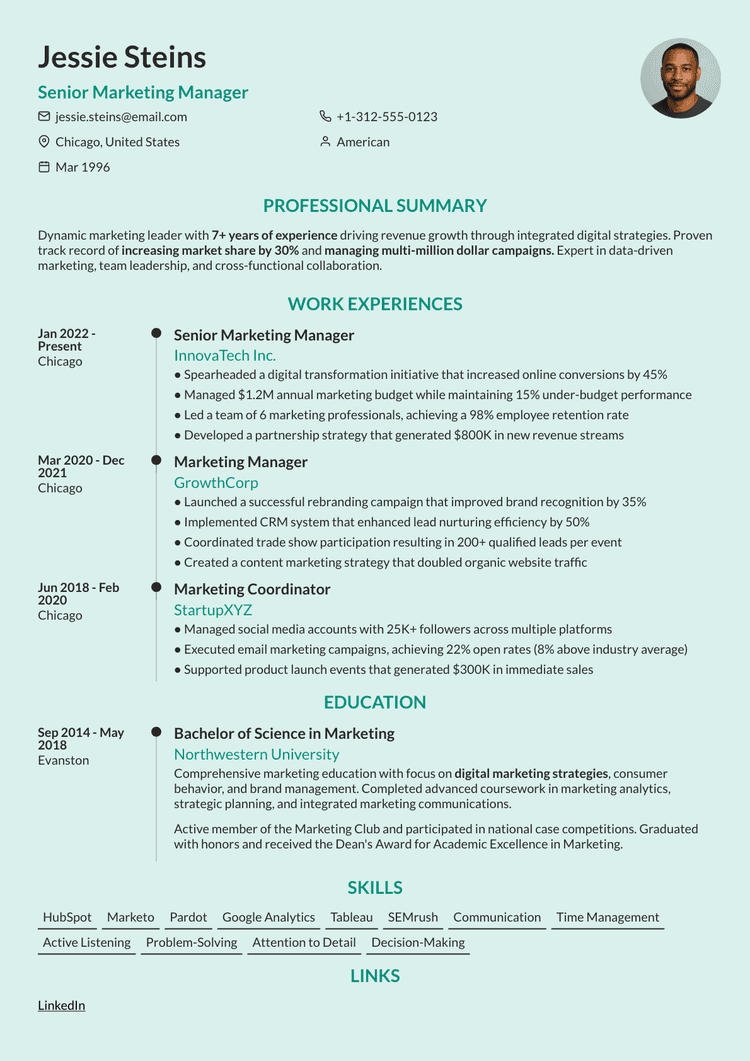
Reverse-Chronological Resume Template
Here’s a proven reverse-chronological resume template structure to organize your information effectively:
Final Thoughts
The reverse-chronological resume remains the most powerful tool for showcasing career progression and professional growth. When crafted thoughtfully with attention to ATS optimization and recruiter preferences, this format can significantly increase your interview opportunities and career advancement potential.
Remember that success depends not just on following the format, but on strategically presenting your unique value proposition through quantified achievements, targeted content, and a well-written cover letter. Take time to tailor each application and continuously refine your approach based on market feedback, and you may land your dream job in no time!
Reverse-Chronological Resume FAQs
#1. Is the reverse-chronological resume the best format?
Yes, the reverse-chronological resume is considered the best format for most professionals with consistent work histories. Research shows 95% of recruiters prefer this format because it clearly demonstrates career progression and relevant experience.
#2. How many jobs should I list on a chronological resume?
You should typically list your last 3–5 relevant jobs on a chronological resume, or cover the past 10–15 years of your work history. If you're early in your career, include internships, part-time roles, or volunteer work that demonstrates transferable skills.
#3. What if I have employment gaps in my work history?
If you have employment gaps in your work history, address them strategically by using years instead of months in your dates, focusing on skills developed during breaks, or including relevant activities like volunteering, consulting, or education.
#4. Do recruiters prefer chronological resumes over other formats?
Hard Skills
- Google Analytics
- Salesforce CRM
- Adobe Creative Suite
- WordPress
- Hootsuite
Soft Skills
- Writing skills
- Clear communication
- Creative thinking
- Attention to detail
Yes, recruiters do prefer chronological resumes over other formats because they're familiar, easy to scan quickly, and provide clear context about career development.

Emily Foster knows how nerve-wracking it can be to land your first job—she’s been there. As a mentor for young professionals, she shares exactly what hiring managers want from entry-level candidates. From internship hacks to interview confidence tips, Emily helps students and recent grads navigate the job search with ease.