Career Goals: Meaning, Examples, and How to Set Them


Career goals are the professional targets you set for yourself based on where you want your working life to go. They can be short-term, such as gaining a new skill, earning a promotion, or landing a better role, or long-term, like moving into leadership, changing industries, or building a more stable and rewarding career.
Clear career goals give your decisions direction and help you focus your time, effort, and development on something meaningful instead of drifting from one job to the next.
Today, you will learn why they matter and how they can shape your professional growth. You will also discover different types of career goals, how to set them realistically, and how to talk about them in a way that sounds focused and professional.
- Career goals are specific professional targets that give your work life direction, unlike vague wishes that sound ambitious but cannot be tracked.
- Short-term and long-term career goals work best together, with smaller milestones helping you build toward bigger career moves like leadership, specialization, or a career change.
- The SMART method makes career goals more effective by forcing them to be specific, measurable, achievable, relevant, and tied to a clear deadline.
- Strong career goals should match your current experience level and can support students, mid-level professionals, senior leaders, and career changers in different ways.
- Clear career goals also help you present yourself better on resumes and in interviews because they show employers that your growth plans are realistic, focused, and connected to the role.
What Are Career Goals?
Career goals are clear, well-defined targets you set for your professional life, from skills you want to build to roles you want to reach. In other words, they're the difference between drifting through a career and actively designing one. Their purpose is straightforward: direction when choices feel overwhelming and motivation when progress is slow.
The distinction between a goal and a wish matters, too. "I want to be successful" sounds more like a wish, but "I want to lead a marketing team within three years" is a career goal; a specific, directional, and achievable one.
You should also know that a career goal is different from a resume objective on your resume. Namely, the objective is a compressed, employer-facing version of your goal, written to fit a specific application rather than your full professional vision.
Short-Term vs. Long-Term Career Goals
Short-term career goals are targets you aim to reach within days, months, or up to one year. On the other hand, long-term career goals cover a horizon of one to five years or more.
That said, here’s a quick long vs. short-term career goals comparison:
| Type | Timeframe | Purpose | Example |
|---|---|---|---|
Short-term career goals | 0–12 months | Build skills & momentum | Complete certification |
Long-term career goals | 1–5+ years | Define career direction | Become team leader |
Short-Term Career Goals
Short-term goals keep momentum alive between major milestones. Here are some career goal examples from this category:
- Complete a project management certification within six months to qualify for a team lead role.
- Improve public speaking skills by presenting at four Toastmasters meetings this quarter.
- Expand a professional LinkedIn network by 50 targeted connections in the next 90 days.
Building the right hard skills through short-term goals is one of the most reliable ways to stay competitive and make long-term ambitions feel achievable.
Long-Term Career Goals
Long-term goals tell you where you ultimately want to go, even when the route shifts. As career specialists recommend, setting a clear long-term vision dramatically improves navigation through the career landscape. Some examples of this type of goal include the following:
- Become a senior software engineer at a product-led company within four years.
- Launch a consulting practice in a specific niche within five years.
- Move from individual contributor to people management within three years.
Long-term goals should be revisited at least annually. Life changes, industries shift, and priorities evolve, so a goal set at 25 may look very different at 30; that's career planning working as it should.
20 Career Goal Examples Across Experience Levels
Here are 20 real-world career goal examples sorted by experience level, so you can find the ones that match where you are right now:
- Land a first full-time role in your chosen field within six months of graduation: this creates the professional baseline that everything else builds on.
- Complete a paid internship before graduating: internships develop both skills and employer relationships.
- Earn one industry-recognized certification within the next year to close the credential gap that entry-level candidates often face.
- Build a professional portfolio with at least three sample projects by semester's end: work samples substitute for work history.
- Grow a LinkedIn profile to 200 targeted connections within six months: networks open doors that job boards don't.
- Earn a promotion to senior or lead level within 18 months by consistently exceeding performance targets.
- Develop leadership skills by owning at least one cross-functional project this year.
- Gain experience outside your current department within the next year: cross-functional exposure makes you more adaptable and more promotable.
- Mentor a junior colleague formally over the next six months to build both your teaching skills and your leadership track record.
- Complete an advanced certification or MBA within two years
- Transition into a VP, director, or executive-level role within three years through deliberate positioning.
- Build a recognizable personal brand through speaking, writing, or a professional podcast within two years.
- Publish thought leadership content (articles, whitepapers, or a book) within the next 18 months to establish authority that your job title alone can't.
- Improve team performance metrics by 15% over the next two quarters through coaching and process work.
- Launch a side advisory practice in your area of expertise within the next year to diversify income and test entrepreneurial instincts.
- Complete a relevant bootcamp or certificate program within six months: structured learning is the fastest way to close a credential gap in a new field.
- Build a portfolio of three to five projects in the target field within eight months, so you have work samples before you have work history.
- Secure a bridge role (a position that uses current skills in the new industry) within 12 months so that you earn while you transition.
- Connect with 20 professionals already working in your target field over the next three months for referrals, advice, and realistic expectations.
- Apply to at least 10 relevant roles within 90 days.
How to Set Career Goals Using the SMART Method
You can set effective career goals by following the SMART method, which stands for Specific, Measurable, Achievable, Relevant, and Time-bound.
Vague intentions feel motivating in the moment, but rarely survive a busy week; SMART career goals, however, hold up under pressure because they force clarity at the point of commitment.
S: Is Your Goal Specific Enough to Act On?
A specific career goal interview answers clarify what needs to happen, when, and why it matters. Answering those questions before you commit is the fastest way to find out whether a goal is real or just an idea.
Vague
Get better at project management.
Complete the PMP certification by December 31st by studying two hours per week.
M: How Will You Know When You've Hit It?
Measurable goals attach numbers or milestones to the outcome; for instance, "Increase sales pipeline by 20% in Q3" might be better than "improve sales performance." Without a measure, there's no way to track progress or catch drift before it becomes a full miss.
A: Is It Genuinely Within Reach Right Now?
Ambitious goals are worth pursuing, but unrealistic ones drain motivation the moment they hit friction. The test is to ask yourself whether achieving this requires resources and time you can actually access.
Checking job growth projections for your target role should be part of this step since committing to a five-year goal in a declining occupation requires a plan that accounts for that reality.
R: Does It Connect to Your Bigger Picture?
A relevant goal moves you meaningfully toward your longer-range vision and fits your current situation. So, the work experience on your resume should reflect the same direction as your professional goals; if they're pointing in different ways, one of them needs updating.
T: When Exactly Does This Happen?
Deadlines separate goals from wishes. For example, "Someday I'll move into UX design" stays on the shelf indefinitely. Meanwhile, "Complete three portfolio projects and apply to five UX roles by September 30th" has a finish line.
Short-term goals need tight timelines (30–90 days), while long-term goals need an end date plus quarterly check-ins.
How to Write Career Goals for a Resume
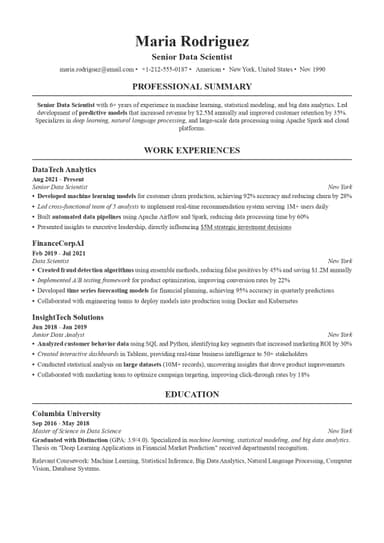
You can write career goals for a resume by including a career objective or summary at the top of your document. The two formats serve slightly different purposes, and choosing the right one matters.
- A resume summary works for candidates with experience: it frames background and signals direction.
- A resume objective works better for students and career changers; it names the role you want and why you're positioned for it.
Here are two sample career goal statements:
Recent marketing graduate seeking a digital marketing coordinator role where strong content creation and analytics skills can drive brand awareness, with a goal of growing into a marketing manager position within three years.
Results-driven operations manager with 7 years of experience streamlining logistics processes, seeking a director-level role to lead organization-wide efficiency initiatives across multiple sites.
Keep both to 2–3 sentences, tailor them to the specific job you’re applying for, and lead with good action verbs.
You can also use our AI-powered resume builder to generate a professional resume that will include an effective summary based on your career goals in seconds. We let you pick the best resume template for your industry and ask for some essential details about your qualifications; next thing you know, you already have a solid resume that perfectly connects your goals to what the employer needs!
How to Answer "What Are Your Career Goals?" in an Interview
You can answer “What are your career goals?” in an interview by briefly explaining your short-term priorities, connecting them to the role, and showing how they fit into your longer-term direction.
That structure works because it shows focus, maturity, and a realistic sense of progression. It also reassures employers that your goals align with the opportunity in front of you rather than sounding disconnected, generic, or self-serving.
A good answer should be specific enough to sound credible but broad enough to leave room for professional growth. In most cases, the safest approach is to focus on professional development, increasing responsibility, deeper expertise, leadership, or impact within the field. The key is to show that this role makes sense as part of your next step.
On the other hand, you should avoid vague answers like “I just want to grow,” overly personal answers like “I want to make more money,” or goals that clearly point away from the role or industry. Strong answers stay grounded in the job, reflect ambition without sounding opportunistic, and make it clear why this position is a logical next step.
Here are three good sample answers you can use for inspiration:
Short term, I want to build strong data analysis skills in a real business environment, which is exactly what this analyst role would allow me to do. Longer term, I’d like to grow into a strategy-focused position where I can use data to influence larger business decisions.
My short-term goal is to deepen my expertise in enterprise SaaS sales, and this role directly supports that by giving me exposure to larger accounts and more complex deal cycles. Over the next few years, I’m working toward leading a regional sales team, so I’m looking for a company where strong performance can lead to real internal growth.
At this stage of my career, my short-term goal is to drive measurable impact at scale, particularly by improving cross-functional execution and mentoring high-performing teams. Longer term, I want to continue growing in senior leadership roles where I can shape strategy, build strong operational structures, and help the business expand sustainably.
5 Common Mistakes When Setting Career Goals
Finally, these are the five most common mistakes you can make while setting your professional goals:
- Your goals are vague to track. "Get better at my job" is not a career goal. Without specificity, there's nothing to track, nothing to measure, and no way to know if you're making progress. Every goal needs a clear definition of done.
- You’re confusing ambition with wishful thinking. Bold goals are worth pursuing, but impossible ones in impossible timeframes drain motivation and create a cycle of reset. The best career goals require real stretch without requiring miracles.
- You haven’t attached a deadline to a goal. Goals without timelines become permanent items on a mental list. A deadline creates urgency, and even an approximate one (end of this quarter, by my next review) is better than none.
- You’re not reviewing your goals regularly. A goal set in January can be irrelevant by June if your role changes, your industry moves, or a better path emerges. Review your goals every quarter, or after any major career event. When a role no longer connects to where you're headed, it may be time to act on that.
- Your resume doesn’t reflect your current goals. It should evolve with your career ambitions. If your goals have shifted but your resume still reflects who you were three years ago, that gap is costing you opportunities. Career goals examples for performance reviews and job applications only land when your whole document tells the same story.
Final Thoughts
Career goals give your professional life direction, helping you make better decisions about the jobs you pursue, the skills you build, and the progress you want to make over time. Be it gaining experience, moving into leadership, or changing industries, the important thing is that they are clear, realistic, and relevant to your long-term growth.
Strong ones can also help you present yourself more confidently in applications and interviews, since employers want to see that you have purpose and motivation. Once you understand how they work, it becomes much easier to set priorities, stay focused, and move forward in a way that supports both your current needs and your future ambitions.

Maya Brooks believes that a fulfilling career shouldn’t come at the cost of your mental health. Having worked in corporate HR, she’s seen firsthand how burnout culture can wreck careers. Now, she shares real-world strategies for setting work boundaries, avoiding toxic workplaces, and finding joy in your job.