21+ Essential LinkedIn Profile Tips to Stand Out in 2026

In today's job market, having an optimized LinkedIn profile can be the difference between getting noticed and getting overlooked. However, many struggle with low profile views, few recruiter messages, and a headline that blends into the crowd. That frustration usually isn’t about experience—it’s about positioning.
To help you, we share 21+ essential LinkedIn profile tips for 2026. You’ll learn how to optimize your headline, summary, experience, and activity using proven strategies that align with recruiter search behavior and hiring psychology. Let’s begin!
- Your Linkedin headline and summary are critical for first impressions and LinkedIn SEO.
- Professional photos increase profile views by up to 21 times compared to no photo.
- Recommendations and endorsements build credibility and trust with potential employers.
- Regular activity and engagement keeps your profile visible in your network's feed.
- Custom URLs and featured content enhance professionalism and showcase your best work.
What Makes a Strong LinkedIn Profile?
A strong LinkedIn profile combines strategic optimization with authentic personal branding to create a compelling narrative about who you are and what value you bring. Unlike resumes and cover letters, your profile is searchable, shareable, and constantly working to connect you with opportunities.
LinkedIn's search algorithm considers multiple factors when ranking profiles, including:
- Keyword relevance
- Profile completeness
- Engagement levels
- Connection strength
By understanding how the platform works and implementing strategic optimizations, you can increase your chances of appearing in recruiter searches and attracting quality opportunities that align with your career goals.
21+ LinkedIn Profile Tips to Transform Your Professional Presence
Now that you know what makes a strong Linkedin profile, here are several expert tips that will help you increase your visibility and interactions on the platform:
#1. Use a Professional Profile Photo

Your profile photo is one of the first things people notice, and profiles with professional photos receive 21 times more views and 9 times more connection requests. Here’s what to consider before you place your Linkedin profile photo:
- Choose a high-quality headshot with good lighting where you're dressed professionally and smiling.
- Make sure the photo is recent, clearly shows your face, and maintains a neutral or professional background.
- Avoid group photos, vacation snapshots, or overly casual images
Remember, this image represents your personal brand, so invest in a professional photographer if possible or ensure your DIY photo meets professional standards.
#2. Create a Custom LinkedIn URL
Customizing your LinkedIn URL makes your profile more professional and easier to share on your resume, business cards, and email signature. Instead of a URL with random numbers, create a clean URL using your name (e.g., linkedin.com/in/johnsmith). This small detail demonstrates attention to professionalism and makes it easier for recruiters to find and remember you.

To customize your URL, navigate to your profile, click "Edit public profile & URL" on the right side, and then edit your URL in the top right section. If your full name is taken, try variations like adding your middle initial, professional designation, or location.
#3. Add a Background Banner Photo
Your background banner appears at the top of your profile and provides an opportunity to showcase your personal brand, industry, or areas of expertise. Choose an image that's professional and relevant to your field—this could be an industry-specific scene, a branded graphic with your tagline, or a clean, professional design.
The recommended size of the cover image is 1584 x 396 pixels. This visual element helps your profile stand out and immediately communicates what you're about. Think of it as the cover of your professional book—it should intrigue people enough to want to read more.
#4. Craft a Compelling Headline
Your LinkedIn headline is the 120-character snippet that appears next to your name everywhere on the platform. Instead of just listing your job title, use this space to showcase your value proposition and key expertise areas. Think of it as your professional elevator pitch—concise, compelling, and keyword-rich for LinkedIn SEO.
Here are a few examples of effective Linkedin headlines:
Recent Marketing Graduate | Social Media Enthusiast | Ready to Drive Brand Engagement
Product Manager | SaaS Solutions | Transforming User Feedback into Product Innovation
VP of Engineering | Building High-Performance Teams | Cloud Architecture Expert
Former Teacher Transitioning to UX Design | Empathy-Driven Problem Solver
Freelance Graphic Designer | Branding & Identity | Helping Startups Stand Out
#5. Write a Story-Driven Summary
Your LinkedIn summary (or "About" section) is your opportunity to tell your professional story in your own voice. Here are a few tips to help you craft a good Linkedin summary:
- Use conversational language and write in the first person to create authenticity.
- Start with a strong opening that captures attention, then discuss your expertise, achievements, and what drives you professionally.
- Include relevant keywords naturally throughout for search optimization, but prioritize readability and genuine connection.
- End with a clear call-to-action, whether that's inviting people to connect, visit your website, or reach out about opportunities.
- Aim for 3-5 paragraphs that showcase both your professional competence and personality.
That said, let’s see a good real-world example you can use for inspiration:
I didn’t start my career aiming for a specific title—I started by wanting to solve problems and create work that actually delivers results. Over the years, that curiosity has grown into a career focused on building high-quality content, improving visibility, and helping brands communicate with clarity and confidence.
Today, I specialize in content strategy, SEO-driven writing, and editorial quality control. I’ve worked across industries like digital marketing, iGaming, and career development, collaborating with cross-functional teams to produce content that’s not only engaging but also optimized for performance. From refining workflows to mentoring writers, I enjoy turning complex ideas into clear, actionable messages.
What drives me most is continuous improvement—finding better ways to research, write, and optimize content while maintaining a strong human voice. I value precision, consistency, and collaboration, and I take pride in delivering work that meets both user needs and business goals.
If you’re looking to connect, collaborate, or simply exchange ideas about content, SEO, or digital growth, feel free to reach out or send a message—I’m always open to meaningful conversations.
#6. Incorporate Strategic Keywords
LinkedIn functions as a search engine for professional talent, so strategic keyword optimization is essential for being discovered by recruiters. Research the terms and phrases commonly used in job descriptions for your target roles, then incorporate these keywords naturally throughout your profile—especially in your headline, summary, job descriptions, and skills section.
Think about what recruiters would type when searching for someone with your background. Include both broad industry terms and specific technical skills. However, avoid keyword stuffing, which appears spammy and reduces readability. The goal is to balance search optimization with natural, compelling language that resonates with human readers.
#7. Detail Your Work Experience
Same as when building your resume, each position in your work experience should tell the story of your impact and contributions, not just list responsibilities. Start with a brief overview of the role, then use bullet points to highlight specific achievements, quantified results, and projects you led or contributed to. Include relevant keywords for each position to improve searchability.
Your LinkedIn experience section can be more detailed than what you'd include on your resume, so take advantage of this space. You're not limited by the one-page rule here, which means you can provide more context and detail about your achievements.
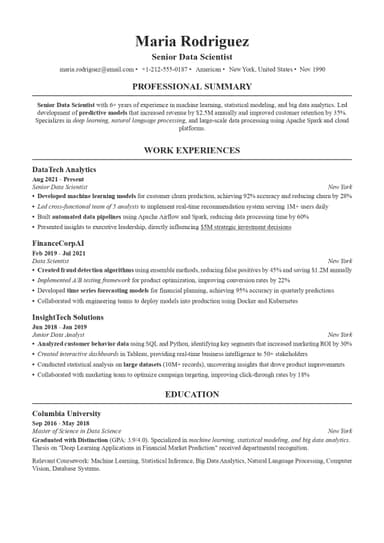
Here’s a good example of a Linkedin work experience entry:
Chief Editor / Content Quality Lead
Dec 2018 - Sep 2019 · 10 mos
Austin, Texas Area
- Managed editorial quality for 300+ SEO-focused articles per month, maintaining accuracy, tone, and search intent alignment
- Built and scaled content QA processes that reduced revisions by 30% and improved delivery timelines
- Collaborated with SEO strategists, marketers, and designers to optimize content for rankings, engagement, and conversions
- Supervised and mentored writers and content analysts, contributing to team promotions and skill development
- Conducted content audits and optimization initiatives that increased organic visibility and on-page performance
#8. Quantify Your Achievements
Numbers and metrics make your achievements concrete and credible. Whenever possible, quantify the impact of your work with specific data points. Include percentages, dollar amounts, timeframes, and scale to give context to your achievements.
Let’s see a few good examples:
- Led a team of 12 to deliver projects 20% under budget
- Implemented a new system that reduced processing time by 30%.
Overall, quantified achievements catch recruiters' attention and provide concrete evidence of your capabilities. This approach transforms generic statements into compelling proof of your professional value.
#9. Add Rich Media and Documents
LinkedIn allows you to upload documents, presentations, images, videos, and links to your profile—a feature many professionals underutilize. Use this functionality to showcase your best work, whether that's presentations you've delivered, articles you've written, projects you've completed, or certifications you've earned.
Add these elements to your summary section (as Featured content) and to individual job entries. For example, include portfolio samples for creative roles, case studies for consultants, or published research for academics. This visual and interactive content increases engagement with your profile and helps you stand out from profiles with text alone.
#10. Prioritize Your Top Skills
LinkedIn allows you to list up to 50 skills, but the first 3-5 receive the most visibility and are weighted more heavily in search algorithms. Strategically order your skills to feature your most relevant and strongest competencies first. Include a mix of hard skills (technical abilities specific to your field) and soft skills (like leadership or communication).
Keep your skills list current by removing outdated competencies and adding newly acquired ones. The skills you feature should align with your headline, summary, and the types of opportunities you're seeking. If you're changing careers, prioritize the skills relevant to where you're going, not just where you've been.
#11. Seek Strategic Endorsements
Endorsements validate your skills and qualifications, as well as increase your credibility with profile visitors. While they're less formal than recommendations, they still add social proof to your expertise. Proactively endorse colleagues and connections for their skills—many will reciprocate. Focus on getting endorsed for your priority skills that align with your career goals.
You can also politely request endorsements from colleagues who've worked with you in areas where you want to build credibility. Remember that quality matters more than quantity—endorsements from respected professionals in your field carry more weight than numerous endorsements from weak connections. Regularly review and manage your endorsements, removing skills you no longer want to emphasize.
#12. Request Thoughtful Recommendations
Recommendations are powerful testimonials that provide authentic third-party validation of your skills and work ethic. Request recommendations from former managers, colleagues, clients, or professors who can speak specifically to your strengths and contributions. Make it easy for them by providing context about the skills or projects you'd like them to highlight.
Aim for 2-3 quality recommendations per major role, with emphasis on recent positions. Quality trumps quantity—one detailed, specific recommendation from a respected connection is worth more than multiple generic endorsements.
#13. Give Recommendations to Build Relationships

Writing recommendations for colleagues and connections serves multiple purposes—it strengthens professional relationships, demonstrates your leadership and generosity, and often results in recommendations in return. When you write a recommendation, be specific about the person's strengths, contributions, and the context of your working relationship.
Highlight concrete achievements and characteristics that would appeal to potential employers. Writing recommendations also helps with your own Linkedin networking, as the recipient is notified and the recommendation may appear in feeds. This practice builds goodwill and establishes you as a supportive, engaged professional.
The recommendations you write say something about you too. They demonstrate your collaboration skills, your generosity, and your ability to recognize and articulate others' strengths—all qualities that employers value.
#14. Share Valuable Content Regularly
Regular activity on LinkedIn keeps your profile visible in your network's feed and positions you as an engaged industry professional. Share articles, insights, and updates relevant to your field, adding your own commentary to spark discussion. Original content—whether posts, articles, or videos—typically receives more engagement than simple shares.
Aim to post 2-4 times per week to stay visible, with best days for Linkedin posting being Tuesdays, Thursdays, and Wednesdays. Share a mix of industry news, professional insights, career advice, and personal achievements. Use relevant hashtags to increase discoverability beyond your immediate network. Consistent, quality content sharing establishes you as a thought leader in your field and keeps you top-of-mind when opportunities arise.
#15. Engage With Others' Content
Actively interacting with others' posts is important for visibility and relationship building. Like, comment on, and share posts from your connections, especially those in your target industry or companies. Thoughtful comments that add value to the discussion are particularly effective for increasing your visibility.
When you engage authentically with others' content, you appear in their networks and demonstrate your expertise and engagement. This strategy helps you build relationships with industry leaders, stay informed about trends, and position yourself as an active participant in professional conversations. Set aside time daily or weekly for genuine engagement with your LinkedIn feed.
#16. Publish LinkedIn Articles
LinkedIn's publishing platform allows you to write long-form articles that showcase your expertise and thought leadership. Publishing original articles on LinkedIn keeps your content within the platform, making it easily discoverable by your network and beyond.
Write about industry trends, share professional lessons learned, provide how-to guides, or offer unique perspectives on relevant topics. For instance, if you're a problem-solving expert, write about your framework for tackling complex challenges. If you're in marketing, share a case study of a successful campaign (with permission, of course).
#17. Complete Every Profile Section
LinkedIn's algorithm favors complete profiles, and users with complete profiles receive more opportunities and visibility. Fill out every section available, including education, certifications, volunteer experience, languages, publications, patents, projects, and honors & awards.
Each section provides additional keywords for search optimization and gives a more comprehensive picture of your professional background. Also, complete profiles signal to recruiters that you're serious about your professional presence and take attention to detail seriously. Even if a section seems minor, completing it contributes to your profile strength score and may contain information that differentiates you from other candidates.
#18. Optimize Your Profile for Search
Beyond keywords in your headline and summary, you should optimize your entire profile for LinkedIn's search algorithm. This means incorporating relevant terms throughout your experience descriptions, skills section, and other areas. Use both broad industry terms and specific technical skills that recruiters in your field search for.
Include variations of key terms to capture different search approaches (e.g., "digital marketing," "online marketing," "internet marketing"). Your job titles should be clear and industry-standard when possible, as these are frequently used search terms.
#19. Adjust Privacy Settings Strategically
If you're actively job searching, make your profile public and turn on the "Open to Work" feature that signals to recruiters you're looking for opportunities. However, if you're employed and conducting a confidential search, adjust settings to only show this status to recruiters.
Control who can see your connections, whether your profile appears in search engines, and who can see your activity updates. Be strategic about profile viewing settings—viewing profiles in private mode maintains your anonymity but prevents you from seeing who's viewed your profile.
#20. Showcase Education and Certifications
Your education section validates your qualifications and can be a key search criterion for recruiters. Include all relevant degrees, clearly listing:
- Education institution
- Degree type
- Field of study
- Graduation year
Also, add descriptions for significant academic achievements, relevant coursework, or thesis topics if they apply to your career goals.
The certifications section is equally important—showcase professional certifications, licenses, and credentials relevant to your field. Make sure to include:
- Certifying organization
- Date earned
- Expiration date (if applicable)
Furthermore, add certification badges when available, as these visual elements increase credibility and make your qualifications immediately apparent.
#21. Add Languages and Publications

Additional sections like Languages and Publications add depth to your profile and can be deciding factors for certain opportunities. List all languages you speak with your proficiency level—language skills are highly valued in many roles and can significantly expand your job opportunities.
The Publications section allows you to showcase articles, papers, or books you've authored or co-authored, establishing your expertise and thought leadership. Make sure to include:
- Publication titles
- Publishers
- Dates
- Brief descriptions
Also, these sections provide additional keywords for search optimization and differentiate you from candidates with similar core qualifications.
#22. Join and Engage in Relevant Groups
LinkedIn Groups provide opportunities to connect with professionals in your industry, participate in discussions, and increase your visibility. Join groups related to your field, target companies, or professional interests. Active participation in group discussions positions you as an engaged industry professional and can lead to valuable connections.
Share insights, answer questions, and contribute meaningfully to conversations. However, prioritize quality over quantity—being genuinely active in 3-5 relevant groups is more valuable than passive membership in dozens. Group activity can appear on your profile and in feeds, increasing your visibility beyond your direct network.
Think of them as specialized online networking events. You wouldn't go to a networking event and stand silent. The same principle applies here—participate, contribute, and build relationships.
How to Maintain and Update Your LinkedIn Profile
Creating an optimized LinkedIn profile is only the first step—maintaining and regularly updating it is essential for continued effectiveness. Your profile should evolve as your career advances and as you acquire new skills and accomplishments. Here are a few proven strategies you should follow:
- Review your profile quarterly at least. Make sure to update your experience section with recent achievements, add new skills you've developed, and refresh your summary if your career focus has shifted. Each time you complete a major project, earn a certification, receive recognition, or change roles, update your profile immediately while the details are fresh.
- Monitor your profile's performance through LinkedIn's analytics. Track who's viewing your profile, what search terms led them to you, and which content receives the most engagement. These insights can guide your Linkedin profile optimization efforts and help you understand what resonates with your target audience.
- Stay current with LinkedIn's features and best practices. The platform regularly introduces new functionalities that can enhance your profile's effectiveness. Participate in the platform consistently through content sharing and engagement—an active profile receives more visibility than a static one, even if optimized.
Common LinkedIn Profile Mistakes to Avoid
Even strong profiles can underperform on LinkedIn. The table below outlines common Linkedin mistakes that quietly limit visibility, credibility, and recruiter interest if left uncorrected:
| Mistake | Why It Hurts Your Profile | What to Do Instead |
|---|---|---|
Copy-pasting your resume | Misses personality and engagement; LinkedIn is more than a static document | Tell a story, add context, and showcase impact with media and detail |
Using corporate jargon | Sounds generic and inauthentic; reduces trust | Write conversationally in your real professional voice |
Leaving your profile outdated | Signals disengagement and stalled growth | Update roles, achievements, and skills regularly |
Sending generic connection requests | Feels impersonal and lowers acceptance rates | Personalize each message with context or shared interests |
Connecting indiscriminately | Inflates numbers but weakens network value | Build a relevant, engaged, quality network |
Ignoring engagement | Limits visibility in the LinkedIn algorithm | Comment, react, and post consistently—even briefly |
Final Thoughts
Your LinkedIn profile is one of the most powerful tools in your career development arsenal. By implementing these LinkedIn profile tips, you can transform your profile from a static online resume into a dynamic professional brand that works for you around the clock.
Whether you're actively job searching or building your professional network for future opportunities, an optimized profile increases your visibility, credibility, and access to quality opportunities. Start with the foundational elements like your photo, headline, and summary, then progressively enhance other sections.
Remember that profile optimization is an ongoing process, not a one-time task. The professionals who get the most value from LinkedIn are those who treat it as a living document that evolves with their careers. Invest time in building and maintaining your LinkedIn presence, and you'll reap the rewards throughout your career journey.
LinkedIn Profile Tips FAQs

Emily Foster knows how nerve-wracking it can be to land your first job—she’s been there. As a mentor for young professionals, she shares exactly what hiring managers want from entry-level candidates. From internship hacks to interview confidence tips, Emily helps students and recent grads navigate the job search with ease.