Collaboration Skills: Resume Guide and Examples for 2026

Collaboration skills matter more than you might think. According to various online sources, 97.5% of employers consider teamwork abilities highly important when evaluating candidates. However, many job seekers struggle to showcase these soft skills effectively on their resumes.
In this guide, we break down everything you need to know about collaboration skills—what they are, why they're crucial, and how to list them on your resume properly. You'll find 50 real resume examples, common mistakes to avoid, and practical strategies for highlighting your collaborative achievements.
- Collaboration skills are soft skills that enable effective teamwork and achieving common goals through communication, listening, and positive contribution to team dynamics.
- Essential skills include communication, active listening, emotional intelligence, conflict resolution, flexibility, and trust-building.
- Collaboration skills are best showcased through specific achievements in your work experience section with quantifiable results, not just listed in a skills section.
- These skills can be developed through practice, training, real-world application, and feedback.
- Collaboration skills are critical for remote work environments and cross-functional teams as they directly impact job performance, career advancement, and workplace satisfaction.
What Are Collaboration Skills?
Collaboration skills are soft skills that enable you to work effectively with others toward a common goal by communicating clearly, listening actively, and contributing positively to team dynamics. They encompass a range of competencies including verbal and written communication, emotional intelligence, problem-solving, and interpersonal skills that allow you to navigate complex workplace relationships and projects.
While teamwork and collaboration are often used interchangeably, there's a subtle difference. Teamwork skills refer to the basic act of working alongside others, while collaboration skills emphasize active participation, shared decision-making, and mutual contribution toward outcomes.

Why Are Collaboration Skills Important?
Collaboration skills are important because they directly impact productivity, innovation, and positive workplace experience. They are among the top requirements in job listings across all industries, and for several good reasons:
- Increased productivity and efficiency. When people collaborate effectively, they streamline problem-solving, reduce duplication of effort, and complete projects faster. For example, a challenging task becomes manageable when you can bounce ideas off teammates and divide responsibilities based on each person's strengths.
- Enhanced innovation and creativity. Diverse perspectives lead to better solutions. With people from different backgrounds and departments, you get cross-pollination of ideas that wouldn't emerge otherwise. Brainstorming sessions become more effective, and your organization gains competitive advantages through innovative thinking.
- Improved employee satisfaction and retention. Employees who feel connected to their teams report higher engagement and are less likely to leave. This matters for your career too—strong collaborative relationships often lead to better opportunities, mentorship, and professional growth.
15 Essential Collaboration Skills for Your Resume
These essential collaboration skills span communication, emotional intelligence, problem-solving, and leadership skills that employers actively seek in candidates.
Let’s examine each one in more detail.
#1. Verbal Communication
Clear verbal communication forms the foundation of effective collaboration. This means articulating ideas clearly in meetings, presentations, and one-on-one conversations.
However, keep in mind your target audience. You need to adjust your communication style based on your audience—explaining technical concepts differently to engineers versus executives.
Here’s an example bullet point emphasizing verbal communication skills on resume:
- Delivered clear project updates in weekly team meetings, resulting in 25% reduction in miscommunication errors and improved cross-departmental coordination
#2. Written Communication
Emails, documentation, and reports require different skills than verbal exchanges. Strong writing skills become especially critical for asynchronous collaboration, as clear, concise messages prevent confusion and keep projects moving forward.
Let’s see how you might present this on your resume:
- Created comprehensive project documentation that improved knowledge sharing across 3 departments, reducing onboarding time for new team members by 40%
#3. Active Listening
Active listening means paying full attention to what others say, asking clarifying questions, and understanding before responding. It's not just waiting for your turn to talk. This skill prevents misunderstandings and shows respect for your colleagues' perspectives.
Here’s how you can present active listening on your resume:
- Utilized active listening techniques to mediate team conflict between development and design teams, resulting in improved collaboration and 15% boost in sprint velocity
#4. Empathy
Empathy involves understanding others' perspectives and emotional states. When you can put yourself in a colleague's shoes, you build stronger relationships and navigate difficult situations more effectively.
This doesn't mean agreeing with everyone—it means understanding where they're coming from. For instance, you can phrase it like this on your resume:
- Demonstrated empathy in supporting 5 remote team members' well-being during transition period, creating engaging growth opportunities that improved retention by 30%
#5. Self-Awareness
Understanding your own impact on others helps you collaborate more effectively. Self-aware people recognize their strengths and weaknesses, and how their behavior affects team dynamics. They can adjust their approach when something isn't working.
Here’s how you can highlight this on a resume:
- Adapted communication style based on 360-degree feedback, improving cross-departmental relationships and increasing stakeholder satisfaction scores from 3.2 to 4.5
#6. Emotional Regulation
Managing stress and staying professional under pressure keeps teams functioning during challenging times. You'll face tight deadlines, conflicting priorities, and unexpected setbacks.
Your ability to maintain composure helps your entire team stay focused and productive. That said, here’s a good example you can use for inspiration when writing your resume:
- Maintained calm demeanor during high-pressure product launch, leading 8-person team to on-time completion despite 30% scope increase
#7. Critical Thinking
Critical thinking involves analyzing information objectively and making informed decisions. You evaluate options, consider consequences, and choose the best path forward.
In collaborative settings, this means contributing thoughtful analysis rather than just opinions. For example:
- Applied critical thinking to identify process inefficiencies in customer service workflow, implementing solutions that saved 20 hours monthly and improved response times by 35%
#8. Conflict Resolution
Disagreements happen in every workplace, and how you handle conflict matters. Effective conflict resolution means finding constructive solutions that address everyone's core concerns rather than just compromising or avoiding issues.
Here’s a good example for resume:
- Resolved departmental conflicts between sales and operations by facilitating collaborative solution-finding meetings, restoring team productivity and improving interdepartmental communication
#9. Creative Problem-Solving
Creative problem-solving involves thinking beyond obvious solutions and encouraging collaborative brainstorming. The best ideas often emerge when diverse team members contribute freely.
That said, here’s how you can phrase it on a resume:
- Led brainstorming sessions that generated 7 innovative customer retention strategies, with 3 successfully implemented, resulting in 12% reduction in churn
#10. Trust Building
Trust develops through reliability and consistency. When you follow through on commitments and deliver quality work, teammates know they can count on you. This foundation makes everything else easier—communication, delegation, feedback, and collaboration.
Here’s a bullet point achievement emphasizing this skill:
- Built trust with cross-functional stakeholders by consistently meeting deadlines and exceeding project expectations, becoming the go-to person for high-priority initiatives
#11. Flexibility and Adaptability
Plans change, priorities shift, and team members leave or join projects mid-stream. Your willingness to adapt—embracing different approaches and adjusting to new circumstances—keeps collaboration smooth during transitions.
Here’s a good example you can use for inspiration:
- Adapted quickly to a sudden remote work transition, maintaining team productivity at 95% efficiency while implementing new digital collaboration tools across a 12-person department
#12. Respect for Diversity
Valuing different perspectives and practicing inclusive behaviors creates better outcomes. When team members feel respected regardless of their background, they contribute more freely and creatively.
This isn't just about communication skills—it's about creating psychological safety. Let’s see how you can showcase this on your resume:
- Promoted inclusive workplace practices ensuring all team members felt valued, resulting in 40% increase in idea submissions from junior staff
#13. Delegation
Even if you're not in a formal leadership role, knowing how to distribute tasks effectively matters. Good delegation means matching tasks to people's strengths, providing clear expectations, and trusting others to deliver without micromanaging.
This is how you can demonstrate your delegation skills on a resume:
- Effectively delegated tasks across an 8-person team based on individual strengths, completing major website redesign project 2 weeks ahead of schedule and 15% under budget
#14. Accountability
Taking responsibility for your part—and acknowledging when things go wrong—builds credibility. Accountable team members own their outcomes, both successes and failures, without making excuses or blaming others.
For example:
- Took ownership of project delays caused by vendor issues, implementing corrective measures and backup plans that restored timeline and prevented similar future risks
#15. Giving and Receiving Feedback
Continuous improvement requires honest, constructive feedback. You need both the courage to share helpful criticism and the humility to receive it gracefully. The best collaborators view feedback as a gift that helps everyone improve.
Here’s how you can show this on your resume:
- Implemented bi-weekly peer feedback mechanisms that improved project quality by 30% and increased team satisfaction scores from 3.8 to 4.6
How to List Collaboration Skills on Your Resume
You can list collaboration skills on your resume by showcasing them through specific achievements in your work experience section, professional summary, and project descriptions rather than simply listing them in a skills section.
Professional Summary
Your professional summary offers prime real estate for highlighting collaboration achievements. Include 1-2 specific examples that show your impact when working with others.
Here’s a good example:
Marketing Manager with 7 years of experience bridging communications between Sales, Marketing, and Finance teams, resulting in 25% increase in cross-departmental project completion efficiency and $1.2M in additional revenue from coordinated campaigns.
Work Experience Section
This is a place where collaboration skills should shine brightest. Use action verbs and specify which teams or departments you worked with. Most importantly, include measurable results.
That said, here are a few strong examples:
- Collaborated with a cross-functional team of 12 engineers, designers, and product managers to launch a mobile app, achieving 150% of first-year revenue target
- Partnered with IT and office managers to build stronger onboarding processes, reducing new hire ramp-up time by 20% and improving retention
- Facilitated weekly team meetings for a 5-person sales team, improving communication efficiency by 35% and reducing missed deadlines by 50%
- Coordinated with 3 external vendors and internal stakeholders to deliver $500K project on time despite supply chain disruptions
Projects Section
If you have a dedicated projects section, highlight collaborative initiatives. Note the team composition, describe your specific role, and emphasize outcomes.
For example:
PROJECTS
E-Commerce Platform Redesign | Lead Front-End Developer | Jan 2023 – Aug 2023 Cross-functional team of 8 (2 developers, 3 designers, 2 PMs, 1 QA engineer)
- Owned the front-end architecture and led weekly syncs with the design team to translate Figma mockups into a responsive React component library.
- Coordinated with the backend developer on API contracts and worked closely with QA to resolve 40+ pre-launch defects.
- Delivered the redesign 2 weeks ahead of schedule, reducing page load time by 34%
- Contributed to a 22% increase in checkout completion rate within 90 days of launch
- Component library adopted by 2 additional internal teams post-project
Skills Section
Instead of listing soft skills like "collaboration" or "teamwork," focus on collaboration tools and technologies. List platforms like Slack, Microsoft Teams, Asana, Trello, Zoom, or project management software you've mastered.
These are searchable keywords that Applicant Tracking Systems (ATS) recognize, and they suggest collaborative competence without making empty claims. However, make sure to support these technical skills with evidence in your work experience section.
35+ Collaboration Skills Examples by Career Level
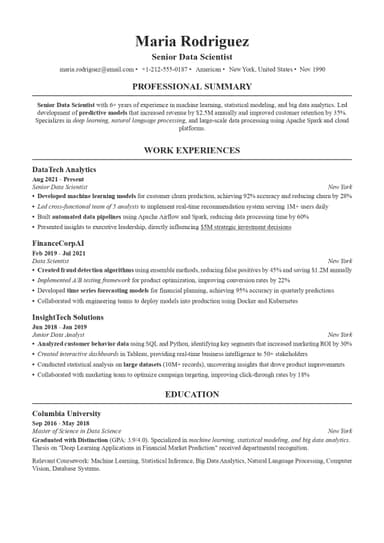
Before we skip to collaboration skills examples, here’s a full resume example, so you can see how these skills look on an actual resume:

Entry-Level Candidate
If you're early in your career, draw from school projects, internships, volunteer work, and part-time jobs:
- Collaborated with 3 classmates on full-stack development project, creating interactive webpage that received highest grade in class
- Worked alongside 5 retail team members to reorganize store layout, improving customer flow and increasing sales by 15%
- Partnered with 2 interns to research competitor strategies, presenting findings to marketing director
- Assisted senior developers by participating in daily stand-ups and contributing to code reviews
- Coordinated with student government committee of 8 to plan campus event attracting 200+ attendees
- Contributed ideas during team brainstorming sessions that led to new social media strategy
- Supported customer service team by sharing best practices that reduced average handle time
- Collaborated with academic advisor and 4 group members on capstone research project
- Worked with volunteer coordinator to organize community fundraiser raising $5,000
- Participated in cross-functional training sessions with sales, operations, and support teams
Mid-Level Professional
With established experience, emphasize cross-functional collaboration and leadership aspects:
- Led cross-functional team of 8 (engineering, design, QA) to deliver $2M e-commerce platform on time and 10% under budget
- Partnered with C-suite executives to align departmental strategies, resulting in 30% improvement in goal achievement
- Coordinated with external vendors and internal teams across 3 time zones to launch international expansion
- Facilitated monthly collaboration sessions between product and customer success teams, improving feature adoption by 45%
- Worked closely with finance department to streamline budget approval process, reducing cycle time from 2 weeks to 3 days
- Collaborated with HR and department heads to design training program that improved employee skills ratings by 25%
- Built consensus among 15 stakeholders with competing priorities to establish unified product roadmap
- Partnered with sales team to develop customer-facing materials that increased close rates by 18%
- Coordinated cross-departmental task force that identified and eliminated $200K in redundant expenses
- Worked with engineering and operations to improve product quality, reducing defect rates by 35%
- Collaborated with marketing and customer service to create feedback loop improving NPS scores from 42 to 68
- Facilitated knowledge-sharing sessions between senior and junior developers, accelerating skill development
- Partnered with compliance team to implement new procedures meeting regulatory requirements ahead of deadline
- Led collaborative workshop series that generated 20+ process improvements adopted company-wide
- Worked alongside procurement and warehouse teams to optimize inventory management, reducing carrying costs by 22%
Senior-Level Professional
At senior levels, showcase strategic collaboration and stakeholder management:
- Aligned C-suite stakeholders across 4 departments to establish unified digital transformation strategy, securing $5M in funding
- Cultivated partnerships with 6 industry leaders to create consortium advancing shared objectives
- Facilitated executive leadership team collaboration resulting in 40% faster strategic decision-making
- Built collaborative culture across 200-person organization, improving employee engagement scores from 3.2 to 4.5
- Partnered with board of directors to develop 3-year strategic plan achieving 25% revenue growth
- Coordinated with legal, finance, and operations during $50M acquisition, ensuring smooth integration
- Led collaborative negotiation with union representatives, reaching agreement that avoided work stoppage
- Established cross-functional council of 12 senior leaders to drive organizational change initiatives
- Worked with external consultants and internal teams to restructure operations, improving margins by 8%
- Facilitated collaboration between competing business units to identify synergies saving $3M annually
- Built strategic partnerships with 3 major clients, generating $15M in new revenue over 2 years
- Coordinated with government agencies and community stakeholders to gain approval for expansion project
- Led collaborative transformation of company culture, reducing turnover by 35% across all departments
- Worked alongside executive team to navigate crisis situation, maintaining operations and customer trust
- Facilitated merger integration bringing together 300 employees from two distinct corporate cultures
Common Mistakes to Avoid When Listing Collaboration Skills
The table below outlines the most common resume mistakes when listing collaboration skills and how to avoid them:
| Common Mistake | Why It Hurts Your Resume | How to Show Collaboration Correctly |
|---|---|---|
Using Vague, Overused Terms | Sounds generic and meaningless to employers | Replace buzzwords with specific examples and measurable results |
Listing Skills Without Evidence | Weakens credibility and raises doubts | Support every skill with real teamwork achievements |
Including Irrelevant Examples | Fails to prove real collaboration ability | Choose examples showing active contribution and impact |
Taking Full Credit for Team Wins | Makes you seem unrealistic or self-centered | Acknowledge team efforts while explaining your role |
Not Tailoring to Job Description | Misses what the employer actually values | Match your examples to the job’s collaboration requirements |
How to Improve Your Collaboration Skills: 5 Simple Tips
You can improve your collaboration skills through active practice, seeking feedback, taking courses, volunteering for team projects, and using collaboration software effectively to build real-world competence.
#1. Practice Active Listening
Start by truly focusing when others speak. Put away your phone during meetings. Ask clarifying questions before responding. Summarize what you've heard to confirm understanding.
These simple techniques immediately improve your collaborative interactions and help you catch important details you might otherwise miss.
#2. Take Online Courses and Certifications
Platforms like Coursera offer courses specifically on teamwork, communication skills, emotional intelligence, and conflict resolution. While a course won't magically make you collaborative, it provides frameworks and techniques you can practice. Some certifications also add credibility to your resume.
#3. Volunteer for Cross-Functional Projects
Nothing beats real experience. Seek opportunities to work with different departments or teams. These experiences expose you to diverse perspectives, help you build a broader network, and develop versatility that serves you throughout your career.
#4. Learn Collaboration Tools
Master the platforms your industry uses—Slack, Microsoft Teams, Asana, Trello, Monday.com, or others. Go beyond basic use to learn advanced features like automation, integrations, and analytics. Technical proficiency with collaboration tools makes you more valuable and shows you're serious about effective teamwork.
#5. Seek and Act on Feedback
Ask teammates how you could collaborate more effectively. Create regular feedback loops. Most importantly, actually implement the improvements people suggest. This growth mindset—showing willingness to learn and adapt—is itself a valuable collaboration skill.
Create Your Collaboration-Focused Resume with ResumeBuilder.so
Showcasing collaboration skills on a resume requires more than just good examples—you need professional formatting that passes ATS screening.
ResumeBuilder.so's AI-powered resume builder helps you highlight teamwork achievements with ATS-optimized resume templates and easy customization, letting you tailor collaboration skills for each application.
With ResumeBuilder.so, you get real-time feedback. Don't let poor formatting hide your strong collaboration skills.
Final Thoughts
Collaboration skills have become non-negotiable in today's workplace. Whether you're working remotely across continents or sitting in the same office, your ability to communicate clearly, listen actively, resolve conflicts, and contribute positively to teams directly impacts your career success.
What matters most for your job search is showcasing these abilities effectively. Move beyond generic claims. Demonstrate your collaborative impact through specific, quantified achievements in your work experience section, professional summary, and skills section. Show hiring managers exactly how you've contributed to team success.
Collaboration Skills FAQs

Emily Foster knows how nerve-wracking it can be to land your first job—she’s been there. As a mentor for young professionals, she shares exactly what hiring managers want from entry-level candidates. From internship hacks to interview confidence tips, Emily helps students and recent grads navigate the job search with ease.