11+ Common Resume Mistakes (And How to Fix Them)

Resume mistakes are common errors in content, formatting, or strategy that weaken your job application, often without you realizing it. A strong interview can be quietly undone by these, as they often showcase unclear achievements, poor structure, or details that raise doubts about your professionalism, attention to detail, or fit for the role.
In this article, you’ll learn how to identify the most damaging resume errors and understand why they hurt your chances. We’ll break down what recruiters notice first, what are some instant resume red flags, and how to fix them effectively. By the end, you’ll know how to refine your document so it supports (rather than sabotages) your job search.
- Resume mistakes usually aren’t about weak experience—they’re about presenting it poorly through bad structure, vague content, and sloppy details that trigger instant doubt.
- Recruiters scan in seconds and ATS filters first, so your resume must be both human-readable and keyword-aligned to avoid getting rejected before it’s even “seen.”
- The biggest killers are avoidable basics: typos, unprofessional contact info, broken links, inconsistent formatting, and cluttered layouts that confuse parsing systems.
- Strong resumes focus on quantified achievements and sharp action verbs, not duty lists or generic “objective” statements that waste space.
- The most reliable fix is a repeatable process: tailor for each role, proofread in multiple passes, get an external review, and test the document in plain text/ATS-friendly formatting.
What Makes a Strong Resume?
A strong resume balances three core elements: clear structure, relevant content, and professional presentation.
- The structure needs to guide recruiters through your experience logically, typically starting with contact information, followed by a professional summary, work experience, education, and skills.
- Your content should focus on achievements rather than duties, showing what you accomplished, not just what you were "responsible for."
- Presentation matters more than you'd think. Recruiters spend seconds on initial resume reviews. During that brief window, they're scanning for specific signals: relevant experience, recognizable company names, measurable achievements, and professional polish. Your resume needs to communicate value instantly.
The role of applicant tracking systems adds another layer of complexity. These software programs scan resumes for keywords, parse information into databases, and rank candidates before human eyes ever see applications. This means your resume needs to satisfy both algorithms and people, which is a significant challenge.
Therefore, avoiding resume writing mistakes is just as important as highlighting achievements. While a great accomplishment might catch a recruiter's attention, a single typo can undermine your entire application and destroy a valuable job opportunity.
13 Common Resume Mistakes That Cost You Interviews
Let’s take a look at some of the most common resume mistakes you should avoid.
#1. Spelling and Grammar Errors
Bad resume examples often contain typos, which are usually a dealbreaker for potential employers. When recruiters see these, they don't just question your attention to detail; they question whether you care about the opportunity at all. Grammar mistakes compound the problem, making your resume harder to read while signaling weak communication skills.
The impact extends beyond first impression, and such errors undermine your professional credibility regardless of how impressive your experience might be. A candidate with average qualifications and a perfect resume will often beat a highly qualified candidate whose resume contains typos.
Tools like Grammarly and spell-check features help, but they're not foolproof. You need multiple proofreading rounds: once for content, once for technical accuracy, and once for reading aloud to catch awkward phrasing. Additionally, having someone else review your resume provides a fresh perspective that catches errors you've become blind to.
Here are some common typos and grammar errors that can quickly hurt your chances with employers.
- “Managed there social media accounts and updated your website.”
- “I’m responsible for it’s daily operations.”
- “Lead a team of 5 employee’s across multiple department’s.”
#2. Using an Unprofessional Email Address
Your email address sends a message about your professionalism before anyone reads a single bullet point. Recruiters immediately question the judgment of candidates who use inappropriate email addresses, and many simply move on to the next applicant rather than risk hiring someone who doesn't understand professional norms.
Some bad examples include:
- partygirl2000@email.com
- beerlover87@email.com
- cuteboy123@email.com
Creating a professional email address is simple: use some variation of your name, like firstname.lastname@email.com or firstinitiallastname@email.com. If your name is already taken, adding a middle initial or a few numbers works fine. Free services like Gmail, Outlook, and Yahoo all offer professional options.
Below are examples of email addresses that look appropriate and professional on a resume.
- jane.doe@email.com
- j.doe@email.com
- janem.doe@email.com
The professionalism signal extends beyond just getting interviews. When you eventually land a job, that same professional email address continues serving you for networking, job applications years down the road, and maintaining professional relationships. Consider it part of your personal brand that follows you throughout your career.
#3. Poor Formatting and Layout
Resume formatting errors confuse both ATS systems and human readers, creating a lose-lose situation where your resume gets rejected before anyone evaluates your qualifications.
Common ones include inconsistent resume fonts, spacing issues (random gaps between sections), alignment problems (bullets that don't line up), and complicated layouts that break when parsed by software.
Visual hierarchy matters tremendously; according to research, it equals solid design and is more likely to catch the recruiters’ attention in a good way. So, proper use of white space prevents your resume from looking cluttered, while consistent font choices enhance readability. You should also stick with standard fonts like Arial, Calibri, or Times New Roman.
Furthermore, tables, text boxes, graphics, and multi-column layouts might look attractive, but they often cause ATS systems to scramble your information or miss it entirely. The result is your resume getting filtered out before a human ever sees it.
#4. Including Irrelevant Information
Listing every job you've held since high school doesn't strengthen your application; it weakens it. Recruiters want to see relevant experience that connects to the position you're applying for. When you include unrelated jobs, outdated skills, or irrelevant details, you dilute your message and make it harder for reviewers to identify your qualifications.
Here are some examples of irrelevant information that should not be in your resume:
- Age
- Marital status
- Photos (in US applications)
- Social Security number
- References (unless requested)
- And irrelevant hobbies
When it comes to writing about your work experience, the 10- or 15-year-experience rule provides good guidance; older positions add little value unless they're directly relevant to your target role.
Focus your resume on experiences that demonstrate the skills and qualifications the employer actually cares about. Tailoring content to each specific job application requires effort, but it dramatically improves your results; review the job description, identify the key requirements, and ensure your resume highlights experiences that match those needs.
#5. Using an Objective Statement Instead of a Summary
Objective statements are relics of the 1990s resume writing; they waste valuable space telling employers what you want instead of demonstrating what you offer. Plus, generic objectives don't differentiate you from other candidates; they bore recruiters who've read identical statements hundreds of times.
Here’s what a generic, unhelpful resume objective looks like:
Seeking a challenging position that utilizes my skills and offers opportunities for growth.
Resume summaries are more effective because they immediately communicate your value proposition. Instead of stating your career goals, a strong summary highlights your experience level, key achievements, and relevant expertise. This approach shows employers why they should interview you rather than asking them to give you a chance.
Here’s what that might look like in practice:
Marketing professional with 5+ years of experience driving social media campaigns for B2B companies. Skilled in content strategy, SEO, and email marketing, with a proven track record of increasing engagement by 40% year-over-year. Seeking to leverage expertise to help XYZ Corp grow its digital presence.
Tip: Tailor your summary to each application by incorporating keywords and requirements from the job description. This personalization signals genuine interest while improving ATS compatibility.
#6. Lack of Quantifiable Achievements
There's a crucial difference between describing duties and highlighting achievements. Saying you were "responsible for sales" tells recruiters almost nothing about your actual performance. Without numbers, your experience sounds generic and identical to every other candidate who held a similar role.
Let’s take a look at how this can appear on a resume.
- Responsible for customer service
- Managed a team
- Oversaw daily operations
Quantifiable achievements, on the other hand, turn vague statements into compelling evidence of your skills and impact. Using numbers and specifics shows employers exactly what you contributed—and why you’re a strong candidate.
You might write something like:
- Resolved 50+ customer inquiries daily while maintaining a 96% satisfaction rating
- Led a 12-person team to exceed quarterly targets by 23%, generating $2.3M in additional revenue
- Streamlined inventory processes, reducing errors by 15% and saving $50K annually
Use the STAR method (Situation, Task, Action, Result) when describing complex achievements. This framework ensures you provide context while emphasizing outcomes. Plus, action verbs like "increased," "reduced," "generated," "implemented," and "achieved" create dynamic descriptions that catch recruiters' attention.
Finally, numbers don't always mean revenue or percentages. Time saved, team size, budget managed, customers served, projects completed—all of these metrics provide concrete evidence of your impact. Before/after comparisons work particularly well, too.
#7. Resume Length Issues
Both extremes cause problems: resumes that are too long bore recruiters, while ones that are too short leave them with questions.
Entry-level candidates generally need just one page, as they haven't accumulated enough relevant experience to justify more. Cramming your entire life story onto your resume doesn't impress anyone; it suggests you can't prioritize or communicate concisely.
The one-page rule applies to professionals with fewer than 10 years of experience. Once you've accumulated significant relevant work experience, two pages become appropriate, and for senior executives or academic positions, even three pages might be justified. The key is ensuring every line adds value.
When you're over the resume length limit, start cutting ruthlessly. Remove jobs from early in your career that don't relate to your current goals, and eliminate verbose descriptions that could be stated more concisely. Focus on your most recent and relevant positions, giving them more detail while condensing or removing older roles.
#8. Missing Keywords for ATS
Applicant tracking systems screen resumes by scanning for specific keywords that match job requirements. When your resume lacks these terms, the system ranks you lower or filters you out entirely, regardless of your actual qualifications. This means perfectly qualified candidates often get rejected before human recruiters ever see their applications.
Keyword optimization matters tremendously in modern hiring. Job descriptions provide your keyword roadmap—the required skills, qualifications, and industry terms you need to incorporate. Don't just copy-paste these wholesale; instead, naturally integrate them throughout your professional summary, work experience, and skills sections.
Read the job posting carefully, noting specific software, methodologies, certifications, and skills mentioned. Look at multiple postings for similar roles to identify patterns. Industry-specific terminology matters too; if everyone in your field uses "customer relationship management," don't just say "helped customers."
#9. Weak Action Verbs and Passive Voice
Passive language drains energy from your resume. Phrases like "was responsible for," "duties included," and "tasks involved" suggest you merely showed up rather than actively contributing. Plus, they make your experience sound mandatory rather than impactful, turning impressive accomplishments into forgettable descriptions.
Let’s take a look at the following example:
- Was responsible for managing social media accounts
- Duties included coordinating campaigns with the design team
- Tasks involved handling monthly performance reports
These phrases focus on obligation rather than impact. They describe what was assigned, not what was achieved, and give no sense of ownership, results, or leadership.
On the other hand, strong action verbs create dynamic, compelling narratives about your contributions. Start bullet points with words like "spearheaded," "accelerated," "transformed," "orchestrated," "pioneered," or "championed." These verbs immediately communicate agency and impact—you didn't just participate in success, you drove it.
Here’s a strong example:
- Spearheaded social media strategy across five platforms, increasing engagement by 42%
- Coordinated cross-functional campaigns with designers and copywriters to meet tight launch deadlines
- Accelerated reporting workflows by automating monthly performance dashboards
#10. Generic, One-Size-Fits-All Content
Generic content fails to resonate with any specific employer because it doesn't address their particular needs, industry, or organizational culture.
Job descriptions tell you exactly what employers want, so use them as guides for customization. When a posting emphasizes "cross-functional collaboration," make sure your resume highlights teamwork examples; if "data analysis" appears multiple times, ensure you've included specific analytical achievements with measurable outcomes.
Tailored resumes pass ATS screening more reliably because they contain more relevant keywords. They also resonate better with human reviewers who can immediately see your fit for the role. While it takes longer, applying to 10 jobs with 10 customized resumes generates better results than blasting 50 companies with generic applications.
#11. Contact Information Errors
Your resume might be perfect, but it's worthless if recruiters can't reach you. Typos in phone numbers, outdated email addresses, or broken LinkedIn profile links create dead ends when hiring managers try to schedule interviews. Such mistakes are particularly frustrating because they're easily preventable yet cost you opportunities.
Verify every piece of contact information before sending applications. Call your own phone number to confirm you typed it correctly. Send a test email to your listed address. Click your LinkedIn URL to ensure it leads to your profile. These simple checks prevent missed opportunities from preventable errors.
Keep contact information current throughout your job search. If you change phone numbers or email addresses, update your resume immediately and resend it to any ongoing applications. Include your city and state (or region), but skip your full street address; it takes up valuable space while providing unnecessary detail for initial screening stages.
Moreover, professional profile links add credibility when relevant to your field. Ensure these work and showcase professional content; broken links or profiles with inappropriate content damage your candidacy more than omitting them would.
#12. Lying or Exaggerating
Embellishing qualifications might seem tempting, but it's a terrible strategy. Background checks catch education lies, reference calls expose inflated job titles, and skill assessments reveal claimed expertise you don't possess. When dishonesty surfaces (and it usually does), consequences range from immediate rejection to job termination or damaged professional reputation.
The truth carries enough weight when presented strategically. Rather than fabricating an MBA you don't have, highlight relevant continuing education, certifications, or professional development.
Honesty doesn't mean underselling yourself; you can confidently present your genuine accomplishments and skills while remaining truthful. Frame your experience positively, focus on real achievements with measurable results, and let your authentic qualifications speak for themselves.
#13. Ignoring Industry-Specific Conventions
Resume expectations vary significantly across industries, and ignoring these conventions signals you're either unfamiliar with your field or too arrogant to follow professional norms.
So, for example, tech resumes typically emphasize skills and projects over traditional job descriptions. Meanwhile, academic CVs include publications and research that would be irrelevant on corporate resumes, and creative professionals might showcase portfolio work differently than finance professionals.
Understanding your industry's standards requires research. Review resumes of successful professionals in your field (LinkedIn makes this easy). Study job postings carefully to identify what employers emphasize, and speak with recruiters or mentors in your industry about current preferences and pet peeves.
5 Best Resume Writing Tips on How to Prevent Mistakes
Now that we know what the biggest professional resume mistakes are, let’s see the best resume practices that can help you fix or avoid them:
- Use professional resume templates that handle formatting automatically while ensuring ATS compatibility, as this eliminates most technical errors before they happen. Choose them from reputable sources like ResumeBuilder.so, as these are specifically designed for modern applicant tracking systems.
- Create a systematic proofreading process involving multiple review rounds. First, read for content and flow, then check technical details like dates, job titles, and company names. After that, proofread specifically for spelling and grammar, and read the entire resume aloud to catch awkward phrasing and missing words.
- Conduct external reviews, as they provide an invaluable perspective. Ask someone familiar with your industry to review your resume for content and positioning. Have a detail-oriented friend check for typos and formatting consistency.
- Test your resume. Copy and paste it into a plain text document to avoid ATS resume mistakes. Additionally, use free ATS scanning tools to check keyword optimization and print your resume to verify it looks professional on paper, not just on screen.
- Maintain a master document containing all your achievements, skills, and experiences. When customizing resumes for specific applications, work from this comprehensive source rather than repeatedly editing the same document. This approach prevents errors from accumulating and ensures you don't accidentally delete important information.
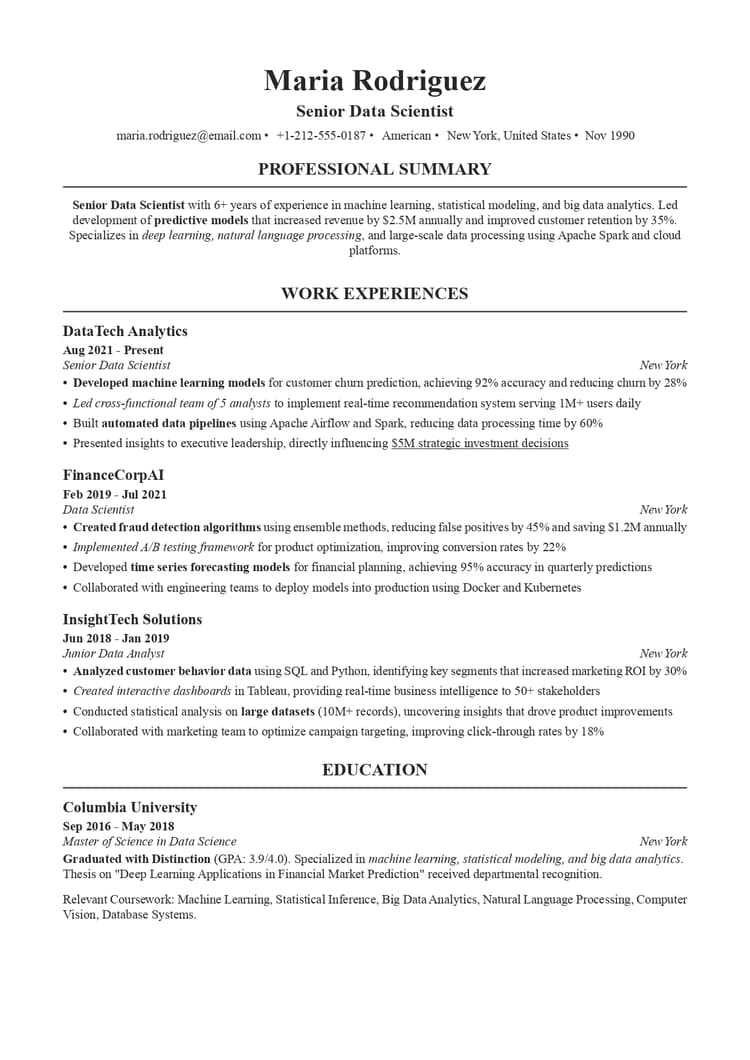
Create a polished, error-free resume with ResumeBuilder.so
Build my resume now!Final Thoughts
Resume mistakes are rarely about lack of experience; they’re usually about missed opportunities to present that experience clearly and strategically.
Small issues like vague bullet points, poor formatting, or generic language can create unnecessary doubt, even for highly qualified candidates. The good news is that every one of these mistakes is fixable once you know what to look for and why it matters.
Professional resume templates, especially those offered by ResumeBuilder.so solve most resume issues automatically. They're built with ATS compatibility in mind while maintaining visual appeal for human readers. Using them eliminates the guesswork around spacing, margins, and layout decisions and lets you focus on content instead of design challenges.
Resume Mistakes FAQ

Emily Foster knows how nerve-wracking it can be to land your first job—she’s been there. As a mentor for young professionals, she shares exactly what hiring managers want from entry-level candidates. From internship hacks to interview confidence tips, Emily helps students and recent grads navigate the job search with ease.