25 Best Jobs for Introverts That Actually Pay Well (+ Salaries)


Jobs for introverts are careers that allow people to work in a way that suits their quieter, more focused, and more independent nature. These roles don’t necessarily eliminate social interaction completely, but they usually offer more space for deep work, thoughtful communication, and fewer situations where someone has to be constantly “on.”
If you’re an introvert, the right job can make a huge difference in your energy, confidence, and long-term satisfaction. Here, we’ll go over the best careers for quiet people and learn what makes them a good fit, as well as how to choose a career path that works with your personality instead of against it.
- Jobs for introverts are roles that support independent work, deep focus, clear expectations, and limited forced social interaction.
- Introvert-friendly careers are common in tech, data, writing, finance, science, healthcare, and creative fields, where analytical thinking and attention to detail are highly valued.
- Some of the highest-paying jobs for these people include software developer, cybersecurity analyst, actuary, research scientist, financial analyst, and economist.
- Many of them don’t require constant face-to-face communication; instead, they rely on written updates, async collaboration, technical skills, portfolios, or certifications.
- To find the right career, introverts should look for roles with autonomy, remote or hybrid options, structured workflows, and work environments that don’t constantly drain their social battery.
What Are Jobs for Introverts?
Jobs for introverts are roles structured around independent work, focused tasks, and minimal forced social interaction. They allow introverted individuals to produce their best output without constant stimulation pulling them in every direction.
One of the most common misconceptions about introverts is that they are antisocial, but that’s far from the truth. These people simply recharge by spending time alone rather than around people. Many of them actually thrive in collaborative settings; they just prefer meaningful, purposeful interaction over constant socializing.
Because introverts often prefer lower-stimulation, independent work environments, they may be especially well suited to roles with more autonomy, which some studies link to stronger motivation and performance behaviors. Additionally, workplace research also links introverted leadership with careful listening and idea processing, and those traits happen to be exactly what well-paying careers demand.
What makes a job introvert-friendly is:
- Autonomous workflow
- Clear deliverables
- Written or digital communication over endless meetings
- Ability to go deep on a single problem without being pulled in multiple directions at once.
25 Best Jobs for Introverts
Now, here are some introvert-friendly roles, sorted by median annual salary and divided into categories. Each entry covers what the job involves, median pay (sourced from Bureau of Labor Statistics data), and why it suits introverted personalities.
Tech & Data
#1. Software Developer / Software Engineer
Software developers design, write, test, and maintain code for applications, systems, and platforms. It's one of the most introvert-friendly fields on the planet, since most of the work happens between you, your IDE, and a terminal.
Median salary sits around $131,450 per year (with senior roles and specialized niches pushing well beyond that), and the job outlook is 15%, according to the BLS.
A computer science degree helps here, but it's not essential; bootcamp graduates and self-taught developers are widely hired, especially with a strong portfolio. The industry runs async-first, remote-first, and communication is heavily written.
#2. Cybersecurity Analyst
Cybersecurity analysts protect systems and networks from digital threats and breaches. The median salary is around $124,910 per year (BLS), and the job outlook is 29%, driven by the fact that cyberattacks aren't slowing down.
A bachelor's degree in cybersecurity or computer science works well here, though certifications like CISSP, CEH, and CompTIA Security+ are often equally valued. Much of the day involves monitoring systems independently, analyzing logs, and responding to incidents of all kinds: technical, analytical, and largely solo.
#3. Data Analyst

These experts collect, clean, and interpret data sets to help businesses make better decisions. The work is largely independent, since they're hunting patterns in numbers, without conference calls. The salary for this field lands around $104,350 per year, and the field is seeing an 8% job outlook.
A bachelor's degree in statistics, math, or data science is typically necessary for this path, along with proficiency in SQL and Python.
#4. IT Specialist / Systems Administrator
Next, we have IT specialists whose job is to manage computer systems, networks, and infrastructure for organizations and keep digital operations running smoothly behind the scenes. They annually earn around $96,800, but the job outlook is currently in decline (-4%).
In this field, certifications like CompTIA A+, Network+, or Microsoft's range often carry more weight than a four-year degree. Everything runs on tickets and documentation; most communication is written, most problems are technical, and most of the job happens without an audience, all of which makes for a great introvert-friendly workplace.
Writing & Creative
#5. Technical Writer
Generally, technical writers create documentation, user manuals, API guides, and instructional content for software and products. So, if you can translate complex systems into clear, user-friendly language, companies will pay well for that skill, and you can earn around $91,670 per year. The job outlook is currently 1%.
For this role, you may need a degree in English, communications, or a technical field, but it’s not always mandatory; it depends on the position. A good writing portfolio with some nice examples of your work often matters more here.
The work is almost entirely solitary, as you communicate through text and rarely have/need any mandatory meetings, which makes it a low-stress job for introverts. Because of this, it’s a natural fit for people who prefer words over small talk.
#6. Content Writer/Copywriter
Professionals in this field produce articles, blog posts, ad copy, product descriptions, and web content. The job outlook is 4%, and the average salary for full-time roles hovers around $72,270 per year, though experienced freelancers in competitive niches frequently earn more.
The good news is that you need no formal degree for such a job; what matters is your portfolio and your ability to understand an audience and write well. Many content writers work fully remotely, set their own schedules, and communicate almost entirely in writing, so this is one of the best jobs for introverts who like to be alone.
#7. Graphic Designer

Experts in the graphic design field create visual content, such as logos, brand identities, layouts, digital assets, and marketing materials. Annually, they earn around $61,300 on average for full-time roles, with experienced freelance designers regularly clearing significantly more.
When it comes to qualifications, you typically need a bachelor's in graphic design, or a compelling self-built portfolio will get you in the door, and the job outlook is 2%. Client feedback usually happens asynchronously via email or platforms like Figma, so there’s no need to present in-person to a room full of people.
Science, Research & Healthcare
#8. Research Scientist
Research scientists design and run experiments, analyze results, and publish findings across fields like biology, chemistry, environmental science, and materials research. They work for an annual salary that goes up to $140,910, depending on specialization and whether the role is in academia, government, or the private sector, and the job outlook is 20%.
For senior positions, you need a master's degree or PhD, while some lab roles are accessible with a bachelor's and the right technical skills. Ideas speak louder than personality here, and it’s a perfect job for methodical thinkers who'd rather spend a week on a problem than on networking events.
#9. Actuary
These people assess financial risk using probability and statistical modeling, primarily for insurance companies, pension funds, and financial institutions, and earn around $125,770 per year, with a 22% projected growth.
Actuaries must pass a demanding series of professional examinations, so it's a long credential path, but the payoff in stability and salary is substantial. The role is defined by numbers over noise; it’s structured, analytical, and with minimal client-facing pressure compared to most finance roles.
#10. Medical Laboratory Technician
Medical lab technicians analyze blood, tissue samples, and other specimens to support medical diagnoses. Their median salary would be $61,890 per year depending on specialization and setting, with a 2% growth outlook.
An associate's or bachelor's degree plus ASCP certification is typically the standard path to this role. The work is lab-based and largely independent; you're interacting with samples and equipment far more than with patients. So, for introverts drawn to healthcare but not to bedside interaction, this is worth a serious look.
Finance & Business
#11. Financial Analyst

Professionals in this field earn $101,910 per year in a position that has a 6% projected growth by evaluating financial data, modeling scenarios, and guiding investment or business strategy decisions. A bachelor's in finance or economics is standard here, and the CFA certification adds significant credibility and earning potential, too.
The role leans heavily on independent research and analysis, so it’s results-driven rather than relationship-driven. Most of the actual work happens at a desk with a spreadsheet and a set of financial statements, without pitch meetings.
#12. Accountant/CPA
Accountants manage financial records, prepare tax documents, and advise clients on fiscal decisions. The average salary is around $81,680 per year, while CPAs regularly earn even more. Job outlook shows 5% growth, which sounds modest until you remember accountants are essentially always in demand.
To work in this position, you must have a bachelor's degree in accounting and the CPA license, which involves additional examinations. The work is structured, rules-based, and demands deep attention to detail. Therefore, if you'd rather spend your day working through a complex balance sheet than schmoozing at an industry mixer, accounting suits you.
Additional High-Value Roles
#13. Economist
Next, there are economists, who earn around $115,440 annually on average by researching economic trends, modeling markets, and advising governments or corporations on policy and strategy. A master's or PhD is typically required for research roles, though bachelor's holders can find work in private-sector data and analysis positions.
The job is analytical, independent, and writing-heavy, and the projected growth is 1%, which is slower than usual.
#14. Biomedical Engineer
Biomedical engineers develop medical devices, equipment, and systems, from imaging technology to prosthetics, and earn $106,950 per year. A bachelor's degree in biomedical engineering or a related field is required. The job outlook is 5%, and the work sits at the intersection of engineering, biology, and medicine, so it’s technical, research-oriented, and largely lab or computer-based.
#15. Mathematician
As their role name implies, mathematicians develop and apply mathematical theories to solve problems in science, engineering, finance, and beyond. Their average annual salary would be around $104,350, similar to statisticians.
For most research roles, a master's or PhD is a must, but the work is almost entirely independent and made for days of sustained thinking, modeling, and writing. So, if solving abstract problems for hours at a stretch sounds appealing rather than exhausting, this belongs on your radar.
#16. Architect

Experts in the architecture field design buildings and spaces and manage projects from concept through construction. The salary per year is around $96,690, and the job (whose outlook is currently 4%) requires a professional degree and licensure, which involves exams and supervised hours, which is a significant upfront investment.
Day-to-day work balances focused design time with periodic client and contractor communication, rather than constant meetings, which makes this a great introvert-friendly job.
#17. UX Designer
UX designers research how users interact with digital products, then create wireframes, prototypes, and design specifications to improve the experience.
Their average salary per year is around $95,380, and you’re not required to have formal education; a portfolio and proficiency in tools like Figma are usually enough. Work is largely independent with async feedback cycles, which suits introverts who think both visually and analytically. Plus, the job outlook is encouraging, too (7%), so it’s definitely one of the best jobs for introverts without a degree.
#18. Web Developer
These individuals build and maintain websites and web applications and earn a similar amount as UX designers, with strong remote availability across front-end, back-end, and full-stack paths. All are highly portfolio-driven, and communication mostly happens via GitHub, Slack messages, and code reviews rather than face-to-face meetings.
#19. Environmental Scientist
Environmental scientists study ecosystems, analyze pollution data, and advise on conservation policy, and their job typically requires a bachelor's degree in environmental science. The annual payment is around $80,060 on average, and there’s a 4% growth outlook, which is pretty steady. Much of the role involves lab analysis, data interpretation, and report writing.
#20. Landscape Architect
The role of a landscape architect centers on designing outdoor spaces, such as parks, campuses, commercial developments, and public areas.
For this, they get a median salary of $79,660 per year, and the projected job growth is steady at 3%. To get this job, you need a bachelor's degree plus licensure, and much of the design work is independent and detail-focused; field visits and client meetings exist but don't dominate the schedule.
#21. Video Editor

These editors assemble raw footage into finished films, commercials, YouTube content, and corporate videos, with a median salary around $70,570 per year and a 3% job outlook. You don’t need a formal degree for this job, but you do need software proficiency in Premiere Pro or DaVinci Resolve, and a solid showreel is what hiring managers actually look for. It’s an almost entirely solo work environment, which is also deadline-driven and highly remote-compatible.
#22. Court Reporter
These professionals produce verbatim transcripts of legal proceedings using stenography and get paid around $67,310 on average per year, but the outlook for this job is 0%.
The role requires an associate's degree and professional certification, and the work is quiet, precise, and highly focused, as you're the person in the room whose job is to listen carefully and record accurately, without speaking.
#23. Librarian/Archivist
Generally, librarians and archivists manage collections of information, including books, digital records, historical documents, and research databases. On average, they work for $64,320 per year; the job outlook is 2%, and they need an MLS (Master of Library Science) for such a role.
The job involves careful organization, research support, and purposeful quiet work, where a lot of time is spent with materials instead of managing people.
#24. Translator
Translation experts convert written content, such as contracts, books, software interfaces, and medical documents, between languages.
Their median salary is approximately $59,440 annually, with specialized legal or medical translators earning more, and the projected job growth is 2%. To work in this position, you may need a bachelor's degree plus demonstrated fluency in two or more languages as the baseline. Translation work is solitary, detail-oriented, and one of the best remote jobs for introverts.
#25. Animal Trainer
And finally, there are animal trainers, who work with dogs, horses, marine mammals, and other species for performance, assistance, or behavior modification.
The salary per year for this position is around $33,860, which is much lower than others on this list, but the job outlook is fast (11%), and the interaction structure is almost exclusively one-to-one and non-verbal. Plus, you don’t need a degree for it; certifications through organizations like CCPDT will suffice.
How to Find and Get Jobs for Introverts
You can find and get jobs for introverts by starting with self-awareness and working outward. This includes identifying your strengths, targeting the right credentials, and building a resume that showcases your ability to do focused, independent work. The job search process itself doesn't have to be the draining, high-interaction ordeal it's sometimes made out to be; most of it can happen in writing.
Here are the steps you should take:
- Know your strengths and weaknesses. Deep focus, written communication, careful analysis, active listening; figure out which of these you do best, then match them against the roles above.
- Build the right credentials. Many introvert-friendly roles (tech, writing, design, etc.) care far more about portfolios and certifications than traditional degrees. Invest time there before assuming you need another four years of school.
- Target remote or hybrid roles. Filter for "remote" on LinkedIn, Indeed, and We Work Remotely. These setups are naturally introvert-friendly and include async communication, no open-plan offices, and far fewer mandatory social events.
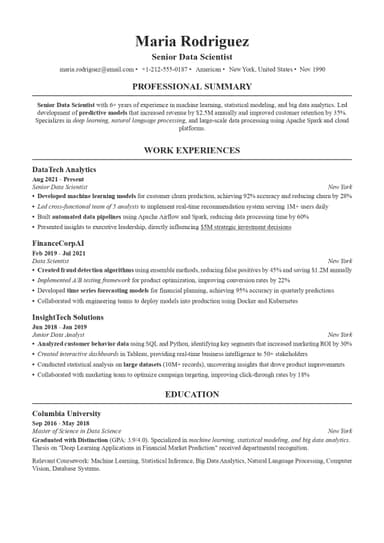
- Write a targeted, ATS-friendly resume. Focus on independent accomplishments, technical skills, and quantifiable results. For this, you can rely on resume templates and examples at ResumeBuilder.so, which can help you generate a document that clears applicant tracking systems without losing its personality.
- Prepare for interviews strategically. Heavy upfront research plays to introverts' strengths. Prepare structured answers, know the company well, and look for organizations known for async or low-meeting cultures.
Final Thoughts
Every quality that makes socializing feel draining is the same quality that makes introverts exceptional in focused, analytical, and creative roles. Deep thinking, careful attention to detail, precise output, and the ability to stay with a problem until it's actually solved are the skills that most employers in tech, research, finance, and the sciences actively look for.
The key is not to force yourself into a work style that constantly drains you, but to choose a career that turns your natural tendencies into professional advantages. When you understand what kind of environment helps you do your best work, you can build a career that feels sustainable, rewarding, and aligned with who you actually are.
Jobs for Introverts FAQ
#1. Can introverts be successful in the workplace?
Yes, introverts can absolutely be successful at work. Introversion correlates strongly with deep focus, precise output, careful listening, and autonomous performance. These are exactly the qualities employers in technical, research, creative, and analytical fields value most. The key is choosing environments and roles that reward those traits rather than penalize them.
#2. Are there remote jobs for introverts?
Yes, many high-paying jobs for introverts are also remote-first or remote-compatible. For instance, software developer, content writer, data analyst, graphic designer, video editor, and UX designer are all roles you can realistically do entirely from home. It’s best to filter job boards by "remote" and look for companies with documented async-first cultures for the best fit.
#3, What jobs should introverts avoid?
Introverts should avoid roles that require constant face-to-face persuasion, high-volume social interaction, or rapid context-switching. These may include the positions of sales representative, event manager, public relations specialist, and customer success manager.

Max Harper is the resume guru who actually makes job searching easier. With years of experience as a hiring manager, Max knows what makes a resume stand out in a pile of 200+ applications. From breaking down ATS myths to helping you craft bullet points that pop, Max shares easy-to-digest, no-BS resume advice.