How to Write a Graphic Design Resume That Gets You Hired
This complete guide with detailed explanations and expert tips will teach you how to write an acting resume in record time!
Edit this resume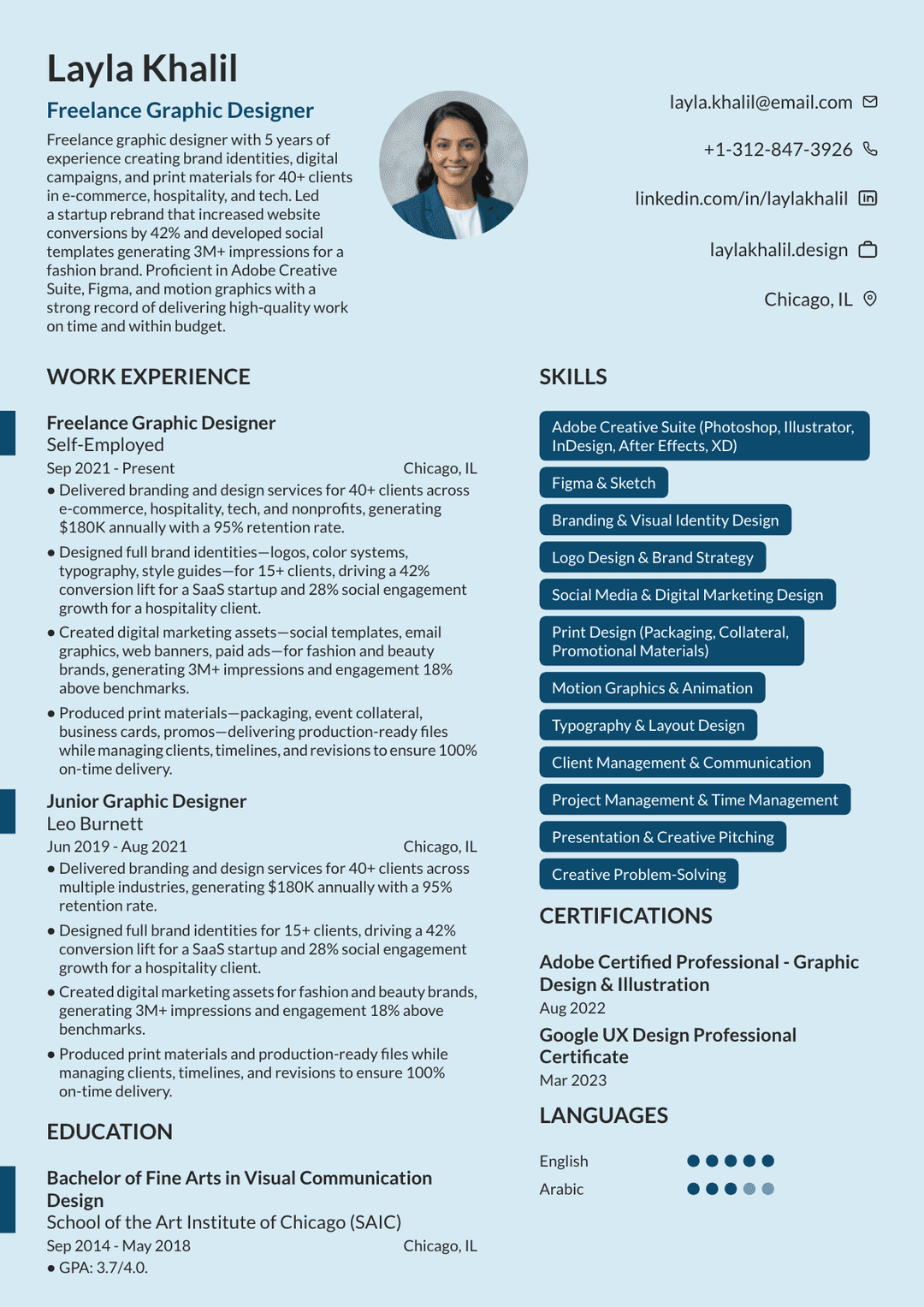
A graphic design resume is a strategic showcase of your creative skills, which highlights your expertise and ability to communicate ideas effectively through layout, typography, and imagery. Its purpose is to also reflect your personal style and make it a key tool for standing out in a competitive, visually driven industry such as this one.
Today, we teach you how to craft a graphic design resume that balances creativity with clarity. You’ll learn what to include in it, how to structure the content, and how to present your work in a way that appeals to prospective employers. As an extra, we offer some handy creative resume tips that will make your resume both visually engaging and easy to read.
- A graphic design resume acts as both a professional document and a design sample, so it must balance creativity with clarity while remaining ATS-friendly.
- Choosing the right format (chronological, functional, or combination one) depends on your experience level, but reverse-chronological is generally the safest and most preferred.
- Strong resumes focus on relevant, measurable achievements in the work experience section rather than listing generic responsibilities.
- Including key sections like a clear header, concise summary, tailored skills, and a visible portfolio link is essential for making a strong impression.
- Optimising for ATS by using standard formatting, keywords from job descriptions, and simple layouts significantly improves your chances of getting noticed.
What Is a Graphic Design Resume?
A graphic design resume is a professional job application document that outlines a designer's skills, work experience, education, and accomplishments. It’s structured to show hiring managers why you're the right fit for a specific role.
The document is, in a way, a design sample before your portfolio even opens. Therefore, you need to make sure that it’s properly formatted, contains only relevant details, and meets all ATS requirements.
3 Graphic Design Resume Examples by Experience Level
The right approach to your graphic design resume depends entirely on where you are in your career. Here's how to adjust your strategy at each stage:
Entry-Level Graphic Design Resume

Freelance Graphic Design Resume

Creative Director Resume

How to Format a Graphic Design Resume
Choosing the right resume format for a graphic design resume is the first step toward a job application that works for both software and humans.
There are three main graphic designer resume format options, and the right one depends largely on where you are in your career; let’s see what these are:
- Chronological: it’s the standard choice for designers with two or more years of experience. With it, you list your most recent role first and work backward, which makes career growth easy to track at a glance. Hiring managers prefer it, ATS systems parse it cleanly, and it signals professional consistency.
- Functional: leads with a prominent skills section rather than job titles. It suits career changers or people re-entering the workforce after a gap. That said, it carries real risk, as some ATS systems struggle to parse it correctly, and plenty of hiring managers grow suspicious when they can't see a clear employment timeline.
- Combination: blends a skills summary with a reverse-chronological work history. It's ideal for mid-career designers switching niches because it lets you front-load relevant skills while still showing a clear professional track record.
What to Include in a Graphic Design Resume
Here's what to include in your graphic design resume and why each of these sections matters:
#1. Header & Contact Information
The contact information part should be brief, clean, and scannable, featuring your:
- Full name
- Phone number
- Email address
- City/state
- Portfolio URL (you shouldn’t bury it further down the page)
- LinkedIn profile URL
Practical tip: A custom link on a graphic designer portfolio for a resume, such as yourname.com, looks more intentional than a default Behance or Dribbble link on its own. It costs very little to set up and signals that you treat your personal brand seriously.
Now, it’s time to see how you can format this part:
Jessica Martinez
Brooklyn, NY
(347) 555-9821
jessica.martinez@email.com
www.jessicamartinez.com
linkedin.com/in/jessicamartinez123
#2. Resume Summary
A graphic designer resume summary represents a 2-/3-sentence overview of your top industry-related skills, years of experience, and career focus. It's typically the first thing a recruiter reads after your name, so every word needs to earn its place.
Entry-level candidates or career changers, however, are better served by a resume objective, which is similar but focuses more on what they’re working toward, as they don’t have enough work experience to showcase it.
Here's what a resume summary looks like in practice:
Brand identity designer with 6 years of experience across fintech and consumer goods. Proficient in Adobe Creative Suite, Figma, and motion graphics. Known for translating complex briefs into clear, compelling visuals that drive measurable engagement.
The main reason why this example is strong lies in the fact that it tells a recruiter about your specialization, preferred tools, and values in three simple sentences.
#3. Work History Section
Next comes the crucial section of your resume, your work experience, so you need to make sure it’s perfectly formatted and sheds light on your biggest achievements.
When presenting your previous roles, mention the position you held, the company name and location, employment dates, and your best (and preferably measurable) accomplishments. You can see what it looks like here:
Work Experience
Graphic Designer
BMarketing World, New York, NY
June 2021 – Present
- Designed social media campaigns that increased client engagement by up to 40%
- Developed branding assets for 15+ clients, including logos, color systems, and guidelines
- Collaborated with marketing teams to create cohesive visual strategies across digital platforms
- Produced print materials (brochures, posters, packaging) for national campaigns
Junior Graphic Designer
PixelMama, New York, NY
March 2019 – May 2021
- Assisted in creating digital assets for websites, email campaigns, and ads
- Maintained brand consistency across multiple client projects
- Prepared production-ready files for print and digital use
- Supported senior designers with concept development and revisions
It’s best to use reverse-chronological order and aim for 3–5 bullet points per role.
According to the Bureau of Labor Statistics, there will be around 20,000 new job openings per year within this industry over the next 10 years, and the competence might be real. So, if you want to increase your chances of getting one of the roles, the quality of how you present your experience will matter more than volume.
#4. Graphic Design Resume Skills
The skills on a graphic design resume typically fall into three main categories: technical tools, design theory competencies, and professional soft skills. Hiring managers look for all three; the tools tell them what you can use, the competencies how you think, and the soft skills how you work with other people.
For hard skills and theory competencies, you can cover:
- Core Adobe Creative Suite tools, including Photoshop, Illustrator, InDesign, After Effects, Premiere Pro, XD, and Lightroom
- UI/UX tools like Figma, Sketch, InVision, and Zeplin
- AI-assisted design tools, such as Midjourney, Adobe Firefly, Stable Diffusion, etc.
- Branding & visual identity design
- Wireframing & prototyping
- Typography, etc.
On the other hand, it’s also beneficial to mention some of the following soft skills:
- Creativity
- Attention to detail
- Client management
- Presentation skills
- Critical thinking
- Problem-solving, etc.
One consistently effective tactic is to try to mirror the exact tool names from the job posting, as such small differences can trip up ATS matching.
Let’s see a well-written skills section here:
Skills
- Adobe Creative Suite (Photoshop, Illustrator, InDesign)
- Figma
- Canva
- Branding & visual identity
- Social media & digital design
- Typography & layout design
- Print design (brochures, flyers, packaging)
- Basic HTML & CSS
- Project & client management
#5. Education
Your education section should feature:
- Your degree type
- Institution name
- Graduation year
Entry-level candidates can also add bullet points on relevant coursework (such as typography, color theory, and UX principles) to signal design fluency, even without extensive work history.
Many successful designers hold non-design degrees, and that's entirely fine. If you’re one of them, you should prioritize design-specific certifications or bootcamp credentials. For example, the Adobe Graphic Designer Professional Certificate is widely recognized, as is the Google UX Design Certificate.
An example looks like this:
Education
Bachelor of Fine Arts in Graphic Design
Pratt Institute, Brooklyn, NY
Graduated: 2018
- Relevant Coursework: Color Theory, Typography
#6. Optional Sections
Depending on your background, these additions can meaningfully strengthen your case:
- Freelance clients and projects (especially useful for independent contractors)
- Awards and recognition
- Volunteer work
- Language skills (relevant for international agencies)
- Brief personal branding statement
How to Make an ATS-Friendly Graphic Design Resume
You can make your graphic design resume ATS-friendly by:
- Avoiding infographic-style layouts, text embedded inside images, non-standard or decorative fonts, and multi-column structures that parse in the wrong order. These are all things that look polished in a PDF viewer and read like scrambled code to an ATS system.
- Submitting it as a PDF unless the job posting specifically requests a .docx file
- Using standard section heading names, e.g., "Work Experience" rather than something like "Where I've Been."
- Incorporating keywords from the job description naturally, matching the exact phrasing wherever possible.
Luckily, ResumeBuilder.so's got your back here! Our resume templates are built to pass ATS screening while still looking polished and design-forward. Besides that, AI suggests the right skills and properly formats your document automatically so you spend less time coming up with the entire layout and structure!
Additionally, if you want to see what successfully written resumes look like, we prepared amazing examples that can serve as solid starting points if you still decide to work from scratch!
Final Thoughts
A strong graphic design resume is proof of concept, so it should be clean, purposeful, and easy to read. All this, when you think about it, are the same qualities clients and employers want from your actual design work.
To recap what matters: choose the right format, optimize every section for ATS compatibility, include your portfolio link, and balance visual polish with scannable structure. Following the steps we mentioned above will position you as a strong candidate and land you an interview of your dreams before you know it!
Graphic Design Resume FAQ
#1. What should a graphic design resume look like?
A graphic design resume should look clean and professional, with a clear visual hierarchy, readable fonts, and consistent spacing. It should reflect your design sensibility without sacrificing ATS compatibility.
#2. How long should a graphic design resume be?
A graphic design resume should be one page long for most designers with under 10 years of experience. Still, senior designers or creative directors with extensive, directly relevant experience may extend to two pages, but every line should earn its place.
#3. Should a graphic design resume be creative?
A graphic design resume can be creative, but it should prioritize clarity and ATS compatibility over visual flair. Clean typography and subtle design choices are the right sweet spot, so you should save the bold, experimental work for your portfolio, where a hiring manager is specifically viewing it as a design artifact rather than a document to scan.
#4. Do I need a portfolio with my graphic design resume?
Yes, you definitely need a portfolio link on a graphic design resume. Employers expect to see your actual work, not just a description of it, so make sure you include the URL in your header and reference it in your resume summary so it's impossible to overlook.
#5. How do I write a graphic design resume with no experience?
You can write a graphic design resume with no experience by highlighting your education, personal projects, freelance work, and any volunteer design contributions. Use a resume objective instead of a summary, link to a portfolio of your strongest work regardless of origin, and focus on transferable skills that demonstrate how you approach design problems.

Max Harper is the resume guru who actually makes job searching easier. With years of experience as a hiring manager, Max knows what makes a resume stand out in a pile of 200+ applications. From breaking down ATS myths to helping you craft bullet points that pop, Max shares easy-to-digest, no-BS resume advice.