Accountant Resume: Examples, Formatting & Writing Tips (2026)
This complete guide with detailed explanations and expert tips will teach you how to write an acting resume in record time!
Edit this resume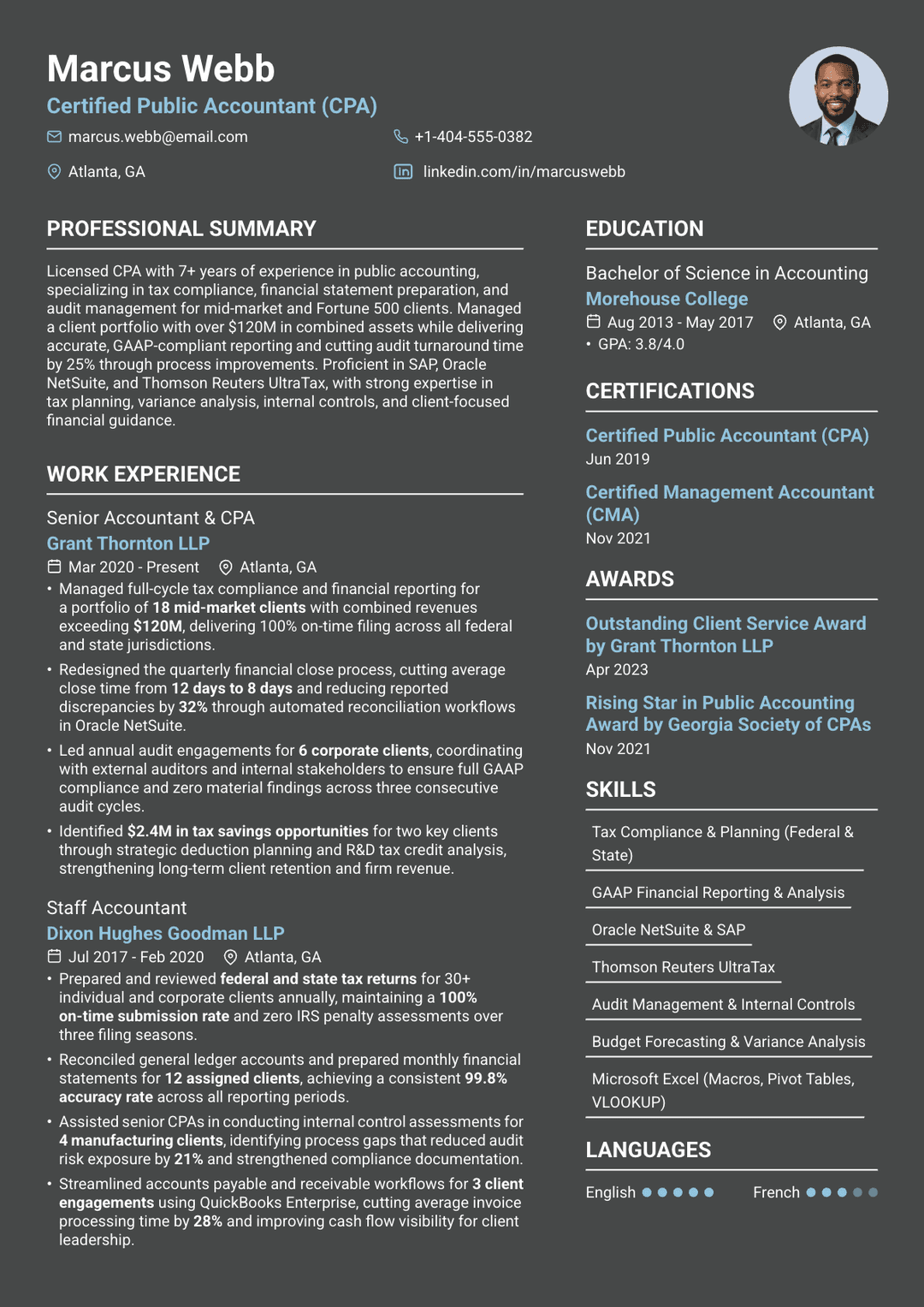
Accounting roles attract dozens of qualified candidates, and a generic resume won't make the cut. If yours doesn't highlight your financial expertise, certifications, and key accomplishments within a few seconds, it gets passed over—no matter how strong your actual skills are. That's the frustrating reality of accounting job searches, however, it doesn't have to be yours.
In this guide, we cover everything you need to write a strong accountant resume, i.e. what sections to include, how to format it, which skills matter most, real-world examples for every career level, and a step-by-step writing process you can follow today. Let’s begin!
- An accountant resume must include a strong summary, quantified achievements, and relevant technical skills.
- Both entry-level and senior accountant resumes follow the same core structure—but differ in emphasis.
- ATS optimization is critical: accounting job postings are keyword-heavy, and most applications are screened by software before a human reads them.
- The reverse-chronological format is the most effective format for most accounting candidates.
- Certifications like CPA, CMA, or CFA should be prominently featured, especially at the senior level.
What Makes a Strong Accountant Resume?
A strong accountant resume showcases your financial expertise, work history, technical skills, and credentials to prospective employers. If you’re considering a career in accounting or auditing, the job outlook is pretty solid. According to the U.S. Bureau of Labor Statistics, employment in this field is expected to grow by about 5% by 2034, which is a bit faster than most other professions. With 124,200 openings projected each year—mostly because people retire or move into different careers— there’s steady demand for new talent.
To land a job, your accountant resume needs to demonstrate precision because employers expect accuracy not just in your numbers, but in how you present yourself on paper. Also, this type of resume applies across a wide range of accounting roles: staff accountant, financial analyst, forensic accountant, CPA, tax accountant, and more. Each variation highlights different strengths, but the core structure stays consistent.
However, one thing that sets accounting resumes apart from most others is that ATS screening is nearly universal. Over 90% of Fortune 500 companies rely on applicant tracking systems to filter candidates before a human ever opens the file. That means keyword optimization isn't optional—it's essential.
Accountant Resume Examples
Now that you know what makes a strong accountant resume, let’s see a few resume examples for accounting you can use for inspiration. Each one follows the same core structure but emphasizes different strengths depending on where you are in your career.
#1. Entry-Level Accountant Resume Example

#2. Accounting Assistant Resume Example

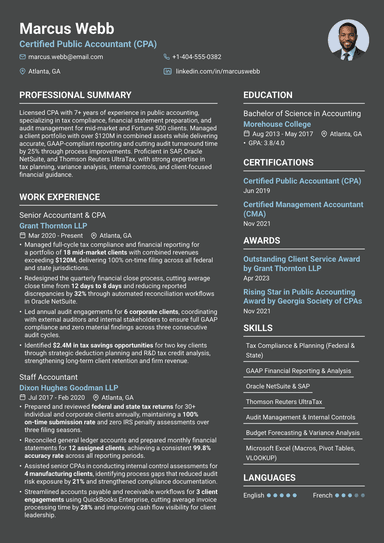
#3. Certified Public Accountant (CPA) Resume Example

#4. Tax Accountant Resume Example

#5. Senior Accountant Resume Example

What to Include on an Accountant Resume
A well-structured accountant resume typically includes contact information in the resume header, summary or objective, work experience, education, skills, and certifications and licenses. Each one serves a specific purpose, and skipping any of them can cost you an interview.
Let’s see what each section should cover.
#1. Contact Information
Your resume contact information should appear at the top of your accountant resume, formatted cleanly and consistently. Make sure to include:
- Full name
- Professional email address
- Phone number
- City and state
However, leave off your full street address, resume photo, and date of birth. These details aren't required and can create unnecessary complications depending on the employer's location.
Here’s what a clean, complete version looks like in practice:
Michael Anderson
michael.anderson@email.com
(312) 555-7890
Chicago, IL
linkedin.com/in/michaelanderson
#2. Resume Summary or Objective
A resume summary for an accountant is a 2–3 sentence snapshot of your experience, core strengths, and the value you bring to the role. If you’re experienced, you should use a summary. On the other hand, if you're just starting out or making a career change, write an objective statement. Resume objective focuses on your goals and transferable skills rather than a track record you haven't had the chance to build.
Either way, your opener must include your job title and at least one or two key skills. Here are two good examples you can use when writing your own:
Licensed CPA with 7 years in public accounting, specializing in tax compliance and financial statement preparation for mid-market clients. Reduced average audit turnaround by 25% through process redesign.
Recent accounting graduate with hands-on experience in QuickBooks and Excel seeking a staff accountant role to apply strong analytical skills and a foundation in cost accounting coursework.
#3. Work Experience
The work experience of an accountant's resume should list your previous roles in reverse-chronological order—most recent position first. For each role, include:
- Job title
- Company name
- Location
- Employment dates
- 3–5 bullet points describing your responsibilities and achievements
The bullet points matter more than almost anything else on the page. Start each one with a strong action verb, such as reconciled, audited, analyzed, prepared, forecasted, and quantify your achievements.
Here’s a good example of how to structure it with strong, results-driven bullet points:
Senior Accountant
Deloitte LLP, Chicago, IL
Jan 2021 – Present
- Reconciled monthly financial statements, reducing discrepancies by 18%
- Prepared quarterly reports in compliance with GAAP standards
- Analyzed budget variances, improving cost forecasting accuracy by 15%
- Streamlined accounts payable processes, cutting processing time by 25%
- Collaborated with auditors during annual audits, ensuring full compliance
#4. Education
The education section on an accountant resume should include:
- Degree and major
- University name
- Graduation year
If you're entry-level, include your GPA if it's 3.5 or higher. Also, you can list relevant coursework—intermediate accounting, auditing, taxation—to compensate for limited work experience. Academic honors and dean's list recognition are worth a line too.
Let’s see a strong example:
Bachelor of Science in Accounting
University of Illinois at Urbana-Champaign
2022
- GPA: 3.8/4.0
- Relevant Coursework: Intermediate Accounting, Auditing, Federal Taxation
- Honors: Dean’s List (2020–2022)
#5. Skills
Accounting resume skills should reflect a mix of technical (hard) and soft skills that employers can actually verify. As for hard skills, think about QuickBooks, SAP, Oracle, Excel (pivot tables, VLOOKUP), GAAP and IFRS compliance, financial reporting, tax preparation, accounts payable/receivable, and payroll. On the other hand, attention to detail, analytical thinking, communication, and time management are all good soft skills to include.
The key is to match your skills list to the job description. ATS systems scan for exact keyword matches. If the posting specifies "NetSuite" and you have that experience but didn't list it, the software may filter you out before any human reviews your application.
Here’s how that can look:
Technical Skills
- QuickBooks
- SAP
- Oracle NetSuite
- Microsoft Excel (Pivot Tables, VLOOKUP)
- GAAP
- Financial Reporting
- Tax Preparation
- Accounts Payable/Receivable
Soft Skills
- Attention to Detail
- Analytical Thinking
- Communication
- Time Management
#6. Certifications & Licenses
Certifications on an accountant resume demonstrate your commitment to the profession and signal to employers that you've cleared a meaningful professional bar. The most recognized credential is the CPA (Certified Public Accountant), however, there are others worth including, such as:
- CMA (Certified Management Accountant)
- CFA (Chartered Financial Analyst)—particularly relevant for finance-adjacent roles
- EA (Enrolled Agent)—for tax-focused accountants
When listing certifications on a resume, make sure to include:
- Certification name
- Issuing body
- Year earned (or expected completion date if in progress)
That said, here’s a well-structured example:
Certified Public Accountant (CPA)
Illinois Board of Examiners
2023
Institute of Management Accountants (IMA)
2022
How to Write an Accountant Resume: A Step-by-Step Guide
Writing an accountant resume isn’t difficult if you follow a structured process. That said, let’s see how to write a resume for accounting from start to finish.
Step 1: Choose the Right Resume Format
The best resume format for an accountant is the reverse-chronological format. It's what hiring managers expect, and it works well with ATS systems. If you have a solid work history, start here.
However, if you’re a career changer who needs to emphasize transferable skills over a limited accounting-specific track record, a functional resume is a good choice.
Step 2: Tailor Your Resume to the Job Posting
Tailoring your accountant resume to the job posting means mirroring the keywords used in the job description—not copying it verbatim, but working the same language into your summary, skills section, and bullet points naturally.
Pull out the specific software names, certifications, and responsibilities mentioned in the posting. If they ask for "NetSuite experience" or "variance analysis," those exact phrases need to appear somewhere in your document. This is the step that separates resumes that pass ATS screening from the ones that don't.
Step 3: Write a Strong Resume Summary/Objective
Whether you’re writing a resume summary or an objective depends on your experience level. If you have experience, go with a professional summary: lead with your job title, years of experience, key strengths, and one quantified achievement.
However, if you’re entry-level or changing careers, use a resume objective to highlight your skills, relevant education, and what you aim to contribute.
Either way, keep it brief—2–3 sentences that are specific and results-driven. Let’s compare the two examples:
| Type | Weak Example | Strong Example |
|---|---|---|
Resume Summary (Experienced) | Experienced accountant with strong organizational skills looking for a new opportunity. | CPA with 5 years in corporate accounting, specializing in financial close and variance analysis. Improved quarterly reporting accuracy by 20% through ERP data validation protocols. |
Resume Objective (Entry-Level) | Motivated graduate looking for an accounting job where I can grow and learn. | Recent accounting graduate with strong knowledge of financial reporting and Excel. Seeking an entry-level role to apply analytical skills and support accurate financial reporting. |
Step 4: Quantify Your Achievements
Quantifying your achievements on resume means adding numbers, percentages, or dollar amounts to your work history bullets—and this single habit does more for your resume than almost anything else.
The formula is simple: Action Verb + Task + Result. If you can attach a number to the result, do it every time. Some examples to model your own after:
- Managed $4M in accounts payable monthly
- Reduced audit findings by 40% year-over-year
- Prepared federal and state tax returns for 200+ clients annually
Step 5: Optimize for ATS
Optimizing your accountant resume for ATS is important. Here are four ATS tips you should follow when writing your resume:
- Use ATS-friendly structure. Optimizing your accountant resume for ATS starts with a clean, readable format that the software can easily parse. Avoid tables, graphics, text boxes, and unusual fonts, as these can confuse the system and distort your information.
- Stick to standard section headings. Use clear, conventional resume fonts and headings like Work Experience, Education, Skills, and Certifications so the ATS can quickly identify and categorize your content.
- Include relevant keywords. Mirror the job description by incorporating role-specific keywords (e.g., financial reporting, GAAP, reconciliations, ERP systems) to improve your chances of passing ATS filters.
- Choose the right file format. Save and submit your resume as a .docx or .pdf file, unless the job posting specifies a different format.
Step 6: Proofread and Polish
Proofreading your accountant resume is non-negotiable. Even minor errors signal a lack of attention to detail—and attention to detail is the core competency employers are hiring for. A typo in your resume is quiet but devastating.
Read your resume aloud to catch awkward phrasing. Run it through spell-check and a grammar tool like Grammarly. Then have a colleague or mentor review it with fresh eyes—a second set always catches what yours misses.
Top Accountant Resume Skills to Include in 2026
Accountant resume skills include both technical competencies and interpersonal skills that employers actively screen for—often before a recruiter even opens the file. Getting the skills section right is about balance. Load it with every hard skill you actually have, then layer in the soft skills that round out the picture.
Hard Skills
These are the technical capabilities that define day-to-day accounting work. List every tool and framework you're genuinely proficient in:
- Accounting software: QuickBooks, SAP, Oracle Financials, Sage, Xero
- Microsoft Excel—pivot tables, VLOOKUP, macros, data validation
- GAAP and IFRS compliance
- Financial statement preparation and analysis
- Tax preparation and planning (federal, state, local)
- Accounts payable and receivable management
- Payroll processing
- Budget forecasting and variance analysis
- Internal auditing and risk assessment
- ERP systems: NetSuite, Workday, Dynamics 365
Soft Skills
Technical skills get you past the ATS. Soft skills get you the offer. Employers want to know you're not just accurate—you're also dependable, communicative, and able to work with others under pressure.
- Attention to detail
- Analytical thinking and problem-solving skills
- Time management and meeting deadlines
- Written and verbal communication
- Integrity and confidentiality
- Collaboration and cross-functional teamwork
- Adaptability to regulatory changes
Accountant Resume Dos and Don'ts
Following key accountant resume dos and don'ts helps you avoid the most common resume mistakes that cost candidates interviews. The rules aren't arbitrary—they reflect what actually works with both ATS systems and human reviewers.
Use strong action verbs (reconciled, audited, forecasted)
Include relevant certifications prominently
Quantify achievements wherever possible
Tailor for each job application
Keep to one page (entry-level) or two pages max (senior)
Don't
Include irrelevant work history
Use jargon that isn't in the job description
List skills you can't demonstrate in an interview
Use a generic summary—customize it for each role
Neglect white space and readability
Build a Job-Winning Accountant Resume Faster with ResumeBuilder.so
ResumeBuilder.so helps you create a polished, ATS-friendly accountant resume without the guesswork. Our AI-powered resume builder suggests strong action verbs, highlights measurable achievements, and helps you tailor your content to each job description—so you’re not stuck rewriting from scratch every time.
You can choose from professional, recruiter-approved resume templates designed specifically for clarity and readability, ensuring your application looks clean while still passing ATS scans. Also, the platform guides you to include the right sections, keywords, and formatting—so you avoid common mistakes like using generic summaries or hard-to-parse resume layouts.
Whether you’re entry-level or a senior accountant, ResumeBuilder.so makes it easier to turn best practices into a resume that actually gets interviews.
Final Thoughts
A strong accountant resume isn't complicated—but it does require deliberate effort. Lead with a sharp summary, back your experience with numbers, list the right skills, and make sure the whole thing is ATS-ready. Those four habits alone put you ahead of most applicants.
Once your resume is polished, pair it with a strong cover letter tailored to the specific role. The resume gets you screened in. The cover letter makes you memorable.
Accountant Resume FAQs
#1. What should an accountant put on their resume?
An accountant should include on their resume contact information, a professional summary or objective, a reverse-chronological work experience section with quantified bullet points, education credentials, a skills section covering both hard and soft competencies, and any relevant certifications such as CPA, CMA, or EA.
#2. What skills should an accountant list on their resume?
Accountants should list hard skills like QuickBooks, SAP, Excel, GAAP compliance, and financial reporting alongside soft skills such as attention to detail, analytical thinking, and communication. Always match your skills list to the keywords in the specific job posting—this is critical for passing ATS screening.
#3. How do I write an accountant resume with no experience?
Writing an accountant resume with no experience means leaning on your education, internships, academic coursework, and any software skills you've gained through school. Use an objective statement rather than a summary. Highlight accounting-relevant tools like Excel or QuickBooks, and consider including relevant volunteer work—like managing books for a student organization or a nonprofit—to demonstrate practical application.
#4. Should I include a resume objective or summary?
Whether to use a resume objective or summary depends on your experience level. Experienced accountants should use a summary that highlights achievements and expertise. Entry-level candidates and career changers should use an objective that frames their goals and transferable skills.
#5. What is the ideal length of an accountant resume?
The ideal length of an accountant resume is one to two pages. Entry-level candidates should keep their resume to one page. Experienced professionals with five or more years of relevant history can extend to two pages—but never more. Every line should earn its place. If you're cutting for space, drop outdated roles or redundant bullets before shrinking margins or fonts.
#6. What is the best format for an accountant resume?
The best format for an accountant resume is reverse-chronological for most candidates, since it highlights a clear career progression and reads well with ATS systems. Functional formats work for career changers who need to lead with transferable skills. A combination format suits mid-level professionals shifting between accounting specializations—it shows both what you've done and what you bring.
#7. Do accountant resumes need to be ATS-friendly?
Yes, accountant resumes absolutely need to be ATS-friendly. Most accounting firms and corporations use applicant tracking systems to filter applications before a human reviews them. Use standard section headings, avoid unusual formatting or embedded graphics, and mirror the keywords from the job posting throughout your document. Without this, even a strong resume can get filtered out before anyone reads it.
#8. How to present GPA on an accountant resume?
Present your GPA if it’s 3.5 or higher next to your degree in the Education section. For example: “BSc in Accounting, GPA: 3.7/4.0.”
#9. How do I list internships on an accountant resume?
List internships under the Work Experience section with job title, company, and dates. Include bullet points highlighting relevant accounting tasks and measurable achievements.

Max Harper is the resume guru who actually makes job searching easier. With years of experience as a hiring manager, Max knows what makes a resume stand out in a pile of 200+ applications. From breaking down ATS myths to helping you craft bullet points that pop, Max shares easy-to-digest, no-BS resume advice.