How to Answer "Tell Me About Yourself" in a Job Interview

"Tell me about yourself" is one of the most common—and most mishandled—questions in any job interview. Almost every hiring manager opens with it, yet candidates either ramble through their entire work history, freeze up halfway through, or give such a generic answer that it barely registers. None of those outcomes are doing you any favors.
In this guide, we break down exactly how to craft a compelling, memorable answer to the "tell me about yourself" interview question, offering real examples for every experience level, from recent graduates to career changers. By the end, you'll have a clear structure and the confidence to walk into any interview ready to make a strong first impression.
- "Tell me about yourself" interview question is your chance to set the tone for the entire interview; treat it as a strategic opening, not a casual chat.
- The strongest answers follow a simple structure: past experience → present role → future goals.
- Your answer should run 60–90 seconds when spoken aloud, and should be tailored to each specific job.
- Common mistakes include oversharing personal details, reciting your resume, and forgetting to connect your background to the role.
Why Do Interviewers Ask "Tell Me About Yourself"?
Interviewers ask "tell me about yourself" because it immediately reveals how well a candidate can communicate under mild pressure. It's the question that sets the tone for everything that follows.
Hiring managers use your answer to size up three things at once:
- Your ability to summarize your own value
- The clarity of your professional narrative
- Whether you've done enough research to connect your background to this role at this company
It's also a window into personal branding during the interview. The way you frame your work experience shapes the questions the interviewer will ask next. A focused, well-structured answer positions you as someone who knows their worth. A scattered one signals that you haven't thought it through.
Overall, this isn't a warm-up question, it's the most important 90 seconds of your interview. The way you answer it tells the hiring manager whether the next 45 minutes will be worth their time.
How to Structure Your Answer to "Tell Me About Yourself"
You should structure your answer to the "tell me about yourself" interview question using the past-present-future formula. It's simple, logical, and it gives your answer a clear beginning, middle, and end. Most candidates who struggle with this question haven't thought about structure at all. They just start talking and hope something useful comes out.
Here's how each part works.
#1. Start With Your Past (Relevant Background)
Open with a brief summary of your professional background, i.e., the experience that's most relevant to the role you're interviewing for. This is not your origin story. Nobody needs to know where you grew up or why you chose your college major.
What the interviewer wants to hear is a crisp, confident line about where your career started and what shaped you professionally. Therefore, keep this part short—two or three sentences, max.
#2. Bridge to Your Present Role
Transition naturally to what you're doing now or, if you're between jobs, your most recent position. This is where you highlight your key hard skills and drop in a specific accomplishment or two. Using numbers and dollar figures is important here, just as achievements on a resume.
This part of the answer is often where candidates spend too little time. Your current role is the most relevant thing you have to offer. Give it the space it deserves.
#3. Look Ahead to the Future
Tie everything together by connecting your career goals to this specific job opportunity. This final piece shows intentionality. You're not applying to every open position in a panic, you're here because this role aligns with where you want to go.
Be specific. The more clearly you can show you've thought about why this job, the more memorable you become.
What to Include and What to Leave Out
The table below provides a quick summary of what to include vs. what to leave out when answering the "tell me about yourself" interview question:
Relevant experience and key skills
Specific achievements with numbers
Clear connection to this role
Brief note on your enthusiasm for the opportunity
Leave This Out
Personal details unrelated to the job
Negative comments about past employers
A full recitation of your resume
Vague claims like "I'm a hard worker"
Also, it’s worth noting that this answer should evolve for every interview. The version you'd give for a startup product role should sound different from the one you'd give for a corporate finance position, even if the facts are identical.
“Tell Me About Yourself” - Sample Answers for Every Situation
The best way to answer this common interview question is practice. Let’s examine “tell me about yourself” sample answers for five different career stages.
#1. Sample Answer for Recent Graduates / No Experience
With no work experience to draw on, recent graduates should lean on education, internships, and the transferable skills they've built along the way. The key is to sound intentional, not apologetic.
Here’s a good example:
I recently graduated with a degree in Marketing from Ohio State, where I focused on digital strategy and consumer behavior. During my junior year, I interned at a mid-sized e-commerce brand where I helped run their social media accounts and contributed to a campaign that grew their Instagram following by 40% in three months. I'm now looking to take those skills into a full-time role where I can work on both the creative and analytical sides of digital marketing — which is exactly what drew me to this position.
#2. Sample Answer for Mid-Level Professionals
With three to seven years of experience, you have enough of a track record to let your accomplishments lead the answer. However, you don't need to account for every job you've ever had. For example:
I've spent the past six years in B2B sales, most recently as a Senior Account Executive at a SaaS company where I consistently hit 120% of quota and helped onboard our largest enterprise client to date. Before that, I worked in inside sales at a fintech startup, which is where I developed my foundation in consultative selling. I'm ready for a step up into a leadership role, and your company's reputation for promoting from within — along with the scale of the accounts I'd be managing here — really appeals to me.
#3. Sample Answer for Career Changers
You need to frame the shift as a logical next step, not a random detour. Lead with what carries over, not with what you're leaving behind. A strong career change resume uses the same principle.
Let’s see a good sample answer:
I spent eight years as a high school teacher, which sounds unrelated to UX design — until you realize that teaching is fundamentally about understanding how people learn and removing friction from that process. I completed a UX certificate through Google's program, built a small freelance portfolio doing usability audits for local nonprofits, and I'm now looking to move into a full-time design role. The research and communication skills I developed teaching have actually made me a sharper researcher and a better presenter of design decisions.
#4. Sample Answer for Senior Professionals
With 10+ years of experience, your answer should feel measured and strategic. You don't need to run through your whole career; pick the thread that matters most and pull it. Senior-level answers should convey vision and judgment, not just longevity.
Here’s how you can frame your answer:
I've led product teams at two SaaS companies over the past 12 years, most recently as VP of Product at a 300-person company where I oversaw three product lines and a team of 18. Before that, I was a founding member of a product team that scaled from 10 to 80 people — that experience taught me how to build processes without losing speed. I'm now looking for a role where I can apply that experience at a larger scale, and what you're building here, particularly in the enterprise space, is exactly the kind of challenge I'm after.
#5. Sample Answer for Remote / Tech Roles
Technical and remote roles call for a slightly different emphasis. Hiring managers want to hear about specific tools and, just as importantly, your ability to work independently and communicate asynchronously. For example:
I'm a full-stack developer with five years of experience, primarily working in React and Node.js. For the past three years I've been fully remote, working with a distributed team across four time zones—which has made me very intentional about async communication and documentation. My most recent project was rebuilding a legacy payment system that reduced transaction errors by 35%. I'm looking for a team where I can contribute at that level while continuing to work in a remote-first environment, which is what brought me to your company.
5 Common Mistakes to Avoid When Answering “Tell Me About Yourself”
Here are the five most common interview mistakes when answering the “Tell Me About Yourself” question and how to avoid them:
- Starting with "I was born in..." This is too personal and too far back. Start with your career because interviewers don't need your origin story, they need your professional narrative.
- Reciting your resume. The hiring manager is already looking at it. Your job is to give them context and narrative, not a verbal version of what's on the page.
- Giving a 10-minute monologue. Sixty to ninety seconds is the sweet spot. Anything longer and you've lost the room. Practice out loud, time yourself, and edit ruthlessly.
- Being too vague. "I'm a hard worker" is meaningless without evidence. Every claim you make should be anchored to a specific experience, number, or result.
- Forgetting to connect to the role. Your answer should always end with a clear reason why you're excited about this specific job. Without that, your answer is a summary of your past—not a pitch for your future.
Tips to Nail Your Answer Every Time

Knowing the structure and avoiding the mistakes is a solid foundation. However, these interview tips will push you into the second category:
- Tailor it for every interview. A one-size-fits-all approach doesn't work. The version you give at a scrappy startup should land differently than the one you give at a Fortune 500 company. Adjust your emphasis based on what each employer values most.
- Practice out loud — not just in your head. Saying it in your head and saying it out loud are completely different experiences. Record yourself and play it back. You'll immediately hear what sounds robotic and what feels natural.
- Use confident body language. Maintain eye contact, sit up straight, and avoid fidgeting. A relaxed posture, natural gestures, and a genuine smile make your answer sound more confident and help you connect with the interviewer.
- Keep a running "career highlights" list. Maintain a short list of your top accomplishments, specific numbers, and noteworthy projects. Before each interview, pull the two or three points most relevant to that role.
- Research the company before you walk in. The best answers weave in something specific about the company—their mission, a recent product launch, a challenge in their industry. It shows you're genuinely interested, not just available.
- Use your professional summary as a starting point. If you've already written a strong resume summary, you're partway there. The same structure translates well to a spoken answer.
Back Up Your Interview with a Great Resume
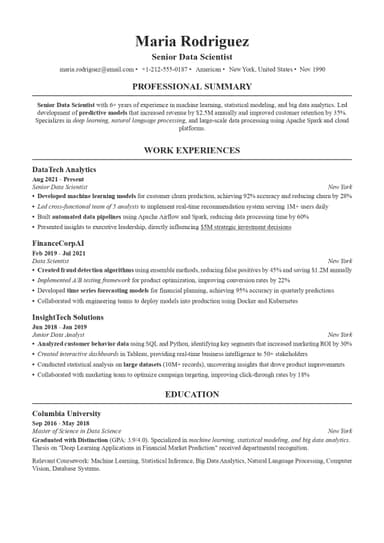
Your interview answer is only as strong as what's backing it up. When a hiring manager asks about your biggest achievement, your resume had better tell the same story. With ResumeBuilder.so you streamline the entire resume writing process.
Our AI-powered resume builder does all the hard work. Also, if you’re not sure what a well-written resume should look like, you can browse our resume examples to see what strong one looks like in your field, or start fresh with one of our resume templates if yours needs a full reset.
Final Thoughts
"Tell me about yourself" isn't a trap, it's an invitation. Most candidates treat it like a burden, which is exactly why the ones who treat it like an opportunity immediately stand out.
Use the past-present-future structure, keep it to 90 seconds, and make sure every sentence is doing something useful. Tailor your answer for each role, practice until it sounds natural rather than rehearsed, and lead with the accomplishments that actually matter for the job at hand.
“Tell Me About Yourself” FAQs

Daniel Carter is the salary negotiation coach you wish you had before accepting that lowball job offer. With years of HR experience, he knows all the employer tactics—and how to counter them. His posts break down negotiation strategies, industry salary trends, and scripts you can actually use in real conversations.