UX/UI Designer Cover Letter: Examples & Writing Guide
This complete guide with expert tips and real examples will teach you how to write a compelling cover letter — fast and stress-free!
Edit this cover letter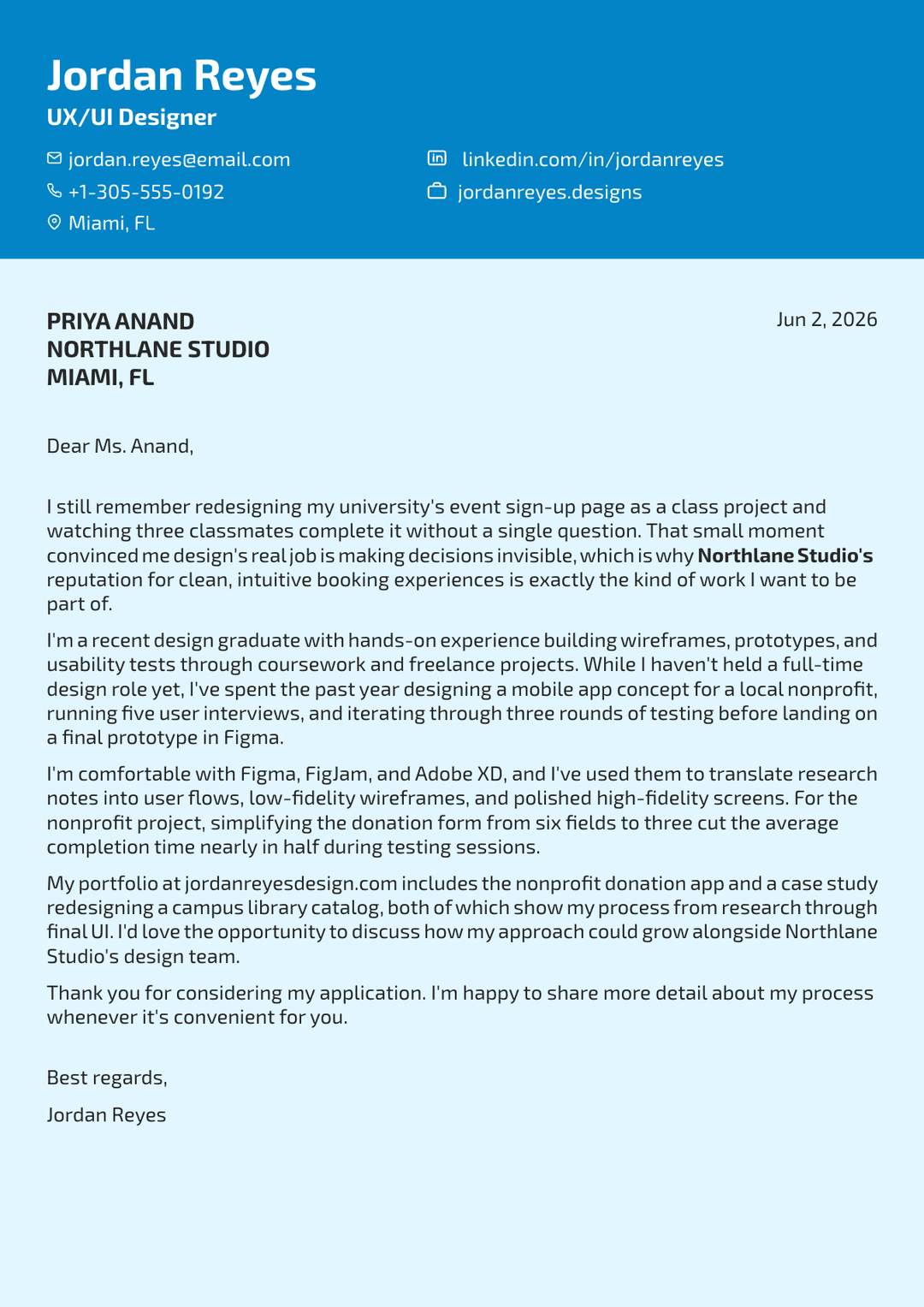
A UX/UI designer cover letter is a job application document that introduces your design background, explains why you’re interested in a role, and shows how your skills match the company’s needs.
While a resume lists your experience, tools, and achievements, a cover letter gives context to your work. It lets you explain how you approach user research, interface design, usability, collaboration, and other parts of your job in a more personal and persuasive way.
This article will show you how to write one that feels specific, professional, and relevant to the job. This includes learning what to include in each section and avoiding generic wording that makes your application blend in with everyone else’s.
- A UX/UI designer cover letter should explain the story behind your resume and portfolio, including your design thinking, collaboration style, and interest in the company.
- A good one avoids generic openings and starts with a specific design perspective, achievement, or observation about the company’s product.
- The skills and tools should be mentioned in context, showing how you use platforms like Figma, Miro, or Adobe Creative Suite to create prototypes, design systems, accessibility improvements, and user-focused solutions.
- Quantified achievements and portfolio examples make the letter more convincing because they give hiring managers clear proof of your impact.
- The best UX/UI designer cover letters are tailored to the role, connected to the company’s product challenges, and closed with a confident invitation to review your portfolio or discuss your design process.
What Is a UX/UI Designer Cover Letter?
A UX/UI designer cover letter is a one-page document that accompanies your UX/UI resume and portfolio and introduces your skills, work philosophy, and experience to a hiring manager.
The "UX" side of the role covers the research-heavy work, including:
- User interviews
- Personas
- Journey mapping
- Wireframing
- Usability testing
Meanwhile, the "UI" side is about the visual execution and entails:
- Typography
- Interaction design
- High-fidelity prototypes
- Design systems
Your cover letter should show that you understand both and can move fluidly between them depending on what the team needs.
What separates a cover letter from a resume is the difference between stating the facts and proving them. Your resume gives the structured facts, such as job titles, dates, tools, and metrics. Meanwhile, the cover letter gives the story behind these by answering the following:
- Why did you choose design?
- What drives your decisions?
- Why this company, this product?
That narrative is what turns a candidate file into a person a hiring manager actually wants to meet.
Creative roles like UX/UI design are a special case. Portfolios show your work, but they can't always reveal your thinking process, collaboration style, or enthusiasm for a company's mission. Yet, a good cover letter, one that complements rather than duplicates your resume, fills that gap.
UX/UI Designer Cover Letter Examples
Below are four full cover letter examples you can have a look at and use as inspiration:
Experienced UX/UI Designer Cover Letter Sample

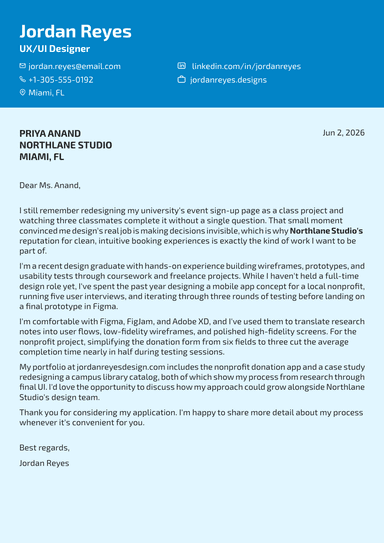
UX/UI Designer Cover Letter With No Experience Sample

UX Researcher Cover Letter Sample

UI Developer Cover Letter Sample

What to Include in a UX/UI Designer Cover Letter
Here's what every UX/UI designer cover letter should include and why each piece matters:
#1. Header
The header of your UX/UI designer cover letter should be neat and easy to scan. It should contain your full name, phone number, email address, location, and a link to your portfolio, as well as your LinkedIn profile or personal website.
Below your contact details, add the date and the employer’s information, including the hiring manager’s name, company name, and company address if available. Keep the formatting consistent with your resume so both documents feel like part of the same application package.
Maya Collins
Austin, TX
maya.collins@email.com
(512) 555-0148
mayacollinsdesign.com
linkedin.com/in/mayacollins123
May 18, 2026
Lewis Bailey
Hiring Manager
BoneCart
Austin, TX
#2. Opening Line
Next, you should skip "I am writing to apply for…" entirely. You should start your cover letter with something that earns attention, be it a design philosophy you hold, a specific achievement, or a sharp observation about the company's product. Rest assured that hiring managers notice when a letter starts with a genuine perspective rather than a formality.
Dear Mr. Bailey,
Great UX often comes down to removing the small moments of friction users have learned to tolerate. That is what drew me to BoneCart’s focus on simplifying online shopping, especially for customers who want a faster, clearer path from product discovery to checkout.
#3. Professional Summary
In two or three sentences, summarize your experience level, specialization (whether that's UX research, visual UI design, or full product design), and the specific value you bring. Then tie it directly to the role, as vague summaries don't differentiate you like specific ones.
I’m a UX/UI designer with three years of experience creating responsive web and mobile experiences for e-commerce and SaaS products. My work focuses on user research, interaction design, prototyping, and conversion-focused interface improvements. I would bring BoneCart a practical design approach grounded in user behavior, clean visual systems, and close collaboration with product and engineering teams.
#4. Relevant Skills and Tools
Mention tools (Figma, Sketch, Adobe XD, InVision, Miro, etc.) naturally, but don't just put them there. Focus on what you actually do with those (design systems, research synthesis, rapid prototyping, accessibility reviews, etc.).
Cover letter skills for designers land better when they're framed around outcomes rather than technical familiarity. That said, mentioning current tools does show you're keeping up with the field.
In my current role at Diline Digital, I use Figma, FigJam, Miro, and Adobe Creative Suite to turn research findings into wireframes, prototypes, design systems, and polished user interfaces.
#5. Quantified Achievements
Even approximate metrics, such as user counts, time-on-task improvements, CSAT, etc., give hiring managers something concrete to hold onto. If you genuinely don't have numbers, describe the scope of the project, team size, timeline, or release impact.
I recently redesigned an e-commerce checkout flow by reducing five steps to three, clarifying error states, and simplifying payment options, which contributed to a 21% increase in completed purchases over three months. I also helped expand a shared Figma component library, reducing repetitive design work and improving consistency across client projects.
#6. Portfolio Call-Out
Always include a design portfolio in a cover letter, and give it context by referencing one or two projects that are directly relevant to the company's product space. This represents the difference between a passive link and a genuine invitation.
You can view my portfolio at mayacollinsdesign.com, especially the LumaCart checkout redesign and Diline Digital SaaS onboarding case study. Both projects show how I approach research synthesis, wireframing, accessibility checks, and high-fidelity UI design for products where clarity and speed directly affect business results.
#7. Confident Closing and Call to Action
Don't close your cover letter with "I look forward to hearing from you"; it's forgettable and passive. Instead, invite a specific next step, such as a portfolio review, a 20-minute call, or a conversation about the role.
I’d welcome the chance to walk you through one of these case studies and discuss how my UX/UI process could support BoneCart’s current product goals. Thank you for your time and consideration.
Sincerely,
Maya Collins
3 More Tips on How to Write a UX/UI Designer Cover Letter
Here’s some more advice to help you write a solid cover letter for a UX designer job:
Before you write anything, you should:
- Read the job description carefully
- Visit the company's product pages
- Read their app store reviews
- Scan their design blog if they have one
- Look for the friction their users are experiencing
- Identify one or two design challenges the company is likely wrestling with
Once you do all this and detect a specific challenge, address it by name in your letter. That level of personalization shows you think like a designer: you identified a problem before proposing a solution.
Using the same language in your cover letter as that in the job posting matters for two reasons:
- First, ATS scans for keyword alignment before a human ever sees your application.
- Second, when a hiring manager reads language they recognize from their own job posting, they feel like you understood what they were actually asking for.
Read your letter aloud, and detect any awkward phrasing, and then run it through a grammar checker (Grammarly works fine for this).
Additionally, ask yourself whether the tone matches the company, as different companies want different registers, and you need to adjust accordingly. You should also save your document as a PDF so that the formatting stays intact.
4 Common UX/UI Designer Cover Letter Mistakes to Avoid
And finally, before we end this guide, let’s see the most common cover letter mistakes UX/UI designers make:
If your resume already mentions specific achievements or measurable results, the cover letter shouldn't repeat them; instead, tell the story behind them. Why did you approach it that way? What did you learn? What would you do differently? These are the questions whose answers make your accomplishments believable.
This is a surprisingly common mistake, as many designers submit a cover letter without a portfolio link, or they bury the URL in their email signature without referencing it in the letter itself.
Always include your portfolio link with a sentence of context; a naked one with no framing gets ignored, but if you introduce it with a relevant project reference, it could mean a lot.
If your cover letter could be sent to any design company without changing a word, it needs work. So, research the company or a specific product, mention it, and connect your experience to its design challenges. That specificity is what will make you memorable.
Listing every software you've used without context adds noise rather than value. Tools are a means to an end; what matters is what you built with them and what happened as a result. Therefore, make sure you emphasize outcomes and let the tools appear in context.
Final Thoughts
A properly written UX/UI designer cover letter is personalized, achievement-driven, and directly connected to the company's product and design challenges. It demonstrates that you can communicate as clearly in writing as you can in pixels, and for creative roles, that matters.
For the best version of your job application, you can build an ATS-friendly cover letter for this role with ResumeBuilder.so. We offer professional templates, great examples to use as references, and AI-powered suggestions that can significantly improve the way you present your qualifications!
UX/UI Designer Cover Letter FAQ
#1. How long should a UX/UI designer cover letter be?
A UX/UI designer cover letter should be one page long, ideally 300 to 400 words. Hiring managers spend only a few seconds on each letter, so conciseness and clarity matter here. If it runs longer than a page, you should edit until it doesn't.
#2. Do UX/UI designers need a cover letter?
Yes, UX/UI designers need a cover letter even when it's listed as optional. It provides an opportunity for them to demonstrate communication skills, design thinking, and genuine interest in the role. All these are qualities that a portfolio alone can't fully convey, so skipping this part is definitely a missed opportunity.
#3. How do I write a UX/UI designer cover letter with no experience?
You write a UX/UI designer cover letter with no experience by highlighting portfolio projects, demonstrating your knowledge of UX/UI tools and processes, and emphasizing transferable skills. You should also focus on outcomes from real projects, even if they weren't paid engagements.

Max Harper is the resume guru who actually makes job searching easier. With years of experience as a hiring manager, Max knows what makes a resume stand out in a pile of 200+ applications. From breaking down ATS myths to helping you craft bullet points that pop, Max shares easy-to-digest, no-BS resume advice.