Creative Thinking Skills: Definition & How to Improve Them

Creative thinking skills are the abilities that help you look at problems, ideas, and situations from a fresh or unique perspective. While analytical thinking focuses on logic and evaluation, creative thinking is about exploring possibilities, making unexpected connections, and finding original ways to move forward.
These skills are useful in almost every role, from designing campaigns and solving customer issues to improving internal processes or developing new products.
In this guide, we’ll explain their definition, why employers value them, and how they show up in the workplace. You’ll also find creative thinking examples, practical ways to improve these abilities, and tips for highlighting them in your job application.
- Creative thinking skills help professionals approach problems from fresh angles, generate original ideas, and find solutions beyond obvious or established methods.
- These abilities are not limited to artistic roles; they apply across fields such as operations, data analysis, customer service, marketing, engineering, and project management.
- The strongest creative thinkers use both divergent thinking to generate ideas and convergent thinking to evaluate, refine, and choose the best solution.
- Employers value creative thinking because it supports innovation, adaptability, problem-solving, and the ability to work through ambiguity.
- On a resume, such skills should be shown through specific achievements and measurable outcomes rather than generic phrases like “creative thinker.”
What Are Creative Thinking Skills?
Creative thinking skills are those that allow you to approach problems, ideas, and challenges from new and unconventional angles and find solutions that go beyond obvious or established approaches. They're not a single talent but a cluster of interconnected habits, perspectives, and techniques that can be developed deliberately over time.
It's worth being clear about the fact that creative thinking doesn’t exclusively revolve around artistic expression, design ability, or working in a so-called creative industry.
For instance, a logistics manager who redesigns a warehouse routing system to cut delivery times is also exercising creative thinking. So is a data analyst who spots a counterintuitive pattern in a dataset and reframes the entire business question around it.
Psychologists distinguish between two core modes of creative thought: divergent and convergent.
- Divergent thinking is the expansive phase that generates as many possible ideas as you can from a single starting point without filtering.
- Convergent thinking is the narrowing phase that evaluates those ideas and selects the most viable path forward.
Both are essential, and the ability to move fluidly between them is what separates genuinely creative professionals from those who either generate ideas they can't execute or execute efficiently without ever questioning their assumptions.
Creative Thinking vs. Critical Thinking: What's the Difference?
The difference between creative and critical thinking is that the former generates new ideas and possibilities, while the latter evaluates and analyzes those ideas to determine the best course of action.
The two are most powerful when used in combination since creative thinking opens up the solution space, and critical thinking helps you choose which door to walk through. For example, a marketing team might use creative thinking to brainstorm twenty campaign concepts in a 30-minute session, then switch to critical thinking to evaluate each one against budget constraints, audience data, and brand guidelines.
10 Key Creative Thinking Skills With Examples
As previously mentioned, creative thinking in the workplace is not a single ability but a collection of interconnected skills. Here are the ten most valued by employers, along with practical examples of each:
#1. Open-Mindedness
Open-mindedness is the willingness to consider new ideas, perspectives, and approaches without immediate judgment. This also means sitting with uncertainty long enough to genuinely evaluate what's in front of you rather than filtering it through what you already believe. Professionals who boast this trait are more adaptable, more collaborative, and tend to catch opportunities that more fixed thinkers miss entirely.
A product manager who receives user feedback that directly contradicts their original design assumptions, incorporates it into a redesign rather than dismissing it, and ends up with a feature that dramatically outperforms the original.
#2. Brainstorming
Meanwhile, brainstorming is the structured practice of generating as many ideas as possible before evaluating any of them. The quantity-over-quality approach during a brainstorm is intentional, since filtering too early kills momentum and causes teams to anchor on the first decent idea rather than the best possible one.
A marketing team that runs a focused 15-minute brainstorm and produces 30 headline options before selecting the strongest three, rather than debating the first two ideas that come up.
#3. Problem-Solving
Creative problem-solving means approaching an obstacle with fresh eyes rather than defaulting to the most familiar solution, asking "what else could work here?" before committing to the obvious path.
Employers across every industry consistently list this as one of their most sought-after competencies, and it shows up in roles at every level. Therefore, developing strong problem-solving abilities is one of the highest-leverage investments you can make in your career.
An operations coordinator who devises a new internal workflow that cuts project turnaround time by 25%, not through additional resources but by rethinking the handoff sequence between departments.
#4. Lateral Thinking
The ability to approach a problem indirectly or from an unexpected angle, rather than following the obvious, step-by-step logical path, is called lateral thinking. It's particularly useful when conventional approaches have already been tried and found wanting or when the straight road is blocked, and the solution requires finding a door no one else noticed.
A software developer who solves a persistent bug not by rewriting the problematic code but by rethinking the underlying data structure that was generating the error in the first place.
#5. Analytical Thinking
Along with creative thinking, analytical skills reinforce each other more than most people realize. Approaching a data set creatively (by looking for unexpected patterns, narrative arcs, or counterintuitive anomalies) generates insights that straightforward, by-the-numbers reporting consistently misses.
A data analyst who interprets quarterly performance data not as a simple metrics summary but as a narrative arc, identifying the root cause of a revenue dip that had stumped the finance team for months.
#6. Curiosity
Curiosity is the professional habit of asking "why" and "what if" rather than accepting the status quo as fixed. Research shows that curious employees are more engaged, more innovative, and faster at acquiring new skills. This is partly because they're motivated by the questions themselves rather than just the outcomes.
A customer service representative who investigates the root cause of recurring support complaints and proposes a product fix rather than simply resolving each individual ticket and moving on.
#7. Flexibility and Adaptability
When someone is flexible, they can adjust their thinking and approach fluidly when circumstances change and abandon a plan that's no longer working without treating the change as a failure.
This is the creative skill for a resume that keeps projects moving when the unexpected happens, which in most professional contexts is a matter of when, not if. Strong collaboration skills and flexibility are deeply connected, as adapting to others' working styles is itself a form of creative adjustment.
A project manager who restructures an entire timeline mid-project after a key resource becomes unexpectedly unavailable, keeping the team on track without sacrificing the quality of final deliverables.
#8. Experimentation
Creative thinkers treat failure as data rather than defeat. Experimentation means being willing to test untested ideas in a low-risk, controlled way before scaling them. After all, this also means accepting that most experiments won't work while understanding that every failed attempt narrows the solution space.
A sales professional who A/B tests two outreach email formats over a month, uses the performance data to identify which approach generates more replies, and refines the entire team's outreach strategy based on the results.
#9. Visual Thinking
Visual thinkers can process information and communicate ideas through imagery, diagrams, and spatial relationships rather than words alone. It's particularly valuable in design, engineering, project management, and any role where complex systems need to be made legible to a non-specialist audience.
A team lead who untangles a complex project dependency not with a written explanation but with a mind map that makes the solution instantly comprehensible to every stakeholder in the room within minutes.
#10. Collaboration
Creative thinking rarely happens in isolation. Diverse teams generate stronger ideas because each member brings different knowledge, mental models, and life experiences to the table. Those differences, when well-managed, produce solutions that no individual would have reached alone.
A cross-functional team that cracks a persistent supply chain problem by bringing together perspectives from logistics, finance, and customer experience.
Why Employers Value Creative Thinking Skills
Employers value creative thinking skills because they drive innovation, improve problem-solving, and help organizations adapt to a rapidly changing business environment.
Companies that actively foster creative thinking consistently outperform their peers in revenue growth and market adaptability. The mechanism is straightforward: when employees can generate novel approaches to problems, the organization accumulates a competitive advantage that's hard for competitors to replicate, because it's embedded in people rather than processes.
Furthermore, creative employees are also better equipped to handle ambiguity, which is increasingly the norm as industries evolve, job functions expand, and traditional role boundaries blur. The ability to operate productively without a clear playbook and generate a path forward when none exists yet is exactly what employers mean when they say they want "self-starters" and "problem-solvers."
And critically, soft skills like creative thinking are more durable than technical skills in a labor market increasingly reshaped by automation. A specific software competency can become obsolete within a few years. Yet, the ability to think creatively, adapt quickly, and generate ideas that a machine wouldn't produce remains valuable precisely because it's hard to replicate programmatically.
How to Improve Creative Thinking Skills
You can improve your creative thinking skills by practicing techniques that challenge your default thinking patterns, expose you to new ideas, and build your tolerance for ambiguity.
Let’s see how it should go:
Actively seek new experiences. This includes learning a skill that has nothing to do with your profession, engaging with unfamiliar communities, or putting yourself in environments where your existing knowledge doesn't apply.
Set a timer for ten minutes and write down every possible solution to a problem without filtering any of them. Do this alone or with a small group. The goal is volume, or getting past your first three or four ideas and into the territory where genuinely unexpected options start to emerge.
Over time, brainstorming techniques train your mind to treat its first instinct as a starting point rather than a conclusion.
Mind mapping is a visual brainstorming technique that starts with a central idea and branches outward into related concepts, associations, and sub-topics. It mirrors the way the brain actually connects ideas (associatively and non-linearly) and consistently surfaces connections that conventional list-making misses. Start with a blank page, a central concept, and without any rules about where the branches go.
Talk regularly to people from different professional backgrounds, industries, and lived experiences. Diverse input challenges your assumptions and introduces mental models you simply wouldn't encounter within your own field.
The key is to listen fully before responding, as creative insight often arrives during listening rather than speaking, when something someone else says triggers a connection you wouldn't have made alone.
Keep a simple log of what didn't work and why, not so that you can dwell on mistakes, but to extract learning from them systematically. Creative thinking requires experimentation, and experimentation requires accepting that most attempts will fail before one succeeds.
Reframing failure as useful data rather than evidence of incompetence is the mindset shift that makes sustained creative output possible.
Some of the most productive creative thinking happens away from a screen.
Some unstructured mental time (during a walk, a rest, or a low-stimulation activity) activates the brain's default mode network. This network is closely associated with idea synthesis and the kind of non-linear connections that deliberate focused thinking rarely produces.
How to List Creative Thinking Skills on Your Resume
You can list creative thinking skills on your resume by incorporating specific examples and measurable outcomes rather than simply stating the word "creative" in your skills section.
"Creative thinker" as a standalone resume claim means nothing to a hiring manager but is a self-reported adjective that any candidate can write. What matters is demonstrating creative thinking through the evidence of what it produced.
There are a few places to embed this effectively:
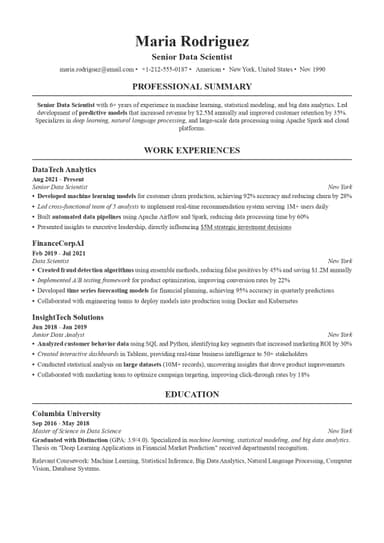
- In your resume summary, you should use one sentence to frame your creative approach in terms of professional impact, for example: "Marketing professional who uses data-driven brainstorming to develop campaign concepts that consistently outperform industry benchmarks."
- In your work experience bullets, replace generic duty descriptions with results-driven statements that show creative thinking in action, e.g.: "Redesigned onboarding workflow by applying design thinking principles, reducing new hire ramp-up time from 12 weeks to 8."
- In your skills section, list specific sub-types rather than the blanket term ("Creative problem-solving," "Lateral thinking," "Brainstorming facilitation," "Visual communication").
If you are ready to build a resume that highlights your creative thinking skills, use the AI-powered resume builder on our platform. It will help you generate achievement-focused bullet points tailored to your role and industry, and present your skills in the best way.
We also encourage you to browse through our resume example library to see how other professionals frame their creative skills, or start directly from resume templates built for ATS compatibility.
Final Thoughts
In conclusion, creative thinking skills are not a niche talent reserved for artists and innovators but practical, learnable, and increasingly essential abilities across every profession. In fact, employers are actively looking for people who can generate new ideas, adapt to change, and solve problems in ways that go beyond the standard playbook.
Once you've identified your creative strengths and presented them well on your resume, you’ll be able to talk about them more easily in a job interview, using them as a weapon to impress recruiters!
Creative Thinking Skills FAQ

Emily Foster knows how nerve-wracking it can be to land your first job—she’s been there. As a mentor for young professionals, she shares exactly what hiring managers want from entry-level candidates. From internship hacks to interview confidence tips, Emily helps students and recent grads navigate the job search with ease.