Project Manager Resume: How to Write One in 2026 + Examples
This complete guide with detailed explanations and expert tips will teach you how to write an acting resume in record time!
Edit this resume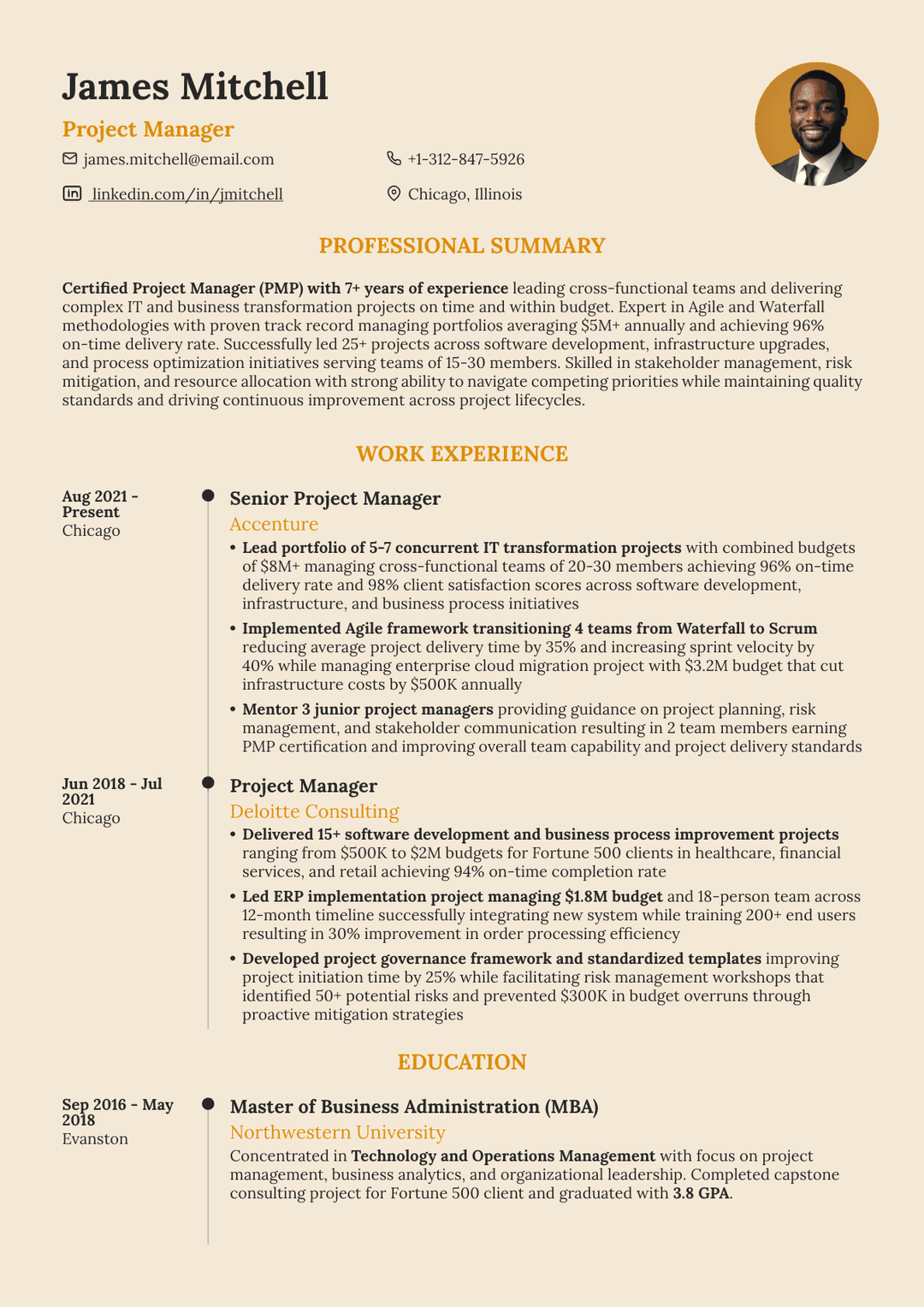
A project manager resume needs to do more than list your job history. It has to demonstrate leadership, showcase your ability to deliver results under pressure, and prove you're someone who can turn chaos into coordinated success. However, the competition's fierce.
Most PM roles attract hundreds of qualified candidates, and your resume has maybe six seconds to make an impression before it's tossed aside. That's why understanding what makes a project manager resume effective isn't optional—it's essential.
In this guide, you'll learn exactly how to structure your PM resume, what accomplishments matter most, which skills to highlight, and how to format everything for both applicant tracking systems and actual recruiters.
- A project manager resume should demonstrate leadership, results delivery, and the ability to manage complexity, rather than simply listing job responsibilities.
- Quantifiable achievements, such as budget size, timelines, cost savings, and delivery rates, are central indicators of project management effectiveness.
- Certifications like PMP, CAPM, Agile, Scrum, Six Sigma, and PRINCE2 serve as standardized proof of competence and influence eligibility for many roles.
- Resume structure and formatting must align with applicant tracking system requirements, including keyword usage, standard section headers, and simple layouts.
What Makes a Strong Project Manager Resume?
A strong project manager resume needs to demonstrate your ability to lead teams, manage complex projects, and deliver results on time and within budget. Unlike other professional resumes, it has to balance technical expertise with leadership capabilities—showing you're equally comfortable creating Gantt charts and motivating teams through challenging deadlines.
That said, here’s what you need to show in your project manager resume:
- Clear value proposition. Your resume should immediately communicate the value you bring. This means leading with a strong summary statement that highlights your years of experience, key methodologies you've mastered, and the scale of projects you've managed. Recruiters spend seconds scanning resumes, so consider this your elevator pitch.
- Quantifiable achievements. Project management is results-oriented, and your resume should reflect this reality. Including specific metrics transforms vague claims into concrete evidence of your capabilities. Rather than saying you "improved efficiency," show that you "reduced project delivery time by 30%, saving the organization $400K annually."
- Relevant certifications. Credentials like PMP, CAPM, Agile, Scrum Master, or Six Sigma demonstrate professional commitment and expertise. These shouldn't be hidden at the bottom of your resume. Many companies won't even consider candidates without a PMP for senior positions, so if you've earned these certifications, make sure they're prominently displayed.
- ATS optimization. Most project manager positions receive hundreds of applications, and applicant tracking systems (ATS) screen resumes first. Your resume must include relevant keywords from the job description while maintaining natural readability. This doesn't mean keyword stuffing—it means carefully reading job descriptions and incorporating their language authentically throughout your resume.
Project Manager Resume Examples by Experience Level
Before we show you how to write a resume, let’s examine some project manager resume examples you can use for your own inspiration. These resume examples are divided by experience level, so you can find a suitable one regardless of your career stage.
Entry-Level Project Manager Resume Example
Entry-level project manager resumes should focus on education, certifications, relevant internships or volunteer experience, transferable skills, academic projects, and a strong career objective that explains your aspirations and potential.

Mid-Level Project Manager Resume Example
Mid-level project manager resumes emphasize measurable achievements, project complexity and scale, team leadership experience, process improvements you've implemented, and certifications combined with ongoing professional development.


Senior Project Manager Resume Example
Senior project manager resumes highlight strategic impact, portfolio management experience, leadership and mentorship accomplishments, organizational influence, and executive stakeholder management capabilities.


How to Write a Project Manager Resume: Step-by-Step Guide
Writing a good project manager resume is all about following proper steps. Let’s examine each one in more detail so you can craft an application that gets interviews.
#1. Choose the Right Resume Format
You can choose between different resume formats, but the reverse-chronological format is the gold standard for project manager resumes. It showcases career advancement and increasing responsibilities, making it easy for recruiters to track your project management journey. Also, ATS systems can easily parse this format.
However, if you're making a significant career change into project management and need to emphasize transferable skills over job titles, opt for a functional resume. On the other hand, if you're transitioning from a related role (like business analyst or team lead) into formal project management; the combination format makes sense.
#2. Add Your Contact Information
Your resume header is one of the first things recruiters see. They’ll use this information if they want to contact you, so make sure that it is accurate. Include the following:
- Full name
- City and state
- Phone number
- Professional email address
- Linkedin profile
Also, if you have a professional website or portfolio showcasing projects you've managed, include that too. Just make sure everything's current. Nothing screams "inattention to detail" quite like listing a disconnected phone number on a project management resume.
Let’s see a good example:
JAMES RODRIGUEZ
Seattle, WA
(206) 555-0892
james.rodriguez@email.com
Linkedin profile: linkedin.com/in/jamesrodriguezpm
Portfolio: jrodriguezprojects.com
#3. Write a Professional Summary or Objective
This 3-4 line section highlights your experience level, specialization, and key achievements. Experienced PMs should use a professional summary that demonstrates their track record. On the other hand, entry-level candidates should use a resume objective that explains their goals and what they bring to the table.
This is a simple formula you can follow when crafting your resume summary:
[Years of Experience] + [Job Title] + [Specialization/Industry] + [Key Methodologies] + [Notable Achievement] + [Certification]
Here’s a good example of a resume summary:
Certified Project Manager (PMP) with 5+ years of experience managing cross-functional teams in the construction industry. Skilled in risk management, budget oversight, and stakeholder communication. Led 30+ commercial projects averaging $2M+ with 98% on-time completion rate.
Now that we’ve covered a professional summary example, here’s a good one for a resume objective:
Organized and proactive recent graduate with PMP certification and internship experience managing small-scale projects. Eager to apply strong analytical and communication skills to support project delivery and team success at [Company Name].
#4. List Your Work Experience
The work experience section is where you prove your capabilities through concrete examples and measurable results. This section should demonstrate not just what you did, but the impact you made. List positions in reverse-chronological order, including:
- Company name
- Location
- Job title
- Dates
Write 4-6 bullet points per position focusing on achievements, not duties. Start each bullet with strong action verbs that convey leadership and results.
That said, let’s take a look at a couple of strong work experience entry:
Senior IT Project Manager | TechCorp Solutions | San Francisco, CA | Jan 2020 - Present
- Spearhead digital transformation initiative managing $8M budget and 40+ team members across 5 departments, resulting in 35% improvement in operational efficiency
- Implemented Agile methodology across organization, reducing average project delivery time from 8 months to 5 months
- Mentor team of 6 junior project managers, with 4 earning PMP certification under my guidance
- Negotiate with C-suite executives and external vendors to secure resources and resolve conflicts, maintaining 98% stakeholder approval rating
#5. Include Relevant Skills
Your skills section should showcase both technical project management abilities and soft skills. This isn't just about listing buzzwords—it's about demonstrating the full range of competencies you bring to the table.
To format your skills, you can either categorize them (technical, leadership, tools) or use a proficiency matrix for experience levels (expert/advanced/intermediate). Also, tailor your skills to each job description.
ATS systems scan for matching keywords. Prioritize relevant skills like Agile, Jira, stakeholder management, and specific tools mentioned in the posting to pass initial screening.
Project managers need different hard skills, including technical competencies, methodologies, and software tools, to successfully deliver projects on time and within budget.
Here’s a short list of some of the most important ones:
- Agile/Scrum & Waterfall methodologies
- Jira, Asana, Monday.com, Microsoft Project
- Budget Management & Cost Control
- Risk Management & Mitigation
- Resource Allocation & Planning
- MS Office Suite (Excel, PowerPoint, Visio)
- Schedule Development & Critical Path Method (CPM)
- Scope Management & Change Control
- Quality Assurance & Six Sigma
- Slack, Microsoft Teams, Confluence
- Vendor Management & Procurement
- Requirements Gathering & Documentation
- Earned Value Management (EVM)
- Lean & Kanban methodologies
- PRINCE2 & PERT techniques
While technical skills get you in the door, soft skills often determine success in project management roles. These include:
- Leadership
- Communication
- Stakeholder Management
- Problem-Solving
- Critical Thinking
- Conflict Resolution
- Negotiation
- Time Management
- Adaptability & Flexibility
- Decision-Making
- Emotional Intelligence
- Collaboration
- Strategic Planning
#6. Consider Your Education
While project management doesn't always require a specific degree, most employers prefer candidates with at least a bachelor's degree. Make sure to list the following for your entries in the education section:
- Degree
- Institution
- Graduation year
Recent graduates with no experience should place education before work history since it's their primary credential. On the other hand, experienced professionals should place education after work experience because accomplishments matter more than where you studied.
Include relevant coursework, academic honors like Dean's List or Magna Cum Laude since these signal consistent high performance, as well as GPA, but only if it's above 3.5 and you graduated within the last 3-5 years.
Here’s how you can do it properly:
Bachelor of Science in Business Administration
University of California, Berkeley | Berkeley, CA | 2015
- Concentration in Project Management
- GPA: 3.7/4.0
#7. Add Your Project Management Certifications
Certifications demonstrate commitment to the profession and validate your knowledge. They're particularly important on a project manager resume because they provide standardized proof of competency.
Here are some of the most valuable PM certifications:
- Project Management Professional (PMP). Issued by the Project Management Institute (PMI), this is the most recognized PM certification globally. It requires 4,500-7,500 hours of project management experience and demonstrates serious professional commitment.
- Certified Associate in Project Management (CAPM). Also issued by PMI, this certification is ideal for entry-level project managers or those transitioning into PM roles. It requires 23 hours of project management education but doesn't demand extensive work experience.
- Agile certifications. Credentials such as Certified ScrumMaster (CSM), PMI Agile Certified Practitioner (PMI-ACP), SAFe Agilist, and Professional Scrum Master (PSM) matter increasingly as more organizations embrace Agile methodologies.
- Six Sigma certifications. Six Sigma Green Belt, Six Sigma Black Belt, and Lean Six Sigma certifications demonstrate your ability to improve processes and reduce defects—valuable in manufacturing, healthcare, and financial services.
- PRINCE2 (Projects IN Controlled Environments). This certification is widely recognized internationally, especially in Europe.
As for listing certifications on resume, here's how you can do it:
- Project Management Professional (PMP), PMI | ID: 12345678 | Valid: 2023-2026
- Certified ScrumMaster (CSM), Scrum Alliance | 2022
- Six Sigma Green Belt, American Society for Quality | 2021
#8. Think About Additional Sections
Aside from the above-mentioned standard section, consider additional sections, such as:
- Awards and Recognition
- Professional Affiliations (like PMI membership)
- Publications or Speaking Engagements
- Volunteer Project Management Experience
These can differentiate you from other candidates with similar technical skills. They show you're engaged with the profession beyond just showing up for a paycheck.
How to Optimize Your Project Manager Resume for ATS
Optimizing your project manager resume for ATS increases visibility and helps your application reach recruiters. To make these practices easy to apply, the table below breaks down exactly what applicant tracking systems look for and how to avoid ATS mistakes:
| Optimization Area | What ATS Expects | Best Practice Example |
|---|---|---|
Section Headers | Standard, recognizable labels | Work Experience, Education, Skills, Certifications |
Keywords | Exact job-related terms | “Agile and Scrum methodologies,” “$15M+ budget management” |
Acronyms & Terms | Both full terms and abbreviations | Project Management Professional (PMP), Earned Value Management (EVM) |
Formatting | Simple, scannable layout | Single column, standard bullets, clear spacing |
Fonts | Common system fonts | Arial, Calibri, Helvetica, Times New Roman |
Design Elements | Minimal, no visuals | No tables, graphics, text boxes, or charts |
File Format | ATS-readable files | .docx preferred; PDF only if requested |
File Naming | Clear, professional naming | FirstName_LastName_ProjectManager_Resume.docx |
7 Common Project Manager Resume Mistakes to Avoid
Even experienced project managers make resume mistakes that cost them interviews. Here’s a short list of pitfalls you should avoid:
- Listing responsibilities instead of achievements. Focus on outcomes and results, not job duties. Employers want proof of impact, leadership, and delivery—not a rewritten job description.
- Failing to quantify results. Use numbers to show scope, scale, and improvement. Metrics make your contributions clear, credible, and memorable.
- Using generic language. Avoid vague traits and buzzwords. Specific actions and outcomes communicate competence far better than broad claims.
- Including irrelevant information. Remove outdated roles, personal details, unrelated hobbies, and filler phrases. Every line should support your candidacy.
- Making the resume too long. Keep it concise and selective. Recruiters scan quickly, so prioritize your strongest, most relevant experience.
- Typos and grammar errors. These signal poor attention to detail. Proofread thoroughly and review multiple times before submitting.
- Using an unprofessional email address. Your contact information should look polished and credible. Simple, name-based email addresses create the best first impression.
Use ResumeBuilder.so to Build a Strong Project Manager Resume
ResumeBuilder.so makes it easy to create a polished, ATS-friendly project manager resume without wasting hours on formatting or wording. Our AI-powered resume builder guides you step by step, helping you turn your experience into clear, results-focused content.
With our platform, you get ATS-optimized resume templates and role-specific examples to speed up the writing process. Furthermore, our built-in cover letter builder enables consistency across your application documents. With real-time formatting and multiple export options, you can apply faster and with confidence.
Final Thoughts
Creating a compelling project manager resume requires more than listing your job duties—it demands showcasing your ability to lead teams, deliver results, and drive organizational success. With a median annual wage of $100,750, employment for project managers is projected to grow 6% over the next decade, competition for top roles remains strong.
However, by focusing on quantifiable achievements, highlighting relevant certifications, and optimizing for ATS systems, you can create a resume that opens doors to your next career opportunity.
Remember that your resume is itself a project deliverable. Apply the same attention to detail, strategic planning, and quality focus that you bring to your projects. Tailor each application to the specific role, use concrete metrics to demonstrate impact, and let your leadership capabilities shine through every bullet point.
Project Manager Resume FAQs
#1. What should a project manager put on a resume?
A project manager resume should include a professional summary highlighting years of experience and key achievements, detailed work experience with quantified results, relevant certifications (especially PMP or CAPM), technical and soft skills, education, and methodologies you're proficient in.
#2. How do I write a resume if I have no project management experience?
Focus on transferable skills and relevant experiences from any role where you've demonstrated leadership, coordination, or planning abilities. Include relevant coursework, certifications like CAPM that don't require extensive experience, volunteer project leadership, academic projects, and internships. Use a career objective instead of a professional summary, and emphasize your eagerness to learn and grow in the field.
#3. Should I include all certifications on my project manager resume?
Yes, include all relevant project management certifications, but prioritize them by relevance to the target role you're pursuing. List PMP, CAPM, Agile, Scrum, and Six Sigma certifications prominently since these carry the most weight in hiring decisions.
#4. How long should a project manager resume be?
Entry-level project managers should aim for one page since recruiters can quickly assess your qualifications. Senior project managers can extend to two pages but should avoid exceeding this length even with extensive experience. Focus on quality over quantity—every line should add value and demonstrate relevant achievements rather than just filling space.
#5. Should I list all the projects I've managed?
No, focus on the most relevant and impressive projects that demonstrate your capabilities and align with the role you're targeting. For each role, highlight 2-4 key projects that show increasing responsibility, complexity, or exceptional results. Choose projects that align with the job you're applying for.
#6. What's the difference between a project manager resume and a program manager resume?
Program manager resumes emphasize strategic oversight of multiple related projects, portfolio management, organizational impact, and long-term planning across the enterprise. On the other hand, project manager resumes focus on tactical execution, specific project deliverables, and immediate results for individual initiatives.
#7. Should I include a photo on my project manager resume?
In the United States, Canada, and the U.K., do not include a resume photo since it can lead to unconscious bias and isn't standard practice. Some countries in Europe, Asia, and Latin America may expect photos, so research standards for the specific region where you're applying.

Max Harper is the resume guru who actually makes job searching easier. With years of experience as a hiring manager, Max knows what makes a resume stand out in a pile of 200+ applications. From breaking down ATS myths to helping you craft bullet points that pop, Max shares easy-to-digest, no-BS resume advice.