Data Analyst Resume: Examples and Writing Guide for 2026
This complete guide with detailed explanations and expert tips will teach you how to write an acting resume in record time!
Edit this resume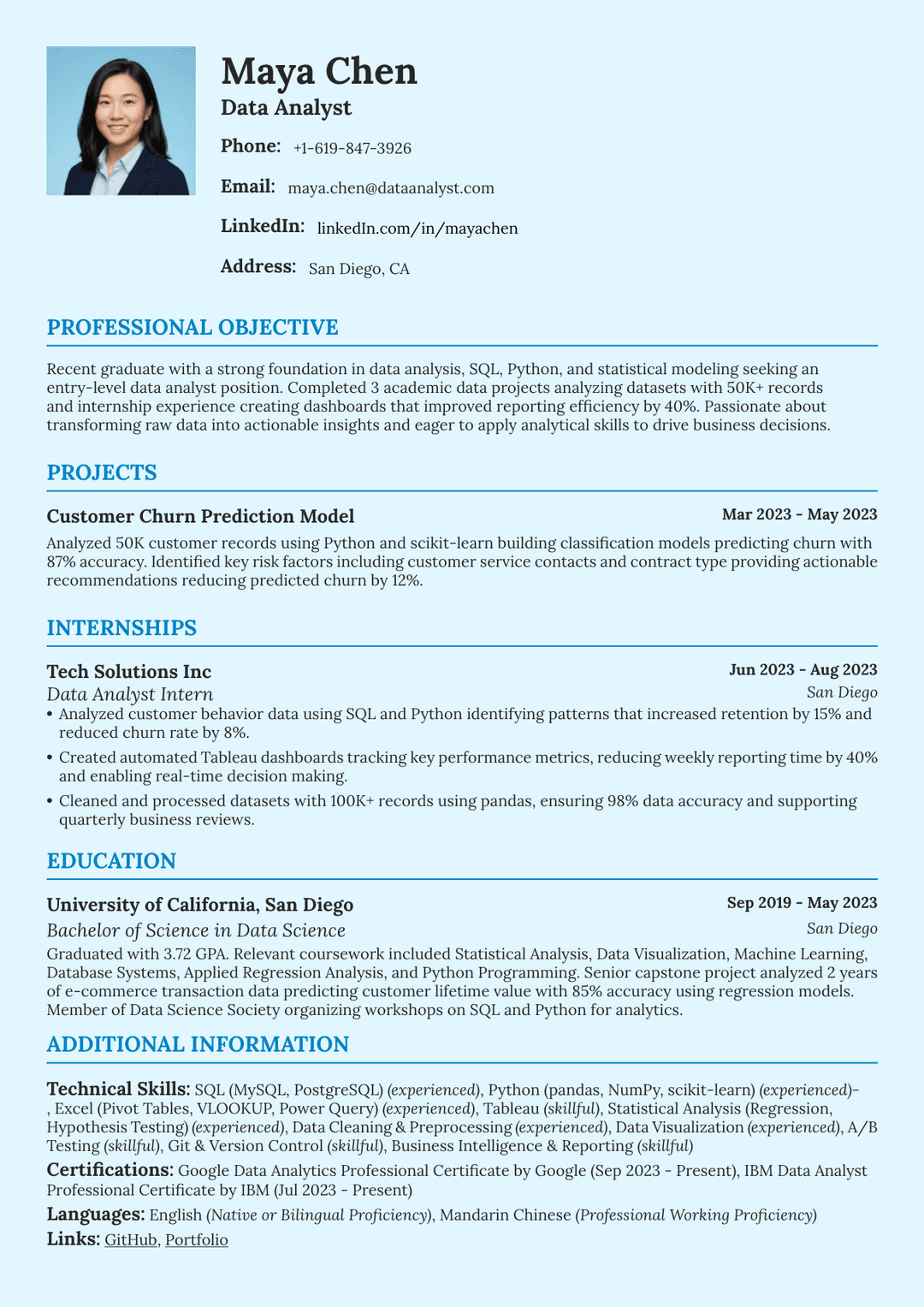
Your data analyst resume needs to impress both the Applicant Tracking systems (ATS) and hiring managers. According to numerous online sources, around 75% of resumes get rejected by ATS before any human reviews them. This means your technical brilliance might never get noticed if your formatting doesn't play nice with the robots.
In this guide, you’ll learn how to write a compelling data analyst resume, whether you're fresh out of school or you're a senior analyst with years of Python and SQL experience. We'll show you exactly which sections matter most, how to present technical skills and accomplishments, and how to optimize your resume for ATS.
- Data analyst resumes must balance technical proficiency with business impact to appeal to both ATS systems and hiring managers.
- Quantifiable achievements (percentage improvements, cost savings, efficiency gains) are more valuable than listing responsibilities.
- Technical skills sections should be organized by category (programming languages, databases, visualization tools, statistical methods).
- Entry-level candidates should emphasize academic projects, internships, and certifications to compensate for limited work experience.
- ATS optimization requires strategic keyword placement, standard formatting, and avoiding graphics or complex layouts.
- Using an AI-powered resume builder can help identify skill gaps, suggest achievements, and ensure ATS compatibility.
What Makes a Data Analyst Resume Effective?
An effective data analyst resume demonstrates both technical expertise and business acumen simultaneously. Unlike standard resumes for other professions, this one needs to prove you can transform raw data into actionable insights that drive real business outcomes.
In today’s tech-driven market, data-related positions are in strong demand. For instance, according to the U.S. Bureau of Labor Statistics, employment of data scientists is projected to grow 34% over the next decade, much faster than average for all other occupations. Therefore, it’s crucial to differentiate yourself through a well-written resume.
As we already said, data analyst resumes must prominently feature technical skills. Hiring managers and ATS systems scan for specific tools and languages like SQL, Python, R, Tableau, Power BI, and Excel. However, simply listing technologies isn't enough—you need to demonstrate proficiency levels and practical applications.
Also, you need to quantify achievements with specific metrics. Numbers speak louder than responsibilities. Percentages, dollar amounts, time savings, and scope (number of users, records, departments) all demonstrate tangible impact.
6 Data Analyst Resume Examples by Experience Level and Role
Different career stages require different approaches in resume writing. That said, let's examine a few resume examples for various experience levels.
#1. Entry-Level Data Analyst Resume Example
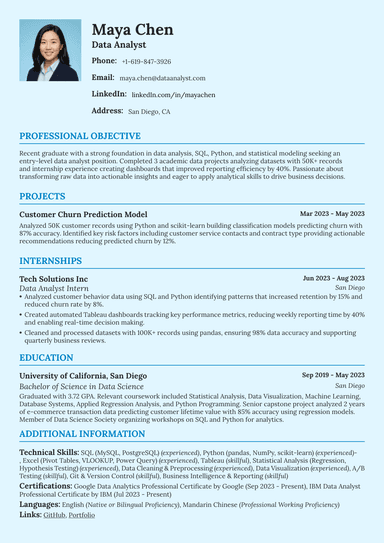
Entry-level candidates face the challenge of limited professional experience. Compensate by emphasizing academic projects, internships, certifications, and portfolio work that demonstrates your analytical capabilities.

#2. Mid-Level Data Analyst Resume Example
Mid-level data analysts (3-6 years experience) should emphasize progression, expanded responsibilities, and measurable business impact. Show how you've evolved from executing analysis to driving strategic decisions.

#3. Senior Data Analyst Resume Example
Senior data analysts (6+ years) compete for strategic positions requiring both technical mastery and business leadership. Your resume should demonstrate organizational influence beyond individual analysis projects.

#4. Career Changer to Data Analyst Resume Example
Transitioning from another field requires emphasizing transferable skills and demonstrating analytical aptitude through alternative credentials and experience.

#5. Healthcare Data Analyst Resume Example
Healthcare analytics requires familiarity with HIPAA compliance, electronic health records (EHR) systems like Epic or Cerner, and healthcare-specific metrics (patient outcomes, readmission rates, cost per episode). Emphasize experience with clinical data, population health analytics, or healthcare operations optimization.

#6. Marketing Data Analyst Resume Example
Marketing analytics focuses on customer behavior, campaign performance, and ROI measurement. Highlight experience with Google Analytics, Adobe Analytics, marketing automation platforms (HubSpot, Marketo), and A/B testing methodologies.

How to Write a Data Analyst Resume: Step-by-Step Guide
Writing a data analyst resume requires following a strategic step-by-step process that balances technical precision with readability. Let's break down exactly how to craft each component.
#1. Choose the Right Resume Format
You can choose from different resume formats, however, most data analysts should use a reverse-chronological format since it’s ATS-friendly and clearly shows your professional trajectory and increasing responsibilities.
On the other hand, if you’re a career changer or recent graduate, you might consider a combination resume. This format lets you highlight analytical capabilities developed through non-traditional paths like bootcamps, self-study, or adjacent roles.
#2. Add Your Contact Information
After you’ve chosen the appropriate resume format for your career level, it’s time to add your contact information to the resume header. Make sure to include:
- Full name
- Phone number
- Professional email (firstname.lastname@domain.com)
- City and state
- LinkedIn profile
- Portfolio/GitHub link (if applicable)
For data analysts, portfolio links provide a visualization of their work, which is a significant competitive advantage. That said, here is a good example of contact information:
John A. Miller
San Francisco, CA
(415) 555-0198
john.miller@email.com
linkedin.com/in/johnmiller
github.com/johnmiller
#3. Craft a Compelling Professional Summary or Objective
Your professional summary serves as an elevator pitch, providing a snapshot of your most impressive qualifications. For data analysts, this means highlighting years of experience, key technical skills, and 1-2 major achievements
If you’re an entry-level candidate, use a resume objective, highlighting transferable skills and enthusiasm for data analytics. You might write:
Recent graduate with a strong foundation in SQL, Python, and statistical analysis seeking an entry-level data analyst position to apply academic training and passion for data-driven decision making.
On the other hand, if you’re an experienced professional, craft a resume summary, showcasing years of experience, key technical competencies, and major achievements. For example:
Data Analyst with 5+ years of experience leveraging Python and SQL to drive data-driven decision making. Reduced reporting time by 60% through automated dashboard creation, impacting 200+ stakeholders across 15 departments.
#4. Showcase Technical Proficiencies Strategically
Create a dedicated skills section positioned prominently—either after your summary or in a sidebar.
Organize technical skills into clear categories:
- Programming Languages (Python, R, SQL)
- Database Management (MySQL, PostgreSQL, MongoDB)
- Visualization Tools (Tableau, Power BI, Matplotlib)
- Statistical Analysis (regression, hypothesis testing, A/B testing)
- Other Tools (Excel, Git, JIRA)
This categorical organization helps ATS systems identify relevant keywords and allows hiring managers to quickly assess your technical breadth. Also, consider indicating proficiency levels (Expert, Advanced, Intermediate) for your most relevant skills. However, be honest—misrepresenting technical abilities becomes evident during technical interviews or skills assessments.
That said, let’s see a good example of a skills section on a data analyst resume:
Technical Skills
Programming Languages:Python (Advanced), R (Intermediate), SQL (Advanced)
Database Management:MySQL (Advanced), PostgreSQL (Intermediate), MongoDB (Intermediate)
Data Visualization Tools:Tableau (Advanced), Power BI (Intermediate), Matplotlib (Advanced)
Statistical Analysis:Regression Analysis, Hypothesis Testing, A/B Testing
Other Tools & Technologies:Excel (Advanced), Git (Advanced), JIRA (Intermediate)
Soft Skills for Data Analysts
However, hard skills alone don't guarantee success since data analysts need to communicate their findings to different stakeholders. Therefore, you need:
- Strong communication skills to translate complex findings for non-technical stakeholders
- Critical thinking to ask the right questions
- Attention to detail to ensure data accuracy
- Problem-solving skills to tackle ambiguous challenges
- Business acumen to align analysis with organizational goals
Demonstrate these through your achievement statements in the work experience rather than simply listing them. For example:
- Presented monthly analytics insights to C-suite executives, translating technical findings into strategic recommendations that informed $5M budget allocation decisions.
#5. Quantify Your Impact in Work Experience
In your work experience section, each entry should include:
- Company name
- Job title
- Dates of employment
- 3-5 bullet points highlighting achievements
Keep in mind that quantified achievements increase interview callbacks compared to responsibility-focused resumes. Begin each bullet point with strong action verbs (analyzed, developed, optimized, implemented) and incorporate metrics wherever possible.
Here’s how that might look in practice:
Data Analyst
BrightEdge Solutions | Austin, TX
June 2021 – March 2024
- Analyzed large datasets using SQL and Python to identify customer behavior trends, increasing retention by 18%.
- Developed automated reporting dashboards in Tableau, reducing weekly reporting time by 35%.
- Optimized data cleaning processes, improving data accuracy and reducing errors by 25%.
- Implemented A/B testing frameworks for marketing campaigns, driving a 12% increase in conversion rates.
#6. List Your Education and Certifications
Your education section should clearly demonstrate your analytical foundation. Start with your highest degree, including:
- Degree title
- Field of study
- University name
- Graduation year
For data analyst roles, degrees in data science, statistics, mathematics, computer science, economics, or related fields are especially relevant. If you’re a recent graduate, you can also include relevant coursework such as data visualization, machine learning, or statistical modeling.
Here’s a good example of an education section on a data analyst resume:
Education
Bachelor of Science | 2022
Data Science
University of California, San Diego
Relevant Coursework:
Data Visualization, Statistical Modeling, Machine Learning, Database Systems, Applied Regression Analysis
Next, list certifications that validate your technical skills and familiarity with industry tools. Create a dedicated section titled "Certifications" or "Professional Development" positioned after education. Make sure to include:
- Certification name
- Issuing organization
- Date obtained
There are several popular certifications for data analysts, such as Google Data Analytics, IBM Data Analyst Professional Certificate, Microsoft Power BI Data Analyst Associate, or SQL and Python.
That said, let’s see how this might look like on your resume:
Certifications
Google Data Analytics Professional CertificateGoogle — March 2023
Microsoft Power BI Data Analyst AssociateMicrosoft — October 2022
IBM Data Analyst Professional CertificateIBM — June 2021
SQL for Data Analysis CertificationCoursera — January 2021
#7. Include Your Most Notable Projects
For candidates with limited professional experience, projects demonstrate practical capabilities and problem-solving approaches that academic credentials alone can't convey.
You can include different types of projects, such as:
- Academic projects. Significant coursework projects, thesis research, or capstone assignments involving substantial data analysis. These show you can handle complex analytical challenges even without formal work experience.
- Portfolio projects. Self-initiated analyses using publicly available datasets (Kaggle, government data, APIs). Examples might include analyzing NYC taxi data patterns, predicting movie ratings, or exploring COVID-19 trends. These demonstrate initiative and genuine interest.
- Freelance work. Small business consulting, pro bono nonprofit analytics, or freelance platform projects (Upwork, Fiverr) demonstrate real-world application and client-facing experience.
- Hackathons/competitions. Participation in data science competitions shows initiative and ability to work under pressure with real datasets. Even if you didn't win, participation demonstrates commitment and competitive drive.
Treat projects like professional experience entries, and list:
- Project title and date ("Customer Churn Prediction Model, March 2024 - May 2024")
- Context explaining the project scope and objectives
- Technical approach with tools and methodologies used
- Quantifiable outcomes
Here’s a good example:
Projects
Customer Churn Prediction Model
March 2024 - May 2024
Utilized Python (pandas, scikit-learn) to analyze 50,000 customer records and build predictive classification models. Achieved 87% accuracy in predicting customer churn, identifying key risk factors including customer service contacts and contract type.
Common Data Analyst Resume Mistakes to Avoid
Now that you know how to write a data analyst resume, understanding these common resume mistakes helps you create a stronger application from the start. These errors regularly appear on data analyst resumes and significantly reduce interview callbacks:
| Common Mistake | Why It’s Problematic | Better Approach / Example |
|---|---|---|
Listing Responsibilities Instead of Achievements | It tells recruiters what you were supposed to do, not the impact you made. | Achievement-focused: Analyzed 2 years of sales data across 50 SKUs, identifying underperforming products and recommending a discontinuation strategy that improved profit margins by 12%. |
Failing to Optimize for ATS | Graphics, tables, unusual formatting, or missing keywords can prevent your resume from being seen by recruiters. | Use standard headings (e.g., “Professional Experience”), natural keywords from the job description, and submit in the requested formats (.docx or PDF). |
Overloading with Technical Jargon | HR or non-technical managers may not understand your expertise, reducing impact. | Business-impact focus: Automated data cleaning processes with Python, reducing data preparation time by 8 hours weekly and enabling analysts to focus on strategic analysis. |
Including Irrelevant Information | Outdated skills, unrelated hobbies, or very old roles distract from your skills and qualifications. | Keep only relevant roles and skills. For example, a restaurant server line should be included only if it highlights transferable skills like attention to detail. |
How to Optimize Your Data Analyst Resume for ATS
Optimizing for Applicant Tracking Systems (ATS) separates candidates who secure interviews from those whose resumes disappear into the void. ATS software parses resumes to extract information into standardized fields.
Systems scan for keywords matching job descriptions, educational requirements, years of experience, and specific technical skills. Resumes with poor formatting, unconventional structures, or missing keywords receive low scores and get filtered out automatically.
With that in mind, let’s see some of the ATS optimization best practices:
- Keyword matching. Carefully analyze job descriptions and incorporate exact terms used. If the posting specifies "data visualization," use that exact phrase rather than "data viz" or "creating visualizations." Match both the terminology and the skill variations employers use.
- Standard section headings. Use conventional labels like "Work Experience," "Education," and "Technical Skills" rather than creative alternatives. ATS systems are programmed to recognize these standard terms.
- Simple formatting. Avoid text boxes, tables, columns, headers/footers, or graphics. Use standard bullet points (•) rather than custom symbols. ATS systems can't interpret complex formatting and may skip entire sections.
- File format. Submit as .docx unless PDF is specifically requested. Some older ATS systems struggle with PDFs and may convert them incorrectly, scrambling your carefully crafted content.
- Spell out acronyms. Spell out abbreviations followed by the acronym in parentheses at least once: "Structured Query Language (SQL)." This ensures the ATS catches both variations when scanning.
- Use standard fonts. Stick with Arial, Calibri, Georgia, or Times New Roman in 10-12pt size. Fancy or decorative fonts confuse parsing algorithms and reduce readability for human reviewers.
Create a Data Analyst Resume in Minutes With Resumeuilder.so
ResumeBuilder.so lets you easily create tailored resume versions for different data-related positions (business analyst, data scientist, market research analyst). Our resume builder ensures consistent, ATS-friendly layouts without requiring design expertise.
With our professional resume templates, you can focus on content while the AI handles technical compliance and visual presentation. Try it out today!
Final Thoughts
Creating an effective data analyst resume requires balancing technical precision with business-focused achievements. Your resume must simultaneously satisfy ATS algorithms and impress human hiring managers—no small feat in today's job market.
The most successful data analyst resumes share common characteristics. They quantify impact with specific metrics, strategically showcase technical proficiencies, optimize for ATS systems through proper formatting and keyword usage, and demonstrate clear progression or potential through well-structured experience sections.
Remember that your resume represents just one component of your job search strategy, so pair it with a compelling cover letter, strong LinkedIn profile, and portfolio.
Data Analyst Resume FAQs
#1. What skills should I put on my data analyst resume?
Include technical skills (SQL, Python, R, Excel, Tableau, Power BI), statistical knowledge (regression, hypothesis testing, A/B testing), and soft skills demonstrated through achievements (communication, problem-solving, critical thinking). Prioritize skills mentioned in job descriptions and organize them categorically for easy scanning by both ATS and recruiters.
#2. How long should a data analyst resume be?
Entry-level and mid-level data analysts should stick to one page. Senior analysts with 10+ years of relevant experience may extend to two pages, but ensure the first page contains your most impressive qualifications since many recruiters focus primarily on page one.
#3. Should I include a cover letter with my data analyst resume?
Yes, always include a tailored cover letter unless explicitly instructed otherwise. Cover letters provide context for career changes, explain employment gaps, highlight specific projects, and demonstrate genuine interest in the position. They're particularly valuable for competitive positions where differentiation matters.
#4. What's the difference between a data analyst and a data scientist resume?
Data scientist resumes emphasize advanced machine learning algorithms, predictive modeling, and programming expertise (Python, R, Scala). Data analyst resumes focus more on SQL, business intelligence tools, reporting, and translating data into business recommendations. Data scientists typically require advanced degrees, while data analysts may enter with bachelor's degrees.
#5. Should I include non-technical jobs on my data analyst resume?
Include non-technical positions if they're recent or demonstrate transferable skills (analytical thinking, problem-solving, attention to detail). Older irrelevant positions can be summarized in one line or omitted entirely if you have sufficient relevant experience to fill your resume.
#6. Should I include my GPA on my data analyst resume?
Include GPA only if you're entry-level (less than 2 years of experience) and it's 3.5 or higher. Omit if you're an experienced professional or if your GPA was below 3.5. Never fabricate or inflate your GPA—verification is common, and dishonesty disqualifies candidates immediately.
#7. How often should I update my data analyst resume?
Update your resume quarterly, even when not actively job searching. Document new projects, certifications, or achievements while details are fresh. Maintain a master resume with comprehensive information, then tailor shortened versions for specific applications based on job requirements.
#8. Should I include references on my data analyst resume?
No, don't include references on your resume—they consume valuable space better used for achievements and skills. Prepare a separate reference document to provide when requested. Note that "References available upon request" is also unnecessary and outdated.

Max Harper is the resume guru who actually makes job searching easier. With years of experience as a hiring manager, Max knows what makes a resume stand out in a pile of 200+ applications. From breaking down ATS myths to helping you craft bullet points that pop, Max shares easy-to-digest, no-BS resume advice.