Decision-Making Skills: What They Are & How to Show Them

Decision-making skills are among the most sought-after qualities employers look for in job candidates, yet most job seekers have no idea how to prove they have them on a resume. You might be a sharp, confident decision maker, but if your resume just says "strong decision-making abilities" and shows nothing, hiring managers will just move on.
Our guide closes this gap; you'll learn exactly what these skills are, the specific types employers value most, how to sharpen them, and how to translate them in a way that actually gets you noticed.
- Decision-making skills are a mix of abilities like analysis, critical thinking, problem-solving, intuition, collaboration, and emotional intelligence.
- These skills are learnable and improve through practice, reflection, and the use of better decision-making frameworks.
- Stronger decisions come from questioning assumptions, seeking diverse perspectives, reviewing past choices, and reducing decision fatigue.
- On a resume, decision-making should be shown through specific accomplishments with measurable results, not empty claims.
- The most effective way to present decision-making skills is to tailor them to the role and mirror the language in the job description.
What Are Decision-Making Skills?
Decision-making skills are the abilities that allow you to evaluate information, weigh competing options, and choose the most effective course of action in a given situation.
They belong to soft skills for a resume, meaning they live in how you think and work, not in a certification, and draw on a combination of critical thinking, analysis, creativity, and leadership.
Nearly every job, from a warehouse associate deciding how to prioritize a picking list to a CFO allocating a multi-million dollar budget, involves some form of decision-making. The scale changes, as well as the stakes change, but the underlying skill set is remarkably consistent across industries and levels.
It’s important to note that these abilities aren't innate traits you either have or don't; they're learnable. This means they sharpen with practice, reflection, and the right frameworks, and they show up across every part of the workplace: project choices, resource allocation, conflict resolution, hiring decisions, and daily operational calls.
According to an Oracle study from 2023, 85% of business leaders report "decision distress", or regretting or second-guessing a major decision made in the past year. The truth is, strong decision-making skills don't eliminate hard calls like this, but they make them more defensible, which is still immensely helpful.
7 Types of Decision-Making Skills
Decision-making in the workplace isn't one single skill but a cluster of related abilities. Here are the most important types employers look for, along with what makes each one distinct and how it shows up at work.
#1. Analytical Skills

Analytical skills represent the ability to gather data, identify patterns, and draw logical conclusions from what you find. It can be considered the "show your work" side of decision-making since you're not guessing but reasoning from evidence.
In practice, this might look like reviewing monthly sales figures to decide which product line deserves more marketing spend, or pulling customer feedback data before redesigning a checkout flow.
On your resume, you should pair this with metrics, e.g.: "Analyzed campaign KPIs to redirect ad spend, increasing ROI by 30%."
#2. Critical Thinking Skills
Next, critical thinking revolves around evaluating information objectively, without letting assumptions, emotions, or cognitive bias cloud your judgment. In other words, it's the mental habit of asking "Is this actually true?" before acting.
At work, this might look like stress-testing a business plan before presenting it to the executive team, or questioning a data set's source before building a strategy around it. Critical thinking feeds directly into problem-solving skills, as you can't resolve what you haven't accurately diagnosed.
#3. Problem-Solving Skills
These skills are all about identifying the root cause of a challenge and devising practical, effective solutions. They represent structured thinking about why something doesn’t work and what the most efficient path forward looks like.
A supply chain manager catching a bottleneck three weeks before a major product launch (and rerouting before it becomes a crisis) is a perfect example of problem solving. That kind of proactive resolution is exactly what hiring managers mean when they flag this ability as non-negotiable.
#4. Collaborative Decision-Making
Collaborative decision-making revolves around actively involving your team's input before reaching a conclusion. Rather than making calls in isolation, you facilitate a process that brings in different perspectives, surfaces blind spots, and produces stronger, more broadly supported outcomes.
For instance, facilitating a cross-functional meeting to agree on a product roadmap and walking out with genuine buy-in rather than simmering resentment is collaborative decision-making at its most effective. Managers who can do this tend to advance faster because they make people feel heard while still moving things forward.
#5. Intuitive Decision-Making
This ability allows a person to draw on experience and instinct when data is limited, incomplete, or simply unavailable.
It’s most valuable in fast-paced, high-pressure environments, e.g., in healthcare professionals triaging patients, military officers in the field, or startup founders making calls without a full picture.
Still, intuition is only reliable when it's earned and works best when backed by substantial relevant experience. Research on expertise suggests that experts often rely more on intuition because extensive experience builds rich pattern-recognition knowledge, not because they have abandoned careful thought; in many domains, intuition and deliberation continue to work together.
#6. Emotional Intelligence

Emotional intelligence (EQ) is the ability to recognize how emotions (yours and those of the people around you) influence choices. High-EQ decision-makers understand that logic alone rarely carries the day, especially when decisions involve people.
Meta-analytic research suggests that emotional intelligence is positively associated with job performance. In practice, this means knowing how to approach a difficult performance conversation with a team member or reading a room before proposing a major change. In other words, EQ doesn't replace hard analysis but simply informs it.
#7. Logical Reasoning
Finally, having logical reasoning means using structured, evidence-based thinking to arrive at sound conclusions. Unlike intuition, it follows a deliberate chain where you have the premise, the evidence, and the options, which help you draw the conclusion.
A procurement manager comparing two vendor contracts before recommending one to leadership is using logical reasoning. It's the foundation of defensible decision-making, where you can clearly explain why you chose what you chose, not just what you chose.
How to Improve Your Decision-Making Skills
You can improve your decision-making skills with deliberate practice. That might sound vague, but there are concrete strategies that actually work, and they include the following:
#1. Use a Structured Framework
When a decision feels overwhelming, structure helps. The five-step decision process (identify the problem, gather relevant information, list your options, weigh pros and cons, then act and review) turns a foggy situation into a manageable sequence.
The review step is the one most people skip, which is also why they repeat the same mistakes, so it should always be mandatory.
#2. Practice Critical Thinking Daily
Challenge your own assumptions by picking one thing you believe today and ask yourself why you believe it, what evidence supports it, and what evidence might contradict it.
Practical ways to build this habit include working through case studies, playing strategy games, or deliberately reading viewpoints that oppose your own. Willingness to learn, including from perspectives that unsettle you, is part of what separates good decision-makers from average ones.
#3. Seek Diverse Perspectives

Before finalizing any significant decision, actively involve people whose backgrounds, roles, or experiences differ from yours. This isn't just about being collaborative but also about reducing blind spots that you can't see precisely because they're blind spots.
So, before you decide, ask one person who would be most affected by the outcome and one person who has no stake in it about their opinions on the matter. Their perspectives together often reveal angles you'd have missed entirely.
#4. Reflect on Past Decisions
Keep a brief record (a note in your phone, a journal, or a simple spreadsheet) of important decisions you've made and what happened afterward. Over time, patterns will emerge, and you'll start noticing your personal tendencies: when you rush, when you second-guess too long, when outside pressure skews your judgment.
This kind of reflection is low-effort and surprisingly high-yield; most people skip it and wonder why they keep making the same mistake all over again.
#5. Limit Decision Fatigue
In some settings, prolonged decision-making can impair judgment quality over time. So, by the time you're making your fifteenth judgment call of the afternoon, you're running on fumes.
The fix isn't always possible, but where you can, batch or delegate low-stakes decisions early so your mental reserves are intact for the ones that matter. Even small routines (a standard lunch or a fixed meeting format) reduce the cognitive overhead that drains decision quality.
Showing Decision-Making Skills on Your Resume
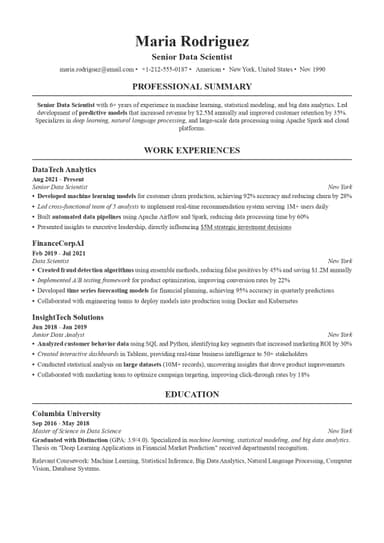
Saying you're a great decision maker on your resume isn't enough; hiring managers have seen that claim hundreds of times. What moves the needle is proof, which features specific situations, choices, and outcomes that make a difference.
Add Accomplishment-Based Bullet Points
The formula is simple: action verb + task + measurable result. It forces you to be specific rather than vague, and specificity is what hiring managers are scanning for.
Here's what that looks like in practice:
- "Assessed vendor proposals and selected a logistics partner that reduced shipping costs by 22%."
- "Led a cross-functional team in deciding on a product roadmap, resulting in a 15% faster time-to-market."
- "Resolved recurring client escalations by implementing a new triage process, cutting resolution time by 40%."
Match Decision-Making Skills to the Job Description
Scan the job posting for decision-related keywords (e.g., terms like analytical, strategic, judgment, risk management) and imitate that language throughout your resume naturally. A hiring manager who wrote "strong analytical judgment" into the job description is going to respond when they see it reflected back in your experience.
Highlight These Skills in Your Resume Summary
Your resume summary features a two-to-three sentence opening that weaves in decision-making signals competence before a hiring manager reads a single bullet point.
For example, it could say: "Results-driven operations manager with 8 years of experience making data-informed decisions that improved efficiency and reduced costs. Proven ability to lead teams through ambiguity and deliver measurable outcomes."
Include Relevant Related Skills in Your Skills Section
Decision-adjacent skills (critical thinking, analytical reasoning, risk management, conflict resolution, strategic planning, etc.) are searchable terms in ATS systems and signal the same core competency cluster as decision-making. You can mention any of them in a dedicated skills section on your resume.
However, avoid phrases like "good decision maker" since it sounds like a vague self-assessment; let your bullet points do the work with concrete, scannable terms.
Here, our AI-powered resume generator suggests accomplishment-driven bullet points tailored to your target role and helps you phrase soft skills in language that passes ATS screening. This way, you get a submission-ready resume that captures your decision-making abilities perfectly!
Decision-Making Skills on Your Resume: Examples by Job Type
The right abilities to highlight depend on the role you're targeting. Here are some decision-making skills examples for three common profiles:
For Managers and Leaders
Focus on strategic, collaborative, and ethical decision-making. Hiring managers for leadership roles want to see evidence that you can direct people through ambiguity and make good individual calls.
"Directed a team of 12 in evaluating three market expansion strategies, selecting the approach that grew revenue by $2M in Year 1."
For Entry-Level and Recent Graduates
As an entry-level candidate or a recent graduate, you should focus on problem solving, analytical thinking, and initiative. You don't need years of experience to demonstrate your decision-making process; all you need is one clear example of a moment you identified a problem and took ownership of solving it.
"Identified an inefficiency in the inventory tracking process and proposed a new system that reduced errors by 30%."
You can also check some resume examples from our library to find more inspiration on framing early-career impact.
For Career Changers
Career changers must focus on transferable decision-making experience from their previous field. The skills you used in one industry translate; they just need to be reframed in language the new industry recognizes.
"Applied triage decision-making from 5 years in healthcare to prioritize project tasks and reduce delivery delays by 25%."
Final Thoughts
In conclusion, decision-making skills represent one of the pillars of workplace success and one of the clearest signals that you'll add real value from day one. Better still, these are skills you can build; not everyone is a natural strategist, but everyone can get better at gathering information, questioning assumptions, and learning from outcomes.
Decision-Making Skills FAQ

Jordan Lee is your guide to navigating the rapidly changing job market in the age of AI and automation. He dives into how AI is reshaping hiring, the skills of the future, and what job seekers need to do now to stay relevant. If you’re curious about how technology is transforming careers and want to future-proof your job, Jordan’s insights are a must-follow.