13+ Analytical Skills to Add to Your Resume [w/ Examples]
![13+ Analytical Skills to Add to Your Resume [w/ Examples]](/_next/image?url=https%3A%2F%2Fcdn.sanity.io%2Fimages%2Fbcftoxbw%2Fproduction%2F3d267f5b9fb5d4407cafebd10755484be36a5acb-1120x630.png&w=3840&q=75)

Analytical skills empower you to interpret information, identify trends, and make data-backed decisions—a combination employers crave in nearly every industry. In today’s job market, having analytical skills isn’t just an advantage—it’s a career accelerant. However, many struggle to translate these abilities into measurable achievements.
To help you, we’ll break down what analytical skills actually are, why they’ve become indispensable, and how to list them on your resume. Whether you’re aiming for your first job, a promotion, or a complete career shift, showcasing analytical skills can open the door to new opportunities and higher earning potential.
- Analytical skills enable you to collect, process, and interpret information systematically for problem-solving and informed decision-making across all industries and career levels.
- Core analytical thinking components include observation, research, interpretation, communication, and critical evaluation.
- You can demonstrate analytical skills on resumes through quantified accomplishments with specific metrics, action verbs, tailored job-relevant examples, and dedicated project sections showcasing concrete outcomes.
- Top analytical skills include data analysis, critical thinking, problem-solving, research, financial analysis, technical proficiency, strategic thinking, forecasting, quality analysis, competitive analysis, and risk assessment.
- To develop these abilities, you can practice with real-world problems, take relevant courses and certifications, learning analytical tools like Excel and Python, seek feedback, and participate in collaborative projects.
What Are Analytical Skills?
Analytical skills are cognitive abilities that enable you to collect, process, and interpret information systematically to solve problems and make informed decisions. These abilities show up in countless workplace scenarios. According to Pew Research Center, about one-in-four workers are employed in occupations in which analytical skills are most important.
For instance, when a marketing manager analyzes campaign performance data to determine which strategies are driving the best ROI, they're using analytical skills. When a nurse evaluates a patient's symptoms to identify potential complications, that's analytical thinking in action. When a project manager reviews team productivity metrics to optimize workflow processes, they're applying analytical reasoning.
What makes analytical skills particularly valuable is their versatility. Unlike technical skills that evolve with technology, analytical thinking remains relevant across industries and career stages. The fundamental ability to examine information and reach logical conclusions is just as important today as it was decades ago—perhaps even more so given the increasing complexity of modern business challenges.
Core Components of Analytical Thinking
Analytical thinking rests on five fundamental pillars that work together, including:
- Observation. It forms the foundation of analytical thinking. Strong observers don't just see what's obvious—they notice subtle changes, inconsistencies, and opportunities that aren't immediately apparent.
- Research skills. These allow you to gather relevant information efficiently and evaluate the credibility of your sources. Strong researchers understand various methodologies and can adapt their approach based on the type of problem they're investigating.
- Interpretation. This includes identifying trends and patterns, understanding what the data actually means in context, and recognizing the implications of your findings. It's the difference between simply collecting information and actually understanding what that information tells you about underlying problems or opportunities.
- Communication. Even the most brilliant analysis becomes worthless if you can't explain your findings clearly to stakeholders who need to act on your recommendations. This skill becomes even more important when working in teams where collaboration helps you share insights effectively.
- Critical evaluation. As a bond that connects everything together, it helps you assess the quality of your own thinking. This means questioning your assumptions, considering alternative explanations, and remaining open to changing your conclusions when new evidence emerges.
Analytical Skills vs. Critical Thinking Skills
While analytical skills and critical thinking skills are closely related and often overlap, they serve slightly different purposes in professional contexts. The table below breaks down and compares both skill sets:
| Aspect | Analytical Skills | Critical Thinking Skills |
|---|---|---|
Main Focus | Breaking down information to find patterns, relationships, or trends | Evaluating information quality and questioning assumptions |
Approach | Systematic and data-driven | Reflective and evaluative |
Goal | To interpret data and reach objective conclusions | To form sound, well-reasoned judgments |
Type of Information | Concrete, measurable, and comparable data | Ideas, arguments, and perspectives |
Key Questions | “What does the data show?” | “Is this reasoning valid and logical?” |
Typical Use | Problem-solving, data analysis, research | Decision-making, argument evaluation, strategic thinking |
In practice, the most effective professionals combine both skill sets. Therefore, to be successful, you should use analytical techniques to process information systematically, then apply critical thinking to evaluate whether your analysis is sound and complete.
How to List Analytical Skills on Your Resume?
Listing analytical skills on your resume effectively showcases these abilities and can strengthen your candidacy and demonstrate workplace value, and here’s how to do it:
- Include them in your skills section. Create a dedicated skills section on your resume where you list specific analytical abilities relevant to your target role. Choose skills that align with the job requirements and that you can genuinely demonstrate through your work experience.
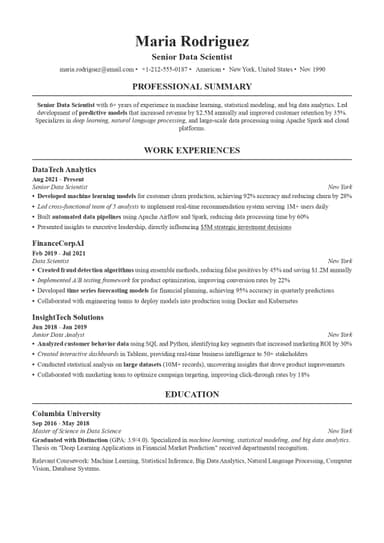
- Demonstrate through accomplishments. Rather than simply listing analytical skills, describe through concrete examples where you used these abilities to achieve specific outcomes. For instance, "Analyzed customer feedback data from 5,000+ responses to identify pain points, resulting in product improvements that increased satisfaction scores by 15%."
- Use action verbs. Begin your bullet points with strong, specific action verbs that emphasize analytical work. These verbs make your accomplishments more dynamic and help hiring managers quickly recognize your relevant skills.
- Tailor to the job description. Carefully review each job posting to identify which analytical skills the employer prioritizes. If they mention "data-driven decision making," ensure your resume reflects this exact phrase where truthful.
- Quantify your impact. Include specific numbers, percentages, timeframes, or metrics that demonstrate the tangible outcomes of your analytical work. Instead of "improved efficiency through process analysis," write "analyzed workflow processes and implemented changes that reduced project completion time by 25% and saved $50,000 annually."
- Leverage relevant projects. Dedicated project sections allow you to describe complex analytical work that might not fit well within job descriptions. This approach is particularly effective for entry-level resumes in which academic or personal projects demonstrate analytical potential.
Top 15 Analytical Skills to Place on Your Resume
Understanding which specific skills to highlight and how to categorize them helps you write a more compelling resume. Below are the top analytical skills to consider, along with practical examples that can strengthen your application.
#1. Data Analysis
When employers think of analytical skills, data analysis often comes to mind first. This involves collecting, processing, and interpreting information to extract meaningful insights. Whether you're working with spreadsheets, databases, or specialized analytics tools, data analysis demonstrates your ability to transform raw numbers into actionable conclusions that drive business decisions.
Here’s how you can demonstrate this on your resume:
Analyzed sales data across 12 regions using Excel and Tableau, identifying underperforming markets and recommending targeted strategies that increased regional revenue by 18%.
Related skills:
- Statistical analysis
- Data mining
- Data visualization
- Quantitative research
- Database management
- Spreadsheet proficiency
- SQL and data querying
- Predictive modeling
#2. Critical Thinking
Beyond just crunching numbers, critical thinking represents your ability to evaluate the quality of information, question assumptions, and form well-reasoned judgments. It's about taking a step back to assess situations from multiple perspectives before reaching conclusions.
Let’s see how you can highlight this on your resume:
Evaluated competing vendor proposals by analyzing cost structures, service quality metrics, and long-term value, leading to selection of a partner that reduced expenses by 22% while improving delivery times.
Related skills:
- Logical reasoning
- Objective evaluation
- Assumption challenging
- Evidence-based thinking
- Contextual analysis
- Bias identification
- Argument assessment
- Independent judgment
#3. Problem-Solving
Closely related to critical thinking is problem-solving, which focuses on navigating challenges and creating practical outcomes. This implies identifying issues, analyzing their root causes, developing potential solutions, and implementing effective resolutions.
It's the skill that shows you don't just identify problems—you actually fix them, and here how to highlight it on your resume:
Identified bottleneck in customer service response times through process mapping, designed and implemented a new workflow system that reduced average resolution time from 48 to 24 hours.
Related skills:
- Root cause analysis
- Solution development
- Creative thinking
- Troubleshooting
- Process improvement
- Decision-making
- Innovation
- Strategic planning
#4. Research
Strong analytical work requires solid research skills. This involves systematically gathering, evaluating, and synthesizing information from various sources to answer questions or support decisions. Whether you're exploring market trends or diving into academic literature, research skills show you can independently find reliable information and draw informed conclusions.
Let’s see a good example of research skills on a resume:
Conducted comprehensive market research across 5 competitor products, analyzing features, pricing, and customer reviews to inform product development strategy that captured 12% market share.
Related skills:
- Information gathering
- Source evaluation
- Literature review
- Survey design
- Market analysis
- Competitive intelligence
- Academic research
- Secondary data analysis
#5. Financial Analysis
For many roles, understanding the numbers behind business decisions is crucial. Financial analysis involves examining financial data, statements, and metrics to assess performance, identify trends, and support strategic choices. Even if you're not in a finance role, demonstrating this skill shows you understand how numbers reflect organizational health and opportunities.
For example:
Performed financial analysis of quarterly reports, identified cost-saving opportunities in operational expenses, and presented recommendations that reduced overhead by $125,000 annually.
Related skills:
- Budget analysis
- Financial modeling
- Ratio analysis
- Forecasting
- Cost-benefit analysis
- Profitability assessment
- Investment analysis
- Variance analysis
#6. Technical Analysis
Today, technical analysis is valuable. It refers to the use of specialized tools, software, and methodologies to examine systems, processes, or data. Your proficiency with analytics platforms, programming languages, or business intelligence tools demonstrates you can leverage technology for deeper insights.
Here’s how you can highlight it on your resume:
Utilized Python and R to perform technical analysis on user behavior patterns, creating algorithms that improved product recommendation accuracy by 35%.
Related skills:
- Programming languages (Python, R, SQL)
- Analytics software (Tableau, Power BI)
- Statistical software (SPSS, SAS)
- Database systems
- API integration
- Machine learning basics
- Data warehousing
- Business intelligence tools
#7. Strategic Thinking
While some analytical skills focus on immediate problems, strategic thinking involves understanding big-picture goals and developing long-term plans. This means anticipating future scenarios, considering broader implications, and ensuring your analysis aligns with organizational objectives. It's the difference between fixing today's issue and preventing tomorrow's challenges.
Here’s a good example for your resume:
Developed a 3-year strategic growth plan by analyzing market trends, competitive landscape, and internal capabilities, resulting in a roadmap adopted by executive leadership for expansion into new markets.
Related skills:
- Long-term planning
- Scenario analysis
- Competitive strategy
- Vision development
- Priority setting
- Risk assessment
- Opportunity identification
- Change management
#8. Business Analysis
Business analysis brings together multiple analytical abilities, including reviewing processes, systems, and requirements to identify improvements and support business objectives. It's particularly valuable because it shows you understand how different business functions interconnect and affect overall performance.
Let’s see a good example for a resume:
Analyzed business processes across 3 departments, documented workflow inefficiencies, and collaborated with stakeholders to implement solutions that improved cross-functional productivity by 28%.
Related skills:
- Process mapping
- Requirements gathering
- Stakeholder analysis
- Gap analysis
- Business case development
- Workflow optimization
- Systems analysis
- Performance metrics
#9. Forecasting
Forecasting involves using historical data, trends, and analytical methods to predict future outcomes or conditions. This skill proves especially valuable because it helps organizations prepare for various scenarios and make proactive rather than reactive decisions.
Here’s how you can frame it in your resume:
Created demand forecasting models using historical sales data and seasonal trends, improving inventory accuracy by 40% and reducing stockout incidents by 65%.
Related skills:
- Trend analysis
- Predictive analytics
- Time series analysis
- Demand planning
- Risk prediction
- Scenario modeling
- Pattern recognition
- Projection development
#10. Quality Analysis
Maintaining high standards requires careful quality analysis—assessing products, services, or processes against established benchmarks to ensure consistency. This skill demonstrates your attention to detail and commitment to excellence, showing employers you won't settle for "good enough" when improvement is possible.
For instance:
Conducted quality analysis on manufacturing processes, implementing statistical process control methods that reduced defect rates by 45% and improved customer satisfaction scores.
Related skills:
- Quality control
- Testing methodologies
- Standards compliance
- Performance evaluation
- Defect tracking
- Six Sigma
- Continuous improvement
- Metrics monitoring
#11. Diagnostic Skills
This refers to the ability to identify problems, understand their underlying causes, and determine appropriate solutions. Rather than just treating symptoms, diagnostic thinking helps you systematically work through complex issues to find root causes.
Diagnosed recurring system failures by analyzing error logs and user reports, identifying configuration issues that once resolved, improved system uptime from 92% to 99.7%.
Related skills:
- Root cause identification
- Systems thinking
- Pattern recognition
- Issue investigation
- Error analysis
- Performance diagnosis
- Troubleshooting methodology
- Failure analysis
#12. Competitive Analysis
Understanding your position in the marketplace requires strong competitive analysis skills. This involves evaluating competitors' strategies, products, strengths, and weaknesses to inform your own business decisions. It's about knowing not just what you're doing well, but how you stack up against others in your space.
Performed competitive analysis of 8 industry competitors, evaluating pricing strategies, feature sets, and market positioning to inform product differentiation strategy that increased market share by 15%.
Related skills:
- Market research
- Benchmarking
- SWOT analysis
- Competitor monitoring
- Industry trend analysis
- Positioning strategy
- Pricing analysis
- Feature comparison
#13. Reporting and Presentation
Even the most brilliant analysis means nothing if you can't communicate it effectively. Reporting and presentation skills involve organizing analytical findings and conveying them clearly to various audiences. This bridges the gap between raw analysis and actionable insights, ensuring your work actually drives understanding and decision-making.
Let’s take a look at a good example for a resume:
Created executive dashboards and monthly performance reports that synthesized complex metrics into clear visualizations, enabling leadership to make data-driven decisions 40% faster.
Related skills:
- Data visualization
- Dashboard creation
- Executive reporting
- Presentation design
- Storytelling with data
- Technical writing
- Insight communication
- Stakeholder presentations
#14. Pattern Recognition
Pattern recognition involves identifying trends, correlations, and relationships within data or situations. This skill is particularly powerful because it can reveal opportunities or problems before they become obvious to everyone else.
Identified purchasing patterns in customer transaction data that revealed cross-selling opportunities, leading to targeted marketing campaigns that increased average order value by 23%.
Related skills:
- Trend identification
- Correlation analysis
- Anomaly detection
- Behavioral analysis
- Data mining
- Signal detection
- Relationship mapping
- Clustering analysis
#15. Risk Assessment
Risk assessment involves identifying potential threats, evaluating their likelihood and impact, and developing mitigation strategies. In an unpredictable business environment, showing you can anticipate and prepare for various scenarios makes you an invaluable team member.
Let’s see how you can show this on your resume:
Conducted comprehensive risk assessment for new product launch, identifying potential regulatory, operational, and market risks, then developed mitigation strategies that enabled successful launch with zero critical issues.
Related skills:
- Threat identification
- Impact analysis
- Probability assessment
- Risk mitigation
- Contingency planning
- Scenario planning
- Compliance analysis
- Crisis management
How to Develop Your Analytical Skills
Developing strong analytical skills requires consistent practice and deliberate effort. Unlike some professional capabilities that take years to master, you can see improvements in your analytical thinking within weeks of focused practice.
Follow these strategies to improve your skills:
Practice with real-world problems. Seek out opportunities to analyze situations in your daily work or personal life. The more you engage with analytical tasks, the more natural the process becomes. Look for patterns in everyday situations, question assumptions you encounter, and challenge yourself to think through multiple scenarios before making decisions.
- Take courses and pursue certifications. Formal education provides structured learning paths for developing analytical skills. Online platforms like Coursera, LinkedIn Learning, and edX offer courses in data analysis, statistics, critical thinking, and business intelligence. Professional certifications in areas like Six Sigma, business analysis, or specific analytical tools demonstrate commitment to skill development. Many of these programs include hands-on projects that let you apply concepts to realistic scenarios, building both knowledge and practical experience.
- Learn analytical tools and software. Start with spreadsheet programs like Excel or Google Sheets, learning functions, pivot tables, and data visualization features. Progress to more specialized tools such as Tableau, Power BI, SQL databases, or programming languages like Python and R. Many of these tools offer free versions or trials, and abundant online tutorials make self-directed learning accessible.
- Seek feedback on your analytical work. Share your analyses, reports, and problem-solving approaches with colleagues, mentors, or managers and ask for constructive criticism. Others may spot gaps in your reasoning, suggest alternative approaches, or identify areas where your conclusions need stronger support. Be open to different perspectives and use critiques as learning opportunities rather than taking them personally.
- Work on cross-functional projects. Collaborating with others exposes you to different thinking styles, analytical methods, and problem-solving approaches. You'll see how colleagues with various backgrounds tackle the same challenges differently, broadening your own analytical toolkit. Team environments also provide natural opportunities to practice explaining your analysis to others, which deepens your own understanding and improves communication skills.
- Challenge yourself with puzzles and games. Logic puzzles, strategy games, chess, and even certain video games require pattern recognition, strategic planning, and systematic thinking. While these might seem recreational, they exercise the same mental muscles used in professional analytical work. Crosswords improve vocabulary and lateral thinking, while Sudoku strengthens logical reasoning.
Showcase Your Analytical Skills With ResumeBuilder.so
Use our AI-powered builder to create a professional resume that effectively highlights your analytical capabilities and catches employers' attention. Don't forget to pair it with a compelling cover letter that demonstrates your analytical thinking in action, or craft a persuasive motivation letter for academic or specialized positions.
Final Thoughts
Analytical skills represent one of the most valuable and transferable capabilities you can develop in today's professional environment. Unlike technical skills that may become obsolete as technology evolves, analytical thinking remains relevant across industries, career levels, and economic conditions.
The beauty of analytical skills lies in their compound effect—as you become better at analyzing information and solving problems, you become more valuable to employers, more confident in your decision-making, and more effective at achieving your professional goals. These capabilities create positive feedback loops that accelerate career advancement.
Remember that developing analytical skills is a marathon, not a sprint. Focus on consistent practice rather than trying to master everything immediately.
Analytical Skills FAQ

Sophia Martinez knows what it’s like to start over—because she did it herself. After switching careers twice, she’s now helping others navigate the transition with confidence. Whether you’re shifting industries, returning to the workforce after a break, or feeling stuck in your current role, Sophia’s insights will help you take the next step.