“How Do You Handle Conflict?”: Interview Question Answered

The “How do you handle conflict?” interview question is one of the most common behavioral questions employers ask, and for good reason. Recruiters use it to understand how you respond under pressure, communicate with others, and deal with disagreements in a professional setting.
They are not trying to find out whether you have ever experienced conflict, because almost everyone has. What they want to see is whether you can stay calm, solve problems maturely, and protect working relationships instead of making tension worse. Your answer helps them judge your emotional intelligence, teamwork skills, and ability to navigate difficult situations at work.
In this article, you will learn why employers ask about your workplace conflict resolution skills, what hiring managers are really listening for, and how to answer conflict interview questions well. You will also see sample responses and practical tips to help you talk about disagreements in a way that strengthens your performance.
- Employers ask “How do you handle conflict?” to assess how you communicate under pressure, manage disagreements professionally, and maintain working relationships.
- A strong answer combines a brief explanation of your conflict-resolution approach with a specific example structured using the STAR method.
- The most effective conflict stories focus on your individual actions, show a clear resolution, and ideally include a measurable or concrete positive result.
- Interviewers are alert to red flags such as blaming others, claiming you have never faced conflict, or giving vague, generic responses.
- Conflict management skills strengthen your overall job application by signaling emotional intelligence, adaptability, and the ability to work well with others.
Why Employers Ask "How Do You Handle Conflict?"
Employers ask "How do you handle conflict?" because they want to assess how you manage disagreements, communicate under pressure, and maintain professional relationships.
Nearly every role involves working with other people, which means friction is inevitable at some point. Deadlines clash, priorities shift, and two smart people can look at the same data and reach completely different conclusions, so it’s completely normal. What separates strong candidates isn't the absence of conflict but how they navigate it.
Furthermore, behavioral interviewing is generally based on the principle that past behavior predicts future performance. So when an interviewer asks how you've handled conflict, they're collecting evidence about how you'll behave on their team.
Here's what they're specifically watching for:
- Communication style: Do you address disagreements directly and calmly, or do you avoid them until they explode?
- Emotional intelligence: Can you stay composed when things get tense and consider the other person's perspective?
- Adaptability: Are you flexible enough to find middle ground, or do you dig in regardless of new information?
- Leadership potential: Even if you're not a manager, how you handle conflict signals how you'll perform under pressure and in collaborative settings
What raises red flags immediately is blaming the other person entirely, claiming you've never experienced workplace conflict (no interviewer believes this), or giving a vague non-answer like "I just try to stay calm and work it out." This tells job interviewers nothing useful.
What Does a Good Answer to "How Do You Handle Conflict?" Look Like?
A good answer to "How do you handle conflict?" combines a brief overview of your conflict resolution approach with a specific real-world example using the STAR method. It doesn't need to be dramatic; being real and specific, as well as presenting a positive resolution, will suffice.
The structure is straightforward:
- Part one is a one-to-two sentence statement of your general philosophy. Something like: "I think conflict is a normal part of working with others, so I try to address it directly and calmly rather than let it fester." This sets the tone before you get into the story.
- Part two is your STAR-method example, and this is where most of the weight should sit. The example you choose matters, and it should always be work-related (or school/volunteer if you're entry-level), clearly resolved, and one where your individual actions made a difference. Don't pick a story where everything worked out because someone else intervened; pick one where you did something.
Behavioral interview answers are essentially the verbal (and extended) version of presenting your skills on a resume, as they give texture and proof to the abilities you've listed. Therefore, a well-thought-out answer to an interview question about a disagreement with a coworker can do more for your candidacy than three bullet points ever could.
How to Use the STAR Method to Answer Conflict Interview Questions
You can use the STAR method to answer conflict interview questions by structuring your response around four elements: Situation, Task, Action, and Result. It's the go-to framework for behavioral questions because it forces you to be specific and organized, and interviewers love these two.

#1. Situation
Set the scene briefly by stating where you were working, what the project was, and what the context of the conflict was. Keep this part one to two sentences at most, as the situation is just background, and the interviewer doesn't need your full life story.
#2. Task
Clarify your role. Were you directly involved in the conflict, or were you in a mediating position? What needed to be resolved, and why did it matter? Maybe the project was at risk, team morale was suffering, or a client relationship was on the line; whatever the stakes, name them.
#3. Action
This is the most important part of your answer, where most people undersell themselves. What specific steps did you take to address the conflict? What did you personally do?
The strongest action steps tend to involve active listening, asking clarifying questions, finding common ground, proposing a concrete solution, or having a direct but calm one-on-one conversation. Avoid saying "we" without specifying your individual contribution; interviewers will notice the dodge.
#4. Result
Share the outcome. Was the conflict resolved? What improved? If you can quantify it (e.g., "the project launched on time," "the client renewed their contract," "team output increased the following quarter", etc.), do it. Numbers give interviewers something concrete to hold onto.
If you also want to earn a little extra credit, briefly mention what you learned; self-awareness and a growth mindset are traits that play well in interviews at every level.
5 Sample Answers to "How Do You Handle Conflict?"
Below are five sample answers tailored to different experience levels and workplace scenarios. Use these as a starting point and adapt them to your own experience because specificity is what makes these answers land.
"I'd say I'm pretty direct when it comes to workplace disagreements. I'd always rather talk it out than let things get awkward. A while back, I was co-leading a product update with a colleague, and we genuinely couldn't agree on the rollout sequence. She wanted to prioritize the enterprise clients; I thought we should start with our mid-market segment, where we had more room to troubleshoot.
Instead of escalating it, I suggested we each write up our reasoning and then get on a call to compare notes. Going through it together, we realized her data on enterprise churn risk was compelling, so we shifted the plan, with some adjustments I proposed to account for support capacity. The rollout went smoothly, and honestly, it set us up as a stronger team for the next project."
"I had a situation where my manager and I disagreed on the priority of a feature my team had been developing. She wanted to pause it for two sprints to redirect resources to a sales request; I felt strongly that stopping mid-build would cost us more time in the long run. I asked if I could put together a brief impact analysis before any decision was finalized, and she agreed.
I laid out the technical debt we'd accumulate and compared it to the estimated timeline for the sales request. She reviewed it with the VP, and we landed on a hybrid approach: a smaller team continued the feature work while the majority pivoted temporarily. It wasn't exactly what I'd proposed, but the process felt fair, and the feature launched with minimal delays."
The key here is that you voiced your perspective with data and then accepted the outcome professionally.
"Two members of my team had developed real tension around how the workload was being divided. Namely, one felt she was picking up slack, and the other felt his contributions weren't being recognized.
It was starting to affect the whole team's dynamic, so I asked to meet with each of them separately first, just to understand their perspectives without anyone feeling put on the spot. Then I brought them together and facilitated a conversation where we mapped out what each person was actually responsible for week-to-week.
It turned out there were some genuine gaps in how we'd set up task ownership, without bad intentions on either side. We restructured a few workflows, and the friction basically disappeared within a few weeks."
This answer works well for leadership-track or management candidates, since it demonstrates a mediator role without overstepping.
"I worked in account management for a SaaS company, and one of our longer-term clients disputed what we'd delivered against their contract, as they felt we hadn't hit a milestone we considered complete.
It was tense because they were a significant account, and the relationship mattered. My first move was to listen fully without being defensive. I asked them to walk me through exactly what they expected and where they felt we fell short. Then I went back through the project documentation with my team.
There was a genuine ambiguity in how the milestone was defined. I came back to the client with a proposed remediation plan that addressed their concern without overhauling everything we'd built. They accepted it, and we actually ended up extending the contract a few months later."
"I don't have a lot of formal work experience yet, but I ran into a real conflict resolution situation during my senior capstone project. Our group had five people and two completely different visions for the direction of the project, so it had gotten to the point where people weren't really collaborating anymore.
I suggested we hold a structured session where each person explained their vision and the reasoning behind it, without interruption. Once everyone had done that, we found there was actually more overlap than we'd realized. We built a combined approach that pulled the strongest elements from both sides, and our project ended up winning a departmental award.
I learned that a lot of conflict comes from people not fully explaining their thinking, and that asking questions is usually more effective than arguing."
5 Common Conflict Resolution Interview Question Variations
Common variations of the "How do you handle conflict at work?" interview question include behavioral prompts about disagreements with coworkers, managers, or clients. Interviewers switch up the phrasing all the time, so if you've prepared one story, you may need to adapt it on the fly.
Here are the most frequent variations and how to approach them:
- "Tell me about a time you had a conflict at work." This is the most open-ended version. Use your strongest STAR method conflict example answer, ideally one with a clear resolution and a quantifiable or demonstrable result.
- "Describe a situation where you disagreed with your manager." Here, tone matters. Emphasize respectful communication and your willingness to present your perspective through proper channels, and then accept the decision professionally.
- "How do you handle disagreements within a team?" This invites a mediator-type answer. If you've ever helped two colleagues work through tension, this is your moment.
- "Have you ever had a conflict with a client? How did you handle it?" Lead with empathy and de-escalation. Show that you prioritize the relationship even when the conversation is difficult.
- "Tell me about a time your idea was rejected. How did you respond?" This is a subtle conflict question. The best answers show you can handle disappointment without becoming disengaged or dismissive.
Do's and Don'ts When Answering Conflict Interview Questions
When answering conflict interview questions, do use a specific real example and focus on resolution, and don't blame others or claim you've never experienced conflict. That's the short version. Here's the full breakdown:
- Use the STAR method
- Pick a real, work-relevant example
- Focus on what you did to resolve a conflict at work
- End with a positive result or a lesson learned
- Keep a professional tone throughout
Don’t
- Say you've never had a conflict
- Blame or speak negatively about past colleagues or managers
- Give a vague or generic answer
- Spend too long on the problem and too little on the resolution
- Get emotional or defensive
The "never had a conflict" answer is worth calling out specifically because it's so common. Claiming you've never experienced it signals to an interviewer either that you're not self-aware or that you're not being honest.
The blame game is just as damaging. Even if a past coworker or manager genuinely was difficult, an interview is not the place to air it. Interviewers are listening to how you behaved, and they don’t need to make a judgment on someone else.
How Conflict Management Skills Strengthen Your Job Application
Conflict management skills strengthen your job application by demonstrating emotional intelligence, leadership, and the ability to maintain productive working relationships. These aren't soft, vague qualities that translate directly into outcomes employers care about.
Interpersonal skills are among the most requested competencies by employers, and conflict resolution sits squarely in that category. Hiring managers want people who can navigate friction without creating more of it, and that's the definition of someone who's genuinely easy to work with.
These abilities should show up beyond the interview, too.
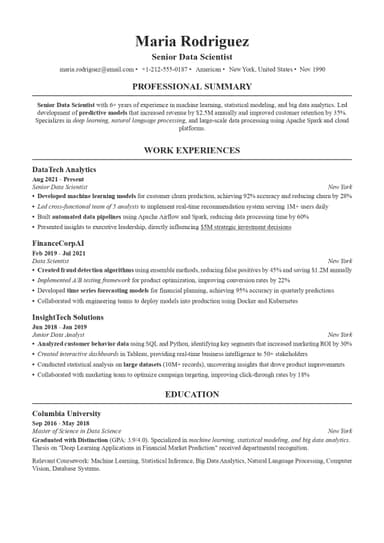
The work experience section of your resume is where you can reflect them in action through bullet points that highlight cross-functional collaboration, client relationship management, or team leadership. Think about how you can frame past roles to surface the communication and adaptability that you're demonstrating verbally in the interview room.
Furthermore, don't underestimate the value of pairing your conflict resolution soft skills with strong hard skills on your resume, since it's that combination that makes a candidate genuinely stand out in a crowded field.
A few places to reflect conflict resolution competencies in your job application include:
- Resume bullet points, where you can use action verbs like mediated, facilitated, negotiated, or resolved to show these skills in context
- Resume summary, where you can mention communication, collaboration, or interpersonal strengths as part of your professional profile
- Cover letter, where you can reference a specific situation where you navigated a challenge collaboratively
On ResumeBuilder.so’s platform, you can browse resume templates and examples for every industry. This can make it simpler for you to create a job application on your own and see how other candidates frame these skills effectively. Enter your information, and we’ll generate a full resume for you in minutes!
Final Thoughts
"How do you handle conflict?" is an invitation for you as a job candidate to show how you think, how you communicate, and how you behave when things get hard.
The STAR method gives you the structure; your real experience gives you the substance, and the preparation gives you the confidence to deliver an answer that lands. Paired with a good resume, solid answers to behavioral interview questions about conflict and other workplace situations can catch the interviewers’ attention and make you stand out!
How Do You Handle Conflict? FAQ

Daniel Carter is the salary negotiation coach you wish you had before accepting that lowball job offer. With years of HR experience, he knows all the employer tactics—and how to counter them. His posts break down negotiation strategies, industry salary trends, and scripts you can actually use in real conversations.