Combination Resume Guide: Format, Examples, and Uses
This complete guide with detailed explanations and expert tips will teach you how to write an acting resume in record time!
Edit this resume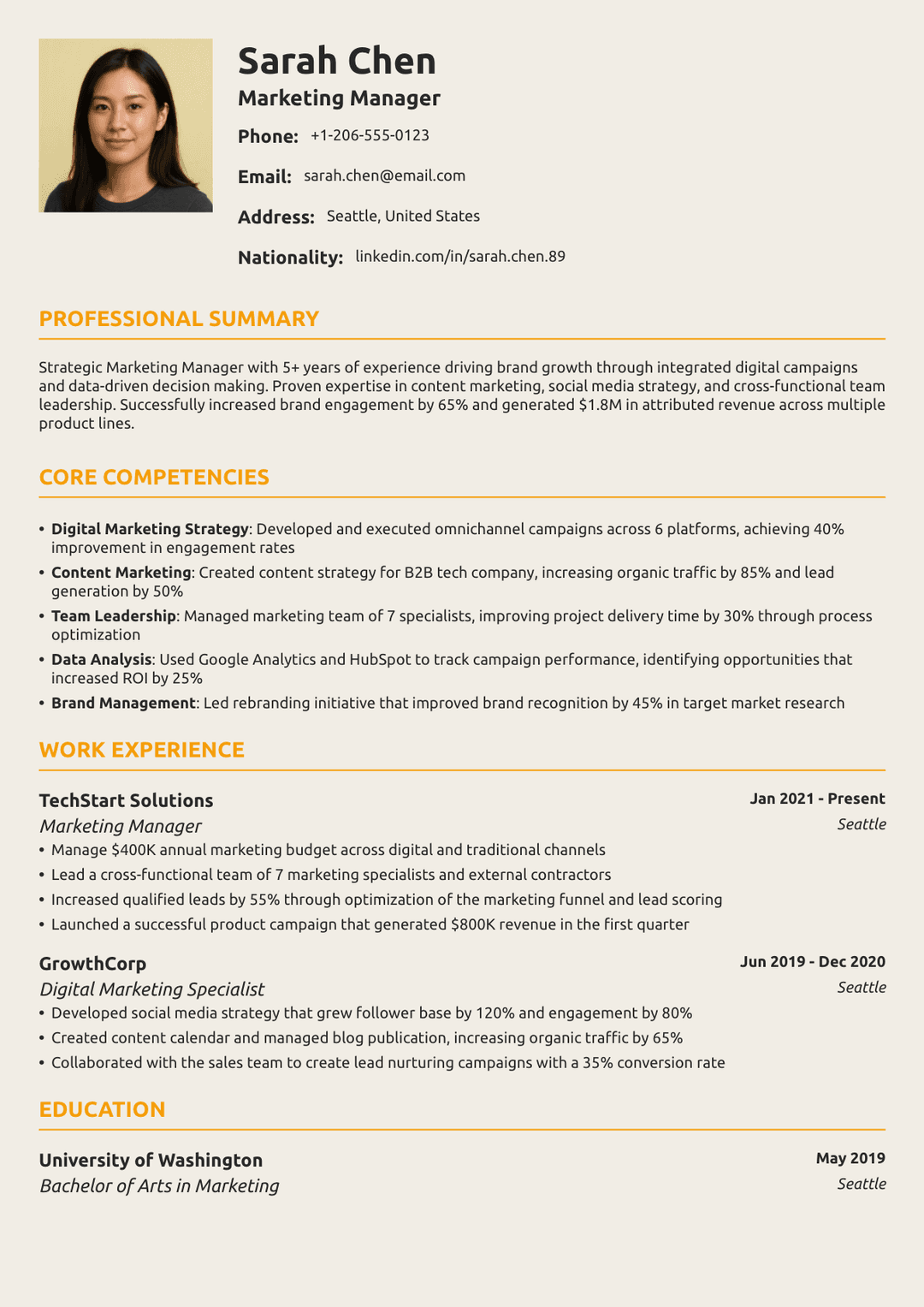
A combination resume (also known as a hybrid resume) is a format that blends the best elements of skills-focused and chronological formats. It creates a compelling narrative that showcases both what you can do and where you've done it.
Your resume format can make or break your job search; it's the difference between landing that interview and watching your application disappear into the digital void. While most job seekers stick to the traditional chronological approach, there are certainly some candidates who might benefit more from the combination resume format.
If you want to know whether you belong to this category of applicants and, if so, how they can write such a resume without hassle, this guide is for you. You’ll learn everything there is to know about this format and discover how to apply that knowledge to your advantage.
- Combination resumes blend skills and chronological work history for maximum impact.
- The combination resume is perhaps the best resume format for career change, mid-level professionals, and those with employment gaps who need to highlight transferable skills.
- This format can be ATS-friendly when formatted correctly with proper keyword optimization.
- Hybrid resumes are more complex to write than traditional formats but offer greater flexibility for diverse backgrounds.
What Is a Combination Resume?
A combination resume, also known as a hybrid resume format, strategically merges elements from both chronological and functional resume styles.
Unlike a purely chronological resume that leads with your work history, or a functional resume that emphasizes skills while minimizing employment details, this format gives equal weight to both your capabilities and your career progression.
It typically opens with a compelling professional summary, followed by a prominent skills section that emphasizes your core competencies. What makes it particularly effective is how it then backs up these skills with a detailed work experience section. This way, it creates a cohesive story that shows not just what you can do, but how you apply these abilities.
Combination Resume Compared to Other Resume Formats
Knowing how the combination format stacks up against other resume formats helps you make the right choice for your situation. With this in mind, let’s examine a comparison table that highlights the key differences between this format and other options.
| Feature | Chronological | Functional | Combination |
|---|---|---|---|
Primary Focus | Work history timeline | Skills and abilities | Skills + work history |
Skills Section | Brief, near the bottom | Extensive, at the top | Prominent, after the summary |
Work Experience | Detailed, chronological | Minimal or absent | Detailed, chronological |
Best For | Steady career progression | Career gaps, new grads | Career changers, diverse skills |
ATS Compatibility | Excellent | Limited | Good with proper formatting |
Recruiter Preference | High | Low to moderate | Moderate to high |
Who Should Use the Combination Resume Format?
Here’s a list of candidates who should use the combination resume format:
- Career changers with transferable skills. If you're transitioning from one industry to another, this format lets you showcase relevant skills and demonstrate your professional experience at the same time.
- Mid-level professionals with 3-8 years of experience. You've developed substantial skills but may not have the decades of experience that make a purely chronological approach compelling. This format lets you highlight both your growing expertise and your career trajectory.
- Professionals with employment gaps. Rather than drawing attention to timeline inconsistencies, the skills-first approach emphasizes what you can contribute. Regardless of whether you took time off for family, health, or education, this format keeps the focus on your qualifications.
However, this format isn't ideal for everyone. Some categories of individuals who would benefit from other resume formats instead include:
- Entry-level candidates with limited work experience since they typically find a functional format more suitable due to the way their skills get emphasized in it.
- Senior executives with extensive career progression, as they often benefit more from a chronological approach that showcases their leadership journey.
- Fresh graduates, unless they have significant internship or project experience to showcase.
- Individuals working in traditional fields, such as law or medicine, where chronological formats are strongly preferred.
When to Use a Combination Resume
Here are the occasions when you should use a combination resume:
- When chasing project-based roles. Be it a marketing manager position, software development role, or consulting opportunity, employers want to see both your technical abilities and your track record of applying them successfully.
- When going for skills-heavy positions in technology, creative fields, and specialized industries. When job descriptions emphasize specific competencies—like data analysis, graphic design, or digital marketing—leading with a skills section immediately demonstrates your qualifications.
- When transitioning to another career. This includes returning to work after an extended absence, changing industries, or pursuing internal promotions that require new skill sets. The format helps bridge the gap between where you've been and where you're going.
Pros and Cons of the Combination Resume Format
Like any strategic choice, combination resumes come with distinct advantages and challenges that you should consider before committing to this format. Here’s what they are:
- Highlights relevant skills immediately
- Shows career progression alongside abilities
- Is perfect for career changers
- Balances skills with credibility
- Accommodates diverse backgrounds
Disadvantages
- Is more complex to write effectively
- Can become lengthy if not carefully edited
- Feels less familiar to some recruiters
- Requires constant customization
- Causes potential ATS parsing challenges
- May seem unfocused if poorly executed
Key Sections of the Combination Resume Format
A well-structured combination resume follows a specific organization that maximizes impact and maintains readability. Each section serves a strategic purpose in building your professional story, so let’s see what they are.
#1. Contact Information
Your header should be clean, professional, and immediately identifiable. Include your full name in a larger font, followed by your phone number, professional email address, and LinkedIn profile URL. Also, skip outdated elements like your full address; city and state will suffice.
This section can look like this:
Erica McMahon
Senior Content Editor
(206) 567-3213
erica.mcmahon@gmail.com
Seattle, WA
linkedin.com/in/erica.mcmahon.66
#2. Professional Summary
This 3-4 sentence section serves as your elevator pitch, immediately establishing your value proposition.
Unlike an objective statement, your professional summary should focus on what you offer employers, not what you want from them. Therefore, you should highlight your years of experience, core competencies, and one or two standout achievements that align with your target role.
Here’s how to do so:
"Dedicated Marketing Manager with 6+ years of experience developing data-driven campaigns that increase brand awareness and drive revenue growth. Expertise in digital marketing, content strategy, and cross-functional team leadership. Successfully launched 15+ integrated campaigns resulting in 40% average increase in lead generation and $2.3M in attributed revenue."
#3. Skills Section
This is where combination resumes truly shine. Select 5-7 key skills that directly align with your target position, organizing them in order of relevance to the job description. For each skill, you might include 2-3 bullet points with specific examples or achievements that demonstrate your proficiency.
Let’s see an example:
Strategic Marketing
- Drove a 40% increase in brand awareness with targeted campaigns.
- Boosted lead generation by 28% in under a year.
Project Management
- Led 15+ campaigns annually, 90% delivered early and on budget.
- Managed cross-functional teams using Agile workflow.
Digital Marketing & Analytics
- Managed $250K ad spend; improved ROAS to 5.6.
- Cut CPA by 18% through A/B testing.
#4. Work Experience
Your employment history should follow reverse-chronological order, starting with your most recent position.
This section validates the skills you've highlighted above by showing where and how you've applied them. Focus on achievements rather than job duties, using metrics wherever possible to quantify your impact.
Marketing Manager
BPath | Seattle, WA
2021–Present
- Led strategic planning for multi-channel campaigns, increasing MQLs by 35%.
- Managed $250K+ annual ad budget; improved ROI through data-driven targeting.
- Rebranded product line, resulting in a 30% sales boost within 6 months.
Marketing Specialist
NovaReach | Remote2018–2021
- Executed paid media campaigns with an average ROAS of 4.8 across Google and Meta.
- Coordinated content and SEO strategy, doubling organic traffic in one year.
- Supported account growth through competitor analysis and client reporting.
#5. Education
In this section, you should include your degree, institution, and graduation year (if within the last 10 years).
Furthermore, you can add relevant certifications, professional development, or continuing education that support your target role.
It looks like this:
Bachelor of Arts in Marketing
University of Washington, Seattle, WA
Graduated: 2017
How to Write a Combination Resume: 5 Expert Tips
Here are five expert tips to help you write a compelling combination resume:
#1. Tailor Your Summary
Your professional summary isn't a generic introduction; it's a targeted pitch that should change for every application. Start by analyzing the job description to identify the most important qualifications, then craft your summary to address those specific needs.
This tailoring extends beyond keywords; you should adjust your tone, emphasis, and highlighted achievements to match the company culture and role requirements. A startup might appreciate entrepreneurial language, while a Fortune 500 company might prefer more traditional corporate terminology.
#2. Choose 5–7 Key Skills
Resist the temptation to include every skill you've ever developed. Instead, carefully select the competencies that are most relevant to your target position and most likely to differentiate you from other candidates.
Use the job description as your guide, but don't limit yourself to exact matches. If the posting mentions "team leadership" and you have experience in "cross-functional collaboration," that's a strong connection worth highlighting.
Finally, organize your skills strategically by placing the most important ones first, and consider grouping related competencies. Technical skills might be clustered together, followed by leadership abilities, then industry-specific knowledge.
#3. Match Skills to Accomplishments
This is where combination resumes prove their worth, as every skill you highlight should have supporting evidence in your work experience section. This creates a powerful narrative thread that reinforces your qualifications.
This matching process also helps you identify gaps in your presentation. If you can't find work experience that supports a skill you've listed, either find a way to demonstrate it through other experiences or consider replacing it with a skill you can better substantiate.
#4. List Work History in Reverse-Chronological Order
Even though skills take precedence in a combination resume, your work experience section still follows traditional chronological organization. Therefore, you should start with your most recent position and work backward, providing comprehensive details for each role.
Include company names, your job title, employment dates, and 3-5 bullet points highlighting your key achievements and responsibilities. Focus on quantifiable results whenever possible—numbers grab attention and provide concrete evidence of your impact.
#5. Keep the Resume Layout Clean and Scannable
With more information to organize than a chronological resume, visual design becomes critical in combination formats. Use consistent formatting, clear section headers, and plenty of white space to guide the reader's eye.
Bullet points are your friends; they break up dense text and make information easier to digest. Use a standard font, such as Arial or Calibri, in 10-12 point size, and maintain consistent margins throughout the document.
Moreover, consider using subtle design elements, such as divider lines or slightly different font weights for section headers. Still, you should avoid anything too creative that might confuse ATS systems or distract from your content.
BONUS: How to Optimize a Combination Resume for ATS
To optimize a combination resume for ATS, you need to pay attention to formatting and keyword strategy. Here are some of the factors you should consider:
- Keyword optimization. Since you have both skill-related and work experience sections, you have multiple opportunities to incorporate relevant terms from the job description. However, you should avoid keyword stuffing; you need to integrate these naturally into your content.
- Standard section headings. Use conventional terms like "Professional Experience," "Skills," and "Education" rather than creative alternatives that might confuse parsing algorithms.
- Formatting consistency. Use standard bullet points, avoid complex tables or text boxes, and ensure your contact information is in a simple, readable format. Save your document as a PDF only if the application specifically accepts that format; otherwise, you should use a Word document.
- Strategic skill placement. Include critical keywords in both your skills section and within the context of your work experience.
Combination Resume Example
Here's how these principles come together in practice; consider this example for a Marketing Manager position:

Build Your Perfect Combination Resume with ResumeBuilder.so
Creating a combination resume that effectively balances skills and experience can feel overwhelming, as there's so much to organize and optimize. That's where ResumeBuilder.so comes in to streamline the entire process.
Our intuitive resume builder is specifically designed to handle the complexities of combination formats. You'll get access to professionally designed templates that automatically organize your skills and experience sections for maximum impact.
The platform guides you through each step, ensuring your combination resume maintains the perfect balance between highlighting your capabilities and showcasing your career progression.
With built-in ATS optimization and real-time formatting suggestions, you can create a combination resume that performs well in both automated screening and human review. Start building your combination resume today and see how the right format can transform your job search results!
Combination Resume Template
Here's a comprehensive template you can customize for your own combination resume:
Final Thoughts
The combination resume format offers a powerful solution for professionals who need to showcase both their skills and their career journey. It's particularly valuable in the dynamic job market, where career paths are rarely linear and transferable skills often matter more than industry tenure.
Success with a combination resume comes down to strategic organization and thoughtful customization. When you can effectively demonstrate how your skills translate into real-world results, you create a compelling case for your candidacy that goes beyond what traditional chronological formats can achieve.
Combination Resume FAQs
#1. Is a combination resume good for fresh graduates?
Generally, no, a combination resume isn’t good for fresh graduates. They typically benefit more from functional resumes that emphasize skills and education over limited work experience.
#2. Can I use a combination resume for remote job applications?
Yes, you can use a combination resume for remote job applications. Such positions often emphasize skills and results over traditional career progression, which makes the combination resume format particularly effective.
#3. Are combination resumes ATS-friendly?
Yes, combination resumes can be ATS-friendly when formatted correctly. This means you should use standard section headings, consistent formatting, and include relevant keywords in both your skills section and work experience to make it work.
#4. How long should a combination resume be?
A combination resume should be one to two pages long. The additional skills section can make combination resumes longer than chronological formats; however, you should prioritize the most relevant information and use concise, impactful language to stay within the limits.
#5. What are the common mistakes to avoid in a combination resume?
The common mistakes to avoid in a combination resume include listing skills without supporting evidence in work experience, including too many irrelevant skills, poor organization, and failing to customize the skills section for each application.

Sophia Martinez knows what it’s like to start over—because she did it herself. After switching careers twice, she’s now helping others navigate the transition with confidence. Whether you’re shifting industries, returning to the workforce after a break, or feeling stuck in your current role, Sophia’s insights will help you take the next step.