Consultant Resume: How To Make One That Gets Interviews
This complete guide with detailed explanations and expert tips will teach you how to write an acting resume in record time!
Edit this resume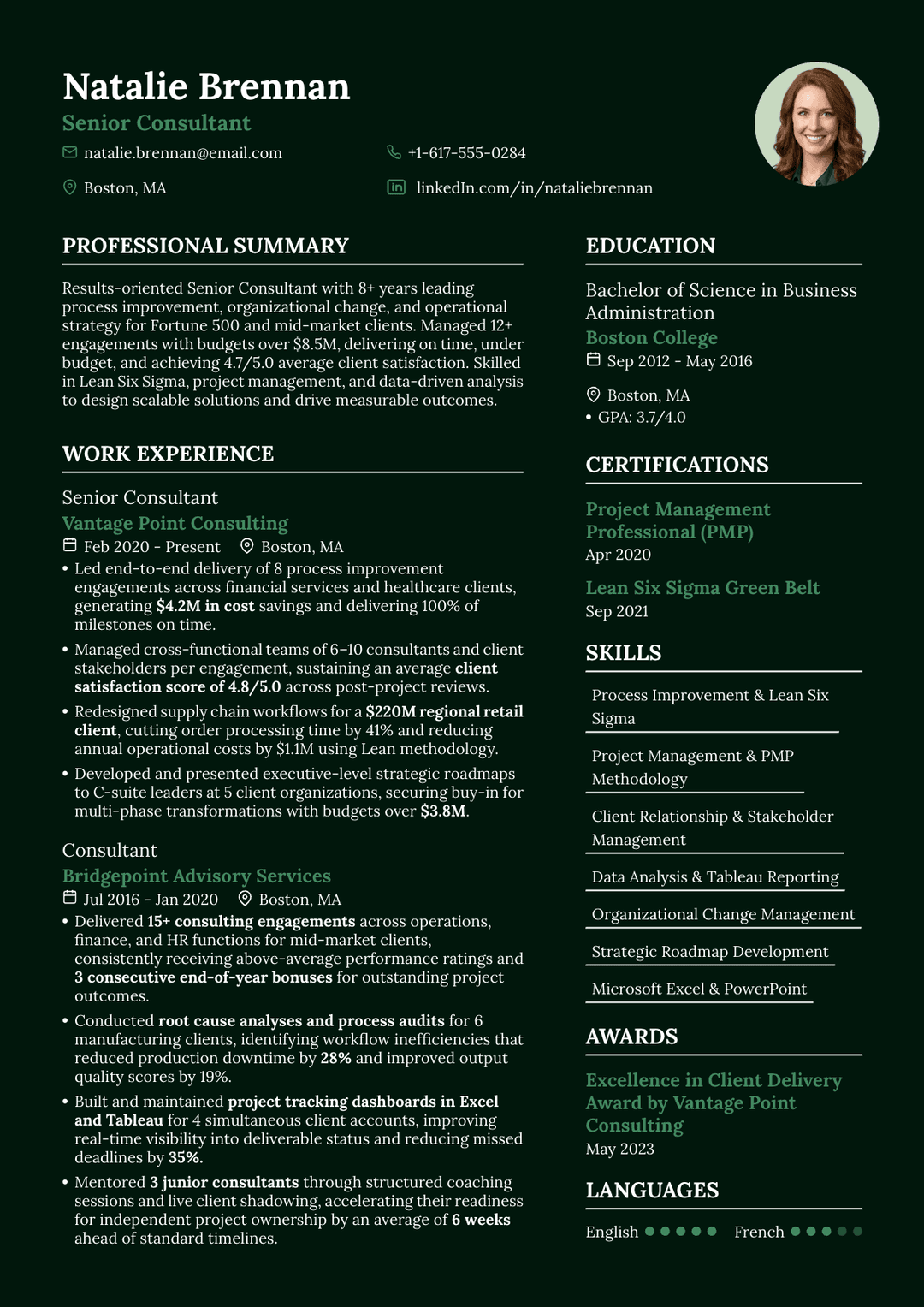
A consultant resume is a document that outlines your ability to work in this role, analyze business problems, develop strategic solutions, and deliver measurable results for clients. It focuses less on routine responsibilities and more on the impact your work has made and the value you’ve created across different industries or organizations.
Today, we offer you an all-in-one guide on how to present that value clearly and convincingly. You’ll learn how to write a consultant resume that reflects both your strategic thinking and execution, which skills and achievements actually matter to employers, and what to avoid doing if you want to make even strong consultants look average on paper.
- A consultant resume must prioritize measurable impact over listing duties, clearly showing how your work delivered results.
- Strict, minimal formatting is essential, as anything beyond a clean one-page, single-column layout can prevent the resume from being properly processed.
- Quantified achievements are expected in every role, as numbers provide concrete proof of your contribution and effectiveness.
- Tailoring your resume to each job by matching relevant keywords improves your chances of passing initial screening.
- Core consulting skills such as analytical thinking, problem-solving, leadership, and client management need to be evident throughout the document.
What Is a Consultant Resume?
A consultant resume communicates your analytical thinking, leadership track record, and measurable business impact to prospective employers. It's built to clear two gatekeepers: the ATS algorithm that scans for keyword matches, and the experienced recruiter who reads what filters approve.
The format is deliberately strict, without creative layouts, icons, or photos, because consulting firms use specific systems that parse plain text and penalize anything decorative. This means your resume might not even reach the hiring managers if it’s not written according to the rules, which are as follows:
- It should (almost always) be one page long, regardless of how many years you've worked.
- Every line must demonstrate impact, not just describe a task.
- The document should emphasize the key transferable skills (such as analytical thinking, structured problem-solving, leadership, and client management), which are the core competencies consulting firms look for.
- The structure should be strict and clean, featuring contact details, summary, experience, skills, and education, in that order.
3 Valuable Consultant Resume Examples to Analyze
First, before we break down the writing process, let’s have a look at a few well-written consultant resumes that demonstrate the one-page format, CAR-formula bullet points, and quantified impact that top firms expect. Studying a real example is the fastest way to understand how each section fits together and what separates a pass from a reject.
#1. Entry-Level Consultant Resume

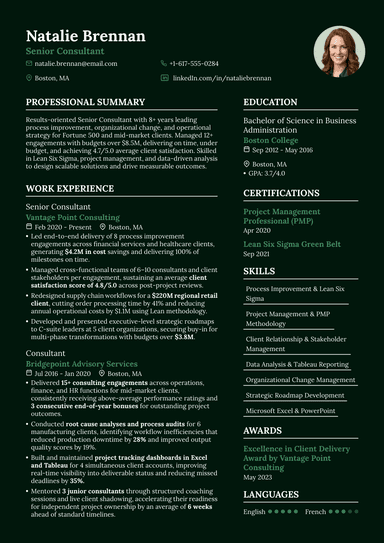
#2. Senior Consultant Resume

#3. Management Consultant Resume

How to Write a Consultant Resume Step by Step
You can write a consultant resume by following these seven steps, in order (skipping any of them, especially the formatting rules, is the most common reason strong candidates don't make it through initial screening):
#1. Choose the Right Format
The best format for a consultant resume is the reverse-chronological format. This option is perfect because it leads with your most recent and most relevant experience, which is exactly what recruiters at consulting firms want to see first. It’s also the only accepted format for a McKinsey/BCG/Bain resume and most Tier 2 firms.
Besides picking this resume format, you should:
- Never exceed one page
- Use clean fonts, such as Calibri, Garamond, or Arial, and keep body text at 10–11pt
- Maintain standard 1-inch margins
- Avoid columns, graphics, icons, and photos, which confuse ATS parsers and often cause your resume to fail screening before a human ever sees it
- Use a single-column layout, standard section headings, and plain text throughout
#2. Come Up With a Clear Resume Header
The resume header is the first thing a recruiter sees, and it should do one job well: clearly identify who you are and how to reach you. In a consultant resume, this part should be clean and minimal, with no graphics or unnecessary details.
Include your full name, phone number, professional email address, and location (city and state are enough for U.S.-based roles). A LinkedIn profile is strongly recommended, especially if it reflects your project work or endorsements. Meanwhile, you should avoid adding personal details like a date of birth or your SSN, as these are not expected in U.S. resumes.
Let’s see what this looks like on a resume:
Jordan Ellis
Chicago, IL
(312) 555-7890
jordan.ellis@email.com
linkedin.com/in/jordanellis123
#3. Write a Compelling Resume Summary
A consultant resume summary should be a 2–3 sentence snapshot that tells the recruiter exactly who you are, what you're good at, and what you've achieved.
This means you should mention years of experience, your core consulting competency (strategy, operations, finance, etc.), and one standout achievement with a metric, cutting anything generic.
However, if you’re still an entry-level candidate who doesn't yet have much experience, you can opt for a resume objective instead. This is a forward-looking statement that connects your background to the consulting role even when your work history isn’t that extensive.
A resume summary looks like this:
Seasoned Management Consultant with 6+ years of experience delivering data-backed strategies that improve operational efficiency and drive revenue growth. Proven track record of leading cross-functional teams, optimizing processes, and advising stakeholders across healthcare, retail, and tech sectors. Adept at translating complex data into actionable insights.
#4. Quantify Your Work Experience
Your consultant resume work experience section should focus on quantified achievements rather than job descriptions. The difference between a resume that gets interviews and one that doesn't usually comes down to this single section.
Wherever you can, provide numbers, be it a cost saved, revenue generated, efficiency improved, team size led, or timeline compressed. Strong consulting resume action verbs set the tone, too, so you can start your bullets with words like spearheaded, diagnosed, supported, streamlined, facilitated, championed, conducted, etc.
With projected job growth for management consultants at 9% by 2034, according to the Bureau of Labor Statistics, competition for top roles is intensifying. Therefore, quantified bullets are no longer a differentiator but the baseline.
Now, this is an example of a well-done work history section:
Senior Consultant
Deloitte Consulting LLP – Chicago, IL
June 2021 – Present
- Led a cost-reduction initiative for a healthcare client, saving $2.3M annually through process optimization
- Managed a team of 5 analysts to deliver a market expansion strategy for a retail client, increasing revenue by 18%
- Developed financial models and dashboards to support executive decision-making
- Facilitated stakeholder workshops and presented recommendations to C-suite executives
Business Consultant
Accenture – Chicago, IL
August 2018 – May 2021
- Conducted data analysis to identify inefficiencies, reducing operational costs by 12%
- Supported digital transformation projects by mapping workflows and implementing automation tools
- Collaborated with cross-functional teams to deliver client solutions within tight deadlines
- Prepared client reports, presentations, and performance metrics
#5. List the Right Consultant Resume Skills
The most important skills to add to a consultant resume are the ones that appear in the job description you're targeting. Repeat the exact language wherever possible, as this section doubles as keyword fuel for ATS systems, and matching terminology is how you clear automated screening.
Here are some suggestions for specific hard and soft skills you should include in this part:
| Hard Skills | Soft Skills |
|---|---|
|
|
Here’s an example of a skills section for a consultant resume:
Skills
Hard Skills
- Data Analysis (Excel, SQL, Tableau)
- Financial Modeling & Forecasting
- Business Process Improvement
- Market Research & Competitive Analysis
- Project Management (Agile, Scrum)
- CRM & ERP Systems (Salesforce, SAP)
Soft Skills
- Strategic Thinking
- Problem-Solving
- Communication & Presentation
- Stakeholder Management
- Leadership & Team Collaboration
- Adaptability
#6. Include Education and Certifications
Next, we craft the education section of a consultant resume, which should contain:
- Your degree
- Institution
- GPA (if above 3.5)
- Graduation year
Consulting firms weigh academic pedigree more heavily than most industries, so honors, awards, and dean's list distinctions belong here, too. Here are some more tips to consider when writing this part:
- List your highest degree first; if you hold a bachelor's and an MBA, the MBA comes first.
- You want to add valuable certifications, such as PMP, Lean Six Sigma (Green or Black Belt), CFA, CMC, etc.
- If you’re an entry-level candidate, it’s recommended to put education before your experience section, and include relevant coursework, a thesis title, or case competition results.
- Leave off certifications that aren't relevant to the role; a long list of generic courses signals filler.
You can do something like this:
Education
Bachelor of Science in Business AdministrationUniversity of Illinois at Urbana-Champaign
2014–2018
Certifications
- Certified Management Consultant (CMC)
- Project Management Professional (PMP)
#7. Add Extracurricular Achievements
Extracurricular achievements matter on a consultant resume because consulting firms specifically screen for evidence of leadership outside of a formal work context. This is especially true for undergraduate candidates with limited professional history; your extracurriculars can carry more weight than a part-time job.
Here, you can mention:
- Student government leadership
- Volunteer committee roles
- Sports captaincy
- Entrepreneurial projects
Frame every item around achievement, not participation. 'Member, Investment Club' is weak. 'VP, Investment Club — grew membership 40% in one year' is strong. And finally, this section differentiates entry-level candidates more than almost any other, so don't skip it and make the best out of it.
Find the Best Consultant Resume Template on Our Platform
A consultant resume template gives you a proven structure to build on so you're not starting from a blank page. This way, you don't accidentally make a formatting mistake that kills your ATS score before a recruiter ever reads your name.
Starting with the right template matters because it:
- Saves time, as you focus on filling in your achievements, not building margins and spacing from scratch.
- Guarantees ATS compatibility since pre-tested templates use single-column layouts and regular section headings.
- Provides a framework so you never miss a required section; summary, experience, skills, and education are all in the right order.
Our AI-powered resume builder lets you select a suitable template for your field, fill in your details, and generate a clean, formatted job application document in minutes. All you should do is provide some basic information about your experience and competencies.
We offer a collection of ATS-friendly templates, as well as some great examples of well-done resumes for inspiration.
5 Powerful Consultant Resume Tips to Consider
The most important tips for writing a consultant resume come down to discipline: every word on the page must earn its place. Here are five rules that separate interview-winning resumes from the pile:
- Tailor your resume to a specific job ad. The best practice you can follow is to directly mirror the language from the posting: if the description says 'operational efficiency,' your resume should contain the exact keyword, not any other synonym.
- Keep it to one page without exceptions. Consulting recruiters review hundreds of resumes in a single session. A two-page resume signals that you can't prioritize, which is a core consulting competency. Meanwhile, a single page forces you to cut duties and keep achievements; if something doesn't prove impact, it doesn't go on the page.
- Avoid the passive voice. Every bullet must start with a strong action verb in the past tense. Passive construction softens your impact and reads as hedging, and consulting firms don't hire hedgers.
- Address resume gaps transparently. Gaps in employment history raise flags during recruiter review, especially at firms where every analyst-to-associate progression is tracked. A brief, honest explanation (career break, upskilling, personal reason) maintains credibility far better than strategic omission.
- Proofread to zero errors. Spelling or grammatical mistakes can eliminate an otherwise competitive application. Therefore, always run spell-check, read the document backward (it forces your brain off autopilot), and ask a peer to review it cold.
Final Thoughts
Writing a strong consultant resume comes down to three non-negotiables: one-page format, CAR-formula bullet points, and ATS-optimized tailoring for every firm you target. Get those three right, and your resume does the selling before anyone reads your name.
The right template makes the whole process significantly faster and removes the risk of formatting mistakes that cost candidates interviews they deserved. Don’t forget to take advantage of ResumeBuilder.so's perks; they will pair a consulting-ready layout with AI-assisted bullet suggestions and make your final document both polished and keyword-rich!
Consultant Resume FAQ
#1. How do I write a consultant resume with no experience?
You can write a consultant resume with no experience by emphasizing your education, GPA, case competition results, leadership roles, and internships. Put education before experience, include GPA if it's above 3.5, and treat extracurricular leadership the same way you'd treat a job: with CAR-formula bullets and metrics where possible.
#2. What skills do you put on a consultant resume?
The top skills to put on a consultant resume include financial modeling, data analysis, stakeholder management, structured problem-solving, and project management, among others. Meanwhile, soft skills like leadership and communication are better demonstrated through your experience bullets.
#3. What format is best for a consultant resume?
The best format for a consultant resume is reverse-chronological because it focuses on your most recent and relevant experience, and it’s the first thing consulting recruiters want to see. Besides this, you should also use a single-column layout, standard section headings, and clean fonts.
#4. Do I need an MBA for a consulting resume?
You do not need an MBA for a consultant resume, though it strengthens applications for associate-level roles at top-tier firms. Undergraduate candidates are regularly hired at MBB through analyst pipelines; an MBA is most valuable if you're targeting a post-business-school entry point or making a career change into consulting from another field.
#5. How do I make an ATS-friendly consultant resume?
You can make an ATS-friendly consultant resume by using standard formatting, mirroring keywords from the job description, and avoiding tables, graphics, and columns. Furthermore, you should submit it as a PDF only when the job posting permits or requests it; otherwise, use a .docx file.

Max Harper is the resume guru who actually makes job searching easier. With years of experience as a hiring manager, Max knows what makes a resume stand out in a pile of 200+ applications. From breaking down ATS myths to helping you craft bullet points that pop, Max shares easy-to-digest, no-BS resume advice.