How to Explain Employment Gaps on Your Resume + Examples

Explaining employment gaps doesn’t have to be a big problem. These career breaks are increasingly common and can happen for various reasons, including layoffs, family care, health issues, education, or personal development.
However, with the right approach, you can address them honestly and effectively without sabotaging your job prospects. What matters now isn't the gap itself—it's how you frame it.
In this guide, we’ll show you how to explain gaps in employment with proven strategies, how to frame them on your resume, and much more. Let’s begin!
- Employment gaps are common and increasingly accepted by employers in today's job market.
- Honesty and strategic presentation are key to addressing gaps effectively without over-explaining.
- Different resume formats can minimize the visual impact of gaps and emphasize your skills.
- Focus on skills gained and professional development during gaps rather than dwelling on the absence.
- Cover letters provide opportunities to explain gaps contextually when needed.
What Is an Employment Gap?
An employment gap is any period of three to six months or longer when you weren't working in a traditional job. A month or two between jobs is just a normal transition. Most employers won't even notice gaps shorter than three months, especially if you're listing years rather than specific months on your resume.
Sometimes, resume gaps are a normal occurrence. For instance, the COVID-19 pandemic created the largest simultaneous employment gap in modern history. It triggered a sharp economic shock that dramatically increased unemployment in the U.S. Before widespread lockdowns began, the U.S. unemployment rate was just 3.8% in February 2020. Within weeks, as COVID-19 spread and stay-at-home orders took effect, it skyrocketed to 14.4% by April.
While some employees were able to transition to working from home, many weren’t so fortunate. When offices, factories, restaurants, and retail businesses temporarily shut down, millions were left vulnerable. As a result, job losses were concentrated among frontline and service workers, driving the historic spike in unemployment during the pandemic’s early months.
6 Common Reasons for Employment Gaps
However, there are other perfectly justified reasons for resume gaps aside from a global pandemic. Here are six common reasons why people actually take career breaks:
- Layoffs and company restructuring. Economic downturns, mergers, and business pivots lead to job losses every day. The job search following a layoff often takes longer than expected, especially in specialized fields. That extended search period counts as a gap, even though you were actively pursuing opportunities.
- Family caregiving. Whether you were raising children, caring for aging parents, or supporting a family member through illness, caregiving is legitimate work. It requires project management skills, scheduling, budgeting, emotional intelligence, and crisis management—all transferable skills that employers value.
- Health issues. Your medical history is private. However, what you can share is that you took time to address a health matter, you're now fully recovered, and you're eager to return to work. Mental health breaks fall into this category, too. Job burnout is real, and taking time to recover shows self-awareness, not weakness.
- Education and professional development. Returning to school, earning certifications, or changing careers through education is a proactive investment in your future. This type of gap is generally viewed positively because it shows initiative and growth. Whether you completed a full degree program or took a series of online courses to learn new skills, educational gaps demonstrate your commitment to professional development.
- Personal sabbaticals and travel. Some people intentionally step away from work to travel, pursue personal projects, or prevent burnout. A planned sabbatical, especially after years of consistent work, shows healthy work-life balance awareness. The key is framing it as an intentional choice that enriched your perspective rather than aimless wandering.
- Unsuccessful job search. Sometimes the job search just takes longer than expected. Competitive markets, niche specializations, geographic limitations, or economic conditions can all extend a job search beyond a few months. The way you discuss this gap matters—focus on how you stayed engaged with your industry during the search.
How Employment Gaps Affect Your Job Search
The way how your employment gap affects your job search depends heavily on several factors, such as:
- Industry
- Company culture
- Length of the gap
- How you address it
Employer concerns typically center on skills and qualifications obsolescence. In fast-moving fields like technology or digital marketing, a two-year gap might mean you've missed significant developments. In more stable industries like accounting or human resources, the same gap might be less problematic.
Company size and culture make a difference, too. Startups and smaller companies often show more flexibility because they prioritize cultural fit and adaptability over perfect chronology. Larger corporations with more rigid HR processes might screen resumes more strictly, though this is changing.
The length of your gap matters, though not always in the way you'd think. A six-month gap often gets a pass. A year-long gap raises questions, but it is still manageable with a good explanation. Multi-year gaps require more strategic presentation, but they're far from disqualifying—especially if you can demonstrate you stayed current in your field.
However, what actually disqualifies candidates are obvious lies about employment dates, unexplained gaps with no context, or defensive attitudes when asked about them. Your explanation and attitude matter infinitely more than the gap itself.
8 Strategies to Address Employment Gaps on Your Resume
How you present your work experience matters far more than the gaps themselves. Let’s explore eight proven strategies that can help you frame your experience honestly while putting your best foot forward.
#1. Use the Right Resume Format
You can address employment gaps effectively by choosing a resume format. The traditional reverse-chronological format lists jobs in order with dates front and center. This draws immediate attention to gaps. On the other hand, a functional format organizes your resume by skills and accomplishments rather than by timeline. A combination (hybrid) format combines both approaches, leading with skills but still including work history.
Choose functional or hybrid formats when you have significant gaps or are changing careers. Stick with chronological formats when your work history is strong and continuous, or when applying to conservative industries that expect traditional formatting.
#2. List Years Only (Not Months)
List only years of employment rather than months and years. This strategy works great when your gaps are less than a year.
Here’s an example that shows how listing months reveals employment gaps:
Marketing Manager | Tech Solutions Inc.
March 2019 - November 2021
Marketing Coordinator | Digital Agency LLC
March 2018 - January 2019
Marketing Assistant | StartUp Co.
May 2016 - December 2017
In contrast, here’s how you can hide gaps in employment by listing only years:
Marketing Manager | Tech Solutions Inc.
2019 - 2021
Marketing Coordinator | Digital Agency LLC
2018 - 2019
Marketing Assistant | StartUp Co.
2016 - 2017
However, this strategy has limits. If your gap spans multiple years, listing years only won't help much. That gap is still obvious and requires explanation.
#3. Fill Gaps with Relevant Activities
Filling employment gaps with relevant activities, including freelance projects, volunteer work, professional development courses, or consulting assignments, shows continued engagement with your field.
The key word here is "relevant." Your yoga practice during your career break probably doesn't belong on your resume (unless you're applying to wellness companies). This approach works especially well if you can create actual position entries, such as:
- Freelance Marketing Consultant, Self-Employed, 2020-2021
- Volunteer Grant Writer, Local Food Bank, 2019-2020
- Professional Development, Online Coursework in Data Analytics, 2022
#4. Create a "Career Break" or "Professional Development" Entry
For longer, more significant gaps, consider creating a formal resume entry for the gap period itself. This approach works particularly well for:
- Sabbaticals
- Extended caregiving
- Dedicated skill-building periods.
Here’s a good example of a career break on a resume:
CAREER BREAK / PROFESSIONAL DEVELOPMENT
2020 - 2022
Took intentional career break to focus on family caregiving while maintaining industry knowledge and developing new skills:
- Completed Advanced Project Management Certification (PMP) through PMI
- Maintained professional network through industry association involvement
- Freelanced on 3 consulting projects for former clients
- Stayed current with industry trends through continuing education and professional reading
- Developed advanced Excel and data visualization skills through online coursework
This example shows how to frame a gap positively. You're honest about the break, but you're also demonstrating that you stayed engaged with your profession. The bullet points prove you weren't stagnant—you were developing yourself.
#5. Be Honest and Straightforward
This might seem obvious, but don't lie about your employment dates. Don't fabricate job titles or claim you worked somewhere you didn't. Background checks will catch these lies, and the consequences are severe—immediate disqualification or termination if already hired.
However, honesty doesn't mean oversharing every detail. Being straightforward means acknowledging the gap exists (through your formatting and dates) without making it the focal point of your application. It means being prepared with a brief, honest explanation when asked, but not volunteering lengthy justifications unprompted.
#6. Focus on What You Gained
Shift the narrative from "what was missing" to "what was gained". Every career break teaches something—even if the lesson was simply what you don't want in your next role.
Perhaps you gained perspective on work-life balance. Maybe you developed patience and organizational skills through caregiving. You might have discovered new interests that relate to your field. Or you might have done intensive self-study that makes you more knowledgeable than before.
#7. Address Gaps in Your Cover Letter
Your resume lists facts; your cover letter provides context. If you have a significant gap that needs explanation, use one or two sentences in your cover letter to address it directly and then quickly pivot to your qualifications.
Acknowledge the gap briefly, explain what you did during it, state what you gained, and redirect to your current value proposition. Keep it factual, positive, and forward-looking. No apologizing, no excessive detail, no defensive tone.
For example:
After my layoff in early 2021, I took the opportunity to complete my MBA while consulting part-time. This period allowed me to deepen my strategic business knowledge, and I'm now eager to apply these enhanced skills to a leadership role.
#8. Use a Professional Summary to Reframe Your Narrative
Your resume summary or objective is often the first thing employers read. A strong professional summary emphasizes your relevant skills, years of overall experience, and key qualifications. It creates a compelling picture of who you are as a professional right now, which matters more than the specific timeline of when you gained each experience.
Let’s see a good example:
Results-driven marketing professional with 8+ years of experience in digital strategy, content creation, and campaign management. Proven track record of increasing engagement by 40%+ through data-driven approaches. Recently completed advanced certification in marketing analytics and eager to apply enhanced skills to drive measurable business results.
This example summary highlights total experience, specific achievements, recent upskilling, and current enthusiasm. It controls the narrative from the start by focusing on strengths rather than gaps. The employer gets immediately hooked by your value before even glancing at dates.
How to Explain Employment Gaps in Job Interviews
Your resume got you the interview—now you need to discuss your gap confidently in person. Preparation makes all the difference here.
When an interviewer asks about your employment gap, they're typically looking for a few things: honesty, accountability, evidence that you stayed engaged with your field, and confirmation that you're committed to returning to work. They're not trying to trap you; they're trying to understand your story.
Keep your explanation to 30-60 seconds and structure your answer using this four-step framework:
- Acknowledge the gap directly
- Explain briefly why
- Describe what you did during that time
- Redirect to the present
Here’s how you can frame your answers using this framework for different scenarios:
I was affected by company-wide layoffs in 2022. During my job search, I used the time to complete my AWS certification and contribute to open-source projects, which actually expanded my technical skillset beyond what I had in my previous role.
I took two years off to care for my young children. During that time, I stayed engaged by freelancing on small projects and taking online courses to keep my skills sharp. Now that my kids are in school, I am ready to return full-time with renewed focus.
I took time off to address a health matter, which is now fully resolved. During my recovery, I focused on professional development through online learning. I'm now ready to bring my experience and new skills to a role like this.
I decided to pursue my master's degree to deepen my industry expertise. That investment in education has given me strategic frameworks and current research knowledge that directly apply to this position.
The job market in my field was particularly competitive during that period. I was selective about opportunities while staying active through contract work and professional development. I'm confident this role aligns perfectly with my goals.
3 Resume Examples That Minimize Employment Gaps
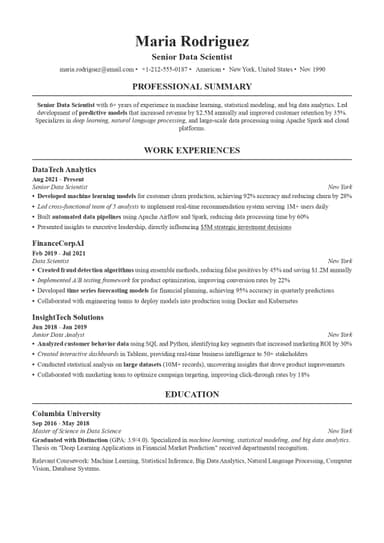
The hybrid or combination format offers the best of both worlds for most people with employment gaps. It starts with a strong skills section that emphasizes your capabilities, then includes a concise work history section.
That said, let's see how this format handles employment gaps on actual resume examples.
Marketing Professional

Project Manager

Customer Success Manager

Create a Polished Resume With ResumeBuilder.so
ResumeBuilder.so provides multiple professional resume templates optimized for different situations, including career gaps. Our intuitive resume builder guides you through the process, prompting you to include relevant activities during gap periods and helping you format dates appropriately.
You can also access professional cover letter templates that help you address employment gaps contextually and effectively. The integrated ResumeBuilder.so tools make it simple to create a cohesive application package that tells your complete professional story.
Final Thoughts
Employment gaps are a normal part of modern careers. Regardless of the relatively low unemployment rate of 4.4% in December 2025, life happens—layoffs, health issues, family needs, education pursuits, or simply needing to step back and regroup. However, none of these make you less qualified, less valuable, or less hirable.
What actually matters is how you handle the conversation around your gap. Be honest, be strategic, and be confident. Frame your career break as part of your larger professional journey rather than an embarrassing detour that needs excessive justification.
Focus on your overall value proposition, i.e. the skills you bring, the experience you have, the results you've achieved, and the contributions you'll make. Your career isn't defined by the gaps between jobs—it's defined by what you accomplished during the jobs themselves and how you grew during the spaces in between.
Employment Gap FAQs

Maya Brooks believes that a fulfilling career shouldn’t come at the cost of your mental health. Having worked in corporate HR, she’s seen firsthand how burnout culture can wreck careers. Now, she shares real-world strategies for setting work boundaries, avoiding toxic workplaces, and finding joy in your job.