How to List Education on a Resume in 2026 [Guide + Examples]
![How to List Education on a Resume in 2026 [Guide + Examples]](/_next/image?url=https%3A%2F%2Fcdn.sanity.io%2Fimages%2Fbcftoxbw%2Fproduction%2Fc5037f3333ad01ef728286e60c854c40ca4bc989-1120x630.png&w=3840&q=75)

Listing education on a resume might seem straightforward, but there's more strategy involved than you'd think. Whether you're a recent graduate or a seasoned professional, the way you format, position, and detail your education section sends signals about your qualifications, attention to detail, and understanding of professional standards.
In this guide, we'll walk you through everything you need to know about listing education on your resume—from deciding where it goes to choosing what details actually help your application. You'll find specific examples for every situation, whether you're dealing with incomplete degrees, multiple credentials, or figuring out if your high school diploma still belongs on the page.
- The education section demonstrates your qualifications and learning capacity.
- Placement depends on career level: recent graduates place it near the top, experienced professionals near the bottom.
- Essential information includes degree, institution name, location, and graduation date.
- Optional details like GPA (3.5+), relevant coursework, honors, and awards can strengthen your section.
- Format varies based on whether you have complete/incomplete degrees, multiple degrees, or are currently studying.
- High school education should only be included in specific situations.
Purpose of the Education Section on a Resume
The purpose of the education section on a resume is to showcase your academic credentials, formal training, and learning accomplishments. Employers scan this section to verify you have the educational requirements listed in their job descriptions, and a well-structured resume uses these credentials strategically.
They're checking for degree types, relevant fields of study, and sometimes specific coursework or academic achievements that relate to the role. For positions requiring licenses or certifications, your education section becomes even more critical since it establishes your eligibility to practice in certain fields.
According to the U.S. Bureau of Labor Statistics, workers with higher educational attainment consistently earn more and face lower unemployment rates, which explains why employers place such emphasis on this section. Your education section essentially translates your learning investment into professional credibility.
Furthermore, your education demonstrates learning capacity. Someone who excelled academically or pursued advanced degrees shows they can absorb complex information and apply it effectively. This matters whether you're fresh out of school or you earned your degree years ago—it's evidence of your intellectual capabilities.
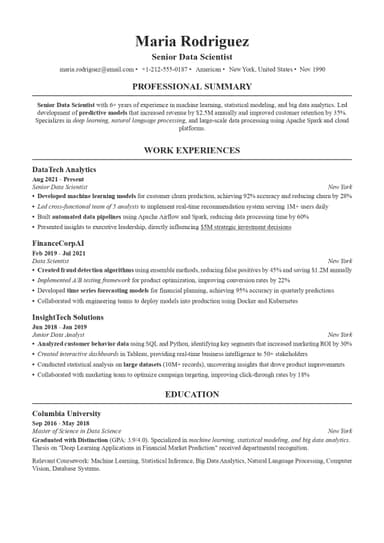
That said, let’s see a good resume example that puts this section into action:

Where to Place Education on Your Resume
The placement of your education on your resume isn't random—it should reflect what strengthens your candidacy most. Career stage, relevance of your degree, and the specific job requirements all influence where this section belongs. Let's break down the right approach for different situations.
Recent Graduates and Entry-Level Professionals
Place your education near the top of your resume, right after your contact information and professional summary. When you have 0-3 years of experience, your degree is your primary qualification and deserves prominent placement.
However, there's one exception here. If you completed substantial internships or relevant work experience during school, you might position that work section first instead. A computer science graduate with two solid software engineering internships should probably lead with experience rather than coursework.
Experienced Professionals
With 5+ years of professional experience, your achievements matter more than where you went to college. Place your education section near the bottom of your resume, after you've detailed your work experience. By this point, your track record speaks louder than your academic credentials.
Keep this section concise and streamlined. You don't need to list your GPA from ten years ago or include every course you took. Your degree, school, and graduation year (or just degree and school) will suffice.
Career Changers
For career changers, placement hinges on relevance. If you recently completed a relevant degree or certification for your new field, position it higher on your resume. On the other hand, if you're leveraging an older, unrelated degree while transitioning careers, keep education lower and focus on transferable skills and any recent training.
For instance, someone moving from teaching to corporate training might place a recent instructional design certificate near the top, even with years of teaching experience, because it directly supports the career pivot.
Essential Information to Include in Your Education Section

Some elements are mandatory for every entry, while others depend on your situation and how recently you graduated. Let’s see which is which.
Mandatory Information
Every education entry needs four core pieces of information:
- Full degree name and major
- Official name of your institution
- Location with city and state (or country if you studied internationally)
- Graduation date
Each element matters because employers and Applicant Tracking Systems (ATS) look for this standard information. Missing any piece can trigger questions or make your application look incomplete, even if you have impressive credentials.
Here’s how that looks in practice:
Bachelor of Arts (B.A.) in Design
University of California (UCLA)
Los Angeles
May 2023
Optional But Valuable Additions
Beyond the basics, several optional elements can strengthen your education section when used strategically, such as:
- GPA, but only if it's 3.5 or higher on a 4.0 scale and you graduated within the last three years
- Honors and awards (e.g., Dean's List recognition, academic scholarships, etc.)
- Relevant coursework to give context to your degree, particularly if your major doesn't perfectly align with your target role
- Major projects or thesis work when they relate directly to your target position
- Study abroad experiences, especially for international roles or positions requiring language skills
Include optional elements that strengthen your specific application, and skip anything that doesn't directly support your candidacy for this particular role.
How to Format Your Education Section
Proper formatting makes your education section scannable, and here’s how to do it effectively:
- Use reverse chronological order. List your most recent degree first and work backward. This follows the standard convention readers expect and makes your latest skills and qualifications immediately visible.
- Create a clear visual hierarchy. Institution names typically appear in bold, while degree names might be in bold or regular text depending on your emphasis. Whatever you choose, stay consistent.
- Use appropriate spacing. White space visually separates different degrees without creating awkward gaps.
- Avoid excessive formatting. This includes underlining, colored text, or unusual fonts that might confuse ATS software.
Here's a proven template structure that works for most situations:
For example:
Bachelor of Science in Computer Science
University of Washington, Seattle, WA
June 2023
- GPA: 3.8/4.0
- Dean's List all semesters
- Relevant Coursework: Machine Learning, Data Structures, Algorithm Design
ATS-Friendly Formatting Tips
Here are a few ATS tips to make your education on a resume machine-readable:
- Use the standard section heading "Education" rather than creative alternatives like "Academic Background" or "Degrees Earned"
- Avoid tables, text boxes, headers, footers, or graphics in your education section
- Stick with standard fonts like Arial, Calibri, or Times New Roman
- Include both the full degree name and abbreviation (e.g., "Bachelor of Science (B.S.)") to catch variations the system might search for.
- Don't use special characters, symbols, or unusual formatting that might not translate correctly
- Spell out months and numbers rather than using symbols
Education on Resume: 12 Examples for Different Situations
Your educational background is unique, and your resume should reflect your specific situation. Here are detailed education section examples for various scenarios you might face.
Bachelor of Arts (B.A.) in Marketing
Boston University, Boston, MA
May 2024
- GPA: 3.7/4.0, Dean's List (4 semesters)
- Relevant Coursework: Digital Marketing Strategy, Consumer Behavior, Marketing Analytics, Social Media Marketing
- Senior Capstone: Developed an integrated marketing campaign for a local nonprofit, resulting in 40% increase in social media engagement
This format works when you need to compensate for limited professional experience with strong academic performance. Include your GPA if it's impressive, highlight honors, and select coursework that matches job descriptions you're targeting. For example, a college student resume benefits from these details.
Master of Science in Software Engineering
Carnegie Mellon University, Pittsburgh, PA
2015
Bachelor of Science in Computer Science
University of Illinois at Urbana-Champaign, Urbana, IL
2013
Notice what's missing: no GPA, no coursework, no extracurriculars. Your work accomplishments tell the story now, and this streamlined format keeps the focus there. If your degrees are more than 10-15 years old, you can even omit graduation years to avoid potential age bias.
Master of Business Administration (MBA)
Northwestern University - Kellogg School of Management, Evanston, IL
2021
- Concentration: Finance and Strategy
Bachelor of Science in Economics
University of Michigan, Ann Arbor, MI
2017
With multiple degrees, list them in reverse chronological order, with your highest or most recent degree first. If you have an associate degree in addition to a bachelor's degree, you can typically leave the associate degree off unless it's highly relevant to the position or from a prestigious institution.
Bachelor of Science in Nursing (B.S.N.)
University of Florida, Gainesville, FL
Expected Graduation: May 2025
- Current GPA: 3.6/4.0
- Completed Coursework: Anatomy & Physiology, Pharmacology, Clinical Practice I & II
Candidate: Master of Public Health
Johns Hopkins Bloomberg School of Public Health, Baltimore, MD
- Expected Completion: December 2025
The key is to include an expected graduation date to demonstrate you're actively working toward your credential. Both examples above clearly indicate you're pursuing the degree without suggesting you've already earned it.
Coursework toward Bachelor of Arts in Psychology
Arizona State University, Tempe, AZ
2019-2021 (62 credits completed)
- Relevant Coursework: Research Methods, Developmental Psychology, Cognitive Psychology
Honestly represent coursework toward a degree without using negative language like "unfinished" or "incomplete." The example above acknowledges your educational experience without claiming a credential you haven't earned.
High School Diploma
Lincoln High School, Portland, OR
June 2024
- GPA: 3.9/4.0
- National Honor Society
- Activities: Debate Team Captain, Student Government Vice President
Recent high school graduates or current students should include their diploma, especially when applying for entry-level positions or internships. Once you've completed any college coursework, drop your high school education from your resume.
Associate of Applied Science in Web Development
Portland Community College, Portland, OR
2023
- GPA: 3.8/4.0
- Capstone Project: Developed a responsive e-commerce website using React and Node.js
If you have both an associate and a bachelor's degree, you can include the associate degree if it's in a relevant field or adds context to your background. However, if your bachelor's degree alone qualifies you for the position, the associate degree becomes optional.
Doctor of Philosophy (Ph.D.) in Molecular Biology
Massachusetts Institute of Technology, Cambridge, MA
2022
- Dissertation: "CRISPR-Cas9 Applications in Gene Therapy for Autoimmune Disorders"
- Advisor: Dr. Jennifer Martinez
- Published 6 peer-reviewed articles in Nature and Cell
Graduate degrees may include additional details like thesis titles, advisors, or concentrations, especially for academic or research positions.
For professional roles outside academia, you can simplify:
Ph.D. in Molecular Biology
Massachusetts Institute of Technology, Cambridge, MA
2022
Tailor your detail level to what matters for the specific role you're pursuing.
Master of Science in Cybersecurity
Georgia Institute of Technology, Atlanta, GA
2023
- Certified Information Systems Security Professional (CISSP), 2023
When certifications are closely tied to your degree, you can include them in your education section. For more extensive certifications, create a separate section.
Bachelor of Science in Information Technology
Western Governors University (Online), Salt Lake City, UT
2023
Legitimate online degrees from accredited institutions should be listed just like traditional degrees—they carry equal weight.
For online courses and certificates from platforms like Coursera or edX, include them if they're relevant and recent:
Bachelor of Arts in Business Administration
University of Florida, Gainesville, FL
2020
Additional Training:
- Data Science Specialization, Johns Hopkins University (Coursera), 2023
- Python for Data Science, IBM (edX), 2023
Master of Science in Mechanical Engineering
Technical University of Munich, Munich, Germany
2021
Bachelor of Engineering (Honours)
University of Toronto, Toronto, Ontario, Canada
2018
- Canadian equivalent of U.S. Bachelor of Science degree
Include the country for degrees earned outside the United States, and consider adding equivalent degree information if it's not obvious.
Coursework in Business Administration
Community College of Denver, Denver, CO
2020-2022
- Completed 45 credits including Accounting I & II, Business Statistics, Marketing Principles
High School Diploma
Denver East High School, Denver, CO
2020
When you've completed some college coursework but haven't earned a degree, list the relevant education without claiming a credential.
5 Common Mistakes to Avoid When Listing Education on Resume
Here’s which resume mistakes in your education section to avoid:
- Including irrelevant education details. Stick to courses directly relevant to your target role, and limit yourself to 3-5 if you include any at all. Similarly, unrelated extracurricular activities waste space once you're beyond entry-level roles.
- Incorrect degree names or abbreviations. Check your diploma or transcript for the exact wording, and use it consistently. Spell out degree names on first reference and include abbreviations in parentheses: "Bachelor of Science (B.S.)."
- Poor formatting and inconsistency. Choose a format and stick with it throughout your entire resume, not just the education section. Your resume layout should follow clear, consistent patterns that create visual harmony. Avoid hard-to-read layouts with cramped spacing or confusing hierarchies.
- Lying about education. Never fabricate degrees, inflate GPAs, or claim honors you didn't earn. Resume fraud has serious consequences: job offers get rescinded, employees get fired, and professional reputations get destroyed. Honesty might feel limiting, but getting caught lying eliminates opportunities entirely.
- Listing high school when you shouldn't. College-level education supersedes high school credentials for professional positions. The exception is when a high school is genuinely your highest educational achievement and you're applying for entry-level roles that require only a diploma.
Tips for Making Your Education Section Stand Out
The table below outlines some resume tips which help transform a basic education section into compelling evidence of your qualifications and potential:
| Tip | What to Do | Why It Works |
|---|---|---|
Quantify Academic Achievements | Add numbers to honors, rankings, scholarships, research, and competitions | Makes achievements concrete, credible, and memorable |
Highlight Relevant Coursework | List advanced, job-related courses aligned with target roles | Directly connects education to employer needs and keywords |
Showcase Academic Projects | Include capstones, research, presentations, and team projects | Proves real-world application of knowledge |
Emphasize Academic Leadership | Highlight roles in student orgs, research teams, tutoring, or teaching | Demonstrates leadership, teamwork, and communication skills |
Use Strong Action Verbs | Describe achievements with active verbs like “led,” “analyzed,” or “developed” | Positions you as a contributor, not a passive participant |
Ready to Create a Resume That Showcases Your Education Perfectly?
Try ResumeBuilder.so's intuitive resume builder and join thousands of job seekers who've simplified their resume creation process while improving their results.
Our platform provides professional resume templates specifically designed for different career levels and to pass applicant tracking systems —proper heading hierarchy, consistent formatting, appropriate spacing—automatically.

Final Thoughts
Getting your education on a resume right matters more than most realize. It's not just about listing degrees—it's about strategically presenting your academic credentials in ways that strengthen your candidacy. Recent graduates should embrace their educational achievements and position them prominently, while experienced professionals need to streamline this section and keep the focus on their track record.
Career changers might need to emphasize recent, relevant education even with years of unrelated experience. Someone with employment gaps can use ongoing education to demonstrate continuous learning. The key is understanding what matters most for the specific role you're pursuing and adapting your presentation accordingly.
Education Section FAQs

Max Harper is the resume guru who actually makes job searching easier. With years of experience as a hiring manager, Max knows what makes a resume stand out in a pile of 200+ applications. From breaking down ATS myths to helping you craft bullet points that pop, Max shares easy-to-digest, no-BS resume advice.