Event Planner Resume: How to Create a Professional One
This complete guide with detailed explanations and expert tips will teach you how to write an acting resume in record time!
Edit this resume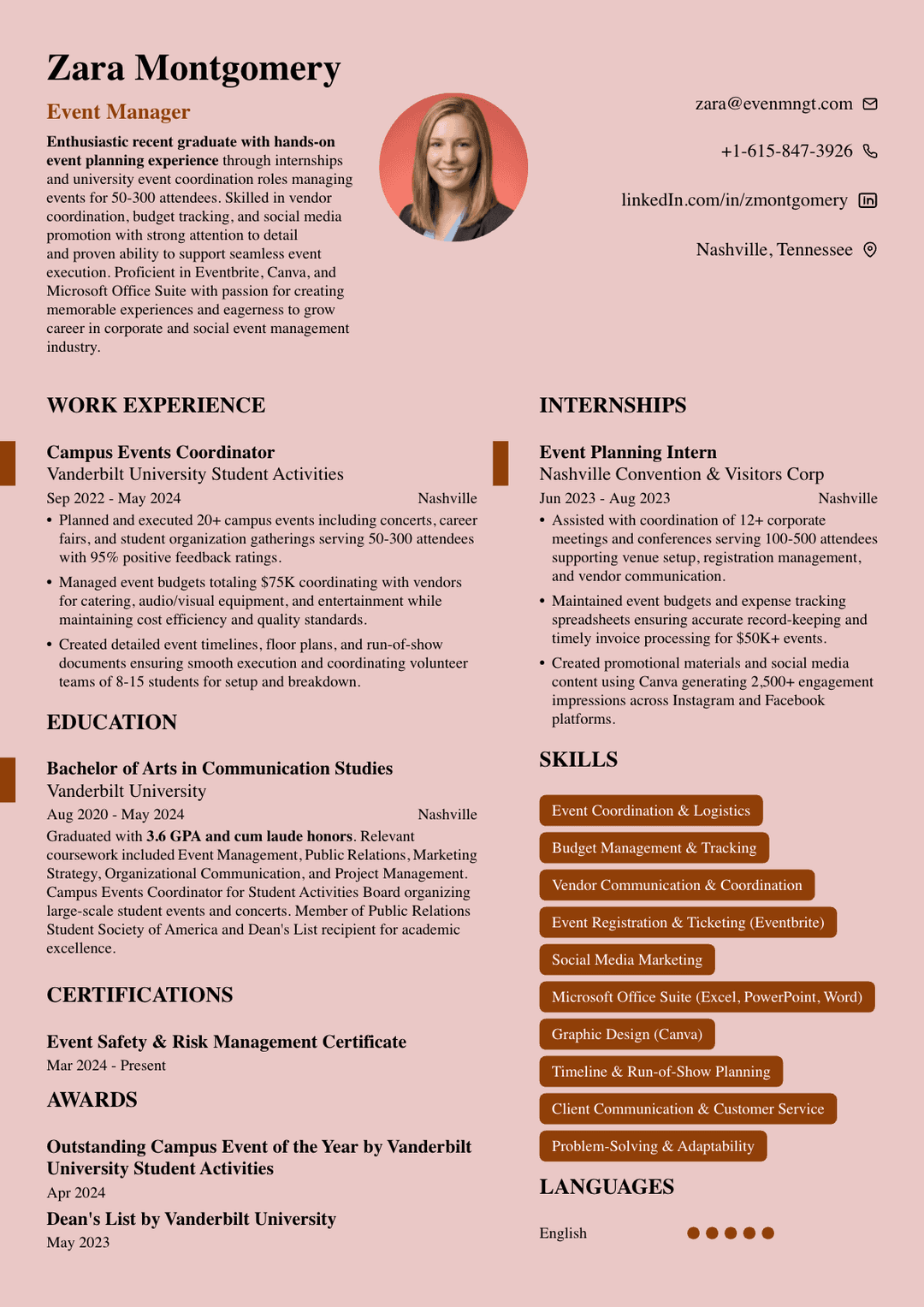
An event planner resume is a targeted summary of your experience organizing, coordinating, and delivering successful events, from small corporate meetings to large-scale productions.
This document matters because hiring managers often review it both before and after an interview to confirm details, compare candidates, and assess results. If your resume doesn’t clearly show your ability to manage budgets, timelines, vendors, and last-minute chaos, it can weaken an otherwise strong interview performance.
In this article, you’ll learn how to structure an event planner resume, highlight measurable achievements, and present your experience in a way that aligns with employer expectations. You’ll also find practical tips for strengthening your chances of landing the role.
- A strong event planner resume must clearly prove your ability to manage budgets, timelines, vendors, and live-event pressure through concrete results.
- Recruiters expect measurable achievements—number of events, budget size, cost savings, attendance figures—not task-based descriptions.
- Reverse-chronological formatting is the safest and most effective choice, making career progression and recent experience easy to scan.
- Hard skills (event software, budgeting, vendor negotiation) should be backed by real examples, not just listed as buzzwords.
- The most common deal-breakers are inconsistent formatting, missing keywords, irrelevant details, and resumes that describe duties instead of impact.
What Does an Event Planner Do?
An event planner organizes successful gatherings, from intimate corporate meetings to large-scale conferences and weddings. These professionals coordinate every aspect of an event, including venue selection, vendor management, budget oversight, and day-of-event execution.
Their core responsibilities include:
- Developing event concepts
- Negotiating contracts with venues and suppliers
- Creating detailed timelines
- Managing event budgets
- Coordinating logistics
- Ensuring seamless event execution
Event planners must juggle multiple projects simultaneously and maintain exceptional attention to detail. The role requires strong organizational and communication skills, as planners regularly interact with clients, vendors, venues, and attendees. They must anticipate potential issues and develop contingency plans to address challenges that arise.
Career paths in event planning vary widely; corporate event planners focus on conferences, trade shows, and company gatherings, while wedding planners specialize in creating memorable celebrations for couples. Social event coordinators organize parties, fundraisers, and community events, and meeting planners concentrate on professional conferences and seminars.
According to the Bureau of Labor Statistics, the job outlook for event planning is 5%, which means that these roles are expected to grow steadily, with a median annual salary of $59,440. It's a dynamic field where your ability to manage chaos with grace translates directly into career advancement and earning potential.
Event Planner Resume Examples
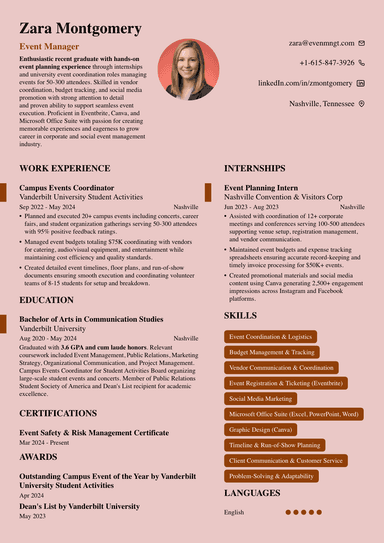
First of all, let’s have a look at a few event planner resume examples based on different experience levels/variations of the role:
Entry-Level Event Management Resume Example

Corporate Event Planner Resume Example


Wedding Planner Resume Example


Event Coordinator Resume Example

How to Structure Your Event Planner Resume
Structuring your event planner resume starts with choosing a professional resume format and including essential sections.
Your resume should be clean, organized, and easy to scan, reflecting the same organizational skills you bring to event planning. The best option is using the reverse-chronological format, which prioritizes your work experience and lists your previous roles from the oldest to the newest ones, showing your career progress.
Let’s see what sections your event planner resume should include:
#1. Contact Information
Place your contact information, including your name, phone number, email address, city and state, and LinkedIn profile URL, prominently at the top.
Ensure your email address is professional; avoid outdated or unprofessional handles. This seems obvious, but you'd be surprised how many applications get tossed because someone's still using their college email address from 2015.
Jody Carter
Event Planner
Austin, TX
(512) 555-0198
jody.carter@email.com
LinkedIn: linkedin.com/in/jody.carter.92
#2. Resume Summary or Objective
Include a 2- or 3-sentence-long resume summary highlighting your experience level, specialization, and key achievements.
It’s going to be your elevator pitch and the first thing recruiters read after your name, so make those sentences count. If you’re a fresh graduate or have little to no experience, a resume objective might be a better option for you, as it focuses on your career goals rather than your previous experience.
Detail-oriented event planner with 6+ years of experience coordinating corporate events, conferences, weddings, and brand activations across diverse venues. Proven ability to manage budgets, oversee vendors, and deliver seamless events under tight deadlines. Known for strong client communication, strategic planning, and calm problem-solving during live events.
#3. Work Experience
The work experience section is the most critical one; it includes your previous roles in reverse-chronological order, including job title, company name, location, and dates.
This part is where you prove your value through concrete achievements. Rather than simply listing job duties, focus on specific accomplishments, metrics, and outcomes that demonstrate your impact as an event planner.
You should structure your bullet points using the STAR (Situation, Task, Action, Result) framework. This approach helps you present accomplishments clearly while providing context and also forces you to think beyond basic tasks and articulate the actual value you created. Additionally, numbers make your achievements tangible, so you need to include metrics like:
- Number of events coordinated
- Attendance figures
- Budget sizes managed
- Cost savings achieved
- Revenue generated
- Client satisfaction scores
- Team size supervised
- Vendor relationships maintained
Work Experience
Senior Event Planner
Spark Events Group, Austin, TX
March 2020 – Present
- Planned and executed 50+ events per year, including corporate conferences, product launches, and private events
- Managed event budgets up to $150,000 while maintaining cost efficiency and quality standards
- Coordinated vendors, venues, catering teams, and technical crews to ensure smooth execution
- Developed detailed timelines, run-of-show documents, and contingency plans
- Increased client satisfaction ratings by 20% through improved communication and post-event follow-ups
Event Coordinator
Bright Moments Events, Dallas, TX
June 2017 – February 2020
- Supported planning and on-site execution of weddings, workshops, and corporate meetings
- Communicated with vendors and assisted in contract negotiations
- Managed guest lists, seating charts, and event logistics
- Assisted with setup, breakdown, and on-site issue resolution
#4. Education
While many successful event planners don't have specialized degrees, listing your educational background strengthens your candidacy and demonstrates professional commitment.
List your highest degree first, including:
- Degree type (Bachelor's, Associate's, etc.)
- Major/Field of study
- University name
- Graduation date (or expected graduation)
- Relevant coursework (optional, especially for recent graduates)
- Academic honors or scholarships
Relevant degrees include hospitality management, event management, business administration, communications, marketing, and public relations. However, many successful event planners have degrees in unrelated fields—what matters most is demonstrating relevant skills and experience.
Education
Bachelor of Science in Hospitality Management
University of Texas at Austin, Austin, TX
2013 – 2017
#5. Skills Section
Your skills section should balance technical abilities with soft skills (interpersonal qualities). Include the event planning skills mentioned in the job description to pass ATS screening, but only list those you genuinely possess.
Measurable hard skills that event planners need include:
- Event management software: Cvent, Eventbrite, Social Tables, Planning Pod, Whova
- Budget management: Financial planning, cost analysis, expense tracking, ROI calculation
- Vendor management: Contract negotiation, relationship building, supplier coordination
- Project management: Timeline creation, resource allocation, task delegation, risk management
- Marketing & promotion: Social media management, email marketing, event promotion, content creation
- Audio/visual coordination: AV equipment knowledge, presentation setup, technical troubleshooting
- Catering coordination: Menu planning, dietary accommodation, food service logistics
- Registration management: Attendee tracking, ticketing systems, check-in processes
- Virtual/hybrid events: Webinar platforms, virtual engagement tools, streaming technology
Include specific software names and tools you're proficient with, as these often trigger ATS keyword matches. If the event planner job description mentions Cvent and you've used it, make sure it's on your resume. These aren't just buzzwords—they're signals that you can hit the ground running.
On the other hand, the soft skills that make event planners successful would be:
- Communication: Clear verbal and written communication with clients, vendors, and team members
- Problem-solving: Quick thinking and creative solutions when challenges arise
- Time management: Juggling multiple events and deadlines simultaneously
- Attention to detail: Ensuring nothing falls through the cracks during event execution
- Flexibility: Adapting to last-minute changes and unexpected situations
- Leadership: Guiding teams and managing on-site staff
- Customer service: Understanding client needs and exceeding expectations
- Negotiation: Securing favorable terms with vendors and venues
- Creativity: Developing unique concepts and memorable experiences
- Stress management: Maintaining composure under pressure
While soft skills are important, you need to support them with concrete examples in your work experience section rather than just listing them. Anyone can claim they're "detail-oriented"—but proving it with an example of catching a critical error that saved an event is what makes the claim believable.
Skills
- Event planning & logistics
- Cvent
- Social Tables
- Client relations
- Timeline & run-of-show planning
- Contract negotiation
- Problem-solving
- Communication
#6. Certifications
Professional certifications demonstrate expertise and commitment, and usually include some of these:
- Certified Meeting Professional (CMP): Industry-recognized credential for meeting and event professionals
- Certified Special Events Professional (CSEP): Focuses on special event design and execution
- Certified Wedding Planner (CWP): Specialization in wedding planning and coordination
- Digital Event Strategist (DES): Expertise in virtual and hybrid event planning
- Certified Hospitality Supervisor (CHS): Hospitality industry fundamentals
- Project Management Professional (PMP): Demonstrates advanced project management skills
List certifications in a dedicated section or under education, including the certification name, issuing organization, and date obtained. If you're currently pursuing certification, note "In Progress" with the expected completion date.
Certifications
- Certified Meeting Professional (CMP)
- Event Safety & Risk Management Training
Common Event Planner Resume Mistakes to Avoid
Learning from others' mistakes is cheaper than making them yourself, so let’s see which ones you should avoid no matter what when writing your event planner resume:
Always quantify achievements and demonstrate impact rather than simply listing job responsibilities. Duties describe what you were supposed to do; achievements prove what you actually accomplished.
Mistake: "Responsible for planning corporate events."
Better: "Orchestrated 35+ corporate events annually with budgets up to $500K, achieving 94% client satisfaction rating and 12% average cost savings."
Inconsistent date formats, font sizes, or bullet styles make your resume look unprofessional, which is especially problematic for event planners who should demonstrate attention to detail. After all, if you can't keep your own resume formatting consistent, recruiters may not believe that you can manage the details of a 300-person conference.
Maintain consistent formatting throughout, including date formats (MM/YYYY), bullet styles, and spacing. This isn't creative license; it's basic professionalism.
Your retail job from 10 years ago or unrelated hobbies don't belong on your event planner resume unless they demonstrate relevant skills. Focus on experience and skills directly applicable to event planning; early-career jobs can be consolidated into a brief line if needed for timeline continuity.
Every line on your resume should answer the question: "So what? Why does this matter for the job I'm applying for?" If you can't answer that, cut it.
Failing to incorporate keywords from the job description means your resume may be filtered out by ATS. Carefully review each job posting and naturally incorporate relevant terms, software names, and skills throughout your resume. However, avoid "keyword stuffing"; use terms contextually, as the goal is to pass ATS while still sounding human when an actual person reads it.
Craft a Seamless Event Planner Resume in a Breeze
Using professional resume templates ensures your event planner resume looks polished and professional while saving you time and effort. Luckily, you don’t have to search for the perfect ones; we’ve already created them for you!
Our quality resume templates ensure proper formatting, ATS compatibility, and visual appeal. Choose one that matches your needs, input your information, and we’ll create a customized event planner resume in minutes using our intuitive resume builder tool. All that remains in the end is to download the file and submit it!
Additionally, you can also explore industry-specific resume examples for inspiration and guidance. Seeing how other successful event planners have structured their resumes, highlighted achievements, and showcased their skills can make it easier for you to make your own!
Final Thoughts
Creating an effective event planner resume means showcasing your organizational prowess, attention to detail, and proven track record of executing successful events. Therefore, it includes focusing on quantifiable achievements, using strong action verbs, and tailoring your resume to each specific position.
With the right approach, your event planner job application will open doors to exciting opportunities in corporate events, wedding planning, nonprofit fundraising, and beyond. Use the examples, templates, and tips in this guide, and you’ll create an ATS-friendly resume that captures recruiters' attention and lands you interviews!
Event Planner Resume FAQ
#1. What skills should I highlight on an event planner resume?
You should highlight both hard skills, like event management software proficiency, budget management, and vendor negotiation, alongside soft skills—communication, problem-solving, and attention to detail, etc. Plus, you should include specific tools like Cvent or Eventbrite, and quantify your skills with examples where possible.
#2. How long should an event planner resume be?
An event planner resume should be one page long for entry-level to mid-career professionals with less than 10 years of experience. Senior event managers with extensive experience may extend to two pages, but ensure every line provides value and relevance to the position you're seeking.
#3. Should I include a photo on my event planner resume?
No, you should not include a photo on your event planner resume in the United States, as it can lead to unconscious bias and ATS compatibility issues. It’s true that photos are standard in some countries, but U.S. hiring practices discourage them, so you should focus on content that demonstrates your qualifications instead.
#4. What's the best format for an event planner resume?
The best format for an event planner resume is the reverse-chronological one, which lists your most recent experience first. This format works well for ATS systems and allows recruiters to quickly see your career progression and most relevant accomplishments in event planning.
#5. Should I customize my event planner resume for each job?
You should customize your event planner resume for each job application by incorporating keywords from the job description, emphasizing relevant experience, and tailoring your summary statement. This customization significantly improves your chances of passing ATS screening and demonstrating you're the right fit for the specific role.
#6. How do I quantify achievements on an event planner resume?
To quantify achievements on an event planner resume, include specific numbers like attendees managed, budgets overseen, events coordinated annually, cost savings achieved, revenue generated, and client satisfaction scores. For example, you can say: "Managed 40+ corporate events with budgets up to $750K, achieving 15% cost savings annually."

Daniel Carter is the salary negotiation coach you wish you had before accepting that lowball job offer. With years of HR experience, he knows all the employer tactics—and how to counter them. His posts break down negotiation strategies, industry salary trends, and scripts you can actually use in real conversations.