Medical Assistant Resume: Top Writing Tips & Real Examples
This complete guide with detailed explanations and expert tips will teach you how to write an acting resume in record time!
Edit this resume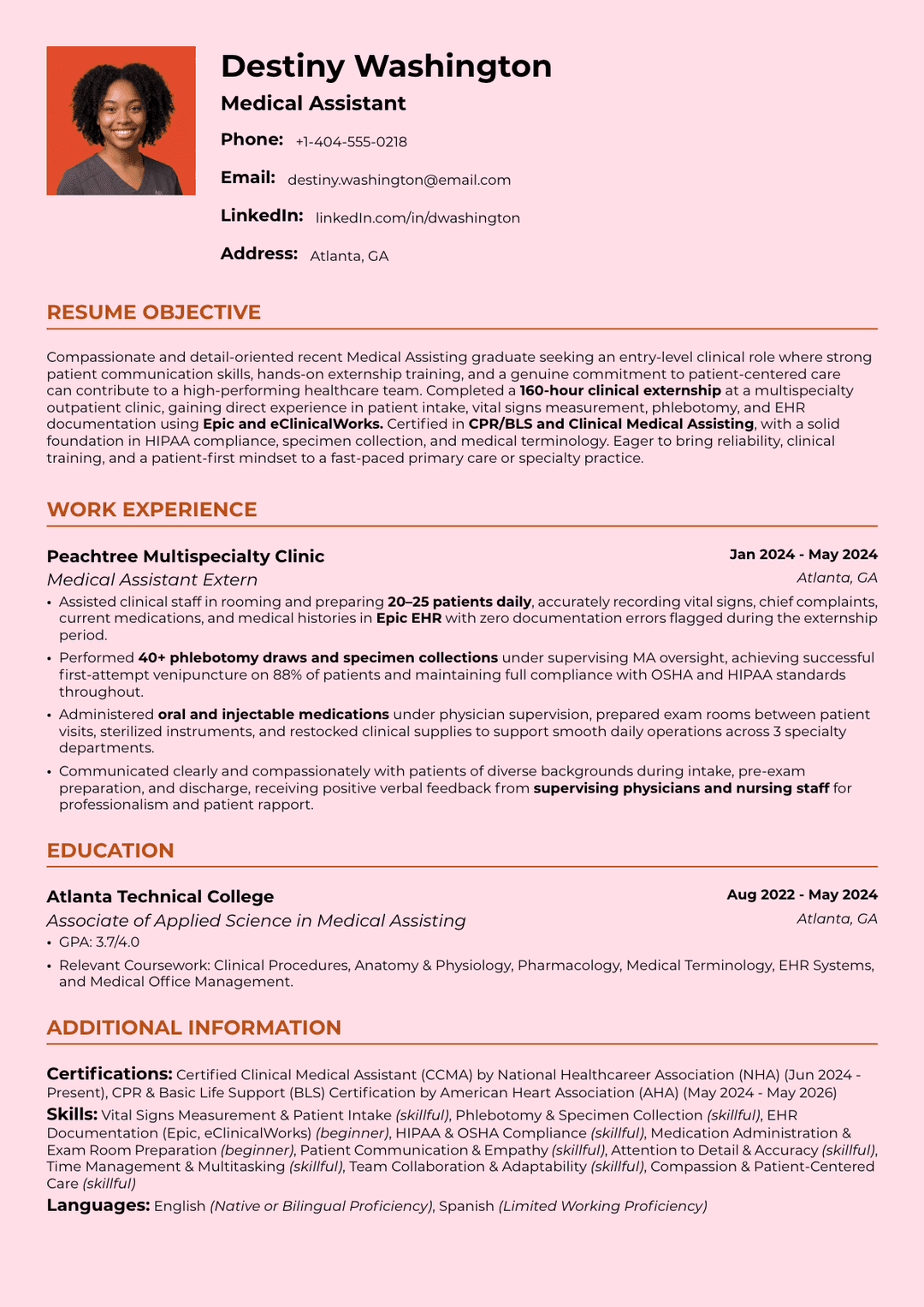
A medical assistant resume is a professional one-page presentation that highlights the clinical and administrative skills needed for this healthcare support role. It usually includes details about your experience with patient care, appointment scheduling, medical records, vital signs, billing, and communication with both patients and healthcare teams.
A strong resume for a medical assistant shows employers that you can handle a fast-paced medical environment while staying organized, accurate, and professional. It should also reflect the qualifications, certifications, and strengths that make you a reliable candidate for clinics, hospitals, and private practices, so it needs to be properly written.
This time, our experts teach you how to write a healthcare support resume that presents your experience clearly and effectively. We’ll cover what sections to include, how to describe your skills and achievements, and what employers usually want to see.
- A strong medical assistant resume should show both clinical and administrative abilities, since the role combines patient care tasks with front-office and documentation responsibilities.
- The reverse-chronological format is the best choice for most candidates because it is the most ATS-friendly and easiest for hiring managers to scan.
- The most important sections to include are contact information, a summary or objective, work experience, skills, education, and certifications, with optional sections added only when they strengthen the application.
- Work experience should focus on measurable achievements, strong action verbs, and job-relevant keywords rather than vague duty-based descriptions.
- Tailoring the resume to each job posting, keeping the layout simple, and including valued certifications like CMA, RMA, CCMA, and BLS can improve the chances of getting noticed.
What Does a Medical Assistant Do?
A medical assistant is a healthcare professional who bridges clinical and administrative work in a single role.
- On the clinical side, that means taking vital signs, drawing blood, administering injections, preparing patients for exams, and assisting physicians with procedures.
- On the administrative side, it's scheduling appointments, managing EHR documentation, handling insurance verification, and keeping the front desk running.
Medical assistants work across a wide range of settings, including outpatient clinics, private practices, hospitals, urgent care centers, and specialty offices. You'll find them in pediatrics, dermatology, orthopedics, oncology, cardiology, and many other medical branches.
Each specialty has its own skill demands, and targeting one on your resume can help you stand out. That dual clinical-administrative nature is exactly what makes your resume different from a nurse's or a phlebotomist's and why it needs to be structured carefully.
3 Professional Medical Assistant Resume Examples
The best way to understand what a strong medical assistant resume looks like is to see one. Below are three targeted examples for different experience levels and situations:
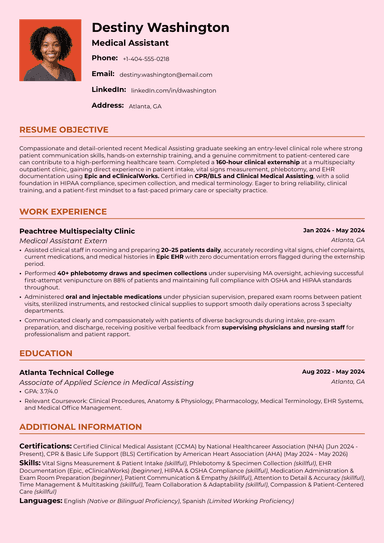
#1. Entry-Level/No Experience Medical Assistant Resume

#2. Certified Medical Assistant (CMA) Resume Example

#3. Specialty Medical Assistant Resume Example (Pediatric or Dermatology)

How to Format a Medical Assistant Resume
You should format a medical assistant resume using the structure that best fits your career stage; for most candidates, one format wins by a wide margin.
#1. Choose the Right Resume Format
Three resume formats dominate the field:
- Reverse-chronological: Best for candidates with a steady work history. It lists your most recent role first and works backward, and it’s most ATS-friendly and most familiar to hiring managers. Because of this, it should be a default unless you have a specific reason not to.
- Functional: Good for recent graduates or candidates with employment gaps. It’s centered on a skills-focused section rather than employment details and works for entry-level applicants. Some ATS systems parse it poorly, though, so you should use it with care.
- Combination/Hybrid: Ideal for experienced MAs moving into a specialty or leadership track because it blends a strong skills block with a full chronological work history.
#2. Set Up Your Layout
Keep the resume layout clean and parser-friendly by:
- Using 1-inch margins on all sides
- Opting for a sans-serif resume font like Arial or Calibri at 10–12pt for body text, and a single-column layout so ATS bots don't skip sections
- Save your file as .docx or PDF based on the employer's instructions
#3. Stick to One Page (Usually)
For entry-level candidates and those with fewer than five years of experience, a one-page resume is the standard length. It forces you to prioritize and eliminate irrelevant parts that don’t add value to your document, which hiring managers appreciate.
Still, if you've got five-plus years, multiple specializations, or significant certifications to list, a clean two-page layout is completely acceptable, but don’t do it just to fill space. Only write more if you actually have something important and relevant to mention.
What to Include in a Medical Assistant Resume
A strong medical assistant resume includes these core sections, built in the right order, with the right content in each:
#1. Contact Information
Put your full name in a larger, bold font at the top. Below that, you should state your city and state (no full street address needed), a phone number, and an email address. A LinkedIn profile URL is optional but worth including if it's complete and up to date. It should be as follows:
Joel Martins
Phoenix, AZ | (602) 555-0184 | joel.martins@email.com
linkedin.com/in/joelmartins123
#2. Professional Summary or Resume Objective
A resume summary is for experienced MAs who want to highlight their track record. Meanwhile, a resume objective is the best option for students, recent graduates, and career changers who want to lead with their goals and transferable skills. Keep either version to 3–4 lines max.
A resume summary example looks like this:
Compassionate CMA with 6 years of experience in family medicine, skilled in phlebotomy, EHR documentation, and patient triage. Reduced patient wait times by 20% through streamlined intake workflows. Seeking a clinical support role at a high-volume outpatient practice.
And here’s what a medical assistant resume objective could look like:
Detail-oriented medical assistant graduate with completed externship at a multispecialty clinic, certified in CPR/BLS, and proficient in Epic EHR. Eager to bring strong patient communication skills and clinical training to a fast-paced primary care team.
#3. Work Experience
A solid work history section lists roles in reverse-chronological order, stating the job title, employer name, location, and dates of employment for each position you held. Furthermore, each entry should contain around 3–5 bullet points per role, each starting with a strong action verb and describing a specific achievement you’re proud of.
You can do something like this:
Work Experience
Medical Assistant
DV Family Medicine, Phoenix, AZ
June 2021 – Present
- Room patients and record vital signs, medical histories, current medications, and chief complaints for 30+ patients per day.
- Assist physicians during routine exams, minor in-office procedures, and follow-up visits, helping reduce patient turnaround time by 15%.
- Administer injections, perform EKGs, collect blood and urine samples, and prepare specimens for laboratory testing.
- Update patient charts in Epic EHR, ensuring accurate documentation and compliance with HIPAA standards.
- Coordinate prescription refill requests, referral processing, and prior authorizations for 20+ cases weekly.
- Train 4 newly hired medical assistants on clinical workflows, charting standards, and patient communication protocols.
- Support front desk operations as needed, including appointment scheduling, insurance verification, and patient check-in.
Medical Assistant
Scott Hopkins Urgent Care, Mesa, AZ
March 2019 – May 2021
- Assisted providers with urgent care visits involving minor injuries, infections, flu symptoms, and basic diagnostic procedures.
- Collected vital signs, performed point-of-care testing, and documented visit information for an average of 35 patients per shift.
- Conducted phlebotomy, prepared exam rooms, sterilized instruments, and restocked clinical supplies to maintain smooth daily operations.
- Verified insurance coverage and entered demographic and billing information with a 98% accuracy rate.
- Explained treatment instructions, medications, and discharge paperwork to patients, improving follow-through and reducing repeat clarification calls.
- Helped implement a revised intake process that shortened average patient wait times by 10 minutes.
#4. Skills Section
Split your medical assistant skills into hard and soft ones; this separation makes the section instantly scannable for both human reviewers and ATS parsers. Also, it’s best to target keyword-rich skills that appear repeatedly in the job postings you're applying to.
You can see some examples of skills you can include in your resume here:
| Clinical Skills | Administrative Skills |
|---|---|
|
|
And here’s what this section can be like in practice:
[box]
Skills
Hard Skills
- Patient intake and triage support
- Vital signs measurement
- Electronic Health Records (EHR)
- Epic and eClinicalWorks
- Phlebotomy
- EKG administration
- Specimen collection and processing
- Insurance verification
- Medical billing support
- HIPAA compliance
- Referral coordination
Soft Skills
- Patient communication
- Attention to detail
- Time management
- Team collaboration
- Compassion
- Multitasking
- Problem-solving
- Organization
[/box]
#5. Education
The education section on your CMA resume needs to feature your degree or diploma name, institution, location, and graduation year. If you completed a formal medical assistant program, you should also note the specific credential.
Recent graduates should include relevant coursework related to clinical procedures, anatomy, pharmacology, and medical office management. Yet, a high school diploma plus on-the-job training meets the minimum bar for some employer settings, particularly smaller practices.
Here’s an example of this section:
Education
Associate of Applied Science in Medical Assisting
GateWay Community College, Phoenix, AZ
Graduated: 2018
#6. Certifications & Licenses
Many employers treat certifications as a hiring filter rather than a bonus. The most valued credentials in the field include:
- CMA (Certified Medical Assistant): issued by the American Association of Medical Assistants (AAMA); the gold standard for the profession.
- RMA (Registered Medical Assistant): issued by the American Medical Technologists (AMT) and widely recognized and valued by employers.
- CCMA (Certified Clinical Medical Assistant): issued by the National Healthcareer Association (NHA), with a strong clinical focus.
- CPR/BLS Certification: issued by the American Heart Association or the Red Cross, and is a non-negotiable requirement for most clinical settings.
- NCMA (National Certified Medical Assistant): issued by the National Center for Competency Testing (NCCT).
An example of this section looks like this:
Certifications
- Certified Medical Assistant (CMA) | American Association of Medical Assistants (AAMA) | 2018 | Expiration: N/A
- Basic Life Support (BLS) | American Heart Association | 2026 | Expires: 2028
- CPR Certification | American Heart Association | 2026 | Expires: 2028
#7. Optional Sections
Depending on your background, these additions can meaningfully strengthen your resume:
- Volunteer experience: especially valuable for recent graduates who need to show patient-facing work outside of formal jobs.
- Professional affiliations: AAMA membership, local medical assistant associations, or healthcare community organizations.
- Languages spoken: high value in multilingual clinic settings; if you're bilingual, say so clearly and early.
- Clinical rotations or externships; treat these exactly like work experience entries for new graduates.
Top 5 Tips for Writing a Medical Assistant Resume
Now, let’s see some extra tips on how to write a foolproof medical assistant resume:
- Tailor every resume to the job posting. Scan each job description for keywords and replicate them in your skills and experience sections. Generic resumes lose to targeted ones almost without exception.
- Lead with your strongest asset. If you're certified, put CMA or RMA right after your name in the header. If years of experience are your edge, you can open your summary with that number. One thing is for sure: your best credential should never be buried.
- Quantify your impact. Numbers make bullet points memorable and credible. Include patient volumes, satisfaction scores, error reduction rates, or efficiency improvements wherever you can find them.
- Don't neglect soft skills. Empathy, active listening, and patient communication are qualities hiring managers explicitly list in MA job postings. Weave them into your summary and specific bullet points.
- Keep it visually clean. Avoid excessive colors, icons, or graphics. These elements can confuse ATS parsers, and even human reviewers in busy clinical settings tend to prefer straightforward layouts that they can scan in 30 seconds.
Lastly, if you don’t want to do this on your own, ResumeBuilder.so can help. You don’t have to start from scratch; pick a template, and we will create a fully customized ATS resume for medical assistants that follows all the rules. You can also check out the best resume examples for your field and make sure yours is as polished and complete.
Do You Need a Cover Letter for a Medical Assistant Job?
You should include a cover letter for a medical assistant job because it gives you space to show the personality and motivation that a resume can't. Healthcare hiring managers want to know why you want to work with patients, and many clinical practices still expect a cover letter, so skipping one can quietly signal low effort.
You should make sure to:
- Address it to the specific hiring manager if you can find the name
- Reference the clinic or practice by name to show you've actually read the job posting
- Connect your MA resume skills to their specific patient population or practice focus
- Keep the letter length to one page without exceptions
Final Thoughts
A strong medical assistant resume comes together through picking the right format, building each section with the right content, and optimizing for ATS. None of it is complicated; it just requires a little bit of intention. Follow all these steps and our practical tips, and you’ll be sitting at an interview in no time, ready to land the role you want!
Medical Assistant Resume FAQ
#1. How do I write a medical assistant resume with no experience?
You can write a medical assistant resume with no experience by emphasizing your resume objective, formatting clinical rotations and externships as experience entries. You can also list any certifications earned during training and showcase transferable soft skills, such as communication, attention to detail, and working in fast-paced environments
#2. How long should a medical assistant resume be?
A medical assistant resume should be one page long for most candidates, especially those with fewer than five years of experience. Two pages are appropriate if you have multiple specializations, extensive certification history, or five-plus years of substantive experience.
#3. Is a medical assistant resume different from other healthcare resumes?
Yes, a medical assistant resume is different because of its dual clinical-administrative nature. Unlike a nurse's resume (focused primarily on clinical skills) or a medical biller's resume (focused on administrative and coding work), a certified medical assistant resume needs to demonstrate competence in both domains clearly and equally.

Max Harper is the resume guru who actually makes job searching easier. With years of experience as a hiring manager, Max knows what makes a resume stand out in a pile of 200+ applications. From breaking down ATS myths to helping you craft bullet points that pop, Max shares easy-to-digest, no-BS resume advice.