Functional Resume 2025 Writing Guide [w/ Examples]
This complete guide with detailed explanations and expert tips will teach you how to write an acting resume in record time!
Edit this resume![Functional Resume 2025 Writing Guide [w/ Examples]](/_next/image?url=https%3A%2F%2Fcdn.sanity.io%2Fimages%2Fbcftoxbw%2Fproduction%2Fb2069c23bbe3aca3d1a960461cba2d457b800a1f-1190x1683.png&w=1080&q=75)
A functional resume format shifts the spotlight from your work history to your skills and capabilities. This makes it an ideal choice for career changers, recent graduates, or anyone with employment gaps. Plus, unlike traditional chronological formats, this skills-focused resume lets you showcase what you can do rather than dwelling on when you did it.
In our writing guide, you will learn everything you need to know about functional resumes, including when to use them and how to structure them effectively to get the desired results.
- Functional resumes prioritize abilities and accomplishments over chronological work history.
- These are ideal for career changers, freelancers, recent graduates, and those with employment gaps.
- This format requires careful keyword integration and proper formatting to pass applicant tracking systems.
- Most functional resumes benefit from an accompanying cover letter to provide context.
What Is a Functional Resume?
A functional resume is a format that emphasizes your skills, qualifications, and achievements rather than your chronological work history. Also known as a skills-based resume, this format organizes your professional experience around key competency areas that align with your target job.
Instead of listing jobs in reverse-chronological order, functional resumes group related skills and accomplishments under themed categories, such as "Project Management," "Customer Relations," or "Technical Skills." Your actual employment history is presented later in the document with minimal detail, including only company names, job titles, and dates.
Functional vs. Reverse-Chronological Resume Format
Let’s see the main functional vs. reverse-chronological resume differences:
| Aspect | Functional Resume | Reverse-Chronological Resume |
|---|---|---|
Focus | Skills and capabilities | Work history and career progression |
Structure | Skills categories first, brief work history at the bottom | Detailed work experience at the top |
Best for | Career changers, employment gaps, and limited experience | Steady career progression |
ATS Compatibility | Moderate (requires careful formatting) | High |
Typically 1 page | 1-2 pages, depending on experience |
Who Should Use the Functional Resume Format?
Here’s a list of professionals who should use the functional resume format:
- Career changers transitioning to new industries who need to emphasize transferable skills
- Professionals with employment gaps due to personal reasons, education, or economic factors
- Recent graduates with limited work experience but strong academic achievements and internships
- Freelancers and consultants with diverse project-based expertise across multiple clients
- Military veterans transitioning to civilian careers
- Stay-at-home parents re-entering the workforce after an extended absence
- Mature workers facing age discrimination who want to focus on their current skills
Who Shouldn’t Use the Functional Resume Format?
This format wouldn’t be the best choice for:
- Professionals with strong, relevant work history in a given field
- Job seekers applying to companies known to prefer different (traditional) formats
- Candidates applying to government positions, since these typically require chronological formats
When to Use the Functional Resume Format
You should consider using the functional resume format when applying for roles where:
- Skills matter more than experience, which are typically positions that prioritize specific competencies over years of experience
- Industry knowledge transfers, e.g., jobs where your skills from other fields directly apply
- Creative problem-solving is valued, such as roles that appreciate diverse backgrounds and unique perspectives
- Training is provided; for example, companies are willing to invest in developing the right candidate
Functional resumes work particularly well for positions in consulting, project management, customer service, sales, and creative fields, where demonstrable skills often outweigh traditional career paths.
Pros and Cons of a Functional Resume Format
Getting familiar with the advantages and disadvantages of functional resumes helps you make an informed decision about whether this format is suitable for your situation. So, let’s see what both its advantages and drawbacks are:
- Highlights relevant skills and achievements
- Minimizes employment gaps
- Is the best resume for career changes
- Emphasizes transferable skills
- Accommodates diverse backgrounds
- Is great for showcasing volunteer/freelance worka
Cons
- May be considered unreliable by some employers
- Provides limited space for showcasing career progression
- May not pass all ATS systems effectively
- Lacks context for accomplishments
- Requires a strong cover letter for explanation
- Isn’t suitable for all industries
How to Write a Functional Resume: Structure and Sections
To write a functional resume, you need to structure the document well and include all the necessary sections in it. The goal is to present your skills in a compelling manner while maintaining professional credibility.
Let’s see what the mandatory sections of a functional resume are:
#1. Contact Information
Your contact section should be clean, professional, and easily scannable. You should place it at the top of your resume and include the following in it:
- Full name (larger font, bold)
- Job title
- Phone number
- Professional email address
- City and state
- LinkedIn profile URL
- Portfolio/website (if relevant)
Let’s see what it should look like:
Sarah Johnson
Marketing Specialist
(555) 123-4567
sarah.johnson@email.com
Chicago, IL
linkedin.com/in/sarahjohnson.66
#2. Resume Summary / Professional Profile
Your professional summary is crucial in a functional resume, as it's your elevator pitch that explains who you are and what value you bring. These 3-4 sentences should immediately capture the reader's attention.
Structure your summary to include:
- Your professional identity/title
- Years of experience (if beneficial)
- 2-3 key skills or achievements
- Career objective or value proposition
Ensure that you tailor your summary to each job application, incorporating relevant keywords from the job description to enhance ATS compatibility. Let’s see an example:
Motivated and adaptable professional with a strong foundation in technical drafting, CAD, and 3D modeling, paired with excellent problem-solving and analytical skills. Known for quickly learning new tools and processes, collaborating effectively in team environments, and delivering creative, detail-oriented solutions. Eager to apply technical expertise and adaptability to a new industry, contributing to innovative projects and continuous improvement.
#3. Skills
The skills section is the centerpiece of your functional resume. Here, you should organize your abilities into 3-5 themed categories that align with your target job requirements. Each category should contain specific examples of how you've applied these skills.
Here’s an effective way to do so:
Project Management
- Led cross-functional teams of 8-12 members to deliver projects 15% ahead of schedule
- Implemented Agile methodologies, resulting in a 25% improvement in team productivity
- Managed project budgets ranging from $50K to $300K with 98% accuracy
Client Relations
- Maintained a 95% client retention rate through proactive communication and problem-solving
- Developed customer service protocols that reduced response time by 40%
- Trained 15+ team members in client relationship management best practices
#4. Work Experience
In a functional resume, your work experience section is brief and factual. List your positions in reverse-chronological order, and include:
- Job title
- Company name and location
- Employment dates (years only if career gaps exist)
- 1-2 bullet points maximum (optional)
However, you should keep descriptions minimal since you've already highlighted your achievements in the skills section.
This is what it should look like:
Work Experience
Marketing Coordinator
ABC Company, Chicago, IL
2020-2023
Customer Service Representative
XYZ Corp, Chicago, IL
2018-2020
#5. Education and Certifications
Place your education section after work experience, unless you're a recent graduate or your education is highly relevant to the position. You can also include relevant certifications, training programs, and professional development if applicable.
Here’s an example:
Education
Bachelor of Arts in Communications
University of Illinois, Chicago
2013–2017
Certifications
- Project Management Professional (PMP) - 2022
- Google Analytics Certified - 2023
- HubSpot Content Marketing Certification - 2022
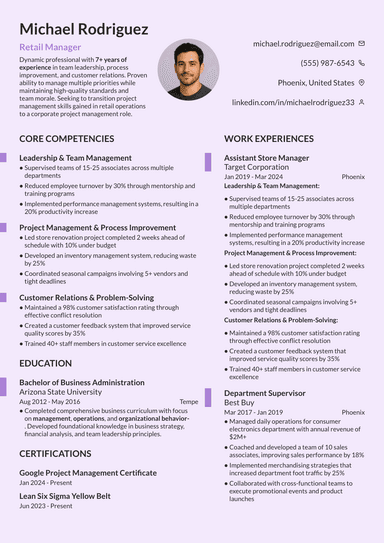
Functional Resume Example
Here's a realistic example of a functional resume for a career changer transitioning from retail management to project management:

4 Powerful Tips to Write a Strong Functional Resume
These functional resume writing tips will help you craft a document that captures attention and opens doors:
#1. Focus on Quantifiable Skills and Achievements
Numbers tell stories that resonate with hiring managers. Instead of saying you "managed a team," specify that you "supervised 12 team members and increased productivity by 18%." This approach transforms generic skills into compelling proof of your capabilities.
To illustrate this, here’s one good and one bad example:
Resolved 50+ customer inquiries daily with a 96% satisfaction rating, contributing to a 15% increase in repeat business
Bad Example
Responsible for customer service activities
#2. Use Keywords From the Job Description
Modern hiring often involves applicant tracking systems (ATS) that scan resumes for relevant keywords before human eyes ever see them.
A good keyword integration strategy involves the following tips:
- Mirror the job title and key requirements in your summary.
- Use industry-specific terminology in your skills sections.
- Include relevant software, tools, and methodologies mentioned in the posting.
- Incorporate action verbs that appear in the job description.
#3. Keep Formatting Clean and Professional
A cluttered or overly creative resume can backfire, especially since some employers already view this format with skepticism. Therefore, you should stick to clean, professional functional resume layouts that emphasize readability. You can do so by:
- Using consistent font sizes and styles throughout
- Maintaining adequate white space between sections
- Choosing professional fonts like Arial, Calibri, or Times New Roman
- Keeping to standard resume margins (0.5-1 inch)
- Using bullet points for easy scanning
- Avoiding graphics, photos, or unusual formatting elements
- Sticking to black text on white background or using minimal color accents (navy, dark gray) for headers only
#4. Attach a Cover Letter to a Resume to Explain Your Background
Functional resumes may raise some questions that cover letters can answer. Use this opportunity to tell your story, explain career transitions, and provide context for your unconventional path.
Your cover letter should:
- Explain why you're changing careers or have employment gaps
- Connect your transferable skills to the target role
- Show enthusiasm for the new direction
- Provide specific examples that complement your resume
The combination of a strong functional resume and compelling cover letter creates a complete narrative that helps employers see your potential rather than focus on what might be missing from your background.
Supercharge Your Resume with ResumeBuilder.so
Creating the perfect functional resume doesn't have to be overwhelming. ResumeBuilder.so's software takes the guesswork out of formatting, structure, and content, helping you craft a professional document that gets noticed.
Our platform offers ATS-friendly functional resume templates designed specifically for career changers, recent graduates, and professionals with unique backgrounds. With built-in keyword optimization and real-time formatting guidance, you can create a compelling functional resume in minutes, not hours!
Functional Resume Template
Here's a complete functional resume template you can customize for your own job search:
Final Thoughts
The functional resume format can be a powerful tool when used strategically. While it's not the right choice for every job seeker, it offers career changers, recent graduates, and professionals with non-traditional backgrounds a way to highlight their potential rather than their limitations.
Remember, the goal isn't to hide your background but to present it in the most favorable light. When done well, a functional resume demonstrates that you're a thoughtful professional who understands how to communicate value effectively.
Functional Resume FAQs
#1. Do employers like functional resumes?
Employers sometimes like functional resumes and sometimes don’t; the reactions are mixed. While some appreciate the skills-focused approach, others prefer traditional chronological formats that clearly show career progression. Therefore, the success of this format depends on your industry, the specific employer, and how well you execute the format.
#2. Can I use a functional resume for my first job?
Yes, you can use a functional resume for your first job, as it’s perfect for job seekers who lack extensive work experience. This format lets you highlight relevant coursework, internships, volunteer work, and transferable skills from part-time jobs without relying too much on your work history.
#3. Are functional resumes ATS-friendly?
Functional resumes can be ATS-friendly, but they require careful formatting and keyword optimization. To help them pass ATSs, you should use standard section headings, include relevant keywords throughout, and maintain simple formatting without graphics or unusual layouts.
#4. How long should a functional resume be?
A functional resume should be one page long, especially for professionals with less than 10 years of experience. If you have extensive skills and achievements that warrant more space, a two-page resume is acceptable.
#5. What is the disadvantage of a functional resume?
The main disadvantages of a functional resume include employer skepticism (some view them as attempts to hide information), limited ability to show career progression, potential ATS compatibility issues, and the challenge of providing context for achievements.

Jordan Lee is your guide to navigating the rapidly changing job market in the age of AI and automation. He dives into how AI is reshaping hiring, the skills of the future, and what job seekers need to do now to stay relevant. If you’re curious about how technology is transforming careers and want to future-proof your job, Jordan’s insights are a must-follow.