Salary Expectations in an Interview: Complete Guide + Real Scripts


Salary expectations are one of the few stressful interview moments, however, most job seekers walk in completely unprepared. If you don't anchor your expectations to real market data, you’re eliminating yourself from consideration or getting far less than the role pays.
In this guide, we give you the tools and example scripts to answer salary expectation questions with confidence—whether you're filling in an application form, fielding a recruiter's opening call, or sitting across the table in a final interview.
- Salary expectations refer to the pay range you consider fair for a specific role based on your experience, skills, and market data; they can come up on applications, in recruiter calls, or during formal interviews.
- Researching your market value is the most important step before any interview; always filter by location, industry, and experience level.
- Always give a range, not a single number, and anchor it on the higher end of what you'd accept to preserve negotiating room.
- Never disclose your current salary if you can avoid it; focus the conversation on market value and your qualifications instead.
- A salary negotiation is expected; an initial offer is rarely the final one.
Why Do Employers Ask About Salary Expectations?
There are three main reasons employers ask about salary expectations:
- Budget alignment. They need to confirm your target compensation fits their approved range before investing further in the hiring process.
- Self-awareness check. Candidates who know their market value demonstrate professionalism and confidence—that matters to employers.
- Negotiation signal. Your response sets the tone for all compensation conversations ahead. How you answer reveals how you approach professional give-and-take.
However, it’s worth noting that in many U.S. states, employers cannot legally ask about salary history. That shifts the power to you because the conversation is about your target, not your past.
How to Do Research for Salary Expectations Talk
You can do research for your salary expectations talk by following the four steps outlined below. Each step builds on the last. Let’s work through all four, and you'll walk into any salary conversation with a figure you can defend.
#1. Use Trusted Salary Databases
The most reliable free salary database is the U.S. Bureau of Labor Statistics, which is best for the U.S. median salary by role. The filtering step here matters.
Make sure to set the job title, city or region, industry, and experience level every time. A software engineer in San Francisco earns significantly more than one in a small Midwestern city, and national averages can mislead you in both directions.
Cross-reference at least two or three sources and take the midpoint as your baseline. One data point is never enough.
#2. Research the Specific Company and Role
Many companies now publish salary ranges directly in job listings, especially in states where it's legally required. Check the original job posting carefully before you do anything else. It's the most direct data point available.
Then, research the company on Glassdoor and LinkedIn to see compensation reported by current and former employees with the same or similar titles.
Company size, funding stage, and industry all affect what's realistic. An early-stage startup usually can't match enterprise base salary, but it may offer equity worth far more. Factor this into your expectations before you set your floor.
If the job listing includes a salary range, aim for the upper third of it. Asking above the posted maximum risks getting immediately eliminated from the process.
#3. Factor In Your Experience, Skills & Achievements
Market data gives you a range. However, your skills and qualifications determine where within that range you belong.
Here are a few factors that push you toward the upper end:
- In-demand technical skills (Python, CRM, PMP certification)
- Management experience
- Measurable past achievements
- Niche expertise
- Competing offers
On the other hand, factors that keep you near the middle include:
- Career transitions where your experience is transferable but not direct
- Employment gaps
- Entry-to-mid-level role at a new company
List three to five specific achievements, as you would on a resume, that justify the upper end of your range. You'll use these in the actual conversation.
#4. Account for the Full Compensation Package
Base salary is only one part of what a job pays you. Before you set your floor, calculate the full value of the package. Consider the following components:
- Health, dental, and vision insurance (employer contribution value)
- Paid time off
- Remote work or hybrid flexibility (real economic value—commuting is expensive)
- Annual bonus potential
- Equity or stock options
- 401(k) match
- Signing bonus
- Professional development stipend
- Home office allowance
If two offers have the same base salary, total compensation may look very different once you add everything up. Run the math before you decide which to accept or counter.
How to Answer "What Are Your Salary Expectations?"
You can answer "What are your salary expectations?" question effectively by choosing one of the three strategies below:
#1. Give a Researched Salary Range
This is the recommended default for most candidates in most situations. Give a range, not a single number. Anchor the range slightly above your real target.
If you'd accept $85,000, your range should open at $85,000 and extend to $95,000—not drop to $75,000. Tie the range to your research: "Based on market data for this role in [city] and my [X] years of experience, I'm targeting…" This frames your ask as objective rather than personal.
Always close with an invitation to discuss: "I'm also happy to consider the full compensation package." That phrase alone can open doors that the base salary conversation closes.
Here are two good example answers to the question "What are your salary expectations?":
Based on my research and my seven years of experience in digital marketing — including leading campaigns that increased revenue by 30% — I'm looking for a range of $90,000 to $105,000. That said, I'm open to discussing the full compensation package, including benefits and any performance bonus structure.
Based on the market data I've found for entry-level [role] positions in [city], the typical range is $52,000 to $60,000. Given my internship experience and certifications in [X], I'd be targeting closer to the midpoint of that range — around $55,000 to $58,000. I'm very open to discussing the full package.
#2. Deflect (Early-Stage Interviews Only)
Deflecting is a valid move if you're on a first screening call and don't yet have enough information about the full scope of the role. The goal is to redirect the conversation toward the role's details, not to dodge the question indefinitely.
If the interviewer presses after your deflection, follow with a range. Use this approach at most once in the process. Recruiters lose patience quickly when candidates keep redirecting, and rightfully so.
That said, here's how you might frame your answer:
I want to make sure we're a great fit before I commit to a specific number. Could you share the budgeted salary range for this position? That would help me give you a much more useful answer.
#3. Lead with Market Data (Experienced Candidates)
For experienced candidates or anyone with a competing offer or a strong best alternative to a negotiated agreement (BATNA), grounding your answer entirely in external data removes the personal element and strengthens your position.
Present the data first, then connect your specific qualifications as the justification for the upper end of the range. This approach works especially well when you have leverage. For example:
Industry data for a Senior Product Manager in Austin, TX shows a market range of $130,000 to $155,000. Given my background launching three products from zero to over $10M ARR and my current competing offer, I'm targeting the upper end — around $148,000 to $155,000. Is there flexibility in that range?
What to Say vs. What NOT to Say When Talking About Salary Expectations
Here's a quick comparison of what to say versus what not to say in salary expectations conversations:
Give a researched range tied to market data
Anchor the lower end at your actual minimum
Invite discussion of the full package
Be specific: "I'm targeting $90,000–$105,000"
Ask for 24–48 hours to review a written offer
DON'T
Say "I'll take whatever you offer" — even at entry level, this signals a lack of research
Drop your floor trying to seem flexible — you'll regret it at offer time
Disclose your current salary if you can avoid it — the conversation should focus on market value
Be vague: "Something fair" or "competitive" means nothing
Accept verbally on the spot without reviewing the full package
How to Fill In Salary Expectations on a Job Application
When filling in salary expectations on a job application, you should match your approach to whether the field is optional or required. Also, always base your entry on the research you've already done.
If the field is optional, leaving it blank is usually the safest choice. It keeps you in contention across the widest possible budget range. Acceptable alternatives are writing "Negotiable" or "Open to discussion."
If the field is required and accepts a range, input your researched range. Match it to the salary range in the job listing if one was published. If the field only accepts a single number, enter the midpoint of your researched range—or the lower bound of your target (you can negotiate upward during the interview).
Never type "$0," "$1," or "N/A" in a numeric field. Some applicant tracking systems automatically filter out candidates whose stated figure falls outside the budgeted range or appears incomplete.
Salary Negotiation After Receiving a Job Offer
After receiving a job offer, you can negotiate a salary by reviewing the full offer first, making a justified counter-offer, and then negotiating beyond the base salary if needed.
Most job seekers find this part nerve-wracking. That's understandable, but it helps to know that most employers expect a counter. The initial offer is rarely the final one.
Step 1: Take Your Time to Review the Full Offer
When a verbal or written offer arrives, thank the employer warmly. Then, ask for 24 to 48 hours to review before responding. This is professional, expected, and gives you time to think clearly rather than react.
During that window, compare the offer against your research, assess the total compensation package (not just base), and decide on your counter range. If you're actively interviewing elsewhere or have another offer, this is the moment your BATNA has the most power.
Step 2: Make a Justified Counter-Offer
Build your counter on at least one of the following:
- Market research
- Specific achievement that justifies the higher ask
- Competing offer
However, state it with confidence. Apologising or over-hedging weakens your position before you've started. Also, be specific, not vague. That said, let’s see a good example:
Thank you so much for the offer — I'm genuinely excited about this role and the team. After reviewing everything, I'd like to discuss the base salary. Based on my research for this role in [city] and my specific experience with [achievement], I was hoping to come in closer to $[X]. Is there any flexibility there, or alternatively, could we look at the overall package?
Step 3: Negotiate Beyond the Base Salary
If the employer confirms the base salary is genuinely fixed, shift focus to other levers where there's typically more budget flexibility. You might be surprised by how much movement there is outside the base.
Here’s a quick overview of what to negotiate and why it works:
| Negotiation Lever | What to Ask For | Why It Works |
|---|---|---|
Signing bonus | One-time payment at start | Often outside the recurring salary budget—easier to approve |
Extra PTO | Additional vacation days | Costs the company little but can be worth thousands in value to you |
Remote / hybrid flexibility | Full or partial WFH arrangement | Eliminates commuting costs and time—measurable financial value |
Accelerated review | Performance review at 6 months instead of 12 | Gets you to the next salary band faster |
Professional development | Conference, course, or certification budget | Employer investment in skills that stay with you |
Equity / stock options | Shares or RSUs, especially at startups | Can significantly exceed base salary over a vesting period |
How to Build a Resume That Supports Your Salary Expectations
Your resume directly influences how seriously employers take your salary expectations because it's the evidence behind the ask. A well-written resume makes your stated range credible before you ever open your mouth.
To accomplish this, make sure to:
- Quantify your achievements. Numbers make your salary ask credible before the interview begins.
- Highlight in-demand, relevant skills. Skills listed in the job description, especially those in short supply, are direct justification for the upper end of a salary range.
- Tailor your resume to each role. Generic resumes signal low effort and often result in lower offers. A resume that mirrors the language in the job posting shows clear fit.
- Use an ATS-friendly format. A professional and clean resume format signals you're a serious candidate. Formatting errors or non-standard layouts can get a strong candidate rejected before a human reads a word.
- Pair your resume with a strong cover letter. A compelling cover letter connects your experience directly to the role's needs. Therefore, it indirectly justifies your target salary.
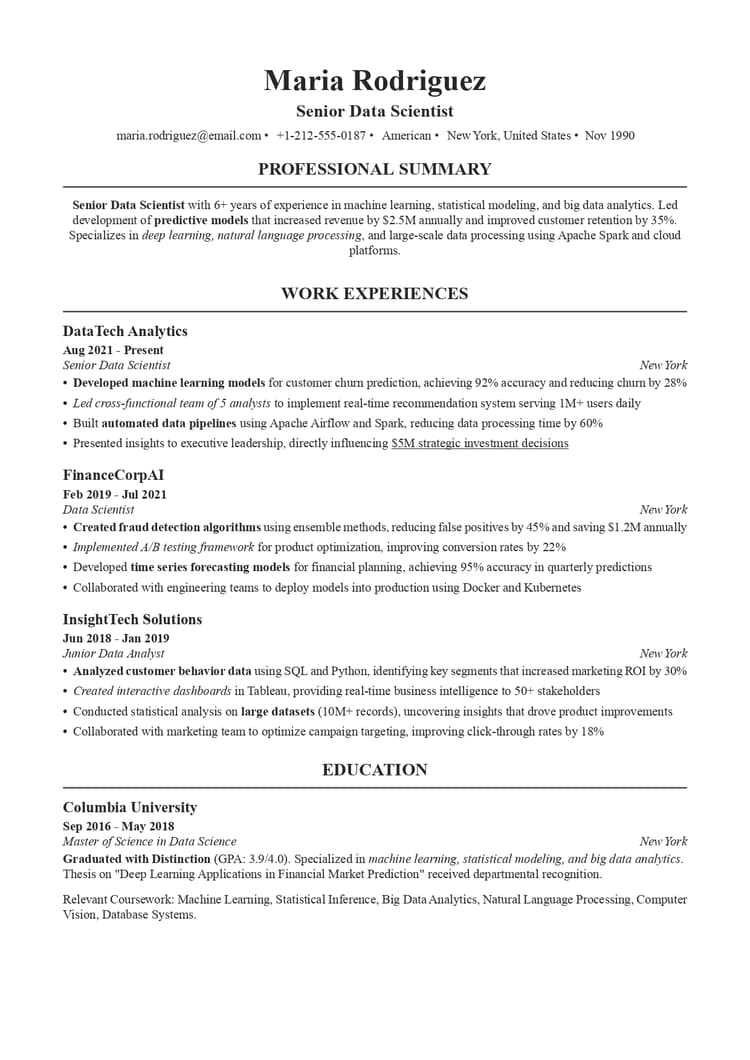
A strong resume is your best salary negotiation tool.
Build yours in minutes at ResumeBuilder.soFinal Thoughts
Salary expectations are one of the most preparation-sensitive moments in the entire job search, and the work you do before the interview determines how confidently you walk in.
Research, a clear answer strategy, and a willingness to negotiate are the three pillars. None of them require years of experience—just time and method. Whether you're a recent graduate with no experience resume or a senior executive, the framework in this guide applies. The numbers change; the process doesn't.
Before your next interview, make sure your resume makes the same argument for your value that your salary ask does.
Salary Expectations FAQs

Jordan Lee is your guide to navigating the rapidly changing job market in the age of AI and automation. He dives into how AI is reshaping hiring, the skills of the future, and what job seekers need to do now to stay relevant. If you’re curious about how technology is transforming careers and want to future-proof your job, Jordan’s insights are a must-follow.