"What Are Your Strengths?": How to Answer + Best Examples

The purpose of the “What are your strengths?” interview question is to allow you to explain the skills, qualities, or work habits that make you effective in a role. Prospective employers want to know whether your strongest abilities match the job, how self-aware you are, and whether you can back up your answer with real examples instead of vague claims.
This article explains why employers ask this question, how to choose the right strengths to mention, and how to answer in a confident, specific, and relevant way.
- Interviewers ask “What are your strengths?” to assess your self-awareness, role fit, communication skills, and confidence.
- The list of strengths for a job interview should contain the qualities that match the job description and reflect the abilities you genuinely have.
- The answer should focus on a real example of your greatest strength, and you should use the STAR method when possible.
- Quantifying your results makes your answer more credible and helps employers understand the value you can bring.
- Common mistakes include giving clichéd answers, sounding arrogant, choosing irrelevant strengths, or speaking too vaguely or for too long.
Why Interviewers Ask "What Are Your Strengths?"
Interviewers ask “What are your strengths?” to assess four things at once:
- Self-awareness. Hiring managers want to know you understand yourself well enough to name what you're genuinely good at. Candidates who can't do this often struggle with feedback, too.
- Role fit. They're checking whether your skills and strengths for work map to what the job actually requires. A great communicator applying for a data analyst role needs to make that connection; it won't happen automatically.
- Communication skills. If the answer to “What is your greatest strength?” is clear, structured, and specific, that's a good sign; anything else is less so.
- Confidence calibrated right. There's a difference between owning your abilities and overselling them. Job interviewers are listening for that distinction the whole time you speak.
So, as you can see, it's a genuinely useful question for them, and once you understand what they're actually after, it becomes a much easier one for you.
How to Identify Your Personal Strengths for an Interview
To identify your personal strengths for an interview, you should:
#1. Review the Job Description
Read the job description and highlight the most prominent abilities. The skills that appear repeatedly in the requirements section are exactly the strengths the employer values most.
Your job is to identify two or three of those that you genuinely possess. This approach to matching a job description to your own experience is the same principle that makes a resume work, applied to interview preparation.
#2. Look at Past Performance Reviews and Feedback
What did your manager say in your last review? What do people consistently come to you for? For example, if colleagues keep asking you to proofread their work, attention to detail is probably a real strength; if your team relies on you to keep meetings on track, organizational skills or leadership might be your answer. Past feedback is one of the most honest mirrors you have.
#3. Ask Trusted Colleagues or Mentors
Other people often see your strengths more clearly than you do, especially the ones you've taken for granted.
Ask a colleague or mentor what they'd say your top professional quality is; you might be surprised. If you want a more structured approach, tools like the CliftonStrengths assessment or the VIA Character Strengths survey can also surface patterns you hadn't noticed.
How to Answer "What Are Your Strengths?"
To answer “What are your strengths?” properly, you need to pick the right strength for the role, then back it up with a real story, a concrete result, and a clear connection to the job.
Don't reach for whatever comes to mind first. Think about what this specific role actually needs; focus on one main strength and, if you like, briefly mention one or two that support it.
Many candidates mention the strength but forget to explain how it manifests. You should explain how this quality helped you handle specific tasks or challenges, and the STAR method for behavioral interviews is the best way to do so. It gives you a clean structure and turns your strength into a story.
Numbers land harder than adjectives, so whenever you can attach a figure to your result (a percentage, a dollar amount, or a timeframe), you should do it. The principle is the same when you want to frame quantifiable achievements on a resume and in an interview.
End your answer by linking the strength to what you'd bring to this specific position, e.g., "That's why I think this role is a strong fit for me; the work requires exactly that kind of problem-solving under tight timelines." It shows you've done your research and you're thinking about contribution rather than just credentials.
20 Best Strengths for a Job Interview (With Sample Answers)
Here are some examples of professional strengths you can mention in your interview, along with a sample answer for each. They're grouped into three categories so you can quickly find what's most relevant to your role.
#1. Communication Skills
Strong communicators can translate complex information clearly, be it a presentation, an email, or a one-on-one conversation. This strength matters in almost every role.
"My greatest strength is communication. In my last role, I noticed that handoffs between our design and development teams kept causing project delays. I set up a weekly alignment call that cut miscommunication issues by about 60% over three months."
#2. Collaboration & Teamwork
Employers want people who can collaborate and make their teams better; they don’t need just contributors who work alongside others.
"I'd say my strength is collaboration. On a recent product launch, I worked across five departments to coordinate our go-to-market timeline. We hit our launch date two weeks early, and the project lead credited the cross-team communication for keeping things on track."
#3. Empathy & Emotional Intelligence
High emotional intelligence, or the ability to read a room and respond to people's emotional state, is increasingly valued, especially in client-facing and leadership roles.
"My greatest strength is emotional intelligence. When a major client was frustrated with delays during a software rollout, I scheduled a call just to listen before proposing solutions. That conversation turned a near-churn situation into a renewed contract."
#4. Conflict Resolution
The ability to handle conflicts, de-escalate tension, and get people back on the same track (without taking sides) is genuinely rare.
"I'm strongest when it comes to conflict resolution. Two team members on a project I led had very different working styles that were slowing the whole team down. I facilitated a direct conversation between them, and we agreed on a clearer division of responsibilities. The friction basically disappeared within a week."
#5. Active Listening
Most people listen to respond, but active listeners do it to understand, and that difference shows up in meeting effectiveness, client relationships, and team morale.
"My greatest strength is active listening. During customer discovery calls at my last company, I began documenting the exact phrases customers used to describe their frustrations. That informed our next product update and drove a measurable uptick in satisfaction scores."
#6. Problem-Solving
Problem-solving skills are a perennial favorite for a reason: almost every job involves obstacles, and employers want people who face them calmly and creatively.
"Problem-solving is where I feel most confident. When our main supplier went out of business mid-project, I identified three alternatives within 48 hours, negotiated pricing, and we kept the project on schedule without significant cost increases."
#7. Critical Thinking
Critical thinkers execute, question assumptions, spot gaps, and improve processes before problems arise.
"I'd say critical thinking is my strongest quality. I noticed our team was spending hours generating reports that nobody was reading. I proposed a streamlined version, got buy-in, and we freed up about five hours per week across the team."
#8. Attention to Detail
In roles where errors are costly, such as finance, healthcare, legal, and engineering, this strength is typically a must.
"My attention to detail has consistently made a difference. Before a major client proposal went out, I caught a pricing discrepancy that would have cost the company around $15,000. The client never saw it, which is exactly the point."
#9. Data Analysis
Since more roles become data-influenced, the ability to extract meaning from numbers has become a competitive edge.
"Data analysis is probably my greatest strength. In my previous role, I built a dashboard that gave our sales team real-time visibility into pipeline health. It cut our quarterly forecast prep from three days to a few hours."
#10. Decision-Making Under Pressure
Fast, sound decisions in high-stakes situations are rarer than most people think.
"I perform well when quick decisions matter. During a system outage that was affecting live client transactions, I made the call to roll back our recent deployment before we had full diagnostic data. That decision restored service 45 minutes faster than if we'd waited."
#11. Leadership & Initiative
Leadership isn't just for managers. Candidates who can take ownership, motivate others, and drive things forward stand out at every level.
"My best strength is leadership, or specifically, leading without a formal title. I noticed our onboarding process was inconsistent across the team, so I drafted a standardized guide, presented it to my manager, and ended up running the training for new hires. Onboarding time dropped from three weeks to ten days."
#12. Adaptability
Priorities, tools, team structures, and market conditions change all the time, everywhere. Given this, adaptable employees are typically real assets during transitions.
"Adaptability is something I genuinely pride myself on. When our company pivoted to a fully remote model overnight, I volunteered to help rebuild our communication workflows. We had a functional remote system in place within two weeks."
#13. Time Management & Organization
Good time management and the ability to juggle competing priorities without dropping anything are something managers deeply appreciate.
"Time management is one of my consistent strengths. I manage my work across multiple clients by blocking time by project type each week. I've never missed a client deadline in three years."
#14. Work Ethic & Reliability
Work ethic may be underrated, but it’s rather meaningful. Managers want people who show up consistently and follow through without being micromanaged.
"Reliability might be my defining professional trait. My manager has told me I'm the first person she calls when something critical needs to get done because she knows it will be handled completely and on time."
#15. Creativity & Innovation
Creative thinking isn't limited to design roles; fresh ideas and new approaches matter in every industry.
"Creativity is my greatest strength. When our email open rates were declining, I proposed shifting our newsletter format from company news to a curated industry digest. Open rates went from 18% to 34% over two months."
#16. Multitasking
Handling several responsibilities simultaneously without losing quality on any of them is genuinely useful in fast-moving environments.
"I'm comfortable managing multiple workstreams at once. As an operations coordinator, I regularly juggled vendor negotiations, event logistics, and internal reporting simultaneously. I built a shared tracking dashboard that kept everything visible and on schedule."
#17. Mentorship & Coaching
This strength shows leadership potential and emotional generosity, which are the qualities that stand out, especially for senior roles.
"Mentorship is something I take seriously. I've been informally coaching two junior team members for the past year. One just got promoted, and she mentioned our sessions as a factor in her growth."
#18. Project Management
If you can get complex initiatives from concept to completion (on time or on budget), it means you have enviable organizational and interpersonal skills.
"Project management is where I'm strongest. I led a cross-functional software migration involving four teams and an external vendor. We finished two weeks ahead of schedule and under budget by 12%."
#19. Self-Motivation
Independent contributors who don't need hand-holding are highly valued, particularly in remote work or hybrid environments.
"I'm very self-directed. During a period when our team was understaffed, I identified a bottleneck in our content approval process, built a new workflow without being asked, and reduced approval time by three days."
#20. Continuous Learning & Growth Mindset
In fast-moving industries, the willingness to learn new things quickly can matter as much as current skill level.
"My greatest strength might be my approach to learning. When my company adopted a new CRM platform, I spent three weekends getting certified before launch. I ended up training the rest of the team and became the internal go-to resource."
How Your Strengths Should Appear on Your Resume vs. in an Interview
There's a difference between listing the examples of your greatest strengths for a resume and explaining them during an interview.
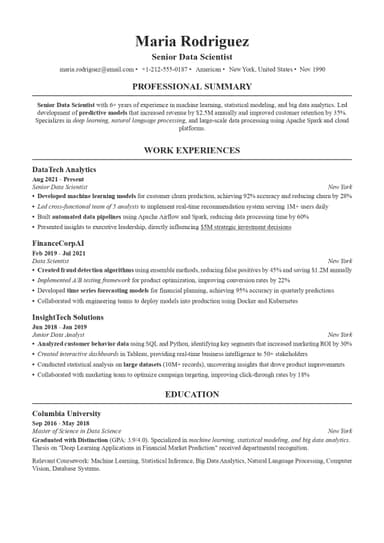
In your job application, they appear as concise, keyword-rich skills, ideally in a dedicated skills section and woven into bullet points in your work experience. Both sections need to be scannable and include the right keywords to get you past the filter.
The best way to approach making these is to use the professional templates offered by ResumeBuilder.so. In just a few minutes and with a few details about your best qualities and work endeavors, we can create an ATS-friendly, customized resume that will showcase your biggest strengths exactly as they should be highlighted to impress hiring managers.
However, in an interview, those same strengths need to become stories. Therefore, you should treat your resume's skills section as your "strength bank." Every item on that list needs to have at least one interview-ready story attached. If it doesn't, either build the story or don't list the skill, but the two should always match.
5 Common Mistakes When Answering "What Are Your Strengths?"
Finally, let’s have a look at several interview mistakes you can make when answering this question:
Every candidate can say that they’re a perfectionist or a hard worker, but that’s essentially meaningless to interviewers. These don't differentiate you, and they don't tell the hiring manager anything specific about how you work. Instead, you should name something concrete and back it up with a result.
Stating that you possess a quality without proof is just a claim, and a claim without evidence is easy to ignore. Use the STAR method for strengths every time, as it turns a generic statement into a credible, specific story with important details.
Talking about your creativity when applying for an accounting role (without connecting the two) doesn’t mean much. Every strength you mention should have a clear line to what the job requires; when in doubt, go back to the job description.
There's a real difference between owning your abilities and boasting about them. The safest way to stay on the right side of that line is to let the story do the talking. Describe what you did and what happened so that the quality of the example can convey confidence without you needing to oversell it.
A five-minute monologue on a single skill will probably test the recruiter’s patience rather than impress them. Your answer shouldn’t be longer than 90 seconds, as this is enough to make your point, and short enough to leave room for follow-up. You can also practice timing this out loud before the interview.
Final Thoughts
Knowing what your strengths are is only half the work. The other half is being able to talk about them in a way that's specific, grounded, and relevant to the room you're sitting in.
When you connect your best qualities to the role and explain the value you can bring, your answer becomes much more convincing. With our interview tips and preparation advice, this question can become one of the easiest ways to show why you are a strong fit for the position.
“What Are Your Strengths?” FAQ

Max Harper is the resume guru who actually makes job searching easier. With years of experience as a hiring manager, Max knows what makes a resume stand out in a pile of 200+ applications. From breaking down ATS myths to helping you craft bullet points that pop, Max shares easy-to-digest, no-BS resume advice.