Organizational Skills: Meaning, Types, and Examples for Resume

Organizational skills can be the deciding factor between an interview and rejection email. Candidates who can't demonstrate that they manage time, tasks, and priorities effectively tend to get screened out before a hiring manager ever reads their credentials. That's a frustrating reality.
However, the good news is that organizational skills are learnable, and they show up clearly in a well-structured resume. To help you in your dream job pursuit, we’ll explain what organizational skills actually are, the specific types employers look for, real-world examples of these skills in action, how to build them over time, and a practical walkthrough for listing them on your resume in a way that gets noticed.
- Organizational skills are soft skills covering your ability to manage time, tasks, priorities, and resources; they're relevant in virtually every job.
- The most valued types include time management, task prioritization, planning and goal-setting, attention to detail, delegation, and communication.
- Real-world examples range from maintaining shared project calendars to using tools like Trello, Asana, or Notion to track deliverables.
- You can strengthen these skills through daily planning habits, time-blocking, regular weekly reviews, and deliberate practice with the 2-minute rule.
- On your resume, demonstrate organizational skills through specific bullet points in your work experience, your skills section, and your professional summary.
What Are Organizational Skills?
Organizational skills are the ability to plan, prioritize, and manage tasks, time, and resources efficiently. They are classified as soft skills, meaning they're broadly transferable, unlike technical skills tied to specific software or domain knowledge.
This means that organizational skills work across industries, job titles, and career stages. For example, a nurse managing patient intake workflows and a software developer coordinating sprint tasks are both exercising the same underlying organizational competencies, just in different contexts.
Given today's job market, transferable skills are very important. According to McKinsey analysis, skills-based hiring is five times more predictive of job success than education alone. However, it’s important to distinguish organizational skills from simple tidiness.
Being organized isn't just about a clean desk or color-coded folders. It's about having systems—for your time, your tasks, your communication, your priorities—that create reliability others can count on.

7 Types of Organizational Skills
"Organizational skills" is an umbrella term. It covers a cluster of distinct abilities that work together to keep you productive and dependable.
Here's a breakdown of the seven most important types, and why each one matters to employers.
#1. Time Management
Time management is the skill of allocating your hours deliberately so that the right things get done first. It's about making conscious choices rather than reacting to whatever demands your attention loudest.
Employers value time management skills because they tie directly to reliability. Someone who meets deadlines consistently doesn't need reminders, doesn't create bottlenecks, and doesn't add stress to the people around them.
In practice, strong time management looks like blocking your calendar for deep work, setting personal deadlines ahead of official ones, and regularly auditing how your hours are actually spent versus how you planned to spend them.
#2. Task Prioritization
Not every task deserves equal attention, and knowing the difference is a real skill. Prioritization skills separate high performers from people who stay busy without moving the needle.
Effective prioritization means identifying what's urgent, what's important, and what can wait, then acting accordingly rather than working through your list in the order things arrive. Many professionals use the Eisenhower matrix to make these calls deliberately.
Others use simple daily rankings, e.g., "What are the three things that, if done today, would make the biggest difference?" Either way, the habit of prioritizing actively rather than reactively is what employers are looking for.
#3. Planning and Goal-Setting
Forward-thinking employees plan ahead, anticipate obstacles, and create structure before a project loses momentum. This means breaking large goals into phases, setting realistic milestones, and using frameworks like SMART goals to give abstract targets real shape.
Planning ability is especially valued in project-heavy roles, operations, and any position where you're coordinating across teams or stakeholders.
#4. Attention to Detail
Attention to detail often gets underrated as an organizational skill, but it's deeply connected to the others. Catching a pricing error in a client quote before it goes out, noticing that a project's timeline doesn't account for a national holiday, spotting an inconsistency in a data report—these are all moments where careful, organized thinking prevents real problems.
It's closely related to hard skills in technical roles where precision is literally part of the job. However, regardless of the role, attention to detail signals that you take ownership of your output and don't offload quality control to others.
#5. Physical and Digital Organization
A well-organized workspace—physical or digital—reduces friction. For many people, this used to mean a tidy desk and a logical filing cabinet. However, with remote and hybrid work now standard in many industries, digital organization has become far more visible to employers than they once were. This is one area where small, consistent habits create disproportionate results.
No matter how trivial it sounds, a logical naming convention for files, a well-maintained shared drive, or a consistently organized project workspace in Notion or Confluence saves hours of collective time over the course of a year. Furthermore, it signals to colleagues that you're someone they can count on.
#6. Delegation
For anyone in a supervisory, team-lead, or senior individual contributor role, knowing what to hand off is as important as knowing what to keep. Effective delegation is a strategic decision about where each person's time and skills create the most value for the team.
Poor delegation (either hoarding tasks or offloading indiscriminately) creates bottlenecks, burns people out, and signals poor judgment to senior leaders.
#7. Communication and Documentation
Clear communication about timelines, responsibilities, and progress prevents confusion before it starts. When you send a meeting recap that captures decisions and next steps, maintain a shared project log, or document a process so others can follow it, you're reducing organizational friction for your entire team.
Documentation and communication skills overlap naturally with collaboration skills. However, it's worth listing them separately because they’re specifically about the structural habits—writing things down, creating shared records, and making sure the right information reaches the right people at the right time.
Examples of Organizational Skills in the Workplace
Examples of organizational skills in the workplace include any action that keeps projects, teams, and workflows running without constant supervision or external intervention. These aren't abstract qualities; they're behaviors you can point to, measure, and describe specifically.
Here are eight of the most common examples of organizational skills in the workplace:
- Creating and maintaining a shared project calendar so all team members track the same deadlines and milestones.
- Building a logical filing system for client documents so nothing gets lost, duplicated, or stored inconsistently.
- Preparing a structured agenda before team meetings to keep discussions focused and time-bound.
- Using task management tools like Trello, Asana, or Notion to assign, track, and close deliverables across the team.
- Meeting all deadlines consistently—without reminders from a manager—across multiple concurrent projects.
- Managing several ongoing workstreams simultaneously without letting quality slip on any of them.
- Maintaining a clean inbox with a defined response SLA (e.g., all messages responded to within 24 business hours).
- Breaking large projects into clear milestones, tracking progress against them, and flagging blockers early.
Each of the above is observable and measurable. That matters because the next step is turning these workplace behaviors into achievements on a resume. The key is quantifying the result, and the table below shows exactly how that works:
| Skill in Action | Achievement on Resume |
|---|---|
Maintained a shared team project calendar | Managed project calendar for an 8-person team, ensuring 100% on-time delivery across Q3. |
Organized client documents into a new filing system | Rebuilt digital filing system for 200+ client files, cutting retrieval time by 40%. |
Prepared agendas for weekly team meetings | Developed standardized meeting agendas that reduced average meeting length by 20 minutes. |
Used Asana to track multiple project deliverables | Coordinated 15+ concurrent deliverables in Asana with zero missed deadlines over 12 months. |
Responded to all emails within 24 hours | Maintained sub-24-hour email response SLA, improving client satisfaction scores by 18%. |
How to Improve Your Organizational Skills
You can improve your organizational skills by building deliberate habits. Most people who describe themselves as "naturally disorganized" simply haven't built the right systems yet.

That said, here are six proven strategies to improve your organizational skills:
- Use a daily planner or digital tool. Apps like Todoist, Notion, or Google Tasks can change the way you approach your day, but only if you use them consistently. Spending even five minutes reviewing tomorrow's priorities trains you to think in terms of intentions rather than reactions. Over time, that shift in mindset becomes automatic.
- Apply the 2-minute rule. If a task takes less than two minutes to complete, do it immediately rather than adding it to your list. This principle, from David Allen's widely used Getting Things Done methodology, prevents small tasks from accumulating into an intimidating backlog.
- Declutter regularly. Set aside 15 minutes at the end of each week to clear both your physical workspace and your digital environment, e.g., inbox, desktop, downloads folder. A cleaner environment isn't just aesthetically pleasant; it genuinely helps you think more clearly and work more efficiently.
- Set SMART goals. The SMART framework—Specific, Measurable, Achievable, Relevant, Time-bound—is useful not because it's complicated but because it forces you to define what "done" looks like before you start. Apply it to professional goals, project milestones, and even personal development targets.
- Practice time-blocking. Schedule focused work periods for specific categories of tasks, such as deep work, email, meetings, and administrative tasks, rather than leaving each day open to whatever comes up. Even though time-blocking doesn't eliminate interruptions, it gives you a structure to return to when they're done.
- Review and reflect weekly. A short end-of-week review builds self-awareness faster than almost any other habit. It takes about 10 minutes and compounds over time. You start noticing patterns, recurring bottlenecks, tasks you consistently underestimate, and areas where your planning consistently breaks down. That awareness is what drives real improvement.
How to List Organizational Skills on a Resume
You can list organizational skills on a resume by distributing them strategically across multiple sections. Here's a section-by-section breakdown:
#1. Skills Section
Start by scanning the job description carefully. If the posting mentions "workflow management," "project coordination," or "deadline tracking," those are the terms you should use.
Applicant Tracking Systems (ATS) score your resume against the job posting, and exact or near-exact keyword matches improve your chances of clearing the automated filter.
In your skills section, avoid one-word entries like "organized" or "detail-oriented." Instead, use specific skill names, e.g., "time management," "task prioritization," "project planning," "calendar management," "cross-functional coordination."
These phrases carry real meaning and are far more likely to match the language in job descriptions. For example:
SKILLS
- Workflow Management
- Project Coordination
- Deadline Tracking & Milestone Planning
- Time Management & Task Prioritization
- Calendar Management (Executive-Level Support)
- Cross-Functional Coordination
- Process Improvement & Documentation
- Resource Allocation
#2. Work Experience
The work experience section is where organizational skills make their strongest impression. Use the formula action verb + scope + quantified result to structure your organizational achievements.
Here are a few good examples:
- Managed a content calendar for 3 concurrent clients, delivering 100% of deliverables on schedule across a 6-month engagement.
- Reorganized the company's shared digital file system, reducing document retrieval time by 40% and eliminating duplicate files.
- Coordinated logistics for a 200-person annual conference, tracking 35 vendor contracts and delivering the event under budget.
#3. Resume Summary
Your resume summary is real estate that most candidates waste on generic claims. It should be your elevator pitch that communicates organizational strength through specifics.
Here’s how this might sound for a manager position:
Operations Manager with 8+ years of experience leading cross-functional teams of up to 25 employees in fast-paced environments. Proven track record of improving workflow efficiency by 30%, reducing project turnaround times by 20%, and implementing process optimization strategies that increased on-time delivery rates to 98%. Skilled in resource allocation, deadline management, and performance coaching, with a data-driven approach to improving team productivity and operational outcomes.
Professional Resume Example With Organizational Skills
Now that we’ve covered everything you need to know about organizational skills, let’s see a resume example with all these elements combined:

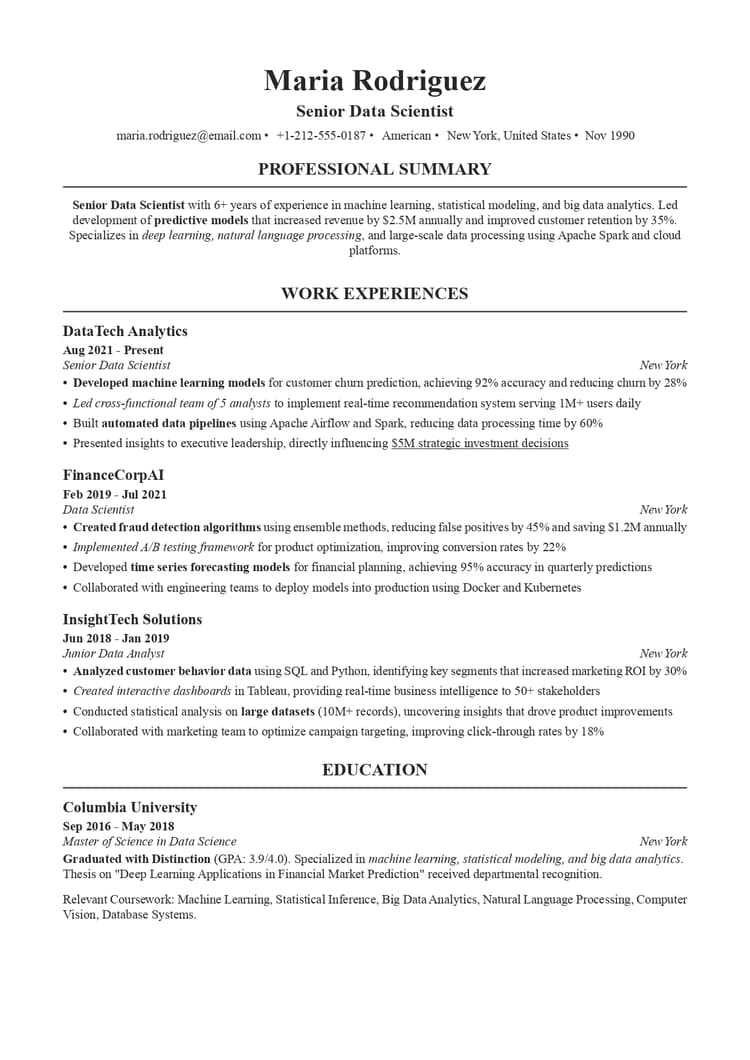
Build a resume that showcases your organizational skills in minutes—try ResumeBuilder.so.
Ready to land your next role?Final Thoughts
Organizational skills are among the most universally valued competencies across every industry and career level. Also, they're among the most demonstrable. You can prove it through specific, quantified examples of how you've managed time, tasks, teams, and resources to deliver real results.
The seven types covered here, i.e., time management, task prioritization, planning, attention to detail, physical and digital organization, delegation, and clear communication, give you a solid vocabulary for describing the actual texture of your professional strengths. The next step is to make a resume that's both ATS-friendly and genuinely compelling to human readers.
Organizational Skills FAQs

Emily Foster knows how nerve-wracking it can be to land your first job—she’s been there. As a mentor for young professionals, she shares exactly what hiring managers want from entry-level candidates. From internship hacks to interview confidence tips, Emily helps students and recent grads navigate the job search with ease.