Why Is My Resume Getting Rejected? 10 Reasons & Fixes

Your resume may be getting rejected because it doesn’t match the job description, lacks the right keywords, fails to show measurable achievements, or gets filtered out by ATS before a recruiter sees it. In some cases, the problem is simpler: the resume looks too generic, too cluttered, too long, or poorly tailored to the role.
The frustrating part is that rejection often has nothing to do with your actual qualifications. Your resume could be getting filtered out before a single human being reads it, even if you have all the necessary competencies. Yet, there is also some good news: this is absolutely fixable.
This time, we’ll explain the most common resume rejection reasons and how to fix each of those situations. Additionally, you’ll learn how to make your resume more targeted, ATS-friendly, achievement-focused, and easier for hiring managers to scan, so your application has a better chance of moving past the first round.
- Resumes often get rejected because they are not tailored to the job description, lack relevant keywords, or use formatting that applicant tracking systems struggle to read.
- A rejection does not always mean you are unqualified; it often means your experience was not presented clearly enough for ATS software or recruiters to identify the match.
- Good resumes have a clear summary, simple formatting, relevant keywords, and quantified achievements that show the real impact of your work.
- Common mistakes like typos, outdated contact information, the wrong file format, or an overly long resume can cost you interviews even when your experience is solid.
- The fastest way to fix a rejected job application is to compare it with the job posting, clean up the formatting, add missing keywords, and rewrite vague bullet points with measurable results.
What Does Resume Rejection Actually Mean?
Resume rejection means your application did not advance past either the ATS screening or the human review stage; it's usually one of two things.
The hiring process runs on a two-stage filter:
- First, most companies run applications through an applicant tracking system (ATS), which is software that scans resumes for keywords, correct formatting, and relevant experience before any person sees the file.
- Second, if your resume survives that first pass, a recruiter or hiring manager does a quick visual scan.
Therefore, rejection isn't necessarily a verdict on your abilities but typically a presentation problem caused by a structural issue, a missing keyword, or anything similar.
10 Reasons Your Resume Is Getting Rejected
These reasons are ordered roughly by how often they cause rejections, starting with the most common culprit. That said, most people have more than one issue at play, so read through all ten before you start editing or making your resume.
#1. It's Not Optimized for ATS
Your resume may be getting rejected by ATS because it lacks the right keywords or uses formatting that the system cannot parse.
An ATS is essentially a keyword-matching engine. It reads your resume like a computer reads a spreadsheet, looking for specific terms, job titles, and phrases from the job description. When it encounters a table, a graphic, a two-column layout, or text buried in a header or footer, it either skips that content or scrambles it entirely.
Research from Harvard Business School found that more than 90% of employers surveyed use automated recruiting systems to filter or rank applicants. The problem is that these systems can exclude qualified candidates whose resumes do not match the exact hiring criteria, but also those who don’t have a properly formatted resume.
Common ATS failure points include:
- Two-column layouts that get parsed out of order
- Tables where key skills or job titles live
- Graphics, logos, or icons replacing text
- Contact information placed in headers or footers
- Unusual fonts or symbols that don't translate to plain text
Use a single-column layout and keep formatting simple and text-based. Also, pull keywords directly from the job description and include them in your experience bullets and skills section.
#2. You're Not Tailoring Your Resume to the Job
Another reason for your resume not getting callbacks would be having a generic document rather than a targeted application.
This is probably the most common mistake candidates make after ATS formatting issues. Sending the exact same resume to 50 companies feels efficient, but recruiters can tell immediately when they're reading a boilerplate document that hasn't been adapted to their role.
Additionally, ATS systems typically confirm it; if your resume doesn't contain the specific language from a job posting, it scores poorly and gets filtered.
For each role, spend 10–15 minutes adjusting three things: your resume summary, skills section, and your strongest bullet points. Mirror the language from the job description where it's accurate; not word-for-word, but with genuine alignment in terminology.
#3. Your Resume Summary Is Weak or Missing
A weak or missing resume summary causes rejection because recruiters have no immediate reason to keep reading.
They spend seconds on initial review, so if the first thing they read is a vague phrase like "Result-driven professional with extensive experience in various industries," they've learned nothing. In fact, it’s not even a summary; for them, it's just a filler that will probably get ignored.
Some frequent summary mistakes would be:
- Too long (more than 4–5 lines)
- Too generic (could apply to any candidate)
- Written in third person ("John is a dedicated...")
- Focused on what the candidate wants, not what they offer
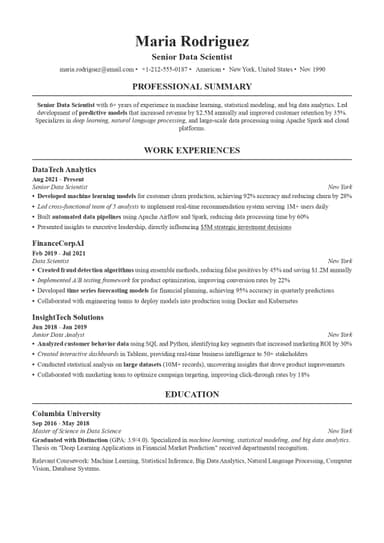
Write 2–3 tight sentences, where you’ll name the specific role you're targeting, drop in your strongest skill or area of expertise, and add one quantified result if you have one. If you're not sure how to phrase it, you can look at resume examples from people in your field; seeing what strong summaries look like makes writing yours much easier.
#4. You're Missing Relevant Keywords
Missing resume keywords cause rejection because both ATS systems and recruiters scan for specific role-related terms.
This isn't just about hard skills; it includes certifications, tools, job titles, industry-specific language, and even soft skills that appear prominently in a job description. If a posting mentions "cross-functional collaboration" six times and your resume never uses that phrase, the ATS will detect this.
Read the job description carefully and highlight nouns: the specific hard and soft skills, tools, credentials, and role titles that repeat. Then check your resume to make sure those terms are present there; if not, add them where it's truthful and natural.
It’s very important not to go overboard. A resume stuffed with keywords at the expense of readability will make it past ATS but confuse the human reviewer.
#5. Formatting Issues Make It Hard to Read
Poor resume formatting leads to rejection due to your skills and qualifications being harder to scan quickly.
Even if your resume clears ATS, a recruiter still has to read it. And if the layout is cluttered, contains inconsistent fonts, features tiny margins, or buries your most relevant experience in walls of text, they'll move on. Therefore, you need visual clarity since it reflects professionalism.
The formatting issues you may encounter include:
- Inconsistent font sizes or styles across sections
- Cramped spacing with no visual breathing room
- Bullet points that run three or four lines long
- No clear visual hierarchy between sections
- Creative layouts that look good as design but break ATS parsing
Use a clean, single-column template, and keep bullet points to 1–2 lines maximum. You should also maintain consistent spacing, simple section headers, and a readable font (Arial, Calibri, or Georgia in 10–12pt).
#6. You Made Typos and Grammatical Errors
One typo is enough to get your resume rejected, as it means a lack of attention to detail to hiring managers. This one sounds obvious, but it trips up experienced candidates more than you'd expect.
When you've been staring at the same document for hours, your brain autocorrects errors you're no longer seeing. A hiring manager reads your document with fresh eyes, and they will detect the resume mistakes you made more easily, which may give you negative points or even eliminate you completely.
Proofread out loud (your ear catches what your eyes skip), and use spell-check, but don't rely on it alone. Also, have a friend or family member read it cold; the checker may flag common errors before you send the document, but it doesn’t hurt to double-check everything.
#7. Your Work Experience Lacks Quantified Results
Resumes get rejected more often when they don’t have any numbers because they fail to show the concrete impact of your work.
For instance, "Responsible for managing customer accounts" tells a recruiter almost nothing. Were those 5 accounts or 500? Did you grow them or just maintain them? The moment you add a number to the equation, the bullet point gains weight and can actually help you.
The difference in practice:
Weak
"Managed a customer success team."
"Led a team of 7 customer success managers, reducing churn by 22% over 12 months."
Go through every bullet point in your work experience section and ask: "Can I add numbers here?" This could be percentages, dollar figures, team sizes, time periods, customer counts, or volume metrics. Even rough estimates ("approximately," "up to") are better than nothing. This is one of the fastest ways to dramatically improve a resume that's technically correct but weak on impact.
#8. It's Too Long (or Too Short)
When it comes to resume length, it may cause elimination if it doesn't match the candidate's career stage or the employer's expectations.
A three-page resume from someone with four years of experience tells a recruiter that the candidate doesn't know how to prioritize. A one-page resume from a VP-level candidate with 20 years of experience tells them even less, which means that the wrong length can easily be a red flag for a recruiter.
Some general guidelines would be as follows:
- Under 10 years of experience → one page
- Senior-level or highly technical roles → two pages maximum
- Academic CVs → different rules entirely
Cut ruthlessly. Remove jobs from 15+ years ago that aren't relevant to your current target, and condense bullets to one line. Deleting the "References available upon request" part can also help you make some more space on your resume, which you can use for a better purpose.
#9. You're Applying to the Wrong Jobs
If the roles you're applying for don't match your current qualifications, it’s a legitimate reason for ATS or recruiters to skip your resume.
This means that, if a job posting lists 10 required qualifications and you meet three, even a tailored resume won't save you. ATS systems are increasingly built to score candidates against requirements, and a low score means automatic filtering.
Aim for roles where you meet at least 70–80% of the requirements. That doesn't mean you need to tick every box, but if you're consistently not hearing back, it's worth checking whether you're targeting roles that are a realistic match for where you are right now. You can also consider building a "bridge" resume that emphasizes transferable skills and targets a lateral move, with your stretch role as the next step.
#10. Your Contact Information or File Format Is Wrong
And finally, incorrect file formats or missing contact details cause immediate resume elimination in many applicant tracking systems.
This one's quick to fix and embarrassing to miss. Submitting a .pages file (Mac's native format) when an employer's system only reads PDF or .docx means your resume arrives as an unreadable file. On the other hand, missing or outdated contact details prevent a recruiter who wants to call you from getting in touch with you.
Here, you can encounter:
- Missing email, phone number, or LinkedIn URL
- Old contact info that hasn't been updated
- LinkedIn URL that's the generic default (linkedin.com/in/johndoe123456789)
Save and submit your resume as a PDF unless the job posting specifically asks for Word (.docx). Moreover, double-check that your email, phone, and LinkedIn URL are all visible and current at the top of the resume. For LinkedIn specifically, it should be enough to customize and update your profile, as well as format the URL correctly.
How to Fix a Resume That Was Rejected in 6 Steps
You can fix a resume that was rejected by auditing it against the common rejection reasons above and making targeted improvements in a logical order.
Here are some resume tips for job seekers that can help you resolve the problem:
- Run it through an ATS checker. Several free tools will score your resume against a job description and show you exactly where you're losing points.
- Compare it side-by-side with your target job posting. Mark every skill, certification, and keyword in the posting, and then circle the ones missing from your document.
- Rewrite your summary. Make it specific to the role by naming the position, your strongest skill, and one result.
- Add at least three quantified achievements. Go back through your bullets and add numbers wherever you can.
- Clean up the formatting. Choose one of the recommended fonts, clear section titles, and enough white space.
- Proofread twice. You should do this once yourself, and once with a tool of your choice.
If you need some help to rebuild your resume the right way, ResumeBuilder.so can help you do so in no time! We offer clean templates that follow ATS-friendly formatting and a neat design, created by experts across dozens of industries. With these, you can have your job application polished and customized, and increase your chances of getting invited to an interview!
Final Thoughts
Resume rejection is almost never personal but usually a process problem: a formatting issue, a missing keyword, or a summary that didn't land fast enough. Every single inconvenience on this list is fixable, often in less than an hour of focused editing.
The candidates who get callbacks aren't necessarily better qualified than you. They've just learned to present their qualifications in a way that clears both the automated filter and the human first impression. That's a learnable skill, not a talent, and once you see how it works, you’ll find the key to the perfect job application that opens many doors!
Why Is My Resume Getting Rejected? FAQ

Jordan Lee is your guide to navigating the rapidly changing job market in the age of AI and automation. He dives into how AI is reshaping hiring, the skills of the future, and what job seekers need to do now to stay relevant. If you’re curious about how technology is transforming careers and want to future-proof your job, Jordan’s insights are a must-follow.