Work Environment: Definition, Types & Tips for Job Seekers in 2026

The work environment is important, and most people only realize this after they've already accepted the job. The problem is that many focus on salary, job title, and commute—then wonder why they're miserable six months in. It’s crucial to articulate what you really want. Employers ask "What's your ideal work environment?" but a vague answer doesn’t get you far.
In this guide, we aim to fix that, helping you along your job hunting journey. You'll get a clear definition of what the work environment is, the main types of it, practical tips for spotting healthy versus toxic workplaces, and concrete strategies for communicating your preferences—on your resume and in interviews. Let’s start!
- A work environment includes both physical and cultural elements of a workplace—from office layout to leadership style.
- The five main types of work environment are: physical/office, remote, hybrid, collaborative, and autonomous.
- A positive work environment measurably improves productivity, engagement, and retention.
- Job seekers should know how to describe their ideal work environment both on a resume and in interviews.
What Is a Work Environment?
A work environment is the physical space and cultural atmosphere in which employees carry out their daily work. It covers your team's communication style, how leadership treats people, the pace of the work, and the values the organization actually lives by.
That said, there are two core dimensions to any work environment:
- Physical environment, which includes office layout, equipment, lighting, noise levels, commute requirements, and whether work happens on-site, remotely, or both.
- Social and cultural environment, i.e., company values, communication norms, team dynamics, management style, diversity, and psychological safety.
Both matter enormously. According to Dame Carol Black’s review titled “Working for a Healthier Tomorrow”, workplace conditions— both physical and organizational—are linked to employee health, performance, and retention. Also, a study on nurses' job stress and their quality of life found that stress is a primary cause of 80% of all occupational injuries. That’s why the right workplace environment is better for your long-term career.
Types of Work Environments

Understanding the main types of work environments helps you figure out where you'd thrive, which is half the battle in any job search. Here's a breakdown of the five most common types, including who each suits best.
#1. Physical (Traditional Office) Work Environment
A physical work environment means a fixed, on-site location, e.g., a corporate office, a hospital floor, a retail store, a factory. You commute to a specific place, work regular hours alongside your colleagues, and use company-provided equipment and facilities.
This setup suits people who thrive with clear structure, in-person collaboration, and a firm boundary between work and home. This work environment usually dominates industries such as finance, healthcare, law, government, and manufacturing.
#2. Remote Work Environment
A remote work environment means employees complete their responsibilities from home, a co-working space, or anywhere with a reliable internet connection. According to the U.S. Bureau of Labor Statistics, remote work expanded dramatically across major industries between 2019 and 2021. Despite a slight decrease in 2022, remote work has stabilized at a significantly higher rate than pre-pandemic levels across most industries.
Work-from-home jobs depend heavily on written communication and self-direction. Tools like Zoom, Google Meet, and Slack replace hallway conversations and in-person meetings. The benefits are real—flexibility, no commute, and greater autonomy. However, there are challenges as well, such as isolation, blurred work-life balance, and the discipline required to stay focused without external structure.
From a resume standpoint, remote-readiness has become its own category of hard skills. Listing tools like Notion, Trello, or Microsoft Teams and demonstrating your communication skills in writing signals to remote-forward employers that you can hit the ground running.
#3. Hybrid Work Environment
A hybrid work environment splits time between on-site and remote work—typically two to three days in the office per week, with the rest from home. It's now the dominant model at many mid-to-large companies, particularly in tech, consulting, and financial services.
Hybrid workers need to be genuinely comfortable with both modes. That means strong written communication for async days and equally strong in-person collaboration skills when you're at the office.
As for your resume, employers value flexibility and adaptability in hybrid candidates. Therefore, knowing how to write a resume properly helps you surface these traits in the right language for the roles you're targeting.
#4. Collaborative / Team-Based Work Environment
A collaborative work environment puts group projects, shared goals, and brainstorming at the center of daily work. Creative agencies, tech startups, consulting firms, and design teams often operate this way. The energy can be exciting; ideas build on each other, decisions get made collectively, and there's a real sense of shared ownership.
Success here requires strong collaboration skills, sharp communication, and solid problem-solving skills. Also, these are among the most marketable skills for a resume, but only if you frame them clearly through specific examples.
#5. Independent / Autonomous Work Environment
An autonomous work environment provides significant independence, e.g. minimal supervision, high individual accountability, and the freedom (and responsibility) to manage your own time and deliverables. Research, writing, software development, and freelancing all tend to operate this way.
People who flourish in autonomous settings tend to be self-motivated, organized, and with strong decision-making skills. On a resume, you signal this through self-directed achievements, e.g. projects you initiated, goals you set and hit independently, results you owned from start to finish. Concrete numbers help here more than anywhere else.
What Makes a Positive Work Environment?

A positive work environment is one where employees feel supported, respected, and genuinely motivated to do their best work—not just out of obligation, but because the conditions make good work possible.
According to the American Psychological Association's report, workplace recognition, psychological safety, and growth opportunities are among the strongest predictors of employee engagement and retention. This translates directly to performance and turnover numbers.
That said, the hallmarks of a healthy work environment tend to cluster around a few consistent traits:
- Clear, two-way communication — leadership shares information and genuinely listens to feedback
- Recognition that's specific and timely — not just annual reviews, but ongoing acknowledgment of contributions
- Growth opportunities — access to mentorship, training, and paths to advancement
- Psychological safety — employees can raise concerns, share ideas, and admit mistakes without fear
- Healthy work-life balance — boundaries around time are respected, not quietly punished
If a workplace checks most of these boxes, you've found something worth protecting. If it checks none of them, you may already know what that feels like.
Signs of a Toxic Work Environment
A toxic work environment is one where negative behaviors, such as micromanagement, favoritism, poor communication, or a work culture of fear, consistently harm employee well-being and professional growth.
Research on toxic workplaces suggests that employees in toxic environments are significantly more likely to disengage, underperform, and leave within 12 months. Watch for these red flags during your job search:
- High turnover; short stays in multiple roles are a signal
- Vague or evasive answers about team dynamics, management style, or growth paths
- Micromanagement framing disguised as "we like to stay closely aligned" or "we have a collaborative culture" without specifics
- No path for career advancement
- How the interviewer treats you, e.g., dismissiveness, constant interruptions, or running significantly late, often mirrors the broader culture
Therefore, it’s important to research the company, including Glassdoor reviews, LinkedIn employee histories, and the company's culture page. However, weigh your in-person impressions heavily. Your gut picks up on things the internet can't.
Here’s a quick positive vs. toxic work environment comparison:
Open, honest communication
Recognition for contributions
Clear growth opportunities
Psychological safety
Healthy work-life balance
Toxic Work Environment
Poor or inconsistent communication
No acknowledgment or credit
No advancement path
Culture of fear or blame
Chronic overwork expected
How to Describe Your Ideal Work Environment
Describing your ideal work environment matters for two reasons: (1) interviews and (2) your resume. Hiring managers ask "What's your ideal work environment?" and "What's your dream job?" more often than most candidates expect, and your answer signals whether you've done your homework on the company and yourself.
How to Answer "What Is Your Ideal Work Environment?" in an Interview
The best way to answer this question is to research the company first, then align your honest preferences with what they actually offer.
Start by reviewing their culture page, recent employee reviews on Glassdoor, and how they describe their team structure in the job posting. However, be specific and pair it with a real example when you can. Saying "I like collaborative environments" is forgettable.
Here are three good examples on how to answer "What Is Your Ideal Work Environment?" in an interview:
I thrive in environments where priorities shift quickly, and people wear multiple hats, because I do my best thinking when I'm close to the problem and can move fast without layers of approval. From what I've read about your team, you're still in the scaling phase where everyone contributes across functions—that's actually what drew me to this role over larger companies I was considering.
I thrive in structured environments with clear processes and high standards for accuracy, because I find that consistency is what builds trust with stakeholders over time. In my last role, I actually helped document a reporting workflow that reduced errors by 30%. From what I can see in your job posting and the way the team is described, that kind of rigorous, process-driven culture is exactly what you're building here.
I thrive in async-first, high-autonomy environments because I do my deepest work without constant meetings, and I've found I communicate better in writing than in real-time anyway. In my previous role I was fully remote across three time zones, and we shipped a major feature with almost no live calls. From what I've seen on your careers page and in Glassdoor reviews, your team operates the same way — that's a genuine match for how I actually work.
How to Reflect Your Work Style on a Resume
You don't write "preferred work environment: remote" on a resume. However, your work style comes through loud and clear in the skills, work experience, achievements, and structure you choose to highlight.
Here's how to signal your fit:
- Collaborative person → list team-based achievements, cross-functional projects, and group outcomes with your specific contribution named
- Independent worker → highlight solo initiatives, self-directed projects, and metrics that show personal accountability
- Remote-ready → list digital collaboration tools you've used (Slack, Zoom, Notion, Asana), and frame achievements in terms of output rather than presence
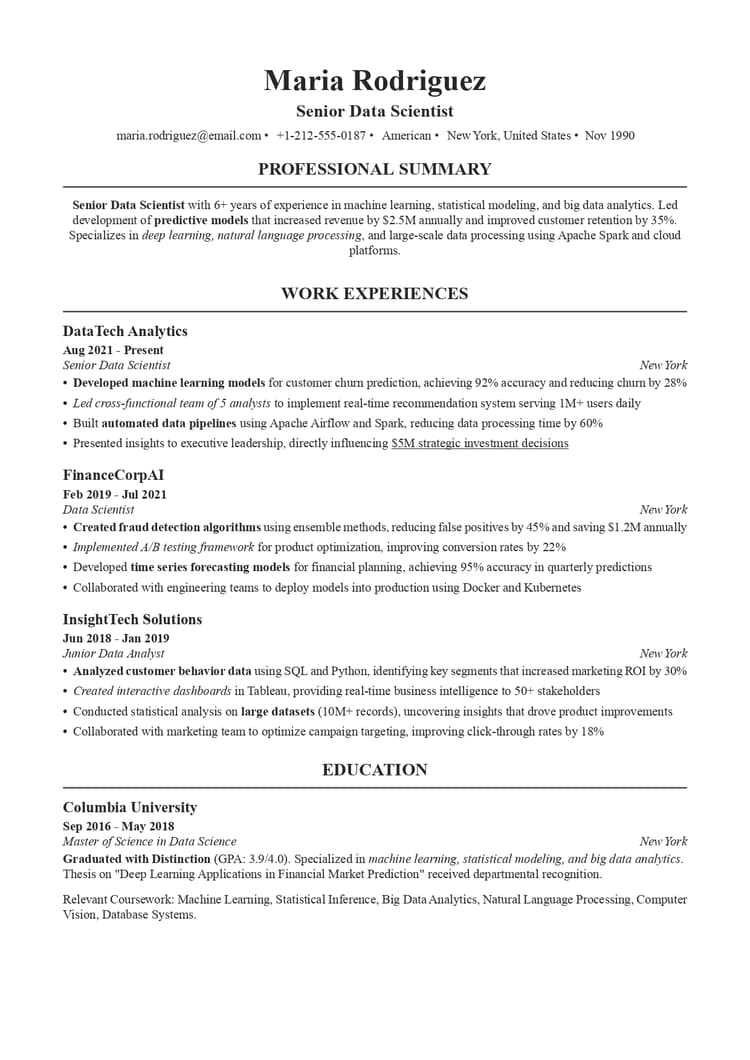
Not sure how to present your work style?
ResumeBuilder.so's AI-powered resume builder suggests the best skills and phrasing for your target role and environment, in minutes. Try it out today!How to Find a Job That Matches Your Ideal Work Environment
Finding a job that matches your ideal work environment is a process, but a manageable one. Here are five steps to follow:
- Self-assess first. Write down what's mattered most in past jobs (structure, flexibility, collaboration, independence) and what's drained you. Patterns will appear.
- Research companies before you apply. Use Glassdoor, LinkedIn, CareerOneStop, and company culture pages to evaluate fit before you invest time in an application.
- Ask in interviews. "How does the team typically communicate on a day-to-day basis?" and "What does a strong first 90 days look like here?" surface real culture information, not just the polished version from the recruiter.
- Tailor your resume for each environment. Use a resume template as a starting point, then adjust language to emphasize the skills most valued in that specific environment.
- Trust your read of the interview process itself. A chaotic, last-minute interview process often predicts a chaotic working environment. A warm, prepared, respectful one often does too.
Final Thoughts
A work environment isn't a perk; it's the context in which everything else about your job plays out. Understanding the types, knowing the markers of healthy versus toxic cultures, and learning to articulate your preferences clearly are among the most underrated advantages a job seeker can develop.
The job search moves faster when you know what you're actually looking for. Checking different resume examples to find the best one for your industry is the first step, because your resume sets the stage. Next, your tailored language makes the case, while your self-awareness in interviews closes the deal.
Work Environment FAQs

Jordan Lee is your guide to navigating the rapidly changing job market in the age of AI and automation. He dives into how AI is reshaping hiring, the skills of the future, and what job seekers need to do now to stay relevant. If you’re curious about how technology is transforming careers and want to future-proof your job, Jordan’s insights are a must-follow.