Career Change Cover Letter: How to Write One + Example
This complete guide with expert tips and real examples will teach you how to write a compelling cover letter — fast and stress-free!
Edit this cover letter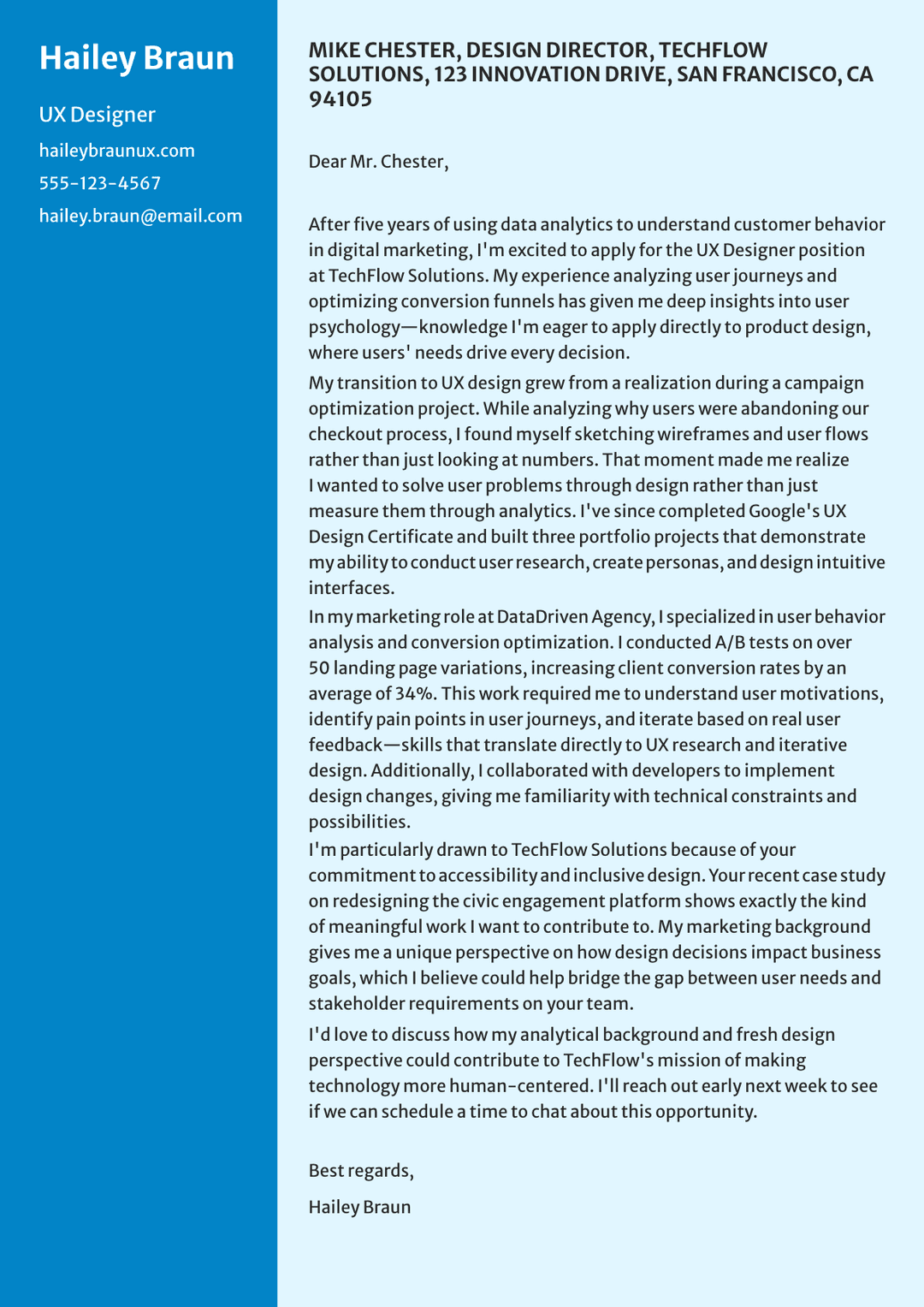
Changing careers can be intimidating. You’re not just applying for a new job—you’re asking employers to see your potential beyond your current title. Most career changers struggle to explain why they’re making the switch without sounding uncertain or unqualified. Employers want confidence and clarity, but if your cover letter doesn’t clearly link your past experience to your new direction, you risk being overlooked.
In this guide, we will show you exactly how to write a career change cover letter that transforms your story into a compelling case. With our tips and examples, you’ll learn how to connect your transferable skills, highlight relevant achievements, and confidently position your transition as the next logical step in your career path.
- Career change cover letters need to translate past experience into new fields as advantages by emphasizing transferable skills.
- The letter must explain your motivation, reframe previous work experiences to highlight relevant abilities, and include quantifiable achievements.
- Research target companies thoroughly to understand current challenges and demonstrate genuine interest.
- Avoid apologizing for your background, using generic applications, overemphasizing irrelevant experience, or ignoring the obvious career transition.
- Different transitions require tailored approaches: industry switches need compelling reasons and shared values, lateral moves highlight cross-functional work, and workforce returners address gaps briefly.
- End with a strong value proposition, specific enthusiasm for the opportunity, and concrete next steps like scheduling a follow-up conversation within a week.
What Makes a Good Career Change Cover Letter?
A good career change letter needs to overcome the "why would we take a risk on you?" mentality. Employers naturally wonder if you're just running away from problems or if you'll stick around once the novelty wears off. The fundamental difference lies in storytelling.
When writing a standard cover letter, you reinforce obvious connections between your background and the role. On the other hand, a career transition cover letter must create those connections from scratch. You're not just highlighting relevant experience—you're translating experiences from one context to another and proving they're actually advantages.
For instance, someone with five years of marketing experience applies for another marketing role, they’re seen as a good fit. However, when that same person applies for a UX design position, suddenly there's a translation gap. In this case, your cover letter helps employers see how your marketing background actually gives you unique insights into user psychology and business objectives.
According to the U.S. Bureau of Labor Statistics, the average worker will have 12 jobs over the course of their lifetime. With career change, the stakes are high. This means you need to work harder to get interviews because you probably don't check all the obvious boxes. Therefore, your cover letter can't just be good—it needs to be compelling enough to make someone reconsider their assumptions about what makes an ideal candidate.
Career Change Cover Letter Example
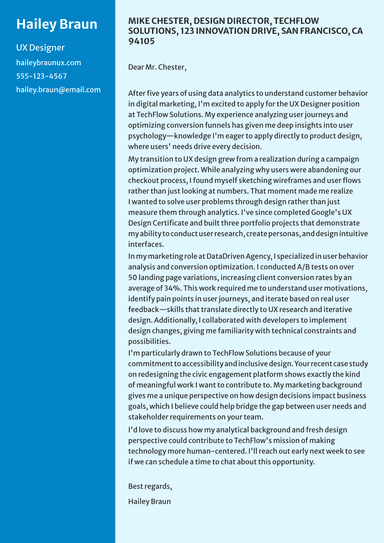
Here's a full example for someone transitioning from marketing to UX design:

How to Write an Effective Career Change Cover Letter?
As already said, writing a career change cover letter is all about connecting your past experience to your future goals. You need to show employers that your transferable skills, motivation, and fresh perspective make you a strong fit.
Follow these steps to craft a persuasive letter that explains your transition with confidence and clarity.
#1. Do Proper Research
Skip basic Google searches and go deeper. Subscribe to industry publications, join professional associations, and follow thought leaders on LinkedIn to understand current challenges, emerging trends, and terminology that make your cover letter feel authentic.
Treat each application like a consulting project. Research the company, mainly recent news about business, financial performance, competitive landscape, and company culture. This helps you find connection points between their initiatives and your background—the more specific your knowledge, the stronger your case. Also, honestly assess where your skills and qualifications align and where gaps exist. Address obvious weaknesses proactively through courses, certifications, or volunteer work, then mention these efforts to show initiative.
#2. List Contact Information in the Header
Your cover letter header should include the same professional contact information as your career change resume. This implies:
- Full name
- Phone number
- Professional email address
- City and state
- LinkedIn profile URL
Here’s a good example of a career change cover letter header:
Jane Smith
Seattle, WA | (206) 555-0123
jane.smith@email.com
linkedin.com/in/janesmith
[Date]
[Hiring Manager Name]
[Company Name]
[Company Address]
Remember to adjust your LinkedIn profile so it supports your transition story and skip your full street address (it's outdated). Also, make sure to include the date and the recipient's information when possible. If you can't find the hiring manager's name, use "Dear Hiring Manager" or "Dear [Department] Team."
For career changers, finding the actual hiring manager's name through LinkedIn research shows the extra effort and attention to detail that helps overcome the "risky candidate" perception. This small touch demonstrates you're serious about this specific opportunity, not mass-applying to escape your current field.
#3. Address Career Change in the Opening Paragraph
Your opening paragraph should immediately acknowledge that you're transitioning careers while framing it as a strategic, well-thought-out decision rather than a desperate escape plan. Lead with your most relevant transferable skill or achievement, then connect it to your new direction. This approach immediately shows value while explaining your transition logic.
Here’s how you can frame it:
Managing crisis communications for Fortune 500 companies taught me that clear, strategic messaging can make or break outcomes—skills I'm eager to apply to healthcare administration, where effective communication literally saves lives.
The key is confidence without arrogance. You're not asking for a favor; you're presenting a compelling case for why your unique background actually makes you a stronger candidate than someone who's followed a traditional path.
#4. Present Your Case in the Body Paragraphs
Your body paragraphs must accomplish four critical tasks:
- Explain your motivation
- Showcase transferable skills
- Reframe your experience
- Demonstrate specific achievements
Effective motivation explanations usually fall into three categories: skill alignment ("I discovered my analytical abilities were better suited to..."), value alignment ("Working in nonprofit showed me the impact I want to make..."), or growth opportunity ("The emergence of AI in marketing made me realize I wanted to be on the technical side of innovation..."). The strongest motivations connect your past experiences to future goals in ways that make your transition feel inevitable.
As for transferable skills, you need to identify these from your background, translate them into the new industry's language, and prove their relevance with specific examples. Universal skills that translate everywhere include problem-solving, project management, relationship building, data analysis, and critical thinking. The key is showing how these skills manifested in your particular context and how they'll apply in your new field.
Furthermore, the art of career change lies in recontextualizing your work history. Every job you've held has given you experiences that connect to other fields. Look for parallel challenges and similar success metrics. Someone transitioning from retail to real estate might emphasize "building trust with skeptical customers, understanding individual needs within time constraints, and negotiating win-win solutions" rather than talking about folding clothes or working cash registers.
Also, quantifiable accomplishments work across all industries. The key is choosing examples that showcase skills relevant to your new field. A teacher moving to corporate training should emphasize measurable learning outcomes and student engagement improvements.
Here’s a good example:
When enrollment dropped 15%, I redesigned our outreach strategy to target underserved communities, resulting in a 30% increase in diverse student applications.
#5. End With Clear Next Steps
Your closing paragraph should reinforce your value proposition while giving the employer a clear sense of what happens next. Effective closings typically accomplish three things:
- Reiterate your main value proposition,
- Express genuine enthusiasm for the specific opportunity
- Suggest a concrete next step
Let’s see this in an actual example:
My combination of analytical skills and customer-focused mindset would bring immediate value to your product team. I'd welcome the opportunity to discuss how my unique perspective could contribute to [specific company goal]. I'll follow up early next week to see if we can schedule a brief conversation.
The follow-up commitment shows professionalism and genuine interest—just make sure you actually do what you say you will. This small detail can set you apart from candidates who submit applications and then wait passively for responses. Also, consider ending with a brief statement that addresses potential concerns, for instance:
I understand this represents a career transition, but my research and preparation have confirmed that this move aligns perfectly with both my strengths and professional goals.
Common Career Change Cover Letter Mistakes to Avoid
These common mistakes sabotage career change applications, so it’s important to avoid them to position yourself as a strategic candidate, not a desperate job-hopper.
- Apologizing for your background. Never start from weakness. Reframe your unique path as a strategic advantage. A teacher transitioning to corporate training shouldn't say, "I've only taught high school students"—they should confidently state, "I've developed expertise in adult learning principles through managing classrooms of diverse learners with varying motivation levels."
- Failing to address the career change. Ignoring your obvious transition creates confusion and makes you seem unaware or evasive. Address the change head-on to demonstrate self-awareness and strategic thinking. However, frame it as a thoughtful evolution, not a random career pivot.
- Being too generic. Using the same letter for multiple applications is painfully obvious. Career changers must work harder to demonstrate fit. Customization means more than swapping company names—research each role and company thoroughly, then tailor examples and language to match their specific needs and culture.
- Overemphasizing irrelevant experience. Focus on experiences translating to your new field rather than justifying every background aspect. Strategic omission matters as much as strategic inclusion. Choose the most compelling, relevant examples rather than explaining every job you've held.
Tips for Different Types of Career Changes
Different career pivots require different strategies. A complete industry switch demands stronger storytelling than a lateral role change within the same field. Major pivots—like finance to nonprofit—need compelling reasons beyond "I want to make a difference."
Lateral moves require highlighting cross-functional experiences and informal leadership roles. On the other hand, career returners should address employment gaps confidently, positioning their return as a strategic choice.
Let’s see some actionable tips for career change cover letters you can use based on the situation:
- Lead with shared values between industries, then connect specific transferable skills
- Emphasize volunteer work, board service, or side projects in your target field
- Quantify achievements from the old industry using metrics that matter in the new one
- Address "why now?" directly—show this isn't impulsive but strategically timed
- Demonstrate deep industry knowledge through certifications, networking, or informational interviews
- Highlight cross-functional projects where you worked outside your primary role
- Showcase informal leadership: mentoring junior colleagues, leading initiatives, training others
- Explain how your current role's expertise strengthens your target position (e.g., technical background makes you better product manager)
- Reference internal advocates or mentors who've supported your transition planning
- Connect company-specific knowledge as immediate value-add in new role
- Address gap briefly in opening paragraph, then move forward—don't over-explain
- Frame break positively: "After taking time to [care for family/pursue education/travel], I'm excited to bring renewed focus to..."
- Highlight any skills development: online courses, certifications, volunteer leadership, consulting projects
- Reframe caregiving or household management: budget management, schedule coordination, conflict resolution, multi-stakeholder negotiation
- Emphasize you're current on industry trends through continued learning during break
- Show leadership mindset shift: from "doing the work" to "enabling others to succeed"
- Highlight mentoring experiences, training new hires, or leading cross-functional projects
- Demonstrate strategic thinking beyond tactical execution in current role
- Reference specific management frameworks or leadership training you've completed
- Address why you want to lead, not just why you deserve promotion
Need Help Transitioning Out of Your Current Role?
ResumeBuilder.so has everything you need to create a polished, professional cover letter in minutes. Our AI-powered cover letter builder helps you craft personalized letters tailored to your target job and industry—no more struggling with what to say or how to say it.
Explore our library of cover letter templates, each designed with modern, ATS-friendly formatting to make a strong first impression. Whether you’re switching careers, applying for your first job, or aiming for a leadership role, we’ve got you covered with real-world examples that show you exactly what works.
Pair your letter with a matching resume to ensure a cohesive, professional look across your entire application. From layout to tone, ResumeBuilder.so gives you the tools to tell your story confidently and land the interviews you deserve—all without starting from scratch.
Final Thoughts
Writing a career change cover letter isn't about convincing someone to take a chance on you—it's about helping them see the value in your unique journey. The strongest career change candidates don't apologize for their non-traditional paths; they position their diverse backgrounds as competitive advantages.
It is your opportunity to control the narrative. Instead of letting employers wonder why you're switching fields, you're proactively explaining how your transition makes perfect sense and benefits them. With the right approach, your diverse background becomes the reason they choose you, not the reason they pass.
The key is preparation, authenticity, and confidence. Research thoroughly, be genuine about your motivations, and present your case with conviction.
Career Change Cover Letter FAQ
#1. How long should a career change cover letter be?
A career change cover letter should typically be one page, but may run slightly longer than standard cover letters to adequately address the transition and transferable skills. The extra length is justified when you need to explain your motivation and connect your background to the new field, but avoid going beyond two pages.
#2. Should I mention my career change in the subject line?
Generally no, unless specifically requested. Let your cover letter content address the career change rather than highlighting it in the subject line. Use a professional subject line like "Application for [Position Title] - [Your Name]" instead of drawing attention to your transition upfront.
#3. How do I explain a career change without sounding desperate?
Focus on positive motivations, growth opportunities, and authentic passion for the new field rather than what you're running from in your current career. Frame your transition as a strategic move toward something you want, not an escape from something you hate. Use forward-looking language and demonstrate genuine knowledge of your target industry.
#4. What if I have no direct experience in the new field?
Emphasize transferable skills, relevant coursework, volunteer work, personal projects, or certifications that demonstrate commitment and capability in the new area. Consider completing online courses, attending industry events, or doing informational interviews to build relevant experience you can reference in your cover letter.
#5. Should I address potential salary differences?
Generally avoid salary discussions in the cover letter. Focus on the value you bring and save compensation conversations for later in the interview process. If salary is a major concern for you, address it during phone screenings or early interview stages rather than in your initial application.
#6. How do I handle employment gaps in a career change cover letter?
Address gaps honestly but briefly, focusing on any skill development, education, or relevant activities during the break that support your career transition. If you took time off for family reasons, completed additional training, or pursued volunteer work related to your new field, mention these experiences as part of your preparation for the change.
#7. Can I use the same career change cover letter for multiple applications?
While you can use a template approach, each letter should be customized for the specific role and company, especially when changing careers. The research and personalization requirements are even higher for career changers because you need to prove you've chosen this particular opportunity thoughtfully, not just applied everywhere hoping something sticks.

Jordan Lee is your guide to navigating the rapidly changing job market in the age of AI and automation. He dives into how AI is reshaping hiring, the skills of the future, and what job seekers need to do now to stay relevant. If you’re curious about how technology is transforming careers and want to future-proof your job, Jordan’s insights are a must-follow.