Internship Cover Letter: Examples & Tips for Writing a Good One
This complete guide with expert tips and real examples will teach you how to write a compelling cover letter — fast and stress-free!
Edit this cover letter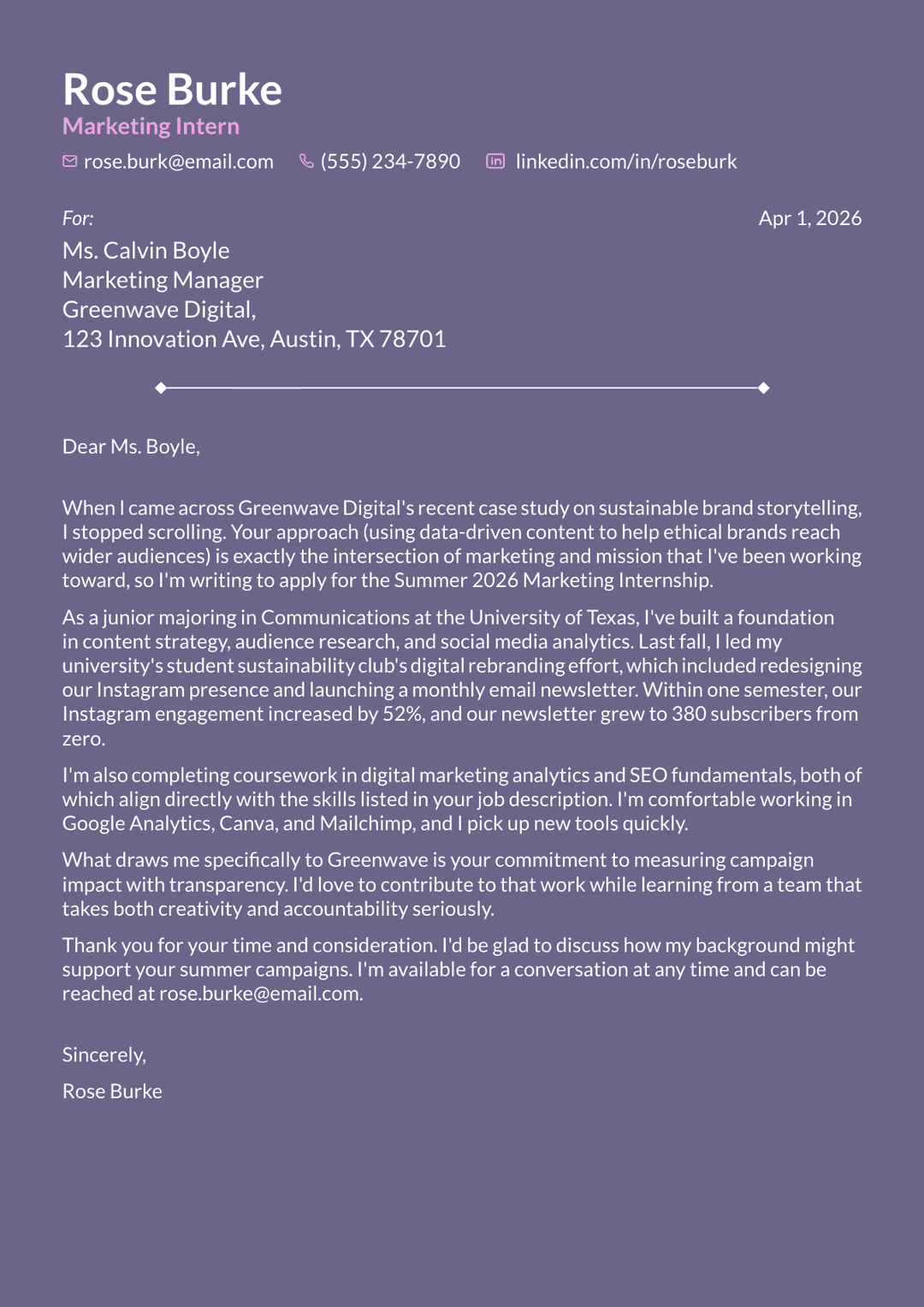
An internship cover letter is a short professional letter that explains why you’re interested in an internship and how your skills and education make you a strong fit.
Unlike a regular cover letter, this document usually focuses less on full-time work experience and more on candidates’ coursework, projects, volunteer work, and transferable skills. Since many internship applicants are still students or recent graduates, the letter helps employers understand their potential beyond what’s listed on their resume.
If you need one, we’ll teach you how to write it so that it feels confident, specific, and professional without sounding forced. We’ll also cover what to include, how to structure each section, and how to show enthusiasm without overdoing it.
- An internship cover letter explains why you’re interested in a specific internship and how your education, skills, projects, and motivation make you a strong candidate.
- Even when it’s optional, submitting one can help you stand out, especially if your resume has limited work experience.
- A solid letter should be tailored to the company, reference specific details from the role, and avoid generic praise.
- Applicants with no formal experience can still write an effective cover letter by highlighting coursework, class projects, volunteer work, student organizations, certifications, and transferable skills.
- It’s best to stay under one page, use specific examples, mirror the job description naturally, and focus on the value the candidate can bring rather than only what they hope to learn.
What Is an Internship Cover Letter?
An internship cover letter is a one-page document submitted alongside your resume that explains why you're interested in a specific internship and what makes you a strong candidate.
What makes an internship application letter different from a standard one is the source material you're working with.
Experienced professionals lean heavily on career achievements. As a person who likely doesn’t have much experience, you need to rely on coursework, projects, extracurricular participation, and ambition. In fact, many entry-level employers actually weigh cover letters more heavily when resumes don't have much to say, because they reveal how you think and communicate.
All in all, the purpose of this document is to make a human connection that your resume alone can't make. Having both documents makes your internship application consistent and tells the complete story.
Does Every Internship Application Need a Cover Letter?
Whether an internship application needs a cover letter depends on the employer's requirements, but submitting one even when it is optional almost always improves your chances.
There are really three situations you'll encounter:
- Required: the job posting explicitly asks for one, in which case you should definitely write it.
- Optional: the posting says "cover letter optional." Write it anyway; candidates who include one show genuine interest, while candidates who skip it signal they couldn't be bothered.
- Not requested: the application portal doesn't have an upload field. In this case, don't force it; some systems specifically discourage attachments, and respecting that is its own form of professionalism.
How to Write a Cover Letter for an Internship
To write a cover letter for an internship, you should follow a structure that works; the steps below will walk you through the entire process.
#1. Research the Company and Role
Good cover letters start before you type a single word. Spend 20–30 minutes on the company's website, recent press releases, LinkedIn page, and the exact job description. What's their mission? What projects have they been running lately? Which skills do they mention more than once?
This company research matters because it feeds directly into your opening paragraph and body, and it's also evidence that you showed up prepared, which can be an important distinction.
#2. Format Your Cover Letter Header
Before the body of your letter comes the header, and it needs to be clean and complete. It should include:
- Your full name
- Phone number and email address
- LinkedIn profile URL or portfolio link (if applicable)
- The date
- The hiring manager's name, title, company name, and address
If you're not sure how to format your contact details, keep it simple and consistent with your resume.
#3. Write a Strong Opening Paragraph
Your first sentence determines whether the hiring manager reads the rest. The single worst opener you can write is: "I am writing to apply for the marketing internship at [Company Name]." They know why you're writing; instead, try one of these approaches:
- Reference a specific company achievement: "Your team's recent campaign on [project] caught my attention because..."
- Lead with a relevant accomplishment: "Last semester, I built and managed a social media strategy for my university's sustainability club that grew our following by 40%..."
- Open with specific enthusiasm: "I've been following [Company]'s approach to [mission or product area] for the past year, and the [specific role] feels like a natural place to contribute."
#4. Highlight Relevant Skills and Experiences
This is where students with no formal work history sometimes freeze up. It doesn’t have to be like that; you have more relevant material than you think.
One or two body paragraphs should draw from:
- Coursework and class projects, especially those that involved research, collaboration, analysis, or presentation
- Volunteer work; many hiring managers treat this identically to paid experience
- Clubs, student organizations, or team leadership
- Freelance or side projects, such as a website you built, a newsletter you wrote, or a podcast you edited
- Soft skills, backed by evidence
#5. Show Enthusiasm for the Role
This part should take one short paragraph only, but it carries real weight. Here, you connect your career goals to what this specific company or team offers. What are they known for that genuinely excites you? A product, a culture, a research area, a client base?
The trap to avoid is generic flattery: "I have always admired [Company] for being a leader in its industry." doesn’t do much. Instead, you can say: "I'm particularly interested in how [Company] is approaching [specific challenge], and I'd love to contribute to that work while developing my skills in [relevant area]."
#6. Write a Professional Closing Paragraph
Your closing paragraph has three purposes: thank the reader, make a clear ask, and confirm your availability. It should feel confident without being aggressive.
A closing that works looks like this:
"Thank you for considering my application. I'd welcome the opportunity to discuss how my background in [area] could contribute to your team. I'm available for an interview at your convenience and can be reached at [email] or [phone]."
#7. Proofread and Tailor Before Sending
The most common cover letter mistakes that instantly disqualify applicants include:
- Using the wrong company name (copy-paste error)
- Typos and grammatical mistakes
- Exceeding one page
- Passive voice (which you should generally avoid) and vague language
- Submitting a letter clearly written for a different role
Read everything aloud. If you stumble over a sentence, rewrite it, and use a grammar checker like Grammarly to catch anything you missed. Finally, ask a roommate, classmate, or career center advisor to read it with fresh eyes.
Internship Cover Letter Example to Use as Inspiration
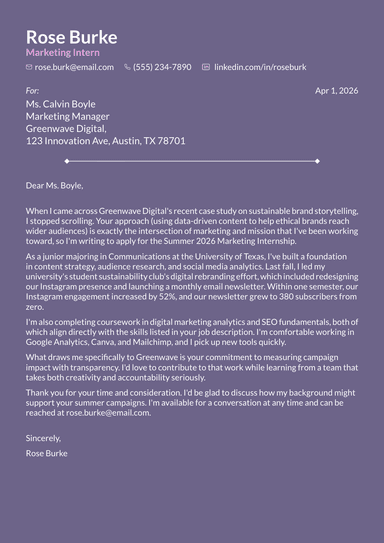
Below is a full cover letter example for a marketing internship, which is a broadly relatable scenario that applies the seven steps above.

What makes this example work:
- Opening: references a specific Greenwave project instead of generic praise, which immediately establishes genuine interest.
- Body paragraph 1: leads with a quantified result (52% engagement increase, 380 subscribers) despite having no paid work experience.
- Body paragraph 2: names specific tools (Google Analytics, Canva, Mailchimp) and ties coursework directly to the job description.
- Paragraph 3: shows enthusiasm for something specific about the company
- Closing: professional, direct, and confident without being pushy.
How to Write a Cover Letter for an Internship With No Experience
You can write an internship cover letter with no experience by relying on academic achievements, coursework, transferable skills, and a strong expression of motivation. The key is reframing what counts as experience.
Most students assume "experience" means paid jobs, but hiring managers for internships (especially at the entry level) think about it much more broadly. Here's how to frame non-traditional experience in cover letter language:
- Class project → "Led a semester-long team project analyzing consumer behavior for a local nonprofit"
- Volunteer work → "Coordinated outreach for 200+ attendees at a regional fundraising event".
- Online course → "Completed Google's Digital Marketing certification, covering SEO, analytics, and paid search".
- Student club → "Served as treasurer for a 50-member student organization, managing a $4,000 annual budget".
5 Expert Tips for a Standout Internship Cover Letter
Finally, before we wrap up, let’s see some internship cover letter tips you can use to improve your document:
ATS systems scan for keyword matches before a human ever reads your letter. Pull exact skill phrases and terminology from the posting ("cross-functional collaboration," "quantitative analysis," "content calendar management", etc.) and weave them naturally into your paragraphs.
This isn't keyword stuffing, and it speaks the employer's language well. They wrote the job description to describe their ideal candidate, so use their words to show you're that person.
One of the most common tonal mistakes in internship cover letters is framing everything around what you hope to get from the experience.
What you need to do is flip it; instead of "I am eager to learn about digital marketing," you can try with "My coursework in digital marketing analytics has prepared me to contribute immediately to your content reporting workflows." This shift changes how the reader perceives you.
Internship cover letter length should never exceed one page; three to four tight paragraphs is the sweet spot, typically between 200 and 350 words.
Rambling only shows that you haven't edited your work. If your draft is running long, cut the weakest paragraph entirely; if every paragraph feels essential, tighten each one until it's doing more with fewer words. The ability to edit yourself is, ironically, one of the most impressive things you can demonstrate before the interview.
"Dear Hiring Manager" gets the job done, but it also tells the reader you didn't try very hard.
Spend five minutes on LinkedIn or the company's About page to find the hiring manager's name. "Dear Ms. X" or "Dear Mr. Y" adds a level of personalization that generic openers simply can't replicate.
If you genuinely can't find a name after a reasonable search, "Dear [Department] Team" (e.g., "Dear Marketing Team") is a more specific fallback than the generic alternative.
ResumeBuilder.so's AI-powered cover letter builder can help you make this document without starting from scratch. Once you choose a suitable template, our tool formats the document automatically based on your competencies and exports a finished letter as a PDF or Word file quickly.
This is the quickest way to go from a rough draft to something that actually looks polished without spending an hour setting your margins alone in Google Docs.
Final Thoughts
An internship cover letter is one of the most powerful tools available to applicants who don't have years of work history to lean on. It creates space for everything a resume can't show: personality, research, genuine enthusiasm, and the ability to write a clear sentence under pressure.
The seven-step process in this guide covers everything from the pre-writing research phase through proofreading. You already have more to offer than you think; the cover letter is just where you prove it.
Internship Cover Letter FAQ
#1. What should I include in an internship cover letter?
An internship cover letter should include a header, a greeting, an opening paragraph, one or two body paragraphs, a confident closing, and a professional sign-off. You should keep the full document to one page.
#2. Can I get an internship without a cover letter?
You can get an internship without a cover letter if the employer doesn't request one, but including one almost always improves your chances, particularly when your resume has limited experience. Plus, a strong cover letter gives you room to make arguments your resume can't.
#3. Should an internship cover letter be formal or casual?
An internship cover letter should be professional but personable. It should be formal enough to demonstrate respect for the employer, and warm enough to convey your personality. When possible, research the company culture and let it guide your tone, as a summer internship cover letter and a law firm one warrant different registers.
#4. Do cover letters matter for internships?
Cover letters matter for internships because candidates at the entry level often have nearly identical academic credentials. A well-written letter gives you a distinct opportunity to stand out, show genuine enthusiasm, and demonstrate communication skills before anyone meets you in person.

Emily Foster knows how nerve-wracking it can be to land your first job—she’s been there. As a mentor for young professionals, she shares exactly what hiring managers want from entry-level candidates. From internship hacks to interview confidence tips, Emily helps students and recent grads navigate the job search with ease.