Presentation Skills: What They Are and How to Improve Them

Presentation skills are the verbal, nonverbal, and organizational abilities that allow a person to communicate ideas clearly and persuasively to an audience. Many people experience significant anxiety about doing exactly that, and the cost of avoiding it is real.
Poor presentation abilities hold people back from promotions, make them lose deals before they're closed, and leave strong candidates struggling in interviews they were otherwise qualified for.
If you want to avoid this, we’ve got your back. This guide covers what these skills are, why they matter, and exactly how you can build them. You will also learn how to make sure they show up on your resume, where employers can actually see them.
- Presentation skills go beyond public speaking and include preparation, structure, visual communication, audience awareness, and the ability to adapt in real time.
- Strong presentation skills matter because they shape how others judge your ideas, confidence, and professional credibility in interviews, meetings, and career-growth moments.
- The most important presentation skills to develop include clear verbal communication, confident body language, eye contact, vocal variety, storytelling, time management, and adaptability.
- Presentation skills improve through deliberate practice, such as knowing your material deeply, rehearsing out loud, recording yourself, studying strong presenters, and getting honest feedback.
- On a resume, presentation skills should be shown through specific skills, quantified work experience bullet points, and a summary that reflects how you communicate value clearly.
What Are Presentation Skills?
Presentation skills are a set of soft skills for the workplace that include public speaking, visual communication, storytelling, and audience engagement. Yet, the definition is broader than most people assume, and it's not just about standing at a podium and speaking clearly.
Preparation, pacing, slide design, reading the room, and knowing when to slow down or shift direction are all part of the package, and so is the ability to handle a tough question mid-presentation without losing composure. Taken together, these abilities form something closer to a communication system than a single skill.
It's also worth distinguishing presentation skills from raw public speaking. Public speaking is a single component that marks the delivery side. Presentation skills, on the other hand, encompass the full arc:
- Knowing your audience before you walk in
- Structuring content so it builds logically
- Designing visuals that support rather than distract
- Wrapping up in a way that leaves people with something actionable
These abilities apply across every professional setting, including job interviews, team meetings, client pitches, performance reviews, academic talks, and video calls.
The context changes, but the underlying abilities transfer. That's why hard skills and professional communication skills together form such a powerful combination in any application. Namely, technical ability proves what you know, while the ability to communicate it effectively determines whether anyone acts on it.
Why Are Presentation Skills Important?
Presentation skills are important because they directly affect how others perceive your ideas, your confidence, and your professional credibility. A good idea poorly delivered often loses to a mediocre idea delivered well, which is the reality of how effective communication skills work in professional settings.
Employees who can present clearly and confidently get noticed. When leadership needs someone to represent the team, brief the board, or pitch a project, they think of the people they've already seen handle a room well.
So, developing strong presentation skills isn't just about performing better in meetings but also about becoming the kind of professional who gets asked into the rooms where decisions are made.
A job interview is a presentation where you are the product, the content, and the delivery mechanism: all at once. A strong resume opens the door, but your presentation skills are what close it, and the interview is where those abilities have to show up in person.
Not every presentation happens on a stage. Most happen in a weekly team meeting, on a client call, during a one-on-one with a manager, or in a five-minute Slack huddle that turns into an impromptu pitch.
The professionals who communicate clearly and confidently in these everyday moments build credibility steadily without even thinking of it as a presentation skill.
Everyday Professional Communication
Not every presentation happens on a stage. Most happen in a weekly team meeting, on a client call, during a one-on-one with a manager, or in a five-minute Slack huddle that turns into an impromptu pitch.
The professionals who communicate clearly and confidently in these everyday moments build credibility steadily without even thinking of it as a presentation skill.
11 Key Presentation Skills to Master

Improving your presentation techniques and skills starts with knowing which ones to focus on. Here are the most important ones to develop, roughly in order from foundational to advanced:
#1. Clear Verbal Communication
Clear verbal communication means choosing words your audience actually understands, structuring sentences so they land in the right order, and eliminating the filler language that erodes confidence. If your audience has to work to follow you, you've already lost part of the room.
#2. Confident Body Language
Your body language in presentations is communicating before you say a word. Open posture (feet grounded, shoulders relaxed, arms uncrossed) signals confidence even when you don't feel it yet. Meanwhile, closed posture (hunched shoulders, crossed arms, hands in pockets) signals the opposite, and audiences pick up on it instinctively.
#3. Eye Contact
Eye contact creates a connection. In a small group, it signals that you're engaged with individuals; in a larger room, moving your gaze deliberately across different sections keeps more of the audience with you. Staring at your notes or your slides breaks that connection immediately.
#4. Vocal Variety (Pace, Tone, Volume)
A monotone voice loses audiences faster than almost anything else. Varying your pace by slowing down for key points or speeding up during transitions keeps people engaged. Volume matters too: dropping your voice slightly before an important line often draws people in more effectively than raising it.
#5. Storytelling in Presentations
Data informs, but stories persuade, and the most effective presenters frame information inside a narrative that gives the audience a reason to care. Even a five-minute internal update lands better when it has a clear beginning, a tension point, and a resolution. Structuring your content as a story is one of the fastest ways to make any presentation more memorable.
#6. Audience Awareness
Reading the room (noticing when people are confused, disengaged, or excited) and adjusting in real time is a skill most presenters underestimate. Audience awareness requires enough confidence in your material to lift your eyes from the script and actually watch the people in front of you.
When you see glazed expressions, you should slow down; when you see nodding, you've hit something worth expanding.
#7. Slide Design and Visual Aids
A slide is a visual aid, not a teleprompter. When slides are dense with text, audiences read them instead of listening, which is where you lose their attention and their comprehension simultaneously. The most impactful slides use one idea per slide, minimal words, and strong visuals that reinforce what you're saying rather than duplicate it.
#8. Time Management
Consistently running over time signals poor preparation. Finishing well within your allotted time signals the opposite: that you respect your audience's schedule and have enough time management skills and control over your material to make decisions about what to include and what to cut.
#9. Managing Presentation Anxiety
Some degree of nerves is normal and even useful during presentations, as it definitely sharpens focus. However, chronic communication apprehension is a different matter and genuinely interferes with performance.
The most effective techniques shouldn’t be centered around eliminating glossophobia but about redirecting it. This involves:
- Reframing the nervous energy as readiness
- Focusing on the audience's experience rather than your own
- Building confidence through repetition rather than waiting to feel ready before you practice
#10. Adaptability and Thinking on Your Feet
Many unpredictable things can happen during a presentation. Because of this, the ability to adapt (calmly, without signaling to the audience that anything has gone sideways) is a significant skill. However, it only comes from having presented enough times that you trust yourself to recover; you can't rehearse every contingency, but you can rehearse the mindset.
#11. Virtual Presentation Skills
Remote presentations introduce a specific set of challenges that in-person skills alone don't solve. Camera presence (looking into the lens rather than at your own face on screen) is the virtual equivalent of eye contact, and almost everyone gets it wrong initially.
Managing technology gracefully (audio issues, screen sharing, chat moderation) without losing your thread is a skill in itself. So is keeping an online audience engaged when you can't read body language and half the room has email open in a second window.
How to Improve Your Presentation Skills
You can improve your presentation skills by practicing consistently, studying great presenters, and seeking constructive feedback. Let’s explore this in more detail:
Step 1: Know Your Material
There's a real difference between having a script to follow and understanding your topic well enough to talk about it from multiple angles, field questions, and recover when something throws you off. Deep familiarity with your content is what makes confident delivery possible, and the delivery is downstream of the preparation.
Step 2: Study Great Presenters
Watch how skilled and confident presenters and communicators structure their presentations. For instance, Steve Jobs is the obvious reference point for a reason because his speeches were built on radical simplicity, emotional resonance, and deliberate pacing.
Studying executive presence in this way (by treating great presentations as a source of technique rather than just entertainment) accelerates your own career advancement significantly faster than practice alone.
Step 3: Practice Out Loud
Running through your presentation mentally feels like a rehearsal, but in reality, it isn't. Saying it out loud, at full volume and at full speed, in a space where you can move, is categorically different.
This is where you discover that the transition between sections doesn't actually work, that a sentence you thought was clear is ambiguous, and that you're consistently losing momentum in the same place.
Step 4: Record Yourself

Most people find this uncomfortable, but that's exactly why it works. Watching yourself on video surfaces habits, such as filler words, nervous gestures, and rushed pacing, that you genuinely cannot detect from inside the experience.
Record a practice run, similarly to how you would do on a pre-recorded video interview. Then watch it once without pausing, and then again, but take notes this time. One session of this usually surfaces more useful feedback than a week of unreflective practice.
Step 5: Get Feedback and Join Practice Groups
Feedback from someone who will actually tell you the truth is worth more than generic encouragement. Toastmasters is the most accessible structured option, as it features chapters in most cities, a clear feedback framework, and a room full of people working on the same thing. After all, the accountability alone tends to accelerate progress faster than solo practice.
Step 6: Work on Your Slides
If your slides are currently full of bullet points and dense paragraphs, they're working against you. Instead, you should treat each slide as a visual reinforcement of one idea and implement some general slide design tips, such as having clean structures and picking relevant content.
Step 7: Manage Your Nerves
The most effective reframe is to treat pre-presentation anxiety not as fear but as preparation energy, as reinterpreting nerves as excitement measurably improves performance.
Your body is doing something useful; it sharpens your focus and heightens your awareness. The goal isn't to channel that response by:
- Breathing slowly
- Focusing on your opening sentence rather than the full presentation
- Reminding yourself that nerves are invisible to the audience from the outside
Presentation Skills for Job Interviews vs. In the Workplace
Presentation skills in the workplace involve ongoing verbal and non-verbal communication with colleagues. On the other hand, in a job interview, they determine how you convey your value to a potential employer in a single, high-stakes conversation.
Furthermore, in a workplace context, presentation skills show up continuously in meetings, project updates, client briefings, and informal conversations with leadership. The stakes feel lower individually, but the cumulative impression they create is enormous.
How you communicate day-to-day is the primary thing people use to assess your professional credibility. In a job interview, the dynamic compresses. You have one conversation to demonstrate competence, cultural fit, and communication ability simultaneously.
How to List Presentation Skills on Your Resume
You can list presentation skills on your resume in:
- Skills section
- Work experience bullet points
- Resume summary
The most effective applications typically use all three in combination.
The skills section is the straightforward place to start. Instead of just listing "presentation skills" as a generic phrase, be specific. Here, you can go with "public speaking skills," "executive presentations," "stakeholder communication," or "virtual facilitation"; each carries more weight and matches more keyword searches in ATS systems.
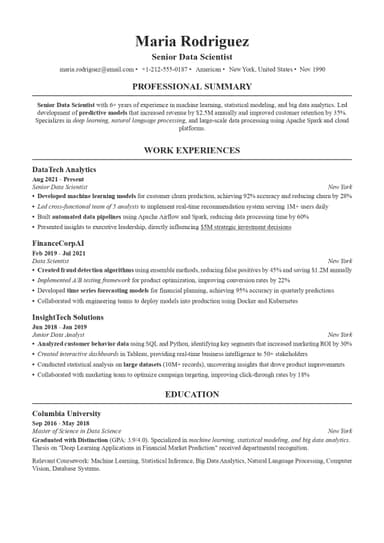
Next, work experience bullet points are where the real evidence lives, though. The goal is to quantify wherever possible, because numbers tell a hiring manager something concrete about the scale and context of your communication experience. You should use strong action verbs to anchor each bullet point, too.
However, you should avoid vague phrases like "excellent communicator," "strong presenter," or "good with people." These appear on so many resumes that they've become invisible, and every candidate claims them, which means they no longer differentiate anyone.
Finally, your resume summary is a third placement option, and a particularly useful one if communication or presentation skills are central to the role you're targeting. One sentence summarizing the way you communicate and present facts should be enough.
Here’s some help: ResumeBuilder.so's AI-powered generator can help you present your communication and public speaking skills based on your target role. We generate a professional resume on your behalf (thanks to expert-designed templates), including strong work experience and skills sections that highlight your strongest competencies!
Final Thoughts
Presentation skills are learnable; they may be a talent some people are born with, but they can also be a set of concrete abilities that respond directly to deliberate practice.
The three biggest levers would be to know your material deeply enough to present it under pressure, practice out loud until it becomes natural, and get honest feedback regularly. Following all the tips we gave you in this guide will be enough to convince every job interviewer of your capabilities!
Presentation Skills FAQ

Daniel Carter is the salary negotiation coach you wish you had before accepting that lowball job offer. With years of HR experience, he knows all the employer tactics—and how to counter them. His posts break down negotiation strategies, industry salary trends, and scripts you can actually use in real conversations.