How to Write a Nursing Cover Letter: Writing Guide & Examples
This complete guide with expert tips and real examples will teach you how to write a compelling cover letter — fast and stress-free!
Edit this cover letter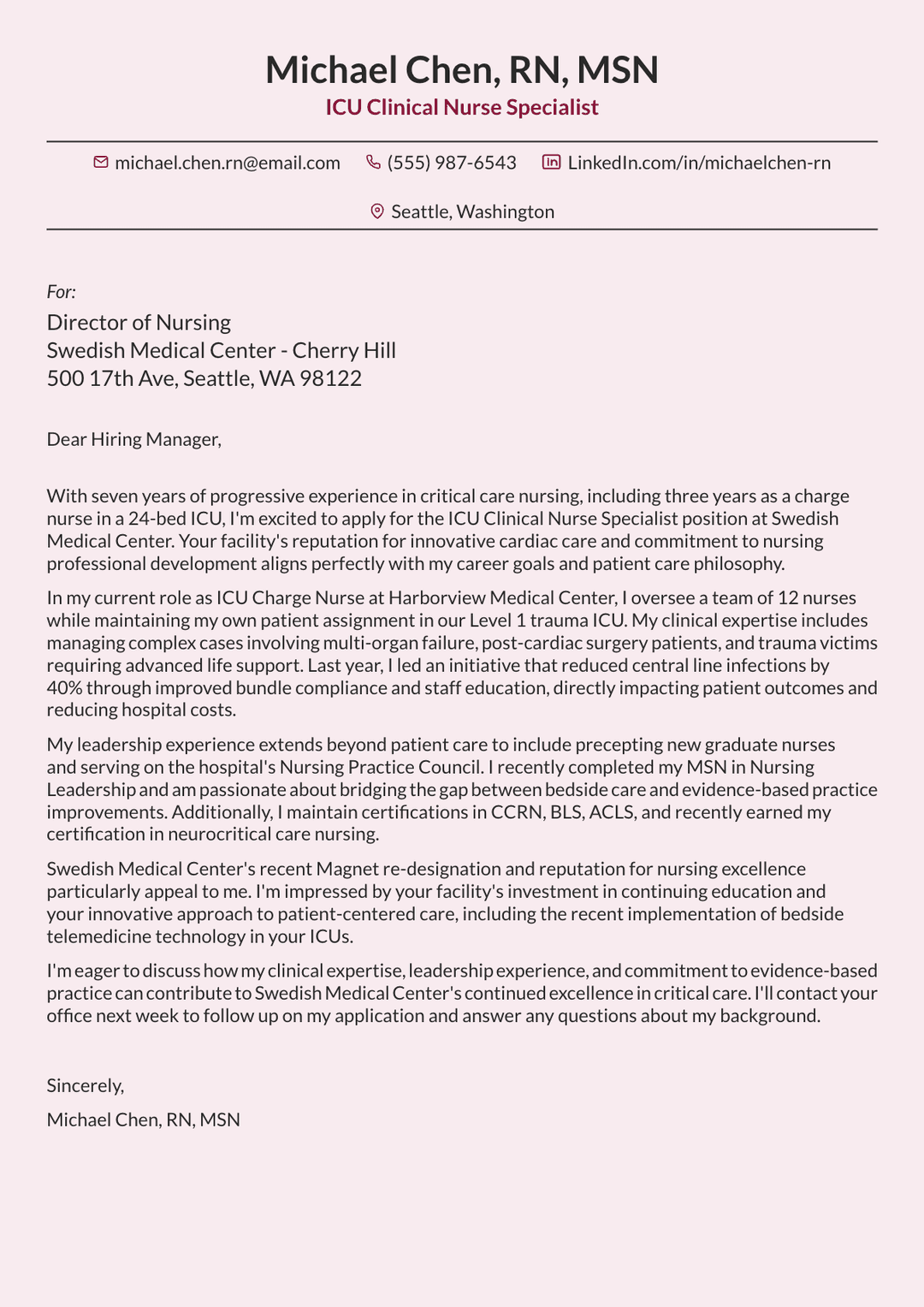
Writing a good nursing cover letter isn't just about introducing your resume. It’s about telling your unique story and showing your potential employers why you're the compassionate, skilled professional their patients need. However, many struggle to balance professionalism with personality, often ending up with generic letters that fail to stand out.
In this guide, we’ll show you exactly how to write a nursing cover letter that highlights your clinical skills, compassion, and commitment to patient care. You’ll find expert tips, step-by-step instructions, and real examples to help you craft a letter that gets you noticed.
- A strong nursing cover letter balances clinical expertise with compassion, showcasing both technical competence and empathy for patients.
- Personalization is crucial—research each healthcare facility’s mission, culture, and specialty to tailor your letter accordingly.
- Highlight specific achievements and outcomes, such as improved patient satisfaction, reduced infection rates, or successful education initiatives.
- Emphasize soft skills and certifications (e.g., BLS, ACLS, CCRN) to show readiness for the role and alignment with patient care standards.
- Avoid common errors like using the same letter for several job applications, focusing on duties instead of results, or overlooking proofreading and formatting consistency.
What Makes a Nursing Cover Letter Different?
Unlike other professions where you might focus primarily on achievements and career progression, a nursing cover letter must balance technical skills with interpersonal abilities. According to the U.S. Bureau of Labor Statistics, employment of registered nurses is projected to grow 5% over the next decade, faster than the average for all occupations. The competition is significant, so your cover letter needs to immediately convey compassion, clinical competence, and your ability to handle life-and-death situations with grace.
The key differentiator in a nursing cover letter is emphasis on patient care experience. While a marketing professional might highlight campaign ROI, you'll want to showcase how you've improved patient outcomes, reduced readmission rates, or earned exceptional satisfaction scores. Your nursing cover letter should paint a picture of both your clinical expertise and your bedside manner.
Also, healthcare facilities care deeply about cultural fit and values alignment. Each hospital, clinic, or specialty practice has its own patient population, treatment philosophy, and organizational culture. Your nursing cover letter needs to show you've researched their specific environment and understand how your background aligns with their needs.
That said, let’s see how a standard cover letter differs from nursing cover letters:
| Nursing Cover Letter | General Cover Letter |
|---|---|
Patient care outcomes | Revenue/profit metrics |
Clinical certifications | Generic skills |
Compassion & empathy | Leadership & strategy |
Interdisciplinary teamwork | Individual achievements |
Healthcare facility knowledge | Company research |
Nursing Cover Letter Examples
Before we dive into how to write a cover letter, let’s see some real-world nursing cover letter examples by experience level that actually work. Whether you are an entry-level candidate or an experienced professional, you can use these examples for inspiration.
Entry-Level Nursing Cover Letter Example

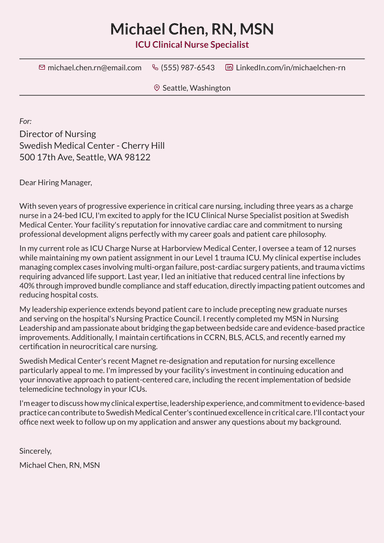
Experienced RN Cover Letter Example

Specialty Nursing Cover Letter Example

How to Write a Nursing Cover Letter: A Step-by-Step Guide
Writing a nursing cover letter doesn’t have to be a tedious job. Now that we’ve established what makes it different from standard business letters and shown examples, let’s dive into each step of the writing process.
#1. Research the Healthcare Facility
Before you write a single word, spend time researching the company, i.e. hospital, clinic, or healthcare organization. Visit their website and look for their mission statement, recent news, awards, and specializations. Check if they're Magnet-designated, recently expanded services, or received recognition for patient care excellence.
Also, look up the facility on social media and professional platforms like LinkedIn. You might discover they've recently implemented new technology, opened a new unit, or achieved significant patient outcomes. This information becomes valuable content for your cover letter.
It doesn’t hurt to research the specific department where you'd be working. An emergency department values different qualities than a pediatric unit or hospice care facility. Understanding their patient population and typical challenges helps you tailor your experience appropriately.
#2. Analyze the Job Description
Read the job posting carefully and identify key requirements, both technical and personal. Look for specific certifications they mention, years of experience required, and any special skills or patient populations they emphasize.
Make a list of your skills and qualifications that match each requirement. If they want someone with telemetry experience and you have it, that becomes a focal point of your cover letter. If they mention working with diverse populations and you speak multiple languages or have cultural competency training, highlight those assets.
#3. Choose the Right Format
As for the cover letter format, you should apply the following guidelines:
- Standard margins (1-inch on all sides)
- Readable font like Arial, Calibri, or Times New Roman in 11-12 point size
- Single-space within paragraphs
- Double-space between paragraphs
As for the length, your nursing cover letter should fit on one page. A concise, well-organized letter demonstrates your effective communication—a crucial nursing skill.
#4. Create a Professional Header
Your cover letter header should mirror your nurse resume for brand consistency. Make sure to include the following:
- Full name
- Credentials (RN, BSN, etc.)
- Phone number
- Professional email address
- City and state
- LinkedIn profile (if it showcases your professional background)
After your contact information, make sure to add the date, followed by employer’s details, such as hiring manager’s name, position, company name, and address.
Here’s how a good example looks in practice:
Jennifer Martinez, RN, BSN
(555) 123-4567
jennifer.martinez@email.com
Phoenix, Arizona
LinkedIn.com/in/jennifermartinez-rn
March 15, 2025
Sarah Thompson, Nurse Recruiter
Mayo Clinic Hospital
5777 E Mayo Blvd
Phoenix, AZ 85054
#5. Craft Your Opening Statement
Start your cover letter with a strong opening that immediately establishes your nursing background and specific interest in their facility. Here are examples for different nursing positions:
- ICU Position: As a critical care nurse with four years of experience managing complex patient cases in a 40-bed ICU, I'm excited to apply for the ICU Nurse position at Excellence Medical Center, known throughout the region for its advanced cardiac care capabilities.
- New Graduate: As a recent BSN graduate with clinical rotations in medical-surgical, pediatric, and psychiatric nursing, I'm eager to begin my nursing career at Community Hospital, where I've observed firsthand the exceptional mentorship and patient-centered care that defines your nursing team.
- Specialty Position: My five years as an oncology nurse, including certification in chemotherapy administration and palliative care, have prepared me perfectly for the Oncology Nurse Specialist role at Cancer Treatment Centers, where your holistic approach to cancer care aligns with my own patient care philosophy.
#6. Highlight Your Clinical Experience
This is where you differentiate yourself from other applicants. Be specific about the units where you've worked, types of patients you've cared for, and medical procedures you're experienced with. For example:
In the surgical ICU, I regularly managed post-operative care for cardiac, thoracic, and vascular surgery patients, including ventilator management, hemodynamic monitoring, and administration of vasoactive drips.
Mention specific technologies or systems you've used if they're relevant to the job title and description. Electronic health record systems, medication administration systems, or specialized equipment experience can set you apart.
#7. Showcase Soft Skills
Nursing requires exceptional interpersonal skills, but don't just claim you have them—provide brief examples. For instance:
My ability to build rapport quickly with patients was evident when I served as the primary nurse for a non-English speaking patient's family, using translation services and visual aids to ensure they understood their loved one's care plan and felt supported during a difficult time.
Also, emphasize teamwork with specific examples, such as:
During a code blue situation, I effectively coordinated with the rapid response team, respiratory therapy, and physicians to help resuscitate a patient who made a full recovery.
#8. Include Relevant Certifications
According to the National Council of State Boards of Nursing, maintaining proper licensure is fundamental to nursing practice. Therefore, always mention your nursing license and state, plus any additional certifications relevant to the position. BLS and ACLS are often required, but specialty certifications can make you stand out.
Here’s a good example of how to phrase it in your nursing cover letter:
In addition to my RN license in Ohio, I maintain current BLS, ACLS, and PALS certifications, and recently completed my Certified Emergency Nurse (CEN) certification to enhance my emergency department expertise.
#9. Write a Strong Closing
End your cover letter with enthusiasm and initiative. Reiterate your interest in the specific position and facility, then indicate your plan for follow-up. Here’s how to do it properly:
I'm genuinely excited about the opportunity to bring my pediatric nursing experience to Children's Hospital's renowned NICU team. I'll contact your office early next week to confirm receipt of my application and answer any questions you might have.
Focus Areas for Different Types of Nursing Positions
Hospital and clinic nursing roles require distinct strengths—hospital nurses should emphasize flexibility, teamwork, and electronic health record proficiency, while clinic nurses should showcase patient education, chronic disease management, and communication skills. That said, make sure to tailor your nursing cover letter to reflect each setting’s priorities and highlight experience with unit-specific systems or operational processes.
The table below outlines different nursing positions and key areas you should focus on when writing your letter:
| Position Type | Key Focus Areas | Essential Skills to Highlight |
|---|---|---|
Hospital Nursing | Patient acuity, teamwork, flexibility | EHR systems, rapid response, unit-specific experience |
Clinic/Outpatient | Patient education, chronic care | Continuity of care, health promotion, insurance knowledge |
ICU/Critical Care | Advanced monitoring, life support | CCRN certification, ventilator management, hemodynamics |
Emergency/Trauma | Rapid assessment, crisis management | TNCC, triage experience, high-pressure response |
Pediatric | Child development, family-centered care | PALS, communication with children and families |
Common Nursing Cover Letter Mistakes to Avoid
Even the most qualified nurses can lose opportunities due to small cover letter mistakes. Avoid these common nursing cover letter errors to ensure your application stands out to healthcare recruiters.
- Using the same cover letter for every application. Each healthcare facility has its own culture, patient population, and priorities. A children's hospital wants to hear about your pediatric experience and patience with young patients, while a trauma center values your ability to think quickly under extreme pressure. Failing to customize shows you haven't invested time in understanding what makes them unique.
- Focusing on duties instead of achievements. Employers want to see how you've made a difference in patient outcomes, not just that you showed up and did your job. Quantify your impact whenever possible—patient satisfaction scores, reduced infection rates, improved efficiency metrics, or successful patient education outcomes all demonstrate your value.
- Ignoring soft skills. Many nurses focus heavily on clinical skills that they forget to showcase the compassionate, interpersonal side of their practice. Include brief examples that demonstrate your ability to connect with patients, work collaboratively with difficult colleagues, or provide emotional support during challenging situations. These soft skills often determine success in nursing more than technical competence alone.
- Poor proofreading. Typos, grammatical errors, or formatting inconsistencies in your cover letter raise serious questions about your accuracy and professionalism in patient care situations. Read your cover letter multiple times, use spell-check, and consider having a colleague review it before submission. Remember that employers will assume your written communication reflects the same care and attention you'd bring to patient documentation.
- Length issues. Nursing cover letters should be concise and focused—typically three to four paragraphs that fit comfortably on one page. If your cover letter runs longer than one page, you're likely including unnecessary details or repeating information from your resume. Focus on the most compelling and relevant information that directly relates to the position.
Ready to Create a Perfect Nursing Cover Letter?
Use ResumeBuilder.so’s AI-powered builder to craft a personalized nursing cover letter that aligns perfectly with your resume. Choose from modern, ATS-optimized cover letter templates tailored for hospital, clinic, or specialty roles.
Follow our expert cover letter examples to highlight your clinical expertise, certifications, and compassion for patient care—so you can impress healthcare recruiters and land interviews faster.
Final Thoughts
A well-crafted nursing cover letter is your opportunity to stand out and showcase not just your clinical skills, but your passion for patient care and commitment to healthcare excellence. Remember that personalization and attention to detail are key to success. Take the time to research each facility thoroughly, customize your cover letter accordingly, and proofread carefully before submitting.
Your cover letter is often the first impression an employer has of you, so make it count by demonstrating the same care and professionalism you'd bring to patient care. The time you invest in creating a compelling nursing cover letter will pay dividends, helping you land interviews and ultimately securing the nursing position.
Nursing Cover Letter FAQ
#1. What should I include in a nursing cover letter?
A nursing cover letter should include your nursing credentials, relevant clinical experience, specific patient care achievements, knowledge of the healthcare facility, and soft skills like compassion and communication abilities. Always mention your current nursing license and any specialty certifications relevant to the position.
#2. How long should a nursing cover letter be?
A nursing cover letter should be one page, typically 250-400 words, with 3-4 concise paragraphs that highlight your most relevant qualifications and experience. Employers appreciate brevity and clarity in professional communications.
#3. How do I address a nursing cover letter if I don't know the hiring manager?
Address it to "Dear Hiring Manager," "Dear Nurse Recruiter," or "Dear [Department Name] Team." Research the facility's website or call to find the specific hiring manager's name when possible, but avoid generic salutations.
#4. Should I mention why I'm leaving my current nursing position?
Only if it adds value, such as seeking growth opportunities, specialization, or relocation for personal reasons. Focus on what you can contribute to the new role rather than negative aspects of your current situation.
#5. What's the best way to format a nursing cover letter?
Use professional business letter format with standard fonts like Arial or Times New Roman, single spacing within paragraphs, and clear paragraph breaks. Include your contact information at the top and maintain consistent professional formatting throughout.

Ava Sinclair is the Founder of ResumeBuilder.so and a seasoned expert in HR and recruitment. As the driving force behind ResumeBuilder.so, Ava combines her expertise in recruitment and job-seeking strategies to empower job seekers with intuitive, high-impact resume-building tools.