Writer Cover Letter: Examples & Practical Tips for 2026
This complete guide with expert tips and real examples will teach you how to write a compelling cover letter — fast and stress-free!
Edit this cover letter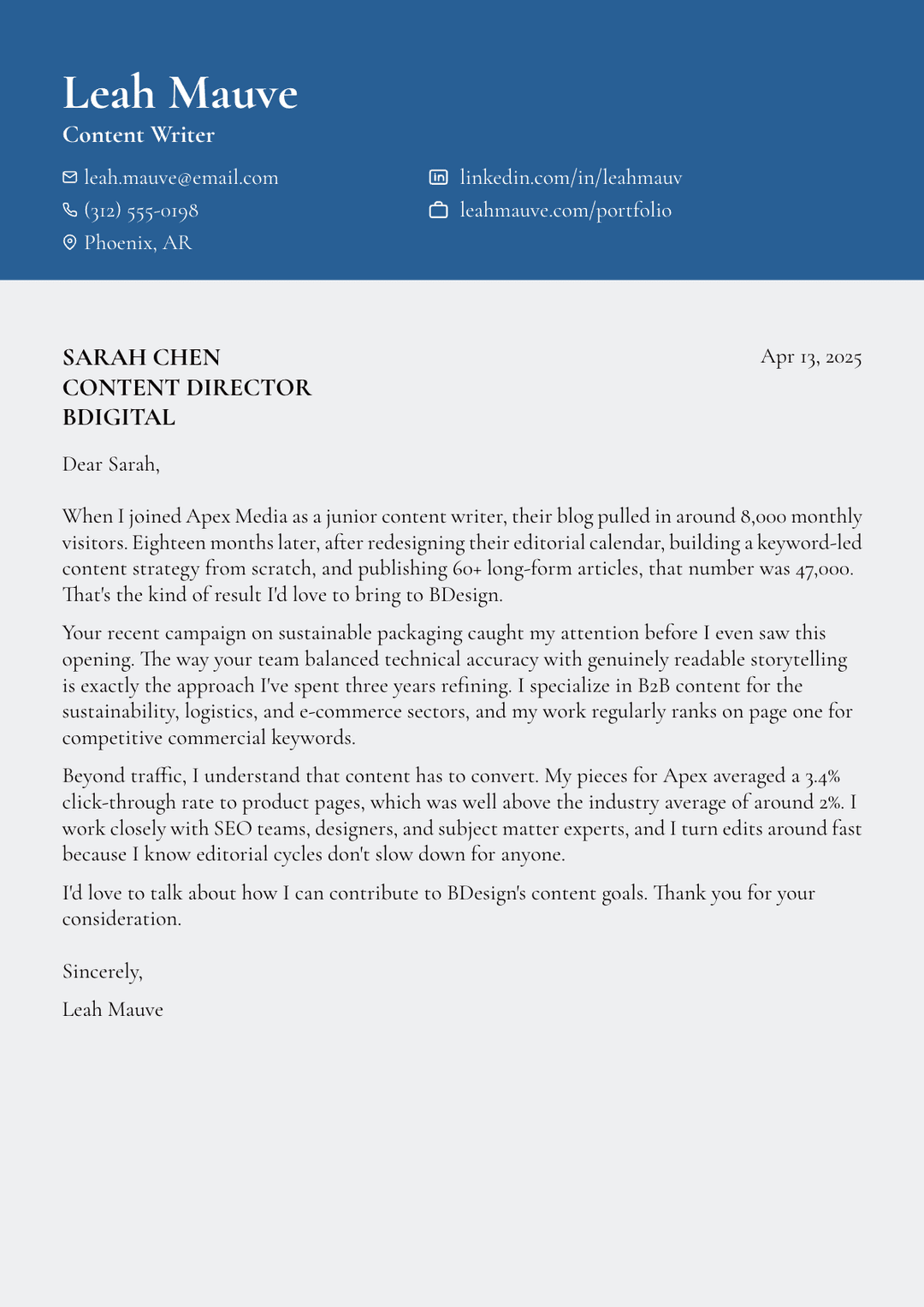
A writer cover letter is a short document sent alongside a resume or portfolio when applying for writing jobs. Its purpose is to introduce the applicant, highlight their relevant writing experience, and explain why they are a strong fit for the role.
Unlike a resume, which lists qualifications in a structured format, a cover letter gives writers the chance to show personality, communication style, and attention to tone, which are all essential in writing-related positions.
This guide will explain how to write a cover letter for a writer position, what to include, how to structure each section, and which details can make your application more convincing. It will also teach you about the mistakes you should avoid at all costs and offer some practical cover letter writing tips that will make the process much easier.
- A writer cover letter is more than a formality because it also acts as a writing sample that shows your tone, clarity, and communication style.
- The strongest writer cover letters are tailored to the specific role and company instead of being reused as generic applications.
- Results matter, so achievements like traffic growth, click-through rates, publication volume, or reduced support tickets should back up your claims.
- A good structure includes a professional header, a specific greeting, a strong opening line, relevant examples, a portfolio link, and a clear closing call to action.
- Common mistakes include weak openings, repeating the resume, skipping ATS keywords, sending generic letters, and submitting without careful proofreading.
What Is a Writer Cover Letter?
A writer cover letter is a one-page document that accompanies your resume when applying for writing roles. It highlights your writing experience, unique voice, relevant skills and qualifications, and the reason you're the right fit for the position.
The key difference between a resume and a cover letter is that the former lists credentials, while the latter tells the story behind them. For someone in a writing role, that distinction carries extra weight; the cover letter serves as a live writing sample here.
Tone, sentence structure, clarity, and even punctuation choices communicate something about your abilities before a hiring manager reads a single line of your portfolio. The format principles typically stay consistent, even though the emphasis changes.
3 Great Writer Cover Letter Examples
The best way to learn how to write a strong writer cover letter is to see one working in context. Below are three examples across different writing roles, each with a different tone, structure, and set of priorities.
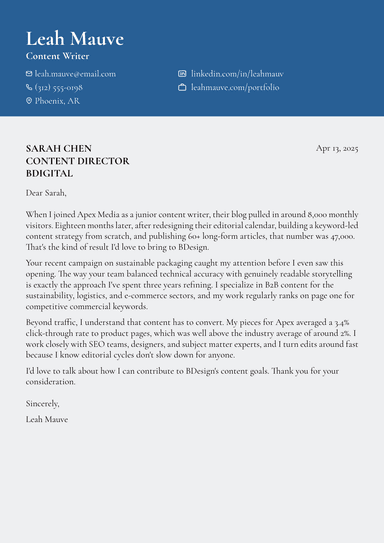
Content Writer Cover Letter Example

Freelance Writer Cover Letter Sample

Technical Writer Cover Letter Sample

How to Make a Good Cover Letter for a Writing Job
To make a cover letter for a writing job, you must pay attention to structure and specificity, as well as follow these six steps:
Step 1: Use a Professional Header
Start with your full name, phone number, email address, and a direct link to your LinkedIn profile or writing portfolio. The header matters more than most people realize; in fact, it's the first visual signal of whether you're organized and professional.
It’s best to match your cover letter's fonts and formatting to your resume so both documents look like a cohesive package. Otherwise, a mismatched application spells carelessness to detail-oriented hiring managers.
Step 2: Address the Right Person
Never default to "To Whom It May Concern" without checking first. Search LinkedIn, research the company's team page, or even the job listing itself for the hiring manager's name.
If you genuinely can't find one, "Dear Hiring Manager" works, but the extra ten minutes of searching typically pays off. After all, writers are expected to be resourceful, so addressing a real person signals exactly that.
Pro tip: LinkedIn's "People" tab on a company page often surfaces the content, communications, or HR team leads. That's usually where your contact may appear.
Step 3: Come Up With a Good Cover Letter Opening Line
The opening line is the most important sentence you'll write. "I am writing to apply for..." is a waste of prime real estate, and every recruiter has read it ten thousand times.
Lead with a specific achievement instead, a bold statement about your specialty, or an observation about the company's own content that shows you've done your homework. Strong openings create momentum, and everything after them just has to sustain it.
Step 4: Showcase Your Writing Skills and Achievements
Don't list skills in isolation; demonstrate them with proof. Every claim in your cover letter should connect to a concrete result, such as:
- Traffic growth percentages
- Word volumes delivered per month
- Client retention numbers
- Click-through rate improvements
- Campaign outcomes
“Imitate” the language from the job description throughout, because ATS systems screen for it, and hiring managers are primed to respond to their own words.
Step 5: Mention Your Portfolio
Writers live and die by samples, so a solid cover letter with no portfolio link is like a chef describing dishes they've never actually cooked.
Include a direct link to your portfolio site, a curated Google Drive folder, or published clips from outlets the reader will recognize. If your work lives behind paywalls, prepare a PDF sampler in advance.
Step 6: Close With a Clear Call to Action
Restate your enthusiasm for the role, then invite them to take the next step with a neat call to action.
Don't be vague ("I hope to hear from you") or presumptuous ("I'll follow up next Tuesday"); land somewhere confident and warm, express interest, and thank them for their time. Finally, close with "Sincerely," "Best regards," or "With appreciation," followed by your full name.
Copyable Writer Cover Letter Template You Can Use
You can use this writer cover letter template as your starting point; replace the bracketed sections with your own information and tailor the language to each specific job:
8 Key Writer Skills for a Cover Letter to Highlight
The most relevant skills you possess deserve to be shown in action within your cover letter. Here's how to frame each one in the letter body rather than simply naming it:
- SEO writing and keyword research: frame around traffic or ranking results you've achieved rather than simply mentioning the technique itself
- Content strategy and editorial planning: reference specific campaigns, content calendars, or publication cadences you've managed
- Research and fact-checking: highlight subject matter depth or the accuracy standards you hold your work to
- Adapting your authorial voice and tone for different audiences: show versatility across industries, formats, or reader personas
- Meeting deadlines across simultaneous projects: mention volume and reliability; editors want writers who don't disappear at crunch time
- CMS proficiency (WordPress, Contentful, HubSpot): name the specific tools listed in the job description
- Data-informed writing: frame around how you've used analytics to improve content performance over time
- Cross-functional collaboration: reference working with editors, designers, or subject matter experts on real projects
5 Biggest Writer Cover Letter Mistakes to Avoid
Before we wrap up, let’s briefly explore the most common cover letter mistakes writers make:
Recruiters spot templated writing job applications immediately. Therefore, customizing each letter to the specific company and role (even if it's just two or three swapped sentences) dramatically improves your response rate.
Reference their actual content, their audience, or something you genuinely noticed about the company before you applied. That specificity is what separates applications that feel considered from ones that feel automated.
Your cover letter adds narrative context. The hiring manager will see your resume on the next page, so use the cover letter to tell the story behind your best achievement, explain a pivot, or connect the dots between experiences that might not be obvious. If everything in your cover letter is also in your resume, one of them isn't doing its job.
Many companies run cover letters through applicant tracking systems before a human ever reads them. To avoid getting eliminated right away, try to mirror keywords from the job description naturally throughout your letter. This includes:
- Job title variations
- Key tools
- Required skills
This should be paired with an ATS-friendly resume that passes the same screening. Otherwise, a brilliantly written letter that gets filtered out at the ATS stage is just a missed opportunity.
"I am writing to express my interest in the writing position" wastes the most visible and valuable part of your letter. Even worse, it comes off as if you couldn't think of anything specific to say, which is a red flag for a writing role.
Open with something earned, be it a result, a sharp observation, or a direct statement of value. This way, you will make the reader want the second sentence and all the other sentences after it.
For a writer, a grammatical error or a typo in a cover letter is both embarrassing and disqualifying. As previously mentioned, your cover letter is your writing sample at this point, so you want to run at least two proofreading passes, read the letter aloud to catch awkward phrasing, and let it sit for an hour before the final review.
Final Thoughts
Your cover letter represents the first piece of writing a potential employer will judge you on, which means it should be as good as anything in your portfolio. Customize it for every role, lead with impact, anchor your claims in results, and always link to your samples.
If you don’t want to write your job application from scratch, you can rely on ResumeBuilder.so to build a fully personalized, ATS-friendly cover letter for you in minutes. You need no design experience for this; you should only pick a cover letter template according to your field, and give us some more information on your qualifications, and we’ll do the rest!
Writer Cover Letter FAQ
#1. What should a writer include in a cover letter?
A writer should include relevant writing experience, key skills, quantifiable achievements, and a direct link to their portfolio in a cover letter. The letter should be tailored to the specific role and written in a tone that reflects the type of content they create.
#2. How long should a writer's cover letter be?
A writer's cover letter should be no longer than one page, ideally between 250 and 400 words. Hiring managers read quickly, so a concise, well-structured letter that demonstrates voice and important skills will always be better than a lengthy one that buries the points that actually matter.
#3. How do I make a writer cover letter with no experience?
You can make a strong cover letter without formal experience by highlighting transferable skills, academic writing, personal blog content, volunteer projects, or freelance work. Focus on enthusiasm, your best abilities, and include any writing samples you have, as even informal ones can demonstrate range.
#4. Can I use AI to write my cover letter?
You can use AI tools to draft or improve your writer cover letter, but always personalize and edit the output so it reflects your authentic voice. Tools like ResumeBuilder.so's AI cover letter generator help writers build a strong baseline and personalize their job applications.

Jordan Lee is your guide to navigating the rapidly changing job market in the age of AI and automation. He dives into how AI is reshaping hiring, the skills of the future, and what job seekers need to do now to stay relevant. If you’re curious about how technology is transforming careers and want to future-proof your job, Jordan’s insights are a must-follow.