Editor Resume: How To Make a Job-Winning One in 2026
This complete guide with detailed explanations and expert tips will teach you how to write an acting resume in record time!
Edit this resume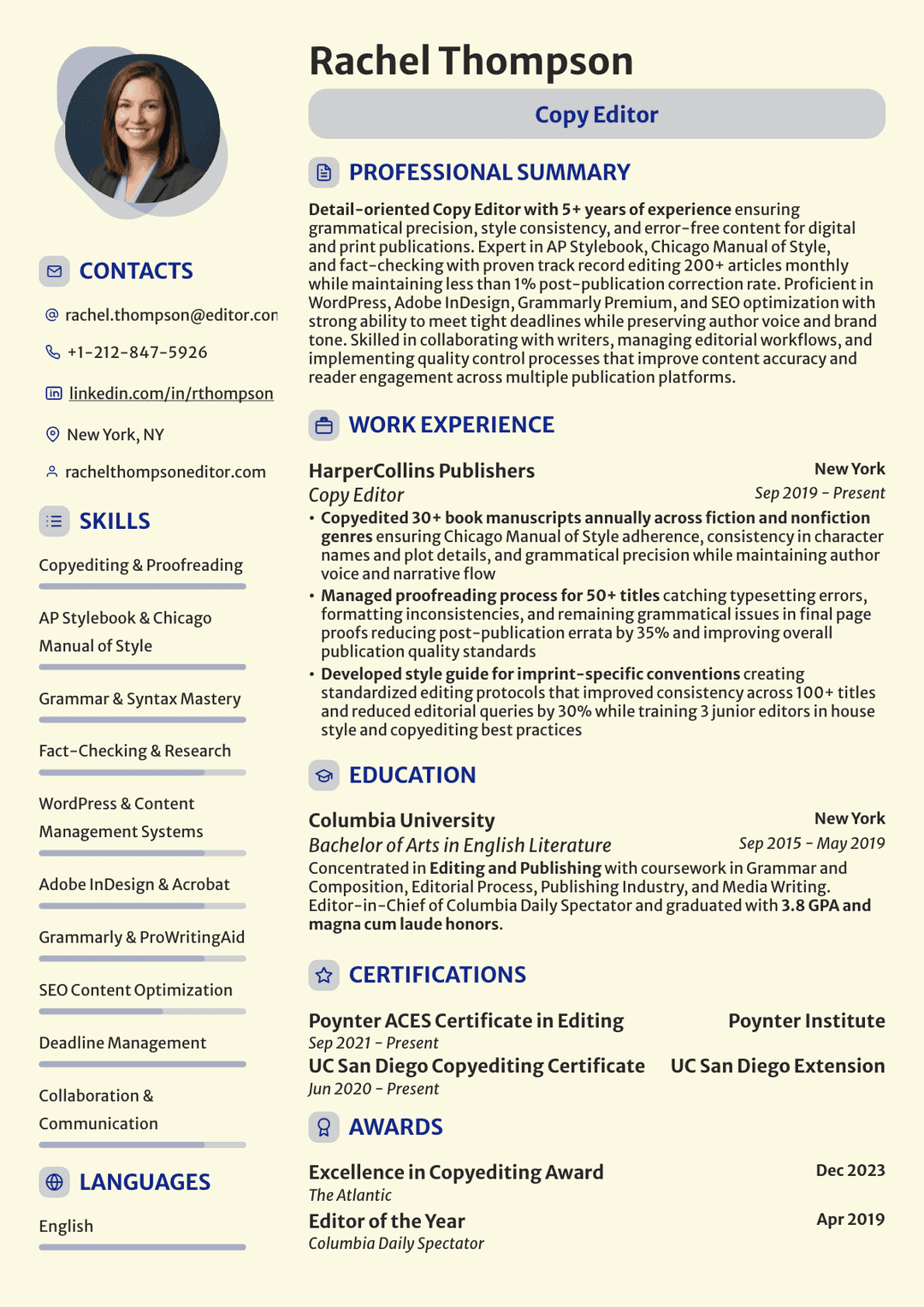
An editor resume is a professional job application document that showcases your ability to refine content, manage editorial processes, and deliver publication-ready work. Regardless of whether you're a copy editor ensuring grammatical precision or a senior editor leading editorial teams, your resume must demonstrate the same attention to detail you bring to your work.
In the publishing landscape, employers scrutinize editor resumes more carefully than most, so even small mistakes could ruin your chances of landing an interview. This guide provides expert strategies, proven examples, and actionable tips to help you create this document properly so that it passes ATS screening and impresses hiring managers. Read on!
- A resume for an editor position has to function as both a qualifications summary and a mini writing sample, proving clarity, precision, and immaculate grammar.
- The fastest way to stand out is to show measurable editorial impact—volume edited, error-rate reductions, deadline performance, traffic/engagement lifts, or workflow improvements.
- Reverse-chronological is usually the safest format for editors, with one page for most candidates and two pages only when a deep portfolio genuinely warrants it.
- A strong editor resume highlights role-specific hard skills (style guides, CMS, editing tools, SEO) alongside collaboration and deadline-driven execution.
- The biggest deal-breakers are avoidable: typos, duty-only bullet points, vague claims with no numbers, generic tailoring, and messy formatting.
What Is an Editor Resume?
An editor resume is a professional document that showcases your editing experience, skills, and achievements to potential employers.
Unlike many other resumes for different professions, these must exemplify the same qualities you bring to your work: clarity, precision, attention to detail, proofreading skills, and impeccable grammar. So, your resume serves as a writing sample that demonstrates your ability to organize information, communicate effectively, and present content in a polished format.
Additionally, hiring managers expect to see evidence of your editing expertise through quantifiable achievements, such as improved content quality metrics, increased publication output, or enhanced reader engagement.
For this reason, your resume should highlight specific editorial competencies, including knowledge of style guides (AP style, Chicago Manual, MLA, etc.), proficiency with content management systems, and experience with various editorial processes from copyediting to content strategy development.
4 Editor Resume Examples for Different Career Levels/Directions
Below, you can see editor resume examples for several specializations, each demonstrating effective strategies for showcasing industry-specific expertise.
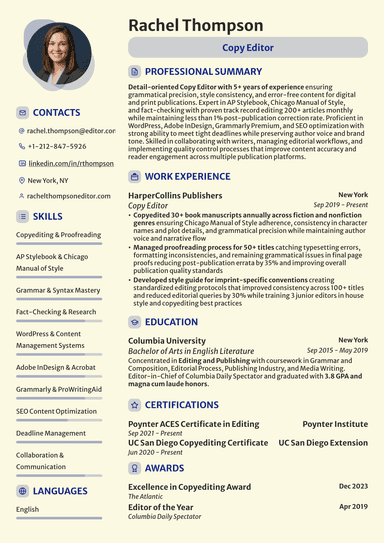
Copy Editor Resume Example

Content Editor Resume Example


Senior Editor Resume Example


Freelance Editor Resume Example


Editor Resume Formatting Tips
Choosing the right resume format is crucial for presenting your editorial experience effectively.
For most editors, a reverse-chronological format works best, as it clearly shows your career progression and increasingly responsible roles. It’s also best for editors with solid work history in the field and lists experience from most recent to oldest, making it easy for hiring managers to see your career trajectory.
Besides this one, you can also opt for:
- Functional format. This one is useful for career changers or those with gaps in employment. It emphasizes editorial skills over chronological work history, though some hiring managers view this format skeptically.
- Combination format. This format, also known as hybrid, blends chronological and functional approaches and works well for editors transitioning between specializations (e.g., from print to digital editing).
Entry-level to mid-career editors’ resumes should be one page long. Senior editors or those with extensive publishing portfolios can extend to two pages, but every line should add value.
You should use clean, professional templates with clear section divisions and ensure adequate white space for readability. It’s also best to choose fonts between 10-12 points for body text and 14-16 points for headers.
6 Essential Components of an Editor Resume
Now that we know how to format an editor resume, let’s see what sections it should contain:
#1. Contact Information and Professional Links
Your contact information should be immediately visible at the top of your editor resume and include your full name, email address, phone number, city and state (full address not necessary), and LinkedIn profile URL. Furthermore, adding a link to your professional portfolio, published clips, or personal website is highly valuable since it provides tangible evidence of your editorial work.
Make sure your email address is professional (firstname.lastname@email.com) and your LinkedIn profile is current. If you have a strong presence on professional platforms like Medium or a personal blog showcasing editorial expertise, include those links as well. Avoid including multiple social media links unless they're professionally relevant.
#2. Resume Summary or Objective
Your professional resume summary or objective is often the first section hiring managers read after your contact information. This 2-4 sentence section should encapsulate your editorial experience, key specializations, and most impressive editorial achievements.
Experienced professionals should use a resume summary for an editor and format it in the following way:
Detail-oriented Senior Editor with 8+ years of experience managing editorial teams and developing content strategies for digital publications. Increased reader engagement by 45% through data-driven content optimization. Expertise in AP style, SEO implementation, and multi-platform publishing workflows.
Meanwhile, entry-level editors or career changers can use an objective statement instead:
Recent journalism graduate with editorial internship experience at university publications seeking an assistant editor position. Strong foundation in AP style, content management systems, and collaborative editorial processes. Passionate about developing engaging content that resonates with target audiences.
The key is specificity; you should avoid generic statements and include concrete details about your experience and specializations.
#3. Work Experience Section
Your work experience section is the part of your editor resume where you need to prove your editorial expertise through concrete examples and measurable achievements.
List your positions in reverse-chronological order, starting with your most recent role. For each role, include job title, company/publication name and location, employment dates (month and year), and 4-6 achievement-focused bullet points.
The critical difference between weak and strong editor resumes lies in the bullet points. Don't simply list job duties—showcase your impact through quantifiable results. You can also use the PAR (Problem-Action-Result) formula: identify the challenge, explain your editorial approach, and quantify the outcome.
Here’s what this might look like on your resume:
Work Experience
Content Editor
Digital Media Company, London
March 2021 – Present
- Edited, proofread, and fact-checked 250+ long-form articles per year, maintaining a <1% post-publication correction rate
- Managed the end-to-end editorial process for 20–30 pieces of content per month, consistently meeting 100% of publishing deadlines
- Collaborated with 10+ writers and cross-functional teams (SEO, design, marketing) to optimise content structure, tone, and performance
- Implemented SEO-focused edits (keyword alignment, internal linking, metadata optimisation) that contributed to a 30–45% increase in organic traffic across key content clusters
- Rewrote and refreshed 80+ underperforming articles, improving average time on page by 25% and reducing bounce rates by 15%
- Introduced a streamlined editorial checklist and style guide updates, reducing revision rounds by 20% and speeding up production cycles
- Provided structured editorial feedback that helped reduce recurring writing errors by 30% within six months
#4. Skills Section
Your skills section should showcase both hard skills (technical editorial competencies) and soft skills (interpersonal abilities). For editors, this is particularly important because the role requires both technical precision and collaborative communication.
The hard skills you can include in your editor resume would be:
- Copyediting and proofreading
- Line and developmental editing
- Fact-checking and research
- Grammar and syntax mastery
- Style guides (AP Stylebook, Chicago Manual of Style, MLA, AMA, APA)
- Editorial planning and calendar management
- Audience analysis and content positioning
- Brand voice and consistency maintenance
- Content management systems (WordPress, Drupal, Adobe Experience Manager)
- Editing software (Grammarly, ProWritingAid, Hemingway Editor)
- Publishing platforms (InDesign, Acrobat, Microsoft Office Suite)
- SEO tools and analytics (Google Analytics, SEMrush, Ahrefs)
- Project management tools (Asana, Trello, Monday.com)
On the other hand, when it comes to soft skills, you can mention:
- Attention to detail
- Deadline management
- Team collaboration
- Communication skills
- Critical thinking
- Problem-solving
- Adaptability
Tailor your skills section to match the job description; if a position emphasizes SEO content editing, prioritize those skills higher in your list.
Let’s see how you can do this:
Skills
Hard Skills
- Editing and proofreading
- Content editing (long-form & short-form)
- Fact-checking and quality control
- SEO content optimization
- Headline and metadata editing
- CMS publishing (WordPress)
- Style guide adherence
- Basic content performance analysis
Soft Skills
- Strong attention to detail
- Clear written communication
- Time and deadline management
- Constructive feedback delivery
- Collaboration with writers and teams
- Adaptability to different tones and brands
- Ability to prioritize under pressure
#5. Education and Editorial Certifications
List your educational background in reverse-chronological order, including your degree, major, institution name, and graduation year (if within the last 5-7 years). Many editorial positions prefer candidates with degrees in English, Journalism, Communications, or related fields, but relevant experience can sometimes compensate for non-traditional educational backgrounds.
Certifications add credibility and demonstrate your commitment to professional development. Some valuable editorial ones include:
- Poynter ACES Certificate in Editing
- Editorial Freelancers Association (EFA) courses
- UC San Diego Extension Copyediting Certificate
- American Copy Editors Society (ACES) membership
- Content Marketing Institute certifications
If you're an entry-level candidate, you can also include relevant coursework, academic honors, and writing awards that demonstrate your capabilities.
An example looks like this:
Education
BA in English Language and Literature
University of Illinois at Chicago, Chicago, IL
2017 – 2021
#6. Additional Sections (Optional)
Finally, consider adding these sections if they strengthen your editor resume:
- Portfolio/published work: Include a link to your online editorial portfolio or list 3-5 notable published pieces with publication names and dates.
- Professional affiliations: Membership in organizations like the Editorial Freelancers Association (EFA), the American Copy Editors Society (ACES), or professional journalist associations.
- Awards and recognition: Editorial awards, writing competitions, or industry recognition.
- Languages: Particularly valuable for editors working with international publications or multilingual content.
- Volunteer experience: Pro bono editing work or editorial volunteer positions at non-profits.
5 Common Editor Resume Mistakes to Avoid
While writing your editor resume, you should steer clear of the following:
- Typos and grammatical mistakes. A single error signals carelessness and immediately disqualifies you. Proofread multiple times, use editing software, and ask a colleague to review your resume before submitting.
- Focusing on duties instead of achievements. Writing "Edited articles for publication" tells hiring managers nothing. Instead, show your impact with "Edited 50+ feature articles monthly for a publication with 500K readers, reducing error rates by 40% through implementation of style guide training."
- Lack of quantifiable results. Numbers demonstrate your effectiveness. Include metrics like articles edited per month, error reduction percentages, team size managed, traffic increases, or publication deadlines met.
- Generic, unfocused content. Tailor your resume for each position; for example, that for a book editor position should emphasize different skills than one for a digital content editor role.
- Poor formatting or design. While creativity has its place, editor resumes should prioritize clarity and readability. Use consistent formatting, adequate white space, and a professional font.
Do You Need a Cover Letter for an Editor Job Application?
Yes, you need a cover letter for an editor job application, even when the job ad doesn’t specify it. While your resume lists qualifications, your cover letter demonstrates your writing ability and explains why you're interested in the specific position. In fact, it's an extended writing sample that showcases your communication skills.
Your editor cover letter should:
- Open with a strong hook. Reference the publication or company specifically and explain what draws you to the position. Demonstrate knowledge of their content, editorial approach, or recent projects.
- Highlight 2-3 key achievements. Choose accomplishments most relevant to the job requirements. Expand on these beyond what your resume says, explaining your work methods and problem-solving strategies.
- Show your personality and fit. While maintaining professionalism, let your voice come through. Editors appreciate candidates who demonstrate a passion for content quality and editorial excellence.
- Be concise. Your cover letter length should be one page maximum; editors respect brevity and clear communication.
- End with a call to action. Express enthusiasm for discussing how your skills align with their needs.
- Be proofread. A typo here is damaging since this document specifically showcases your writing and editing abilities, too, just like your resume.
Let Us Handle Editor Resume Writing For You
Ready to craft your editor resume with zero hassle and in just a few minutes? Use our AI-powered tool to create a professional, ATS-friendly resume that captures your best qualities and competencies. This way, you’ll only get closer to landing an interview and getting the job of your dreams!
All you should do is choose from the numerous templates we designed for different professions, and let our smart suggestions help you craft a compelling addition to your job application.
Final Thoughts
Your editorial expertise deserves a resume that showcases your skills, achievements, and attention to detail. With the strategies and examples provided in this guide, you're equipped to create one that passes ATS screening and impresses hiring managers.
Since it’s a living document, remember that you need to update it regularly, tailor it for each job application, and always proofread meticulously. The editorial job market is competitive, but a well-crafted resume that demonstrates your value through quantifiable achievements will definitely set you apart.
Editor Resume FAQs
#1. How long should an editor resume be?
An editor resume should typically be one page for entry-level to mid-career professionals with less than 10 years of experience. Senior editors, managing editors, or those with extensive publication portfolios can extend to two pages, but only if every line adds value.
#2. What skills should I include on my editor resume?
You should include both hard skills and soft skills on your editor resume. Essential hard skills include specific style guides, content management systems, editing software, and SEO knowledge. Meanwhile, soft ones encompass attention to detail, deadline management, collaboration, communication, and problem-solving abilities. You should tailor your skills section to match the specific editor job description and prioritize skills the employer emphasizes in their posting.
#3. Should I include a portfolio link on my editor resume?
Yes, you should absolutely include a portfolio link on your editor resume, as it provides tangible evidence of your editorial work and writing ability. You can create an online portfolio using platforms like Contently, Clippings.me, or a personal website showcasing your best edited pieces, and then include the link in your contact information section.
#4. Should I use a creative or traditional resume format for editorial positions?
You should use a traditional, professional resume format that prioritizes clarity and readability over creative design for most editorial positions. Exceptions include positions in creative agencies, design-focused publications, or roles emphasizing visual content where a more creative format might be appropriate.
#5. How do I quantify achievements as an editor?
You quantify editor achievements as an editor by tracking content volume, quality improvements, efficiency metrics, team size managed, publication deadlines met, and business impact. Even without formal metrics, you can also estimate reasonable figures and include project scope, publication reach, or prestigious publications, as well as significant numbers that serve as concrete evidence of your editorial impact.

Daniel Carter is the salary negotiation coach you wish you had before accepting that lowball job offer. With years of HR experience, he knows all the employer tactics—and how to counter them. His posts break down negotiation strategies, industry salary trends, and scripts you can actually use in real conversations.