Create a Marketing Resume That Gets You Hired: Full Guide
This complete guide with detailed explanations and expert tips will teach you how to write an acting resume in record time!
Edit this resume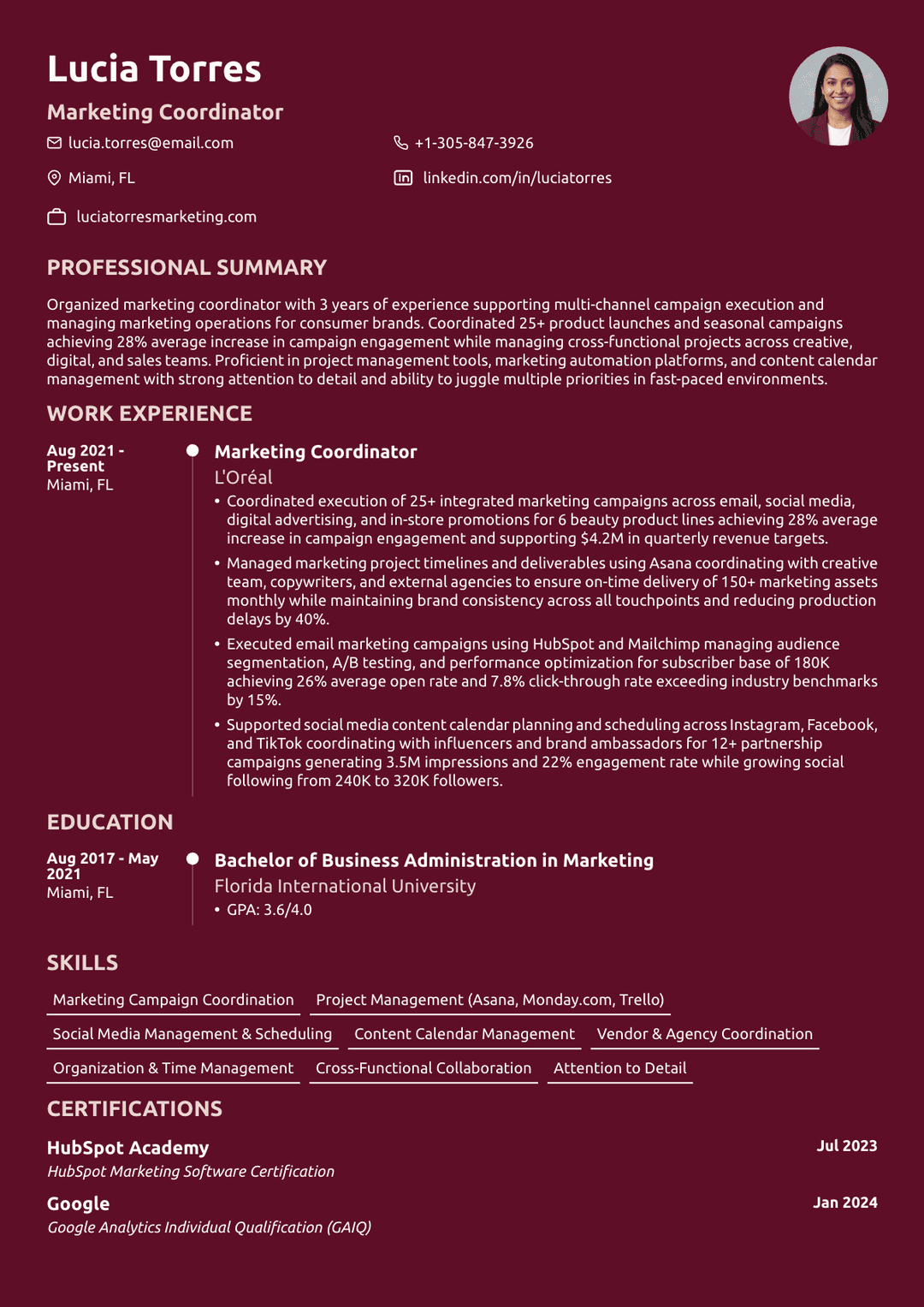
A marketing resume is a document you use to apply for roles in this industry. A well-written one highlights your ability to promote products, grow audiences, and drive measurable results through campaigns and strategy. Because marketing is results-driven, a solid job application usually helps employers quickly see the impact you’ve made.
In this article, you’ll learn how to write a marketing resume that clearly communicates your value. We’ll cover the key sections to include in it, how to present achievements using valuable data, and which skills employers expect across different marketing roles. You’ll also find practical tips and examples to help your resume stand out in a competitive job market.
- A strong marketing resume must clearly demonstrate measurable impact, creativity, and data skills, since hiring managers evaluate it quickly and critically.
- The reverse-chronological format is usually best, as it’s easy to scan and ATS-friendly; more creative layouts often hurt readability and performance in screening systems.
- Work experience should focus on quantified achievements using the Action + Context + Result approach, not vague responsibilities.
- Tailoring is essential: keywords, skills, and emphasis should match the specific marketing role (e.g., digital, coordinator, manager) and mirror the job description for ATS alignment.
- A complete marketing resume includes core sections (contact info, summary/objective, experience, skills, education), with optional additions like portfolios or projects to strengthen your application.
What Is a Marketing Resume?
A marketing resume is a document that showcases your campaign results, skills, and career history, organized to help you land roles in marketing departments, agencies, or in-house brand teams.
This resume is different from a general resume because it’s expected that you demonstrate three things simultaneously: measurable impact, creative thinking, and data fluency. Hiring managers in this field evaluate candidates the same way a target audience evaluates an ad: fast, skeptical, and decisive. So, if your resume doesn't immediately communicate value, you lose the chance of landing the role you want.
The specific role you're targeting also shapes what gets emphasized, so, for example:
- A marketing coordinator resume leans into organizational skills and tool proficiency.
- A digital marketing resume front-loads platform expertise and campaign metrics.
- A marketing manager resume highlights leadership, cross-functional project ownership, and revenue impact.
The structure stays consistent, but the keywords, examples, and framing should always reflect the specific job you're applying for.
Marketing Resume Examples by Role/Experience Level
The structure of your marketing resume stays largely consistent across roles, but the emphasis shifts based on your experience level and what the job actually requires. Here's how to calibrate this document depending on the role/experience level:
#1. Entry-Level Marketing Resume

#2. Digital Marketing Resume

#3. Marketing Manager Resume

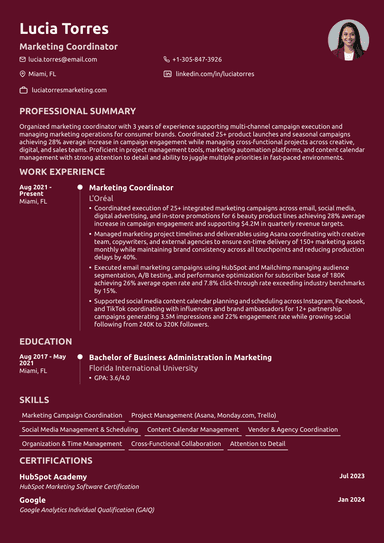
#4. Marketing Coordinator Resume

How to Format a Marketing Resume
Format choice directly affects both readability and whether your resume survives ATS parsing. Marketing resumes need to balance visual appeal with technical compatibility, which means a clean, structured layout wins over a creative one nearly every time.
Here's a breakdown of your three main options when it comes to resume format in this industry:
#1. Reverse-Chronological Format
The reverse-chronological format lists your most recent experience first and works backwards. It's the most widely recognized layout in the industry and the easiest for recruiters to scan.
Career progression is immediately visible with this one, which is exactly what a hiring manager wants to see. This is the go-to choice for mid-career professionals and senior candidates, as well as for most marketing job seekers, regardless of level.
#2. Functional Format
On the other hand, the functional resume leads with skills and competencies rather than a chronological work history. It can help entry-level candidates without much experience, or career changers making the move into marketing from another field.
However, the catch is that many ATS systems don't parse functional layouts cleanly, which can bury your resume before a human ever sees it. Therefore, you should use this format only when a non-linear career genuinely demands it, not as a way to obscure limited experience.
#3. Combination Format
The combination resume blends a strong skills section with a full work history. It's worth considering if you have real, demonstrable marketing capabilities but a non-linear career path, e.g., significant freelance or consulting work alongside traditional employment. It shows both depth and direction.
What to Include in a Marketing Resume: The Essentials
A marketing resume should include these core sections:
#1. Contact Information
Keep the contact information section simple; all it needs to feature is your full name, email address, phone number, location, and a LinkedIn URL. You don't need to include a full street address, as the city and state are sufficient unless requested otherwise.
If you have a portfolio website, personal site, or any relevant public work (a Substack, a marketing blog, a case study repository), add that link too. For creative or content-focused roles, a portfolio link can carry significant weight.
Emma Carter
emma.carter@email.com
+916 123 456 789
Sacramento, CA
linkedin.com/in/emmacarter123
emmacartermarketing.com
#2. Marketing Resume Summary or a Marketing Resume Objective
This section is the first paragraph a recruiter reads, and it determines whether they keep reading or move on. Don't waste it on generic phrases.
A resume summary is for candidates with relevant work experience and consists of two to three sentences that position you for the role you want by highlighting your most impressive results. Meanwhile, a resume objective is better suited for entry-level candidates or career changers and states what you bring to the table, even without a long track record.
Now, let’s have a look at an example of a solid resume summary:
Results-driven marketing specialist with 5+ years of experience planning and executing digital campaigns across social media, email, and paid channels. Skilled in data analysis, content strategy, and brand development, with a track record of increasing engagement and driving measurable growth. Looking to contribute strategic thinking and creative execution to a forward-thinking marketing team.
#3. Work Experience
When it comes to the section that features your previous work experience, you should list your roles in reverse-chronological order, including:
- Company name
- Job title
- Location
- Employment dates
Each bullet point featured in role descriptions should follow the ACR method: Action + Context + Result. This structure forces specificity and turns vague responsibilities into evidence of real impact.
Quantify wherever you can, be it percentages, revenue figures, lead counts, ROAS, CPL, conversion rates, or email open rates. If you don't have exact numbers, use ranges or relative comparisons; the discipline of connecting your actions to measurable outcomes is itself a signal to hiring managers.
It should look like this:
Work Experience
Digital Marketing Executive
HellenicVibe, Sacramento, California
June 2022 – Present
- Managed multi-channel marketing campaigns for 8+ clients, increasing average engagement rates by 32% within six months
- Planned and executed paid social campaigns (Meta, LinkedIn), generating a 4.5x average return on ad spend
- Analyzed campaign performance using Google Analytics and HubSpot, providing actionable insights that improved conversion rates by 18%
- Collaborated with designers and copywriters to develop cohesive brand messaging across platforms
- Led A/B testing initiatives for email campaigns, boosting open rates from 21% to 29%
Marketing Coordinator
Nova Retail, Manchester, UK
March 2020 – May 2022
- Supported the rollout of seasonal campaigns across email, social media, and in-store promotions
- Managed the company’s Instagram and Facebook accounts, growing followers by 40% in one year
- Coordinated influencer partnerships, contributing to a 25% increase in online sales during campaign periods
- Assisted in content creation, including blog posts, newsletters, and product descriptions
- Tracked campaign KPIs and prepared monthly performance reports
#4. Marketing Skills Section
Your skills section pulls double duty: it helps ATS systems match your profile to the job posting, and it gives recruiters a fast visual inventory of your capabilities. Without a dedicated skills section, both of those functions suffer.
You should split all your prominent abilities into two subcategories: hard skills and soft skills.
- Hard skills include abilities such as:
- SEO
- Google Ads
- Meta Ads
- Google Analytics 4
- HubSpot
- Salesforce
- Mailchimp
- Klaviyo
- Marketo
- Email marketing
- Content strategy
- A/B testing
- CRM management
- Looker Studio
- Tableau
- Canva
- Copywriting
- SEM
- Demand generation
- Soft skills, meanwhile, may refer to:
- Communication
- Cross-functional collaboration
- Project management
- Analytical thinking
- Creativity
- Stakeholder management
- Time management
One practical detail that matters more than people realize is that they should mirror the exact phrasing from the job description. If the posting says "SEM" and you write "search engine marketing," an ATS may not connect them as synonyms; therefore, you should copy the language they use.
Here’s an example of a well-written skill section in a marketing resume:
Skills
Hard Skills
- Digital marketing strategy
- Paid advertising (Meta Ads, Google Ads)
- Search engine optimization (SEO) & keyword research
- Email marketing (Mailchimp, HubSpot)
- Social media management & scheduling tools (Hootsuite, Buffer)
- Data analysis (Google Analytics, Excel)
- Content planning & copywriting
- A/B testing & campaign optimisation
- CRM tools (HubSpot, Salesforce)
- Basic HTML/CSS
Soft Skills
- Strategic thinking
- Communication
- Creative problem-solving
- Time management & organization
- Attention to detail
- Collaboration & teamwork
- Adaptability
- Decision-making
- Ability to work under pressure
#5. Education
In this section, you should mention your most recent degree and list its type, institution, and graduation year, in a way similar to this:
Education
Bachelor of Science in Marketing
University of California, Los Angeles (UCLA), Los Angeles, CA
Graduated: May 2020
- GPA: 3.7/4.0
- Relevant Coursework: Digital Marketing, Consumer Behavior, Marketing Analytics, Brand Management
- Dean’s List (2018–2020)
- Marketing Club Member
Recent graduates can also include relevant coursework, a strong GPA, or academic honors in the education section of their resumes. Additionally, certifications fit here naturally, or in a separate section if you have several; if you decide to add any, you need to include the credential name, the issuing organization, and the year when it was earned.
#6. Optional Sections
Depending on your background, these additions can meaningfully strengthen your application:
- Portfolio/Projects. Freelance campaigns, college projects with real metrics, or personal brand work all count, especially for content-heavy or creative roles.
- Languages. Particularly valuable for international teams, multilingual campaigns, or roles in global marketing.
- Volunteer work. Managing social media or running campaigns for a nonprofit counts as real marketing experience.
Making an ATS-Friendly Marketing Resume
Most companies (particularly larger organizations) use applicant tracking systems (ATS) to filter resumes before a human ever reads them. This software scans your document for relevant keywords, evaluates the formatting for parseability, and ranks or filters candidates accordingly.
A highly qualified marketing professional with a poorly formatted resume can get screened out entirely, so here’s what you need to do to make your marketing resume ATS-friendly:
- Use a clean, standard resume layout. This means no text boxes, tables with nested content, graphics-heavy columns, or headers and footers containing critical information. ATS parsers read linearly, and anything that disrupts that flow risks being missed or misread.
- Mirror keywords from the job description. For instance, if the posting uses "demand generation," use that exact phrase; don't substitute it with a synonym you prefer.
- Use standard section headings. Such headings are what ATS systems are trained to recognize.
- Stick to common resume fonts. Calibri, Arial, and Times New Roman are safe, while decorative fonts may not render correctly across all systems.
- Save in the right format. Submit as .pdf or .docx as specified in the job listing. When in doubt, go with .pdf, as it preserves your resume design reliably without formatting shifts.
Final Thoughts
Your marketing resume’s purpose is to market you as effectively as you market products and services for the organizations you've worked for. If it doesn’t have such an effect, it doesn't matter how talented you actually are; you may lose the chance of getting the job.
That's where ResumeBuilder.so comes in, providing a tool that puts these principles into practice fast and easily. We offer seamless, ATS-ready resume templates designed for marketing professionals; it’s enough to enter the crucial details about your career, and we’ll generate a submission-ready job application document within minutes!
Marketing Resume FAQ
#1. What should a marketing resume include?
A marketing resume should include a contact section, a resume summary, work experience with quantifiable results, a skills section highlighting marketing tools and strategies, education, and optional sections like certifications or a portfolio link.
#2. How do I write a marketing resume with no experience?
To write a marketing resume with no experience, you need to focus on internships, academic projects, volunteer work, and personal campaigns. Also, you should lead with a resume objective that highlights your enthusiasm and relevant coursework and use any measurable outcomes to demonstrate real-world impact.
#3. Should I use a resume summary or an objective for a marketing resume?
You should use a summary if you have relevant work experience to highlight or choose an objective if you're entry-level or changing careers. Both should be concise, specific to the role, and include at least one quantifiable achievement or clearly stated professional goal.
#4. How long should a marketing resume be?
A marketing resume should be one page long for candidates with fewer than 10 years of experience. Senior professionals with extensive campaign history, however, may go with two pages, but only if every line earns its place.

Max Harper is the resume guru who actually makes job searching easier. With years of experience as a hiring manager, Max knows what makes a resume stand out in a pile of 200+ applications. From breaking down ATS myths to helping you craft bullet points that pop, Max shares easy-to-digest, no-BS resume advice.