How to Write an Interview Follow-Up Email in 2026 + Examples

The interview went well, the conversation felt natural, and now you're back home, waiting. However, the problem is that most candidates don't send a follow-up email at all, and those who do often send something so generic it barely registers. That's a missed opportunity, because a well-crafted follow-up can genuinely tip the scales in your favor.
In this guide, we cover everything you need to know about an interview follow-up email, including what it is, when to send it, and how to write each part. Also, we provide real examples for different interview types, and a ready-to-use template. Whether you've just come out of a phone screen or a multi-person panel, there's something here for you.
- Send your follow-up email within 24 - 48 hours of the interview.
- Always thank the interviewer for their time and the opportunity.
- Use the email to reinforce your fit for the role with specific, concrete details.
- A clear, professional subject line increases open rates significantly.
- Follow up again politely if you haven't heard back in 5–7 business days.
- Tailor every follow-up email to the interviewer and the conversation you had.
What Is an Interview Follow-Up Email?
An interview follow-up email is a brief, professional message you send to a hiring manager after a job interview to express gratitude and reaffirm your interest. It typically runs three to five short paragraphs.
You can use it to address a concern that came up during the interview, add a relevant point you forgot to mention, or reinforce why you're genuinely excited about this particular company and role. However, before you even get to the email, make sure your foundation is solid. This includes a well-written resume and a cover letter.

When Should You Send a Follow-Up Email After an Interview?
You should send a follow-up email after an interview within 24 to 48 hours of the conversation. Waiting longer than that reduces the impact. By day three, the details of your interview are already fading from the interviewer's memory.
Here are a few nuances worth knowing depending on the situation:
- Panel interviews. When multiple people interview you, send individual emails to each panelist. Don't CC everyone on a single message, personalize each one instead.
- Second interview. The same rules apply here. Timing and personalization still matter at every stage.
- No response after 5–7 business days. In this case, send a second, brief follow-up. Keep it polite and low-pressure.
Also, keep in mind that hiring timelines vary significantly by industry and company size. Tech companies might move in days; public sector roles can take weeks. Knowing the pace of your industry helps you calibrate when that second follow-up is appropriate.

How to Write an Interview Follow-Up Email
Writing a great follow-up email comes down to a handful of key components, each doing a specific job. Let’s examine how to make it feel personal, professional, and memorable.
#1. Write a Clear and Professional Subject Line
A good interview follow-up email subject line should be concise, professional, and reference the role you applied for. These work well:
- Thank You — [Job Title] Interview on [Date]
- Following Up on My Interview for [Job Title]
- Great Speaking With You — [Your Name]
On the other hand, avoid anything overly casual, anything that sounds desperate, or anything so generic it could apply to any email ever sent. The subject line is the first impression—treat it like one.
#2. Open with a Genuine “Thank You”
Start with gratitude and make it real. It doesn't need to be long, however, it has to show you were actually listening, not just waiting for your turn to talk.
Two or three sentences that express appreciation and reference something specific from the conversation are all you need. The specificity is what separates a forgettable email from a memorable one. For example:
Hi Sarah,
Thank you for walking me through the team's ongoing challenges with real-time pipeline latency. I found your candor about the infrastructure debt genuinely refreshing. It's clear the engineering culture there values honesty over polish.
#3. Reinforce Your Interest and Fit
This is where you re-sell yourself briefly. Connect one skill or work experience directly to a challenge or goal the interviewer mentioned. If they said they're struggling with data pipeline reliability, and that's exactly what you managed at your last job, now's the time to make that connection explicit.
Keep it to two or three sentences. You're not rewriting your resume here. Instead, you're landing one focused, well-placed elevator pitch. Employers remember specifics, not summaries.
Here’s a good example of this email section:
The reliability issues you described mirror exactly what I tackled at Meridian Analytics, where I reduced pipeline failure rates by 40% over six months by rebuilding our ingestion layer on top of Kafka. I'd be excited to bring that same approach to your team's migration work.
#4. Address Any Gaps or Concerns
If the interviewer expressed a concern—maybe you lack a specific certification, or your background is in a slightly different industry—the follow-up email gives you a rare second chance to address it.
Keep the tone positive and forward-looking. Avoid being defensive by practicing psychological safety. Frame the gap as a growth area, not a liability. That said, here’s how you can phrase in your email:
I also wanted to follow up on your question about Snowflake experience. While most of my warehouse work has been in BigQuery, I've been deep-diving Snowflake's architecture this week and am confident the transition would be quick. The core data modeling principles translate directly.
#5. Close with a Clear Call to Action
End with genuine enthusiasm for the next steps. Even though you probably answered the most common interview questions, invite them to reach out if they have any additional ones. If you know the timeline, e.g., maybe they mentioned a decision date, you can reference it here.
Close professionally. "Best regards" and "Sincerely" are both reliable. Include your full name, phone number, and LinkedIn in your signature. Don't make them hunt for your contact info.
Here’s a good example of an interview follow up email closing:
I'm genuinely enthusiastic about this role and the direction the team is heading. Please don't hesitate to reach out if any other questions come up. I look forward to hearing from you after your March 15th decision date.
Best regards,
Jordan Reyes
jordan.reyes@email.com | (555) 408-2917 | linkedin.com/in/jordanreyes
4 Interview Follow-Up Email Examples
These interview follow-up email examples cover the most common scenarios. Adapt them freely, but always personalize before hitting send.
Subject: Thank You — Marketing Coordinator Interview
Hi Sarah,
Thank you for taking the time to chat with me today about the Marketing Coordinator role at Brightfield. I really enjoyed learning more about the team's upcoming product launch campaign — it sounds like a fascinating challenge.
After our conversation, I'm even more excited about the opportunity. My background running multi-channel campaigns for e-commerce brands feels like a natural fit for what you're building.
Please don't hesitate to reach out if you need any additional information. I look forward to hearing about the next steps.
Best regards,
Jordan Lee
jordan.lee@email.com | 555-012-3456 | linkedin.com/in/jordanlee
Subject: Following Up on My Interview for Operations Manager
Dear Mr. Thompson,
It was a pleasure meeting with you and the team yesterday. The tour of the facility gave me a real sense of the scale and pace you're working at — and I left genuinely energized.
Our conversation about improving warehouse throughput stuck with me. In my previous role, I led a process redesign that cut pick-pack times by 22% over six months. I'd love to bring that approach to your operations.
Thank you again for the thoughtful interview experience. I'm very much looking forward to the possibility of joining the team.
Sincerely,
Priya Sharma
priya.sharma@email.com | 555-987-6543 | linkedin.com/in/priyasharma
Subject: Great Speaking With You — Software Engineer Interview
Hi Marcus,
Thank you for being part of the interview panel today. I particularly appreciated your questions around system design trade-offs — it pushed me to think more carefully about my approach to distributed architecture.
I'm very interested in the role and excited about the team's direction. Looking forward to hearing how things progress.
Best regards,
Alex Kim
alex.kim@email.com | 555-234-5678 | linkedin.com/in/alexkim
Subject: Checking In — Project Manager Interview
Dear Ms. Rivera,
I wanted to follow up briefly on my interview from [Date]. I remain very interested in the Project Manager role and wanted to check in on your timeline for next steps.
Please let me know if there's anything additional I can provide. I'm happy to make myself available for any further conversations.
Thank you for your time and consideration.
Best regards,
Taylor Brooks
taylor.brooks@email.com | 555-876-5432 | linkedin.com/in/brookstaylor
Interview Follow-Up Email Template
Use this fill-in-the-blank interview follow-up email template as your starting point. Swap out the bracketed placeholders and make sure you personalize before sending.
Already Have Your Follow-Up Email Ready?
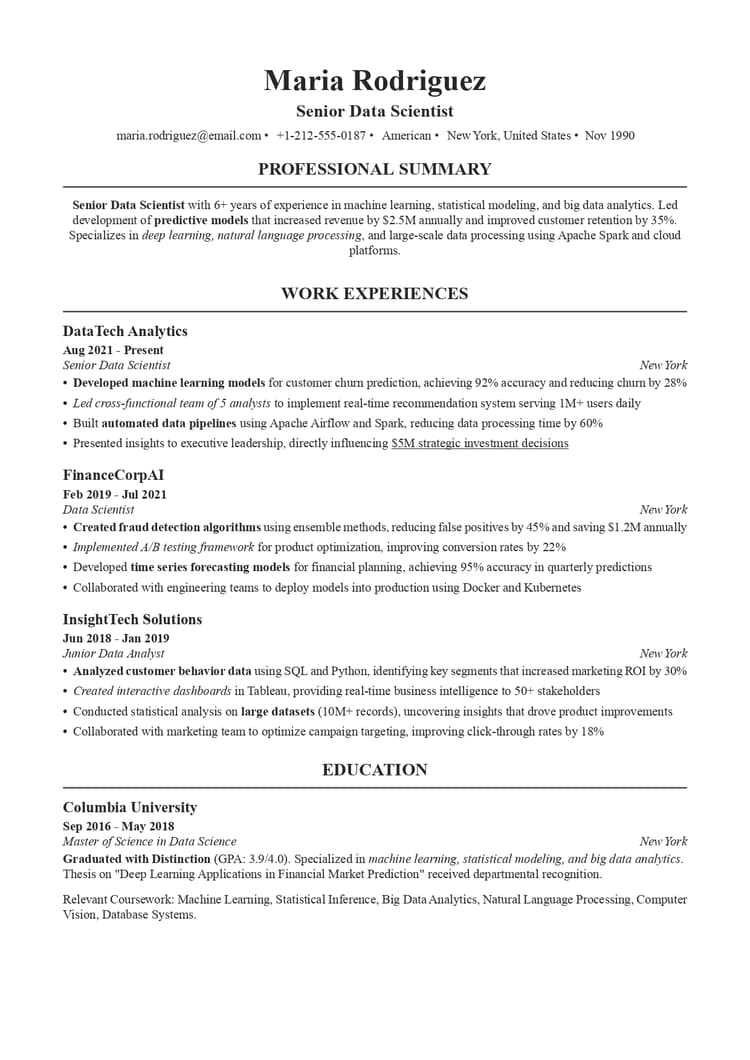
Make sure your resume is just as strong. ResumeBuilder.so helps you create a polished, professional resume that matches the standard of your follow-up.
Common Mistakes to Avoid in a Follow-Up Email
The follow-up email is short, which makes it deceptively easy to get wrong. Here are five mistakes people make most often:
- Sending too late. After 48 hours, you're no longer fresh in the interviewer's mind. The longer you wait, the less impact your email has.
- Being too generic. "Thank you for your time and the opportunity" could have been written by anyone. Reference the actual conversation.
- Spelling errors or wrong names. Calling the interviewer by the wrong name is hard to recover from. Proofread every word — seriously, every word.
- Following up too aggressively. Two emails in three days reads as anxious, not enthusiastic. Space out your communications.
- Missing your contact information. If a hiring manager wants to respond quickly, don't make them dig for your phone number.
Final Thoughts
A well-crafted interview follow-up email is one of the simplest, most overlooked tools in your job search. It takes ten minutes to write, but it can meaningfully shift how an employer remembers you.
Keep the timing tight (24 - 48 hours), keep the tone warm but professional, personalize it to the actual conversation, and make sure your subject line does its job. If you haven't heard back after 5–7 business days, one polite check-in is entirely appropriate.
And once your follow-up is out the door, make sure the rest of your application package is equally strong. To do so, explore different resume templates to get noticed, and learn how to write a cover letter so every piece tells the same compelling story.
Interview Follow-Up Email FAQs

Jordan Lee is your guide to navigating the rapidly changing job market in the age of AI and automation. He dives into how AI is reshaping hiring, the skills of the future, and what job seekers need to do now to stay relevant. If you’re curious about how technology is transforming careers and want to future-proof your job, Jordan’s insights are a must-follow.