How to Write a Receptionist Cover Letter (+ Examples and Tips)
This complete guide with expert tips and real examples will teach you how to write a compelling cover letter — fast and stress-free!
Edit this cover letter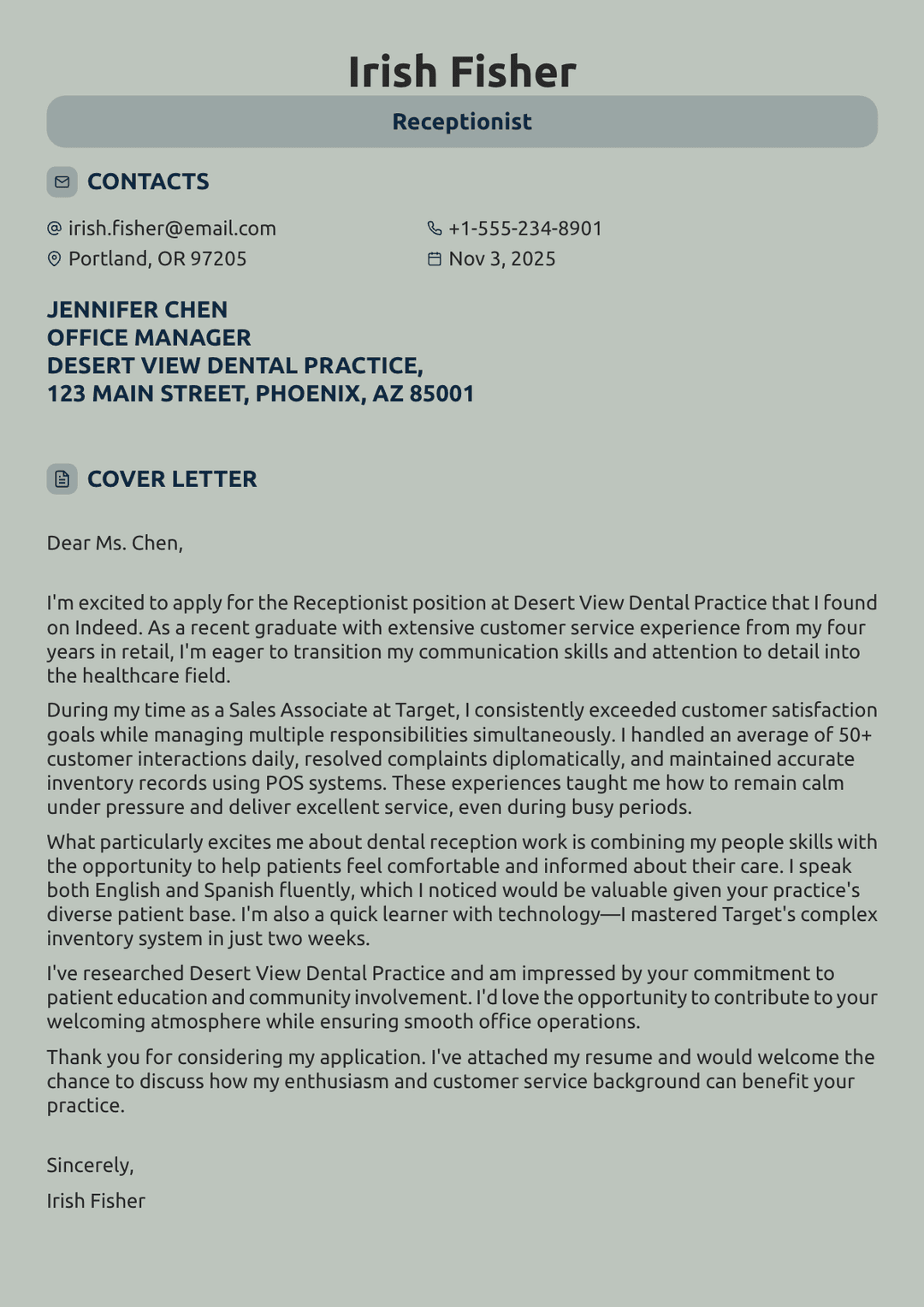
Writing an outstanding receptionist cover letter is your chance to make a lasting first impression—just as you would at a company’s front desk. It’s more than a formality; it’s your opportunity to showcase your communication skills, professionalism, and attention to detail before you ever step into an interview.
Since receptionists are often the face and voice of an organization, employers look for candidates who can express warmth, confidence, and reliability right from the start. However, many candidates have similar skills, so your cover letter needs to show what makes you different.
In this guide, you’ll learn how to write a receptionist cover letter that highlights your strengths, captures attention, and helps you stand out from other applicants. Also, we’ll provide you with real-world examples that you can use for your own inspiration.
- Customer service and communication are some of the most important skills to emphasize in a receptionist cover letter.
- Tailoring the letter to the specific receptionist position and company culture increases relevance and demonstrates awareness of organizational expectations.
- Transferable skills such as multitasking, organization, and client communication are often more valuable than direct experience or job titles from the same field.
- Professional formatting and error-free receptionist cover letter conveys attention to detail and reinforces your reliability and professionalism.
What Makes a Great Receptionist Cover Letter?
A great receptionist cover letter does more than just summarize your resume—it tells a story about why you're the perfect person to represent their company. When someone calls or walks into the office, you'll be their first interaction with the business. Therefore, your cover letter needs to prove you can handle that responsibility with grace and professionalism.
The best receptionist cover letters share three common elements:
- Address the employer's needs immediately
- Provide specific examples of how past experiences translate to the receptionist position
- Demonstrate the candidate's personality while maintaining complete professionalism
Receptionists are employed in almost every industry, so there is a steady demand for this occupation. As a matter of fact, about 128,500 openings are projected each year on average over the next decade in the U.S. Overall, it’s a reliable career path if you excel at organization, communication, and customer service.
Receptionist Cover Letter Examples
Seeing real cover letter examples in action helps you understand how these principles work in practice. Let’s examine three different receptionist cover letter examples that you can use to write your own.
Example 1: Entry-Level Candidate

Example 2: Experienced Professional

Example 3: Career Changer

How to Write a Receptionist Cover Letter: A Step-by-Step Guide
Writing a compelling cover letter becomes much easier when you break it down into manageable steps. Rather than staring at a blank page wondering where to start, follow this systematic approach to write a good receptionist cover letter.
#1. Research the Company and Role
Spend time researching the company and role to understand who you're writing to. Visit the company's website and pay attention to their tone—are they formal and corporate, or casual and friendly? Check their social media presence to get a feel for their company culture. Also, look for recent company news, awards, or achievements. Mentioning something current shows you're genuinely interested and have done your homework.
Read the job posting carefully and note the specific requirements they emphasize. Keep an eye on whether they mention handling multiple phone lines, working with specific software, or supporting executives. These details will help you tailor your letter to show you're exactly what they're looking for.
#2. Craft a Professional Header
Your cover letter header should match your resume to create a cohesive professional brand. Make sure to include the following information:
- Full name
- Phone number
- Email address
- City and state
- LinkedIn profile URL (if you have one)
Below your contact information, add the date, then the hiring manager's name and title, company name, and address. If you don't know the specific person's name, use their title like "Hiring Manager" or "Human Resources Director." This formatting shows attention to detail—a crucial skill for receptionists.
Here’s a good example:
Michael Johnson
(555) 987-6543
mjohnson@email.com
Seattle, WA
linkedin.com/in/michaeljohnson
March 15, 2024
Rachel Thompson
Human Resources Director
Pacific Northwest Legal Group
456 Pike Street
Seattle, WA 98101
#3. Write an Engaging Opening Paragraph
Your opening paragraph needs to grab attention immediately. Start with the specific position title you're applying for, then briefly highlight your most relevant qualifications. This approach immediately shows you're qualified and have done your research. End your opening paragraph with a preview of what makes you unique. Maybe you speak multiple languages, have experience with specific software, or bring a combination of skills from different industries. Give them a reason to keep reading.
Let’s see how you can phrase this properly:
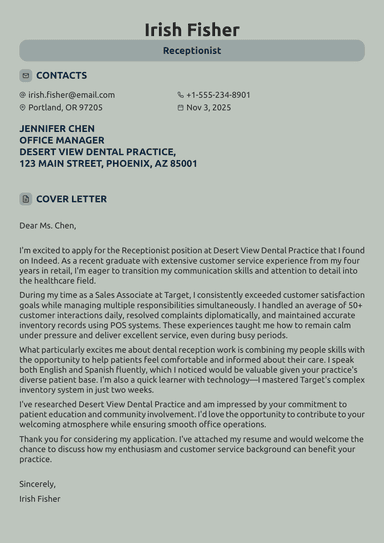
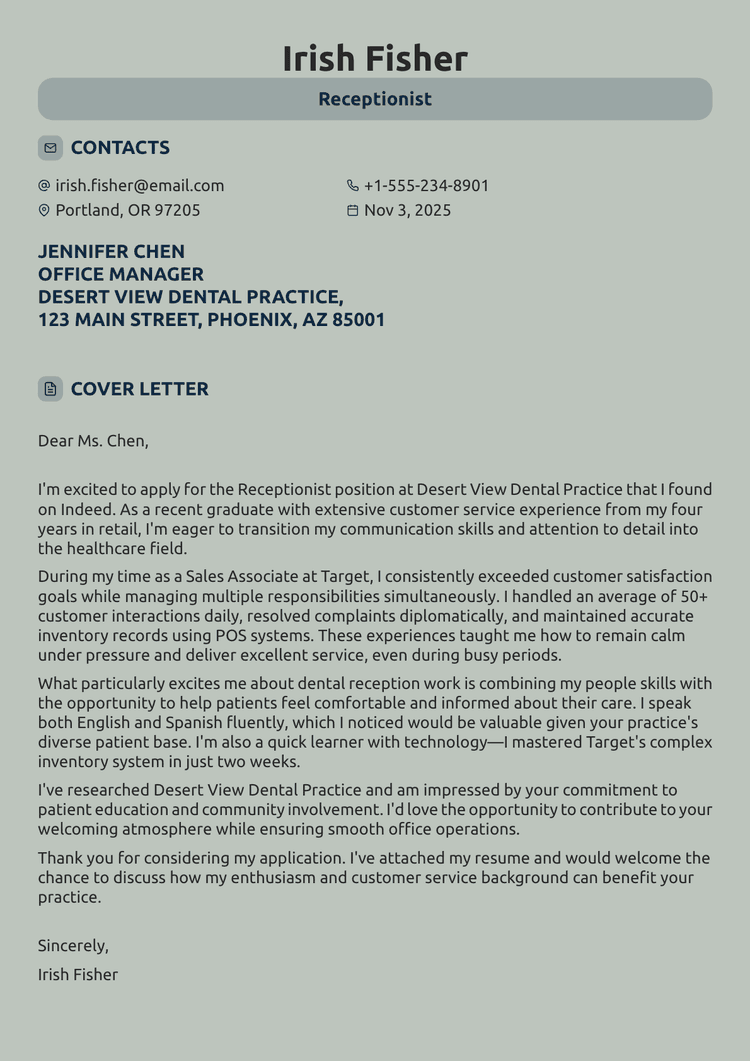
I'm excited to apply for the Receptionist position at Desert View Dental Practice that I found on Indeed. As a recent graduate with extensive customer service experience from my four years in retail, I'm eager to transition my communication skills and attention to detail into the healthcare field.
#4. Develop Strong Body Paragraphs
Your first body paragraph should focus on your most relevant experience and achievements you’ve mentioned in your resume. Don't just list job duties—show how you excelled in previous roles. If you increased customer satisfaction scores, handled a high volume of calls efficiently, or implemented a new system that improved operations, include those details with numbers when possible.
The second body paragraph is where you highlight key personality traits and soft skills. As a receptionist, you need to be patient, professional, and adaptable. Share a brief story that demonstrates these qualities in action. Maybe you handled a difficult situation with grace, or you quickly learned a new phone system when starting a previous job.
Throughout both paragraphs, use specific examples that connect to receptionist responsibilities. Even if your experience comes from retail, food service, or another industry, focus on transferable skills like customer service, problem-solving, and communication.
#5. Create a Compelling Closing
Your closing paragraph should reaffirm your interest in the position and company while requesting an interview. Summarize why you're an excellent fit, mention that you've attached your resume, and suggest next steps. Be confident but not presumptuous.
A strong closing might read:
I'm excited about the opportunity to bring my customer service skills and positive attitude to the front desk at Springfield Family Practice. I'd welcome the chance to discuss how my experience can contribute to your team's continued success. I look forward to hearing from you soon.
#6. Proofread and Format
This step cannot be overstated for receptionist positions. Read your letter aloud to catch awkward phrasing or run-on sentences. Check for grammar, spelling, and punctuation errors multiple times. Consider asking a friend or family member to review it—fresh eyes often catch mistakes you've missed.
The table below outlines best cover letter formatting practices:
| Formatting Element | Best Practice |
|---|---|
Font Style & Size | Use a clean, readable font such as Arial, Calibri, or Times New Roman in 11-12pt. |
Font Color and Background | Stick to black text on a white background. |
Margins and Spacing | Use 1-inch margins on all sides. Apply single spacing within paragraphs and double spacing between paragraphs. |
Length | Keep your cover letter to one page maximum. |
Visual Consistency | Match your cover letter header to your resume (fonts, colors, and contact info). |
File Format and Naming | Save as PDF and name it “FirstName_LastName_CoverLetter_CompanyName.pdf.” |
Which Skills Employers Want to See in a Receptionist Cover Letter
There are several soft and hard skills that you should include, and understanding which skills matter most to employers helps you position your experience effectively.
Hard Skills
Nowadays, receptionists often manage multi-line systems, voicemail routing, and integration with customer relationship management (CRM) software. If you've worked with specific phone systems like Avaya, Cisco, or cloud-based solutions, mention them by name.
Technical skills are increasingly important as companies move away from paper calendars. Experience with Microsoft Outlook, Google Calendar, Calendly, or industry-specific scheduling systems like SimplePractice (healthcare) or Clio (legal) gives you a significant advantage.
Don't overlook Microsoft Office proficiency—it's still a requirement for most receptionist positions. Beyond basic Word and Excel skills, mention experience with PowerPoint for presentations, OneNote for organization, or Teams for communication.
Soft Skills
Aside from professional appearance and demeanor, including body language, facial expressions, and overall energy level, there are several key soft skills that every receptionist must possess:
- Communication skills. Effective receptionists can adjust their communication style based on the audience—whether that's a frustrated customer, a company executive, or a confused visitor. They can de-escalate tense situations, provide clear directions, and communicate complex information in understandable terms.
- Problem-solving abilities. When the appointment system crashes, when an important visitor arrives early, or when multiple urgent issues arise simultaneously, great receptionists find solutions rather than just identifying problems.
- Multitasking and time management skills. Receptionists often handle phone calls while greeting visitors, manage multiple calendars simultaneously, and balance urgent tasks with routine responsibilities. Show specific examples of how you've managed competing priorities effectively.
5 Common Receptionist Cover Letter Mistakes to Avoid
A well-crafted cover letter can open doors, but common mistakes can quickly close them. Let’s see which pitfalls you should avoid in your receptionist cover letter:
- Not customizing the letter. Sending the same generic cover letter to every employer is one of the most damaging mistakes you can make. Take time to research the company's values, culture, and specific needs. Reference the company by name, mention specific details from the job posting, and explain why you're interested in working for that particular organization.
- Focusing too much on what you want. Employers want to know what value you'll bring to their organization. Instead of emphasizing salary expectations, benefits, or career advancement opportunities, focus on your relevant skills and how they'll solve the company's problems. Show them you understand the receptionist role's importance and demonstrate how you'll contribute to their team's success.
- Repeating your resume. Your cover letter and resume serve different purposes and shouldn't contain identical information. While your resume lists qualifications and experience, your cover letter should tell a compelling story about why you're the ideal candidate. This narrative approach makes you memorable and helps hiring managers envision you in the role.
- Spelling and grammar errors. For a receptionist position where attention to detail and communication skills are paramount, errors suggest carelessness and lack of thoroughness. Always proofread multiple times, use spell-check tools, and consider having someone else review your letter. Pay special attention to the company name, hiring manager's name, and job title—getting these wrong shows inattention to detail.
- Being too modest or too boastful. Striking the right balance between confidence and humility can be challenging. Present your qualifications factually and confidently, supporting claims with concrete examples. Use strong action verbs and quantifiable achievements while maintaining a professional, respectful tone that shows both competence and approachability.
Build Your Perfect Receptionist Cover Letter With ResumeBuilder.so
Our AI-powered builder is specifically designed to help you craft professional, tailored cover letters that highlight your unique qualifications. With industry-specific templates and expert guidance, you'll avoid common mistakes while showcasing your hard and soft skills.
Stop sending generic applications that get overlooked. ResumeBuilder.so streamlines the writing process with smart suggestions and formatting assistance. Whether you're an experienced receptionist or entering the field, our platform helps you present your strengths professionally, increasing your chances of landing interviews and securing your ideal position.
Final Thoughts
Writing an effective receptionist cover letter comes down to presenting yourself as someone who can be the professional, welcoming face of a company, capable of handling multiple responsibilities with grace and efficiency. Remember that every company and role is different, so customize each letter to address specific requirements and company culture.
Take time to research the organization and position thoroughly, then craft your letter to show how your unique combination of skills and experience makes you the ideal candidate. Most importantly, let your personality shine through while maintaining complete professionalism.
The best receptionists combine warmth with competence, and your cover letter should reflect that same balance. With careful preparation and attention to detail, your cover letter can open doors to the receptionist position you want.
Receptionist Cover Letter FAQ
#1. What should I include in a receptionist cover letter?
A receptionist cover letter should include your contact information, a professional greeting, an engaging opening paragraph that states the position you're applying for, body paragraphs highlighting relevant experience and skills, and a strong closing with a call to action.
#2. How long should a receptionist cover letter be?
A receptionist cover letter should be one page maximum, typically consisting of 3-4 paragraphs that focus on your most relevant qualifications and achievements without repeating your entire resume.
#3. Should I mention salary expectations in my cover letter?
Generally, no, unless the job posting specifically requests salary expectations. Instead, focus on demonstrating the value you'll bring to the role and leave salary discussions for the interview process.
#4. How do I write a cover letter with no receptionist experience?
Focus on transferable skills from other roles such as customer service experience, communication abilities, multitasking skills, and technology proficiency. Highlight volunteer work, internships, or educational experiences that demonstrate relevant capabilities.
#5. Can I use the same cover letter for multiple receptionist jobs?
While you can use a template as your foundation, always customize each letter to address the specific company, position requirements, and workplace culture to maximize your chances of success.
#6. What's the best way to address a receptionist cover letter?
Research to find the hiring manager's name when possible, using "Dear [First Name Last Name]." If unavailable, use "Dear Hiring Manager" or "Dear Human Resources Director" rather than outdated phrases like "To Whom It May Concern."
#7. Should I follow up after sending my cover letter?
Yes, following up within one week shows continued interest and initiative while demonstrating the proactive communication skills essential for receptionist roles. Send a brief, professional email reiterating your interest in the position and asking about the timeline for next steps.
#8. How do I make my receptionist cover letter stand out?
Use specific examples with quantifiable results when possible, thoroughly research the company to demonstrate genuine interest, customize your letter for each application, and showcase personality while maintaining professionalism throughout your writing.

Daniel Carter is the salary negotiation coach you wish you had before accepting that lowball job offer. With years of HR experience, he knows all the employer tactics—and how to counter them. His posts break down negotiation strategies, industry salary trends, and scripts you can actually use in real conversations.