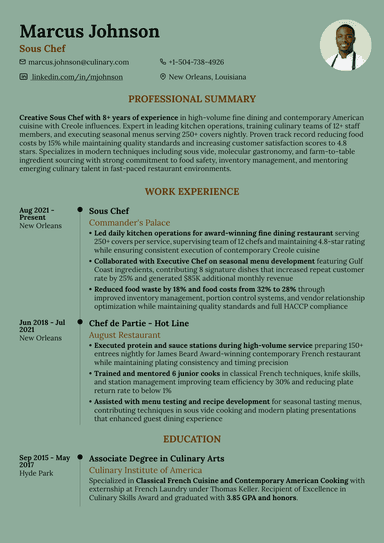
Chef Resume: Examples & Writing Guide for 2026
This complete guide with detailed explanations and expert tips will teach you how to write an acting resume in record time!
Edit this resume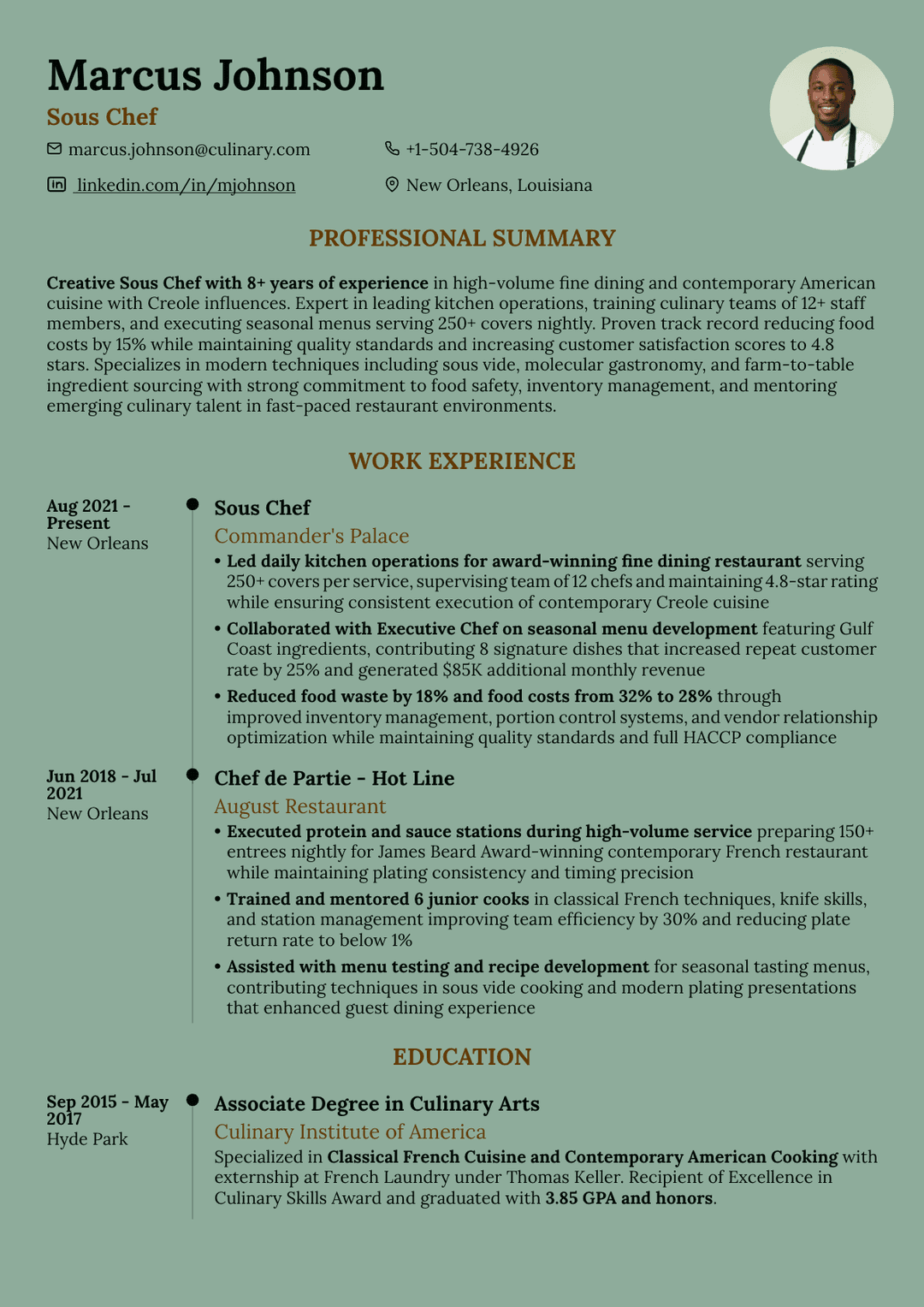
A chef resume is a concise summary of your culinary experience, skills, and achievements, designed to show employers what you bring to the kitchen before you ever step into an interview.
A strong resume matters because hiring managers often decide who to meet—and who to pass on—within seconds. Therefore, if your resume doesn’t clearly communicate your expertise, creativity, and ability to perform under pressure, it may never get a second look.
In this article, you’ll learn how to structure a chef resume that highlights your strengths, choose the right skills to include, and discover practical tips that will help you make a job application that stands out.
Key Takeaways
- A strong chef resume clearly communicates your culinary expertise, creativity, and ability to perform under pressure within seconds.
- The most effective chef resumes balance technical cooking skills with leadership, cost control, food safety, and measurable kitchen results.
- Choosing the right format (chronological, functional, or hybrid) depends on your experience level and career path within the culinary industry.
- Quantifying achievements—covers served, food cost reductions, team size, or revenue impact—significantly strengthens your application.
- Tailoring your resume to each role, using industry keywords, and avoiding generic duties are essential for landing chef interviews.
What Makes a Great Chef Resume?
A great chef resume goes beyond listing your previous kitchen positions; it tells the story of your culinary journey and demonstrates your value to potential employers. Such a document balances technical proficiency with creative flair, showcasing both your knife skills and your ability to innovate in the kitchen.
Your chef resume should immediately communicate your level of experience and expertise. Be it a position in a Michelin-star restaurant, a hotel kitchen, or a fast-casual establishment, your resume needs to speak the language of the culinary industry while remaining accessible to hiring managers.
Key elements that make a chef resume stand out include:
- Specific culinary techniques you've mastered
- Cuisines you specialise in
- Kitchen management experience
- Any notable achievements, like awards, media features, or successful menu launches
Additionally, demonstrating your understanding of food costs, inventory management, and kitchen/food safety regulations shows you're a well-rounded culinary professional.
Chef Resume Examples by Specialization
First, let’s have a look at three chef resume examples for different culinary disciplines so that you can see what they should contain and how they should be structured:
Sous Chef Resume Example


Executive Chef Resume Example

Pastry Chef Resume


Chef Resume Format: Choosing the Right Structure
Selecting the appropriate resume format is crucial for presenting your culinary career effectively. Let’s see what options you have and when each of these is applicable:
Reverse-Chronological Format
The reverse-chronological format is ideal for chefs with a solid work history in the culinary field. It lists your most recent position first and works backwards, making it easy for hiring managers to see your career progression.
Additionally, it’s also the preferred format for most executive chef and sous chef positions, as it clearly demonstrates your increasing responsibilities and growing expertise.
Most restaurant hiring managers expect this format because it quickly shows whether you've worked in similar establishments and handled comparable responsibilities. If you've steadily advanced from line cook to sous chef to head chef positions, it tells that story naturally without requiring extra explanation.
Functional Format
The functional format emphasises your skills and abilities rather than your chronological work history.
It works well for culinary school graduates with limited professional experience, career changers entering the food industry, or chefs with employment gaps. Furthermore, such a format focuses on your culinary training, technical skills, and any relevant accomplishments from internships or volunteer work.
That being said, you should use this format only when your work history genuinely doesn't support your application, and be prepared to address questions about your background during interviews.
Combination Format
The combination (hybrid) format merges the best elements of both chronological and functional formats. This option is excellent for experienced chefs who want to highlight both their impressive skill set and their strong work history. It's particularly effective for pastry chefs, specialty cuisine experts, or those transitioning to different types of culinary positions.
The hybrid approach lets you lead with a robust skills section that showcases your culinary specialisations, then follows with a detailed work history that proves you've applied those skills successfully.
6 Essential Sections of a Chef Resume
Every chef resume should include these sections, each serving a specific purpose in presenting your skills and qualifications:
#1. Contact Information
Place your contact information at the top of your resume, including the following details:
- Your full name
- Phone number
- Professional email address
- City and state
- LinkedIn profile
Additionally, consider adding a link to your culinary portfolio or a professional Instagram account showcasing your plated dishes, as visual representation and food aesthetics are rather important in the culinary industry. Also, if you have a YouTube channel featuring cooking tutorials, it can strengthen your application.
#2. Resume Summary or Objective
Your resume summary should be a compelling 3-4 sentence overview of your culinary expertise, specialisations, and career highlights.
For experienced chefs, focus on your most impressive achievements and leadership capabilities. For entry-level positions, meanwhile, you should use a resume objective that emphasises your culinary training, passion for food, and career goals.
Let’s see an example of a solid resume summary:
Creative Executive Chef with 12+ years of experience in fine dining establishments. Specialised in contemporary American cuisine with French techniques. Successfully managed kitchen teams of 15+ staff members while maintaining food costs below 28%. Known for innovative seasonal menus that increased restaurant revenue by 35%.
#3. Work Experience
This is the most critical section of your chef resume, where you should list your positions in reverse-chronological order, including the restaurant or establishment name, your job title, location, and dates of employment. For each position, include 4-6 bullet points highlighting your responsibilities and achievements.
Make sure you use strong action verbs like "developed," "managed," "created," "implemented," and "coordinated." Quantify your achievements whenever possible: mention the size of your kitchen team, number of covers served nightly, percentage of food cost reduction, or revenue increases resulting from your menu changes.
Here’s what this could look like on your resume:
Senior Sous Chef
La Terrazza Ristorante, London, UK
March 2021 – Present
- Led daily kitchen operations in a high-volume Italian restaurant serving 200+ covers per service
- Supervised and trained a team of 8 chefs, improving service efficiency and consistency
- Collaborated with the Head Chef on seasonal menu development, contributing to a 15% increase in repeat customers
- Ensured full compliance with food safety, hygiene, and health regulations (HACCP)
- Managed inventory, reduced food waste by 12%, and controlled costs without compromising quality
Chef de Partie – Hot Section
Bistro North, Manchester, UK
June 2018 – February 2021
- Prepared and executed meat and sauce dishes during fast-paced lunch and dinner services
- Maintained high presentation and quality standards under pressure
- Assisted with stock ordering, prep planning, and junior staff training
- Consistently met service deadlines during peak hours and special events
#4. Education and Training
The next would be your culinary education and relevant training.
List your culinary school degree, graduation year, and any honours received. Also mention specialised training programs, workshops with renowned chefs, or continuing education courses. For chef positions, culinary education can be as important as work experience, especially early in your career.
Don't overlook apprenticeships or stages (unpaid positions in professional kitchens where you learn from experienced chefs). These experiences demonstrate commitment to your craft and often provide invaluable training that rivals formal culinary school programs.
#5. Skills Section
Once you’re done with listing your education, you need to create a comprehensive skills section that includes both hard and soft skills relevant to kitchen work. The ones you decide to highlight on your chef resume should align with the specific position you're targeting.
Hard skills are the technical abilities you've developed through training and practice. For chefs, these include:
- Knife skills and various cutting techniques
- Food preparation and cooking methods (grilling, sautéing, braising, roasting, sous vide)
- Recipe development and menu planning
- Food safety and sanitation (ServSafe certification)
- Inventory management and ordering
- Food cost calculation and portion control
- Kitchen equipment operation and maintenance
- Plating and visual presentation techniques
- Specific cuisine expertise (French, Italian, Asian, etc.)
Soft skills demonstrate how you work with others and handle the pressures of kitchen work. On your resume, these can be presented as:
- Leadership and team management
- Communication and delegation
- Time management and multitasking
- Problem-solving under pressure
- Creativity and innovation
- Attention to detail
- Adaptability and flexibility
- Work ethic and reliability
- Customer service orientation
- Conflict resolution
You can organise the chef skills into categories like Culinary Techniques, Cuisine Specialties, Kitchen Management, and Technical Skills, like in the following example:
Culinary Techniques: French classical techniques, molecular gastronomy, charcuterie, butchery, pastry fundamentals, sauce preparation
Cuisine Specialties: Contemporary American, French, Italian, Asian fusion, farm-to-table
Kitchen Management: Staff training and scheduling, inventory control, menu costing, vendor relations, health and safety compliance
Technical Skills: Food cost analysis, POS systems, kitchen equipment maintenance, recipe scaling, food plating and presentation
#6. Certifications
Professional certifications signal your commitment to culinary excellence and safety standards. These include:
- ServSafe Food Handler/Manager Certification
- Professional culinary certifications from the American Culinary Federation (Certified Executive Chef, Certified Sous Chef, etc.)
- Sommelier certifications (if applicable)
- HACCP (Hazard Analysis Critical Control Point) training
- Specialised technique certifications (chocolate work, butchery, etc.)
- Food allergy awareness training
5 Extra Tips on How to Write a Chef Resume That Lands Interviews
Writing a chef resume that lands interviews requires strategic thinking about how you present your background and accomplishments. Here are some valuable resume tips that will help you do so properly:
#1. Start With a Strong Professional Summary
Your professional summary should capture your most impressive qualifications and set the tone for everything that follows.
Therefore, make it valuable. Avoid generic statements like "hard-working chef seeking new opportunities." Instead, lead with specific accomplishments, such as "award-winning sous chef with 8 years in fine dining, specialising in modern interpretations of classic French cuisine."
#2. Quantify Your Kitchen Achievements
Numbers make your accomplishments concrete and memorable. Whenever possible, include metrics that demonstrate your impact:
- Team size you managed ("Led kitchen staff of 18+ employees")
- Covers served ("Prepared 300+ meals nightly during peak season")
- Financial impact ("Reduced food costs from 35% to 28% while maintaining quality")
- Revenue growth ("Seasonal menu changes increased dinner sales by $12,000 monthly")
- Customer satisfaction ("Maintained 4.9-star rating across 500+ reviews")
- Awards and recognition ("Earned 'Best New Restaurant' from City Magazine")
- Waste reduction ("Decreased food waste by 25% through inventory system improvements")
The culinary field remains competitive, which is why you need to differentiate yourself with concrete achievements. Needless to say, measurable results will bring you much closer to this goal.
#3. Tailor Your Resume to Each Position
Generic, one-size-fits-all resumes rarely succeed; instead, customise your chef resume for each application by:
- Studying the job posting carefully and noting the required skills and qualifications
- Incorporating relevant keywords throughout your resume
- Emphasising experience that directly relates to the target position
- Highlighting the cuisine types or cooking styles mentioned in the job description
- Adjusting your professional summary to address the specific role
Additionally, if you're making a career change, explain how your previous experience transfers to culinary work, even if your background isn't traditional.
#4. Use Action Verbs and Active Voice
Strong action verbs create dynamic, engaging descriptions of your work; therefore, you should start each bullet point with verbs like:
- Developed, created, designed (for menu and recipe work)
- Managed, supervised, trained (for leadership responsibilities)
- Implemented, established, initiated (for process improvements)
- Coordinated, collaborated, partnered (for teamwork)
- Increased, reduced, improved (for measurable results)
- Maintained, ensured, achieved (for consistent performance)
#5. Optimise for Applicant Tracking Systems
Many restaurants and hotel chains now use ATS software to screen resumes before human review. To ensure your resume passes through these systems, you must:
- Use a simple, clean format without tables, text boxes, or graphics
- Include standard section headings (Work Experience, Education, Skills)
- Incorporate relevant keywords from the job posting naturally throughout your resume
- Save and submit your resume in the format requested (usually .docx or PDF)
- Avoid unusual fonts, headers, or complex formatting
5 Common Chef Resume Mistakes to Avoid
Here are some common chef resume mistakes you should avoid at all costs:
Hiring managers already know what a line cook or sous chef typically does. They want to know what you specifically accomplished in those roles.
So, instead of just saying "responsible for preparing appetisers and salads", you can say that you "designed 6 new appetisers featuring seasonal ingredients, with 3 becoming permanent menu items due to customer demand".
Your resume should focus on culinary experience and skills. Unless earlier jobs taught transferable skills, there's no need to include that retail position from 10 years ago; keep your resume focused and relevant.
Similarly, personal information like age, marital status, or hobbies generally don't belong on a professional resume unless they directly relate to the position (for example, mentioning your food blog if applying for a chef position with social media responsibilities).
Inconsistent fonts, random spacing, or cluttered layouts make your resume hard to read and appear unprofessional. Maintain consistent formatting throughout the document by:
- Using the same date format everywhere (either "Jan 2020" or "January 2020," not both)
- Keeping font sizes consistent for similar elements
- Aligning your bullets and indentations uniformly
- Leaving adequate white space so text doesn't appear cramped
Typos and grammatical errors signal carelessness, which definitely isn’t a trait you want associated with your food preparation. Proofread your resume multiple times, and ask someone else to review it as well to make sure there are no:
- Misspelt restaurant or chef names
- Incorrect dates or inconsistent date formats
- Missing periods or inconsistent punctuation
- Verb tense errors (past jobs should be mentioned in the past tense)
Even small errors can eliminate you from consideration, especially when dozens of other candidates have error-free resumes.
Surprisingly, some candidates forget to include proper contact information or bury it in tiny font. So, make sure your name, phone number, and email are prominent and correctly written at the top of your resume. Also, if your email address is anything other than some variation of your name, create a new professional email for your job search.
Generate a Perfect Chef Resume With Our Tool
If you still don’t know where to start when it comes to writing your chef resume, we’ve got your back! Our resume builder offers multiple expert-made templates for different industries, so the only thing you need to take care of is to provide us with the pieces of information we ask for; we’ll do the rest.
Additionally, in case you’re determined to make your resume from scratch, you can browse our collection of resume examples to see how other culinary professionals have structured their documents for maximum impact.
Do You Need a Chef Cover Letter to Accompany Your Resume?
Yes, you need a chef cover letter to accompany your resume, even if the job ad doesn’t require you to have one. This document provides context, explains your interest in the specific position, and lets your personality shine through.
A strong chef cover letter should:
- Open with a compelling introduction that mentions the specific position and how you learned about it
- Explain why you're interested in this particular restaurant or establishment
- Highlight 2-3 key qualifications or achievements that make you perfect for the role
- Demonstrate knowledge of the restaurant's cuisine, reputation, or recent developments
- Close with a clear call to action, expressing enthusiasm for an interview
Finally, this document shouldn't simply repeat your resume; it should expand on your most relevant qualifications and tell the story of why you're the right fit for this specific position.
Final Thoughts
Creating a standout chef resume takes time and thought, but the investment pays off when you land interviews at restaurants you're excited to work in.
This document isn't just a page listing your work history; it's your personal marketing tool that opens doors to exciting culinary opportunities. Take the time to craft it thoughtfully, tailor it to each position, and showcase the unique skills and passion you bring to the kitchen. With the right approach and presentation, your chef resume will help you secure the culinary position you've been working toward.
Chef Resume FAQs
#1. How long should a chef resume be?
A chef resume should typically be one page for professionals with less than 10 years of experience, or up to two pages for executive chefs with extensive backgrounds. A concise, well-organised single page often makes a stronger impression than a lengthy document full of unnecessary details.
#2. What if I don't have a formal culinary education?
If you don’t have a formal culinary education, you can emphasise:
- On-the-job training and progression through kitchen positions
- Specific chefs you've learned from and techniques you've mastered
- Professional certifications like ServSafe
- Self-directed learning, workshops, or seminars attended
- Years of practical experience in professional kitchens
#3. How often should I update my chef resume?
You should update your chef resume after every significant achievement, new position, certification earned, or special recognition received. Even when not actively job searching, maintain a current version so you're prepared for unexpected opportunities. It’s also a good practice to keep a "master resume" with everything you've done, then create tailored versions that emphasise the most relevant information for each position you apply to.

Emily Foster knows how nerve-wracking it can be to land your first job—she’s been there. As a mentor for young professionals, she shares exactly what hiring managers want from entry-level candidates. From internship hacks to interview confidence tips, Emily helps students and recent grads navigate the job search with ease.