How to Create a Customer Service Resume: Examples & Tips
This complete guide with detailed explanations and expert tips will teach you how to write an acting resume in record time!
Edit this resume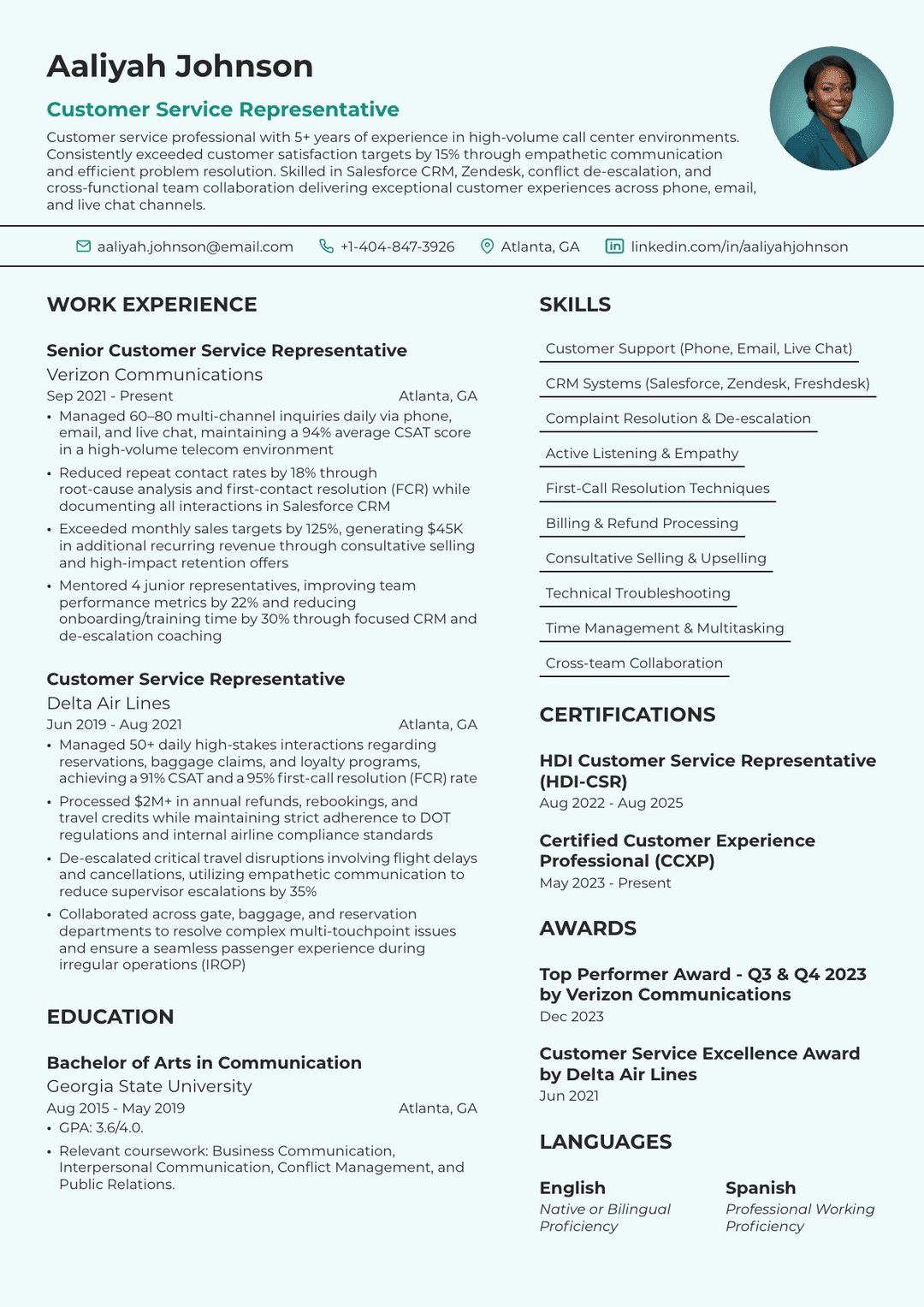
A customer service resume is a professional document that shows how you handle customers, resolve problems, and represent a company in day-to-day interactions. Creating one means clearly presenting your communication skills, relevant experience, and measurable results rather than simply listing job duties.
Because customer service roles are performance-driven, a well-written resume helps employers quickly see how you add value and manage real-world situations.
So, in this article, you’ll learn how to build a resume for a customer service position that highlights your strengths and fits the role you’re applying for. We’ll also cover the essential sections to include and some common mistakes to avoid so your resume stands out for the right reasons.
- A strong customer service resume proves performance, not just presence, by showing how you resolved issues, improved satisfaction, and delivered measurable results.
- Employers look for metrics like CSAT scores, resolution rates, response times, retention impact, and daily volume handled—not generic task lists.
- A clear reverse-chronological structure, concise summary, and targeted skills section help both ATS systems and hiring managers scan your value quickly.
- The most effective resumes balance soft skills (empathy, de-escalation, communication) with hard skills (CRM systems, ticketing tools, technical knowledge).
- The biggest mistakes are generic applications, vague claims without numbers, poor formatting, and typos that undermine credibility in a communication-driven role.
What Is a Customer Service Resume?
A customer service resume is a job application document that showcases your ability to assist customers, solve problems, and build a company's brand with excellence.
Unlike resumes for purely technical or creative roles, customer service resumes place equal weight on interpersonal abilities and job-specific competencies. They're designed to prove you can handle everything from routine inquiries to complex complaints while maintaining composure and delivering solutions.
You typically need to write such a resume when applying as a customer service representative, call center agent, retail associate, technical support specialist, account manager, or front desk coordinator. Each of these roles requires you to interact with customers, address their needs, and ensure they leave satisfied.
What makes a customer service resume unique is its emphasis on metrics that matter in this field. You're not just listing job duties but also demonstrating impact through customer satisfaction scores, resolution rates, response times, and retention statistics. Therefore, you should think of it as your biggest opportunity to impress your potential employer.
Essential Sections of a Customer Service Resume
Every strong resume contains several critical sections that hiring managers expect to see.
Let's break down each component and see how to write a customer service resume that stands out:
#1. Contact Information and Professional Title
Your contact section seems straightforward, but getting it right matters more than you'd think.
Start with your full name in a slightly larger font at the top of the page. Below that, include:
- Phone number
- Email address
- City and state (you don't need your full street address anymore, as most communication happens electronically anyway, and it just takes up valuable space)
Here's what many people miss: you should add a LinkedIn profile URL if you've got a well-maintained profile. It gives employers another way to verify your professional presence and see recommendations from colleagues.
Also, consider including a professional title directly under your name; this immediately communicates your career focus and helps with ATS resume optimization since it reinforces your target role.
Let’s see what this section typically looks like:
Emily Hopkins
Customer Support Agent
Chicago, IL
312-555-0198
emily.hopkins@email.com
linkedin.com/in/emilyhopkins11234
#2. Customer Service Resume Summary or Objective
A resume summary sits right below your contact information, and it's your elevator pitch in written form; it consists of 2-3 sentences that are supposed to hook the reader and make them want to learn more about you.
It’s typically for experienced professionals, as it highlights years of experience, showcases the key skills a candidate possesses, and mentions notable achievements that set them apart.
Here's an example of an effective summary for an experienced candidate:
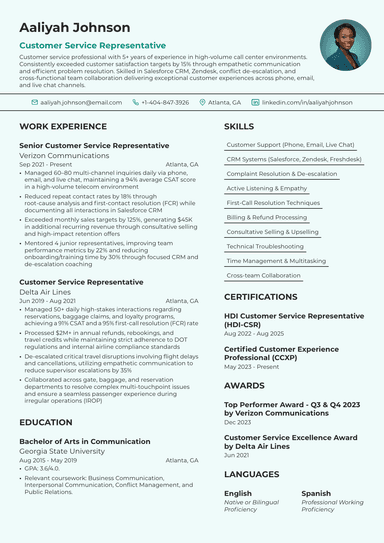
Customer service professional with 5+ years of experience in high-volume call center environments. Consistently exceeded customer satisfaction targets by 15% through empathetic communication and efficient problem resolution. Skilled in Salesforce CRM, conflict de-escalation, and cross-functional team collaboration.
If you're newer to the field or making a career transition, using a resume objective statement makes more sense for you. It focuses on what you're seeking and what you bring to the table despite limited direct experience. An entry-level objective might read:
Motivated recent graduate with strong communication skills and proven ability to resolve conflicts through part-time retail experience. Seeking to apply active listening and problem-solving skills in a customer service representative role where I can contribute to exceptional customer experiences.
So, the key difference between these two is that summaries are achievement-focused and backward-looking, while objectives are forward-looking and aspiration-focused. Both should be tailored to each specific job application, so make sure you don't just use the same generic statement for every position.
#3. Work Experience Section
Your work experience section carries the most weight on your customer service resume, so you'll want to get it right.
List positions in reverse chronological order, starting with your most recent role. For each position, include the company name, your job title, employment dates, and location. Then comes the crucial part: a bullet point list that describes what you actually accomplished.
Here’s how:
Work Experience
Customer Service Representative
SenseiProd, Chicago, IL
March 2021 – Present
- Handled 60–80 customer inquiries daily via phone, email, and chat in a fast-paced environment
- Resolved billing, account access, and service issues with a 94% average customer satisfaction score
- Reduced repeat contact rates by 18% by identifying root causes and providing first-contact resolutions
- Documented customer interactions accurately in Salesforce to support team visibility and follow-ups
- Collaborated with technical and billing teams to resolve escalated issues within SLA guidelines
- Assisted in training new hires on customer service standards and CRM workflows
The strong versions include specific numbers that prove your impact. So, when describing your work history, you want to focus on metrics like:
- Number of customers served per day or week
- Customer satisfaction scores you improved
- Response time reductions you achieved
- Retention rates you increased
- Sales or upsell targets you exceeded
- Awards or recognition you received
- Process improvements you implemented
Even if your previous role wasn't officially titled "customer service," you can still highlight relevant achievements. All experiences count, and framing them properly shows transferable skills that employers value.
Finally, use strong action verbs at the start of each bullet point, e.g., resolved, enhanced, streamlined, coordinated, facilitated, exceeded, implemented, etc. These convey initiative and impact rather than passive task completion.
#4. Customer Service Skills for a Resume
Your skills section is where you get tactical about what you bring to the table. This part is especially critical for customer service resume success because employers need to see both your soft skills (how you interact) and hard skills (what tools you can use).
Let's break down the top customer service skills into categories.
The most important soft customer service skills include:
- Active listening and empathy
- Clear verbal and written communication
- Patience and emotional intelligence
- Creative problem-solving and critical thinking
- Conflict resolution and de-escalation
- Time management and prioritization
- Adaptability and flexibility
- Collaboration skills and team orientation
- Decision-making skills under pressure
On the other hand, you can mention the following hard skills:
- CRM software expertise (Salesforce, Zendesk, HubSpot, Freshdesk)
- Help desk and ticketing systems
- Live chat platforms and tools
- Microsoft Office Suite proficiency
- Data entry accuracy
- Product knowledge and technical understanding
- Multiple language fluency
- Phone systems and VoIP technology
- Email management systems
- Social media customer service platforms
Don't just dump every skill you possess into this section; instead, carefully read the job description and identify which abilities they emphasize. Such a targeted approach helps your resume resonate with both the ATS and the hiring manager reviewing it.
Here’s an example:
Skills
- Customer support (phone, email, live chat)
- Complaint resolution & de-escalation
- CRM systems (Zendesk, Salesforce)
- Order processing & account management
- Billing & refund handling
- Active listening & empathy
- Time management & multitasking
- Cross-team collaboration
#5. Education and Certifications
The education section of your customer service resume typically doesn't need to be elaborate unless you're fresh out of school.
For experienced professionals, it goes toward the bottom of your resume and includes just the essentials: degree type, institution name, and graduation year (which you can omit if you're concerned about age discrimination).
Most customer service positions require a minimum of a high school diploma or GED, though many employers prefer candidates with associate's or bachelor's degrees. If you've got relevant coursework that applies directly to customer service (business communication, psychology, or conflict management), you can mention that.
An example of this section looks like this:
Education
Associate Degree in Business Administration
Oakton Community College, Des Plaines, IL
2016–2020
Furthermore, you can also dedicate some space to customer service certifications, which demonstrate your commitment to professional development and provide concrete evidence of specialized knowledge. Consider pursuing credentials like:
- Certified Customer Service Professional (CCSP)
- Customer Service Excellence certification
- HDI Customer Service Representative (HDI-CSR)
- Customer Experience Professional (CXP)
- Industry-specific certifications for finance, healthcare, or technology sectors
These carry particular weight when you're competing for specialized roles and show you're serious about the profession and willing to invest in your own development. Here, you should include the full credential name, the issuing organization, and the year you received it (or when it expires if it requires renewal).
This section is also rather important for those who make a career transition into customer service, as it can help bridge the experience gap and prove you're committed to this new path.
#6. Additional Sections (Optional)
Once you've covered the essential sections, you might have room for additional information that strengthens your candidacy. It should only be included if it adds genuine value and you've got space to spare while maintaining a clean, uncluttered resume layout.
These sections could be:
- Languages. If you speak multiple languages, definitely highlight this skill. In the increasingly diverse marketplace, bilingual or multilingual customer service representatives command premium salaries and have access to more opportunities. List each language with your proficiency level (native, fluent, conversational, basic).
- Volunteer experience. This can demonstrate character, community involvement, and additional customer interaction experience. If you've volunteered in roles that required helping others, coordinating events, or representing an organization, these experiences translate directly to customer service competencies.
- Awards and recognition. Employee of the month, top performer awards, customer satisfaction achievements, or sales recognition all belong here. These accolades provide third-party validation of your abilities and show you've been recognized for excellence.
- Professional affiliations. Membership in organizations like the Society of Consumer Affairs Professionals (SOCAP) demonstrates you're engaged with your professional community and staying current on industry developments. This particularly matters when you're pursuing more senior positions or specialized customer service roles.
However, these sections shouldn't push your core experience off the page. For most customer service positions, keeping everything on a single page forces you to prioritize what truly matters and prevents information overload.
Customer Service Resume Examples by Experience Level
Now that we know the essentials, let’s see what some well-written customer service resume examples look like:
Entry-Level Customer Service Resume Example

Mid-Level Customer Representative Service Resume Example

Customer Service Manager Resume Example

Customer Service Resume Format and Design Tips
Even the strongest content falls flat if your customer service resume looks cluttered or confusing. The format choice you make directly impacts whether hiring managers can quickly assess your qualifications and whether ATS systems can properly parse your information.
Therefore, you should:
- Choose a clean, professional resume format that emphasizes readability. The chronological resume format works well for most customer service professionals because it clearly shows career progression and stability. If you're making a career transition or have gaps in your work history, a combination resume format lets you emphasize skills while still providing work history context.
- Make a good font choice. Stick with standard, professional options like Arial, Calibri, or Times New Roman in 10-12 point size, as these are universally readable across different devices and systems. Avoid fancy or decorative fonts that might seem creative but actually hurt readability.
- Be consistent. Use the same bullet style throughout, format dates identically across all entries, and maintain uniform spacing patterns. These details seem minor, but inconsistent formatting makes your resume look sloppy and suggests you don't pay attention to details.
- Use single-column layouts rather than multi-column ones. While two-column formats can look appealing, they sometimes confuse parsing algorithms and may result in your information appearing out of order, which may affect its ATS compatibility.
- Avoid images, graphics, tables, and text boxes. These design elements look attractive but often cause ATS systems to skip important information entirely. Headers and footers can also create parsing problems, so keep critical information in the main body of your document.
- Use standard section headings that ATS systems recognize. These would be "Work Experience," "Education," "Skills," and "Resume Summary"; they perform better than creative alternatives like "My Journey".
- Keep your resume design clean with adequate white space. Cramming too much information onto the page makes it harder to scan and leaves no breathing room for the eye. Aim for balanced margins (typically 0.5-1 inch on all sides) and use simple bullet points rather than fancy symbols that might not translate properly across systems.
6 Common Customer Service Resume Mistakes to Avoid
Let's examine the most common resume mistakes a customer service professional can make and how to avoid them:
Sending the same resume to every employer is the fastest way to land in the rejection pile, as each company has specific needs, culture, and priorities.
Take 15-20 minutes to customize your resume for each application, incorporating keywords from the job description and emphasizing the experiences most relevant to that particular role. This tailored approach dramatically improves your success rate with both ATS systems and human reviewers.
Your resume shouldn't read like a job description. Phrases like "responsible for answering phones" or "handled customer inquiries" tell employers nothing about your actual performance or impact.
Therefore, always focus on outcomes, and explain what you achieved, how you improved things, and what numbers prove your success. In other words, the key is to transform every duty into an accomplishment statement.
Saying you "improved customer satisfaction" means nothing without context. Improved from what to what? Over what timeframe? Compared to what benchmark? Specific numbers give your achievements credibility and help employers understand the scale of your impact.
If you don't have exact figures, reasonable estimates with qualifiers like "approximately" or "over" work fine; just make sure you don't fabricate statistics.
We covered this in the format section, but it bears repeating: fancy designs, graphics, unusual fonts, and multi-column layouts often backfire. These might look impressive to you, but they create parsing nightmares for ATS systems.
In customer service roles, communication precision matters enormously. A single typo on your resume suggests carelessness and poor attention to detail, which are red flags for employers who expect representatives to communicate with customers daily.
Proofread multiple times, use spelling and grammar checkers, and have someone else review your resume before sending it. Better yet, read it aloud to catch errors your eyes might skip.
Your high school achievements, unrelated interests, or personal details like age, marital status, or religion don't belong on your resume. Every line should support your candidacy for the specific role you're pursuing; if information doesn't demonstrate relevant skills or experience, cut it and use that space for content that matters.
Find the Best Templates at ResumeBuilder.so
Creating a polished customer service resume from scratch can feel overwhelming, but you don't have to start with a blank page. Using the professional templates and tools our resume builder offers significantly streamlines the process while ensuring your document meets formatting and ATS standards.
All you should do is pick a customer service resume template, which will provide a great and structured starting point with professionally designed layouts, proper spacing, and ATS-compatible formatting already built in.
So, rather than wrestling with document formatting in Word or design elements, you can focus on your content while the tool handles the technical details. The builder guides you through each section and offers some great resume examples for inspiration. In the end, you can preview your resume, make some modifications, and export the final version.
Final Thoughts
A strong customer service resume does more than list past jobs. It shows how you solve problems, communicate clearly, and create positive experiences for customers and teams alike.
The most effective resumes focus on measurable results, relevant skills, and examples that reflect the specific role you’re applying for. Additionally, clear structure, concise language, and tailored content make it easier for hiring managers to see your value quickly.
Before submitting your application, review your resume with a critical eye; remove vague statements, replace duties with achievements, and ensure your skills align with the employer’s expectations. When your resume demonstrates impact, professionalism, and consistency, it positions you as someone who can handle challenges and represent a company well.
Customer Service Resume FAQ
#1. How long should my customer service resume be?
A customer service resume should typically be one page for professionals with less than 10 years of experience. However, if you're a senior professional with extensive relevant experience, leadership roles, or numerous certifications, two pages is an acceptable length for your resume. The key is ensuring that every line adds value, so you shouldn’t pad your document just to fill space.
#2. Should I include a photo on my customer service resume?
In the United States, you should not include a photo on your customer service resume. Doing so can lead to unconscious bias and may actually hurt your chances since many employers specifically avoid photos to ensure fair evaluation based on qualifications alone. Plus, photos create issues with ATS systems and waste valuable space you could use for content.
#3. What customer service achievements should I highlight?
You should highlight customer service achievements that demonstrate measurable impact on the business. Focus on customer satisfaction scores you improved, resolution rates you increased, response times you reduced, sales or upsell targets you exceeded, retention rates you enhanced, awards and recognition you received, process improvements you implemented, or positive customer feedback that led to specific outcomes.
#4. How do I make my customer service resume ATS-friendly?
You can make your customer service resume ATS-friendly by using standard section headings like "Work Experience," "Skills," and "Education" rather than creative alternatives. Also, you should incorporate keywords directly from the job description throughout your resume, avoid tables, graphics, images, and text boxes, and use common fonts.

Max Harper is the resume guru who actually makes job searching easier. With years of experience as a hiring manager, Max knows what makes a resume stand out in a pile of 200+ applications. From breaking down ATS myths to helping you craft bullet points that pop, Max shares easy-to-digest, no-BS resume advice.