How to Write a Resume for Teenagers: Complete Guide + Examples
This complete guide with detailed explanations and expert tips will teach you how to write an acting resume in record time!
Edit this resume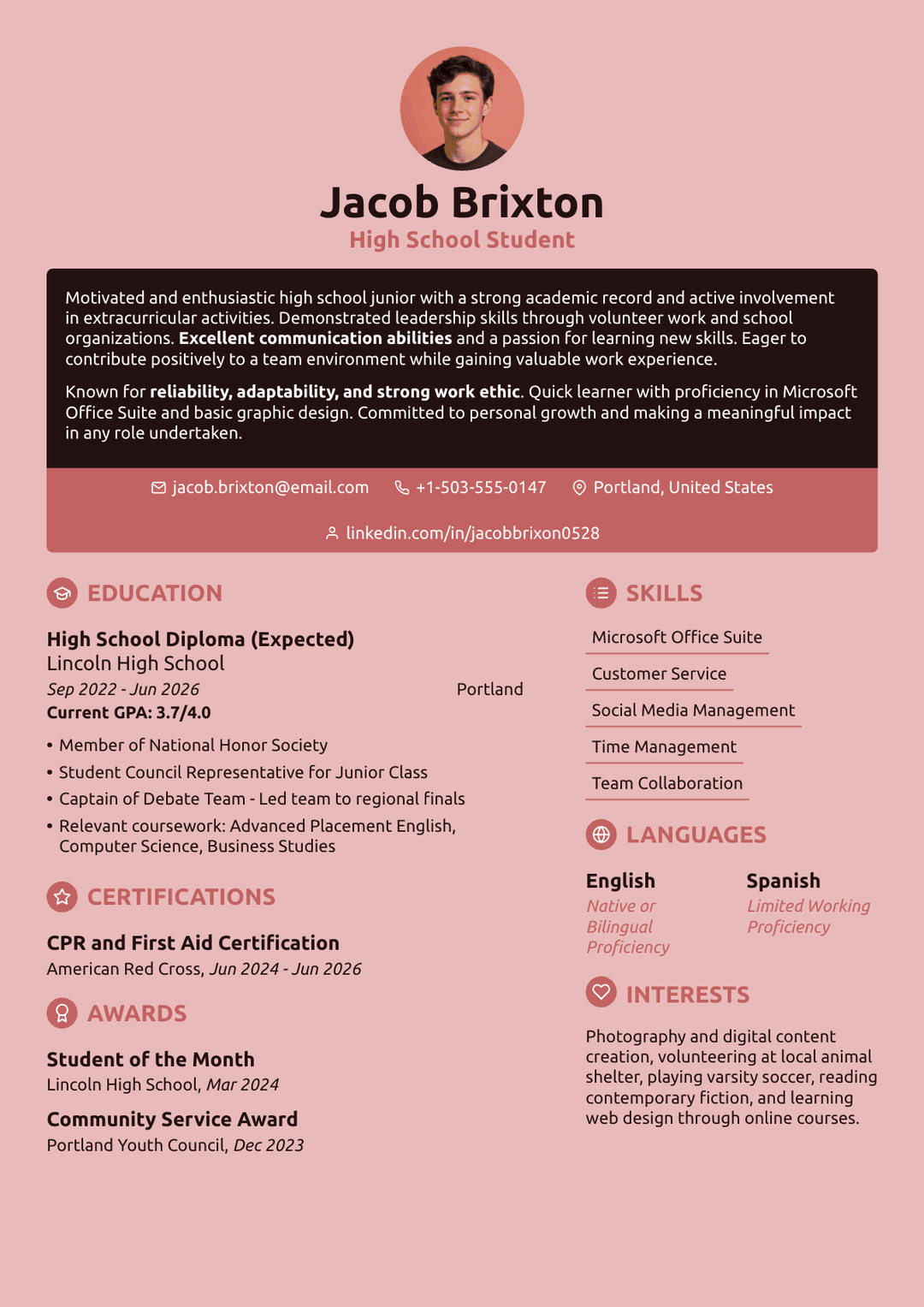
A resume for teenagers is a concise document that helps young applicants introduce themselves to potential employers. It highlights early experiences, such as part-time work, school activities, volunteering, personal projects, and emerging skills. Even with limited professional history, this type of resume focuses on strengths like motivation, responsibility, and willingness to learn to demonstrate potential rather than a long track record.
In this guide, you’ll learn how to craft a clear and effective teen resume, even if you’re just starting out. We’ll walk through each step, from choosing a format and describing your experience to showcasing relevant skills and achievements. You’ll also find practical examples, helpful tips, and guidance tailored to different scenarios, so keep reading!
- Teen resumes focus on potential, not long work history, and highlight school involvement, volunteer work, and transferable skills.
- Every teenage resume should include contact information, education, experience (formal or informal), volunteer work, extracurriculars, skills, and optional awards/certifications.
- Teens can make a strong impression by quantifying results, using action verbs, and tailoring their resumes to each job.
- Volunteering, side jobs, and projects count as real experience, especially when described with clear responsibilities and achievements.
- Keep the resume concise (one page), well-formatted, and professional, avoiding common pitfalls such as unprofessional emails or irrelevant information.
What Makes a Teenage Resume Different?
A resume for teenagers is different because it operates on entirely different principles than adult professional resumes, which might actually be a strength, not a limitation. While experienced professionals focus on career progression and industry expertise, teenage resumes shine by highlighting potential, enthusiasm, and fresh perspectives.
When a person is fifteen and applying for their first job position, employers aren't expecting them to have managed multi-million dollar projects and budgets. They're looking for reliability, teachability, and genuine enthusiasm, so a solid teenage resume should demonstrate these qualities through concrete examples from the candidate’s daily life.
In other words, your resume for teenagers should emphasize learning experiences, leadership moments (even small and unofficial ones), and situations where you've shown responsibility.
According to the U.S. Bureau of Labor Statistics, teen and youth employment (including people ages 16 to 24) has reached 53.1% in 2025. Employers specifically seek young workers who can bring energy and adaptability to their teams, which is why your age isn't a disadvantage but a differentiator.
Teenage Resume Examples
Now that we’ve established what makes a teenage resume different, let’s see a few examples in practice:
Teenage Resume Example With No Work Experience

Teenage Resume Example for Part-Time Jobs

Teenage Resume Example for Volunteering

8 Essential Sections for a Teenage Resume
Now, let’s see what sections a teenage resume consists of:
#1. Contact Information
Getting your contact information right is more important than you'd think, as it's literally how employers reach you, and mistakes here can cost you opportunities. Therefore, your teen or high school resume should begin with a clean, professional section that includes your contact details at the top, as follows:
- Full name (use the name you go by professionally)
- Phone number
- Professional email address
- City and state (no need for full address)
- LinkedIn profile (optional but desirable)
Avoid including photos unless you're specifically in the entertainment industry or it’s required in the job ad.
Let’s see what this would look like on a resume:
Ava Thompson
(555) 123-7890
ava.thompson@email.com
Seattle, WA
linkedin.com/in/avathompson763
#2. Resume Summary or Objective
A resume summary or objective is a short (2 or 3 sentences long) section that goes below the header that serves as an elevator pitch, or a quick snapshot of who you are and what you can offer.
Candidates who are writing a resume for the first time and have little or no experience typically opt for a resume objective, as it focuses on career goals rather than work history. Here’s what it looks like:
Motivated high school junior with strong communication skills and volunteer leadership experience seeking a part-time retail position. Showcased reliability through consistent babysitting commitments and academic achievement. Eager to contribute positive energy and quick learning ability to the customer service team.
This example highlights relevant qualities and specific strengths and connects your current abilities to the job you want. To make your resume objective more compelling, use action-oriented language and be specific about what you bring to the table.
Avoid generic statements like "hardworking student seeking employment," as most teenagers would write exactly that. Instead, mention specific skills, achievements, or qualities that make you stand out from other applicants.
#3. Education Section
Your education section carries more weight on a teenage resume than it will later in your career, so make it count. Since you're still in school, this section should highlight your academic strengths and relevant coursework.
You can format it like this:
- School name and location
- Expected graduation date (Month Year)
- GPA (if 3.5 or higher)
- Relevant coursework, honors, or awards
- Academic achievements or recognitions
Education
Lincoln High School
Springfield, IL
Expected Graduation: May 2026
- GPA: 3.7 / 4.0
- Relevant Coursework: Business Communications, Computer Applications, Advanced Mathematics
- Honors & Activities: National Honor Society
If you're planning for college, mention that too; employers often appreciate knowing you're thinking long-term.
#4. Work Experience (Even Without "Real" Jobs)
Here's where teenage job seekers often sell themselves short: you probably do have work experience, but it just might not look traditional. Short-term side jobs like babysitting, lawn mowing, or pet-sitting work count, and you should treat them as seriously as any other job.
Here’s what you need to disclose in the teenage work experience section:
- Role
- Organization/Client type
- Dates of employment
- 2-3 bullet points with quantified accomplishments
It could be something similar to this:
Work Experience
Childcare Provider
Private families, Springfield, IL
June 2023–Present
- Provide reliable childcare for 3 families with children ages 2-8, maintaining 100% client retention
- Manage evening routines, including meal preparation, homework assistance, and bedtime activities
- Demonstrate crisis management skills and maintain clear communication with parents
#5. Volunteer Experience
Volunteer work is a must on teenage resumes because it demonstrates initiative, community awareness, and commitment, which are all qualities employers value highly. In 2023, it was reported that teenagers contributed 2.4 billion hours of volunteer service annually in the U.S., with an estimated economic value of $34 billion.
In this section, you should highlight both the scope of your contribution and the skills you developed. Regardless of whether you volunteered at a local food bank, helped with a school fundraiser, or participated in community clean-up days, there's always a way to make it relevant.
Volunteer Experience
Volunteer Tutor
Springfield Community Center
September 2023–Present
- Provide weekly math tutoring to 5–8 elementary students, improving average test scores by 15%
- Develop individualized learning strategies for students with different learning styles
- Collaborate with center staff to track student progress and adjust teaching methods
#6. Extracurricular Activities
Extracurricular activities on your resume tell employers about your interests, commitment level, and ability to balance multiple responsibilities. However, you shouldn’t just list activities but also show impact and leadership.
Focus on:
- Leadership roles (team captain, club president, section leader)
- Achievements and awards
- Skills developed through participation
- Time commitment and consistency
Extracurricular Activities
Varsity Soccer Team Captain
2023-2024
- Led team to regional championship, improving season record by 40%
- Mentored 8 junior varsity players in skills development and team dynamics
- Organized team fundraising events, raising $2,500 for equipment upgrades
#7. Skills Section
Your skills section should balance technical abilities with soft skills that employers actually care about. Therefore, you should avoid listing basic skills that everyone has (like "Microsoft Word" or "social media").
Some hard skills you can include would be:
- Programming languages (if applicable)
- Design software experience
- Language proficiency
- Specific software relevant to your target job
Meanwhile, the soft skills that might matter include:
- Customer service orientation
- Team collaboration
- Problem-solving
- Time management
- Communication skills
An example looks like this:
Skills
- Customer service
- Cash handling
- Google Workspace
- Basic coding
- Communication
- Teamwork
- Time management
- Problem-solving
- Reliability
- Adaptability
#8. Additional Sections
Depending on your background and target jobs, consider adding sections for:
- Awards and honors: academic recognition, athletic achievements, community awards, and similar
- Certifications: CPR certification, lifeguard training, food handler's permit, etc.
- Projects: school projects, personal initiatives, or group accomplishments
- Hobbies: only include these if they’re directly related to the job you’re after
These sections can help you stand out, especially if you’re writing an entry-level resume with no experience, where every differentiator counts.
Awards and Honors
- Honor Roll, Fall 2024 & Spring 2025
- 1st Place, Regional Science Fair — Environmental Category (2024)
- Community Service Recognition — 100+ Volunteer Hours (2025
4 Pro Tips for Writing Your First Resume
Here are some valuable tips you should have in mind when writing your first resume:
Using our professional student resume templates is a smart strategy to make the most out of your teen job application. They will ensure proper formatting, appropriate spacing, and an ATS-friendly structure that gets your document past automated screening systems.
Besides offering a vast variety of templates and industry-specific examples, our resume builder can also help you customize the document properly to highlight your strongest qualifications. All you should do is give us the required details, and we will generate a fully personalized resume that matches the tone of your target industry within minutes.
Transform boring job descriptions into compelling achievements using strong action verbs and specific numbers. Instead of "helped customers," write "assisted 20+ customers daily with product selection and checkout processes"; this will make everything more credible.
Generic resumes get generic results; successful job applications require customization for each separate opportunity. You should research the company, read the job posting carefully, and adjust your resume to match their specific needs.
For example, if you're applying to a bookstore, emphasize your love of reading and any library volunteer work. However, if you’re targeting a restaurant job, you should talk about your ability to work under pressure and any food service experience, even if it's just helping with family events.
One page is the perfect resume length for teenagers; you don't have enough experience to fill multiple pages, and employers prefer concise, focused presentations anyway. Make sure you choose a clean, neat format and layout, and make the most out of the available space by including only relevant qualifications.
4 Common Resume Mistakes Teenagers Make
Finally, let’s see what teen resume mistakes you should avoid at all costs:
Your email address is often a potential employer's first impression of your professionalism. Addresses like "partygirl2008@yahoo.com" or "baseballfan99@hotmail.com" immediately signal immaturity, regardless of your actual qualifications.
Create a professional email using your name (firstname.lastname@gmail.com) or similar variations. It takes five minutes and can make the difference between getting an interview and getting ignored.
Teenagers often pad their resumes with irrelevant details because they're worried about having too little content. However, your middle school achievements, elementary school awards, or personal social media followers don't belong on a professional resume.
Instead, focus on recent, relevant experiences that demonstrate skills employers actually want. After all, quality over quantity always wins in resume writing.
Flowery fonts, bright colors, and creative layouts might seem like ways to stand out, but they usually backfire. Most companies use ATS resume scanning systems that can't read unusual formatting, meaning your resume might never reach human eyes.
Therefore, stick with clean, professional formatting using standard fonts, such as Arial or Calibri. Additionally, focus on content quality rather than visual gimmicks.
Nothing kills credibility faster than spelling mistakes or grammatical errors. These suggest carelessness and poor attention to detail, which are the qualities no employer wants in their team members. To prevent them, use spell-check, read your resume aloud, and have someone else review it before submitting.
How to Use Our AI Resume Builder for Your First Resume
Creating your first resume doesn't have to be overwhelming when you have the right tools. Our AI resume builder is designed to help everyone, including teenagers and first-time job seekers, create professional, ATS-optimized resumes quickly and effectively.
As previously mentioned, you can select one of our teenager-specific templates that highlight education, activities, and potential, rather than extensive work history. Each template is pre-formatted for optimal readability and ATS compatibility.
Our smart forms guide you through each section, asking relevant questions and providing suggestions for content. Furthermore, the AI writing assistant helps transform your informal experiences into professional descriptions that employers will take seriously!
Final Thoughts
Starting your career journey with a strong resume sets you up for success in ways that extend far beyond landing your first job. The process of creating one with no experience teaches you to recognize your own value, articulate your strengths clearly, and present yourself professionally, which are the skills you'll use throughout your entire career.
Your age and relative inexperience aren't limitations but opportunities to bring fresh energy, enthusiasm, and new perspectives to employers who value those qualities. With the right resume strategy and consistent effort, you'll soon have the work experience that makes future applications even easier.
Resume for Teenagers FAQ
#1. Should teenagers include a photo on their resume?
No, teenagers should not include photos on their resumes in the United States. Photos can lead to discrimination and are not standard practice for most industries, which makes them unnecessary and potentially harmful to your application prospects.
#2. What if I have no work experience at all?
If you have no work experience at all, focus on transferable skills from school, volunteer work, sports, and informal responsibilities like babysitting or helping family businesses. These experiences demonstrate valuable workplace qualities like reliability, communication, and responsibility that employers actively seek in teenage candidates.
#3. Should I include my GPA on my teenage resume?
You should include your GPA only if it's 3.5 or higher on a 4.0 scale. A strong GPA demonstrates academic achievement and work ethic, while lower GPAs may hurt your application and should be omitted in favor of highlighting other strengths and experiences.
#3. Can I use the same resume for every job application?
No, you shouldn’t use the same resume for every job application. Successful teenage job seekers customize their resumes for each position by emphasizing relevant experiences and skills. This shows potential employers that you understand their specific needs and are genuinely interested in that particular opportunity.
#4. What skills should teenagers put on their resumes?
The skills teenagers should put on their resumes include technical skills like computer programs or languages, plus relevant soft skills like customer service, teamwork, and problem-solving demonstrated through school and extracurricular activities. They should avoid listing basic skills that all teenagers have, focusing instead on unique capabilities that differentiate them.
#5. Should teenagers include references on their resumes?
No, teenagers shouldn’t include references on their resumes, but they can add "References available upon request" at the bottom. They can also prepare a separate reference list with teachers, coaches, volunteer coordinators, or family friends who can speak professionally about their character and abilities.

Daniel Carter is the salary negotiation coach you wish you had before accepting that lowball job offer. With years of HR experience, he knows all the employer tactics—and how to counter them. His posts break down negotiation strategies, industry salary trends, and scripts you can actually use in real conversations.