How to Write an Engineering Cover Letter That Gets You Hired
This complete guide with expert tips and real examples will teach you how to write a compelling cover letter — fast and stress-free!
Edit this cover letter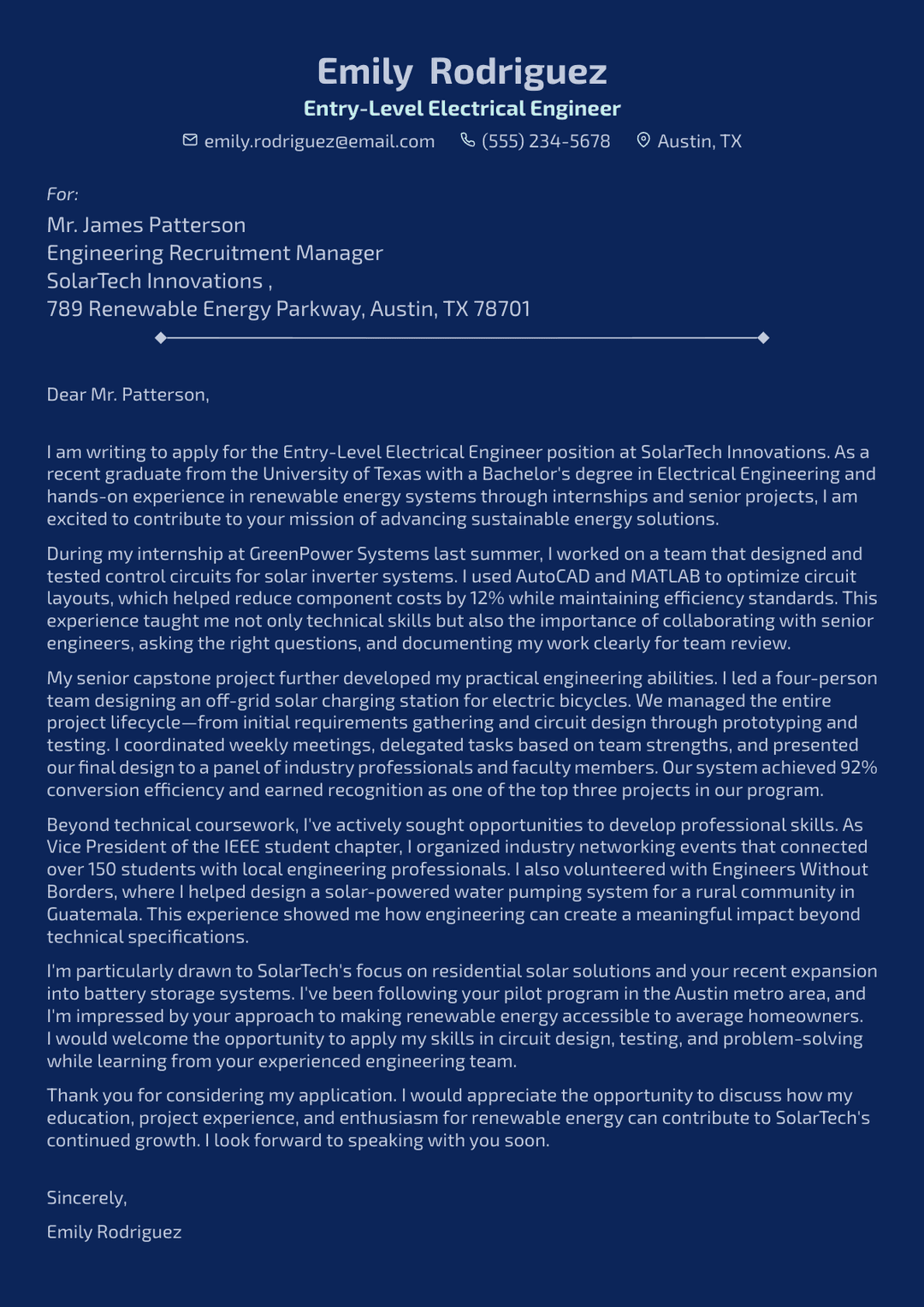
Writing a good engineering cover letter is especially important in today's job market. However, most engineers focus exclusively on their resume, and that's a costly mistake. Your cover letter needs to bridge the gap between your technical accomplishments and the specific needs of each role you're targeting. It's where you transform cold data points into narratives that show hiring managers exactly how you'll solve their problems.
In this guide, we will walk you through every aspect of writing an engineering cover letter that actually gets results. You'll discover what works well, see real examples from successful applications, and learn how to avoid the common mistakes that sink most cover letters.
- Engineering cover letters balance technical precision with accessible communication, focusing on project achievements and problem-solving rather than traditional business metrics.
- Use the STAR method to describe specific challenges, systematic approaches, and measurable outcomes that demonstrate both technical expertise and soft skills.
- Research company projects and technologies before writing, then customize your letter to align your experience with their specific needs and challenges.
- Present technical skills through concrete project contexts showing measurable results rather than simply listing software proficiencies.
- Avoid overly technical jargon, generic applications, and poor formatting that fails applicant tracking systems or excludes non-technical reviewers.
What Makes an Engineering Cover Letter Different?
An engineering cover letter requires a unique balance between technical precision and accessible communication. It focuses on project-based achievements and problem-solving capabilities rather than traditional business metrics.
According to the U.S. Bureau of Labor Statistics, employment in engineering occupations is projected to grow faster than average across all occupations in the next decade. This makes competition increasingly fierce for the best positions, with around 186,500 positions expected to open up each year. This competitive landscape means your cover letter must immediately differentiate you from dozens of other qualified candidates.
Engineering positions demand a distinctive approach to cover letter writing. Unlike marketing or sales roles in which personality and relationship-building take center stage, these cover letters need to establish credibility through concrete technical examples and quantifiable results.
For instance, the technical nature of engineering work means your cover letter must speak to multiple audiences simultaneously. While a hiring manager might appreciate your leadership experience on a cross-functional team, the engineering director reviewing your application wants to see evidence of your technical competency with specific tools, methodologies, or systems.
Engineering Cover Letter Examples
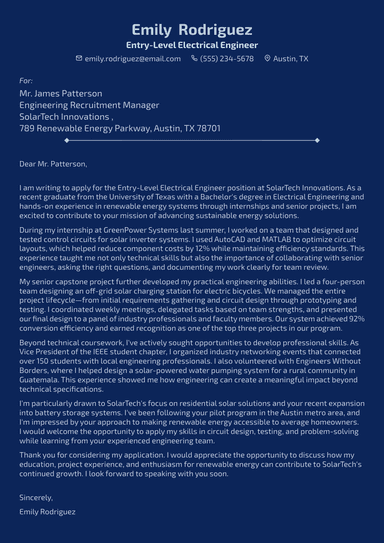
Engineering cover letters should balance technical expertise with business impact, demonstrating both hard skills and soft skills. Here are two complete examples for different career stages.
Entry-Level Engineer Cover Letter Example

Experienced Engineer Cover Letter Example

How to Write an Engineering Cover Letter: Step-by-Step Guide
#1. Research the Company and Role
A crucial step before you start writing your cover letter is to research the company. It allows you to connect your technical expertise to specific company projects, technologies, and challenges. However, effective research goes beyond reading the company's About page.
Look into their recent projects, the technologies they're implementing, any engineering challenges they've publicly discussed, and the specific qualifications mentioned in the job posting. Many engineering companies publish case studies, technical blogs, or white papers that provide insights into their current priorities and technical approaches.
Also, pay particular attention to the tools, software, methodologies, and standards mentioned in the job description. If they're looking for experience with specific CAD software, programming languages, or industry certifications, make sure you understand how your background aligns with these requirements.
Don't overlook company culture and values, especially for engineering roles that involve significant collaboration or client interaction. Understanding their approach to project management, quality assurance, or innovation can help you frame your experience in a more effective way.
#2. Create a Professional Header
Your cover letter header should contain your full name, professional title, phone number, email address, city and state, and LinkedIn URL. Also, include your engineering discipline or specialization in your professional title when it directly aligns with the position you're targeting.
For instance, "Senior Mechanical Engineer" or "Software Development Engineer" immediately orients the reader and helps with applicant tracking software (ATS). However, avoid overly creative titles that might confuse automated systems or human reviewers.
A professional presentation starts with your header, and engineering positions particularly value consistency and attention to detail. Your contact information should mirror the formatting and style choices you've made in your engineering resume. This consistency signals the same methodical approach that employers expect from engineering professionals.
Here’s a good template you can use for your engineering cover letter header:
Marcus Johnson
Senior Mechanical Engineer
marcus.johnson@email.com
(555) 987-6543
Detroit, MI
linkedin.com/in/marcusjohnson
#3. Craft a Compelling Opening
Your opening paragraph should accomplish two goals:
- Capture attention
- Establish immediate relevance
Instead of starting with "I am writing to apply for..." try beginning with a concrete example that showcases your fit for the role.
Here’s a good example:
Having led the design and implementation of an automated quality control system that reduced manufacturing defects by 23%, I'm excited to bring my process improvement expertise to [Company]'s production engineering team.
This approach immediately positions you as someone who delivers measurable results in areas relevant to the position. It also demonstrates that you understand the types of challenges the role likely involves and have successful experience addressing similar issues.
#4. Highlight Technical Skills and Projects
Present technical skills through specific project contexts that demonstrate not just familiarity with tools and technologies, but your ability to apply them effectively to achieve measurable engineering outcomes and solve real-world problems.
Rather than simply listing your technical competencies, show how you've used these skills to create value. The table below outlines good vs. bad examples, so you know what to watch out for:
- Proficient in Python, MATLAB, and statistical analysis
- Experience with project management methodologies
Bad Example
- Applied Python and MATLAB for data analysis of sensor readings, identifying patterns that led to a 20% improvement in predictive maintenance accuracy
- Led agile development sprints for a 6-person engineering team, delivering software updates 30% faster than the previous waterfall approach
This approach confirms your technical competency, demonstrates results-oriented thinking, and provides context that helps the reader understand the scope and impact of your work. It also makes your cover letter more engaging by telling stories rather than reciting lists.
#5. Demonstrate Problem-Solving Abilities
Use the STAR method (Situation, Task, Action, Result) to briefly describe specific engineering challenges you've encountered, the systematic approach you took to address them, and the measurable outcomes you achieved. Make sure to choose examples that showcase different types of problem-solving, such as technical design challenges, process improvement opportunities, resource constraint issues, or cross-functional coordination problems.
Let’s a good example of this framework in action:
- Situation: Complex manufacturing line experiencing 15% defect rate
- Task: Identify root cause and implement sustainable solution within 30 days
- Action: Conducted statistical analysis, implemented sensor monitoring system
- Result: Reduced defects to 3%, saving $180K annually in rework costs
Focus on problems that require creativity, persistence, or innovative thinking rather than routine troubleshooting. The goal is to demonstrate that you can handle the types of complex, ambiguous challenges that characterize most engineering roles.
#6. Show Cultural Fit and Soft Skills
Soft skills are as important as your technical expertise. Engineering projects rarely happen in isolation, so hiring managers want evidence that you can work effectively within their organizational culture and team structure. Highlight experiences where you've successfully collaborated with diverse teams, communicated complex technical concepts to non-technical stakeholders, or led projects that required coordination across multiple disciplines.
However, don't just claim that you have strong communication skills—provide specific examples. Perhaps you presented technical findings to executive leadership, wrote documentation that improved team knowledge sharing, or successfully managed client relationships during project implementation. These concrete examples make your soft skills claims credible and memorable.
Leadership skills are particularly valuable, even for non-management positions. Engineering projects often involve informal leadership opportunities where team members guide technical decisions, mentor junior colleagues, or coordinate with other departments. Highlighting these experiences shows your potential for growth and your ability to contribute beyond your immediate technical responsibilities.
#7. End With a Strong Call to Action
Your closing paragraph should end with a confident restatement of your interest in the role, mention your enclosed resume and any relevant portfolio materials, and include a clear call to action requesting an interview. Keep your closing concise but confident. Avoid apologetic language or uncertainty about your qualifications. Instead, express genuine interest in discussing how your background aligns with their team's needs and current projects.
Let’s see a good example of a closing paragraph:
I've enclosed my resume along with a portfolio showcasing CAD models and test results from recent projects. I'd welcome the opportunity for an interview to discuss how my background in automotive design and passion for sustainable engineering could contribute to your team's continued success.
4 Common Engineering Cover Letter Mistakes to Avoid
Many qualified engineers inadvertently sabotage their applications through common cover letter mistakes that hiring managers spot immediately. Understanding these pitfalls—and how to avoid them—can improve your response rates and help you stand out in competitive job markets.
- Using too technical language. Your letter passes through HR professionals, hiring managers, and technical leads—each with different expertise levels. Therefore, balance technical credibility with business impact, using terminology to establish expertise while emphasizing results that any reviewer can understand and appreciate.
- Generic applications. Customizing each engineering cover letter is essential because roles vary significantly in technical requirements, industry applications, and company cultures. Research each company's current projects, technical challenges, and industry position. Then adjust your examples accordingly: highlight product development experience for companies expanding into new markets, or emphasize process improvement for efficiency-focused organizations.
- Focusing only on technical skills. Don't treat your cover letter like a technical specification listing only programming languages and software proficiencies. Include specific examples demonstrating soft skills in engineering contexts—presenting to executives, coordinating with cross-functional teams, or managing project timelines.
- Poor formatting. Avoid inconsistent spacing, multiple font types, creative layouts that confuse applicant tracking systems, and mixed date formats. Use standard business format with consistent one-inch margins, a single professional font matching your resume, and balanced white space. Pay special attention to technical terms, software names, and industry standards—getting these details wrong suggests carelessness.
Ready to Build Your Engineering Cover Letter?
Transform your career with ResumeBuilder.so! Our platform offers specialized templates, ATS optimization, and industry-specific guidance. With our AI-powered builder, you can personalize each cover letter for any role, maintaining consistent design and tone across all your application documents.
Use our examples to create cover letters that highlight your skills, match employer expectations, and showcase your unique strengths. Join thousands of successful candidates who’ve accelerated their job search, impressed recruiters, and landed interviews at top global companies through our intuitive platform.
Final Thoughts
Writing an effective engineering cover letter requires the same systematic approach you bring to technical projects—careful analysis of requirements, strategic planning of your approach, and methodical execution that addresses all key success criteria.
The most successful engineering cover letters strike a careful balance between technical credibility and accessible communication. It demonstrates deep expertise while remaining readable for diverse audiences, shows individual achievements while emphasizing collaborative capabilities, and highlights past successes while expressing genuine enthusiasm for future challenges.
Remember that your cover letter works in tandem with your resume to create a complete picture of your professional capabilities. While your resume provides comprehensive details about your experience and qualifications, your cover letter offers the opportunity to contextualize that information within the specific needs and culture of each organization you're targeting.
Engineering Cover Letter FAQ
#1. What should I include in an engineering cover letter?
Include specific technical skills relevant to the position, quantified project achievements that demonstrate impact, relevant software and tool experience, problem-solving examples using concrete scenarios, and clear connections between your background and the employer's needs.
#2. How long should an engineering cover letter be?
An engineering cover letter should be one page long, typically 3-4 paragraphs with 250-400 words total. This provides enough space to demonstrate technical competency and relevant experience without overwhelming the employer. Keep your content focused and impactful rather than trying to include every detail of your background.
#3. Should I mention specific programming languages or software?
Yes, include specific programming languages, software packages, and technical tools that match the job requirements, but present them within project contexts that demonstrate practical application and measurable results rather than simply listing capabilities.
#4. How do I write an engineering cover letter with no experience?
Focus on relevant academic projects, internship contributions, co-op experiences, laboratory work, senior design projects, relevant coursework, certifications, and any practical applications of engineering principles, even in non-professional contexts.
#5. Should I include salary expectations in my engineering cover letter?
Only include salary expectations if explicitly requested in the job posting, otherwise, save compensation discussions for later in the interview process when you've established your value and learned more about the complete opportunity and benefits package. Premature salary discussions can limit your negotiating power and may eliminate you from consideration if your expectations don't align with their initial budget parameters.

Emily Foster knows how nerve-wracking it can be to land your first job—she’s been there. As a mentor for young professionals, she shares exactly what hiring managers want from entry-level candidates. From internship hacks to interview confidence tips, Emily helps students and recent grads navigate the job search with ease.