Engineering Resume: Full Writing Guide + Examples for 2025
This complete guide with detailed explanations and expert tips will teach you how to write an acting resume in record time!
Edit this resume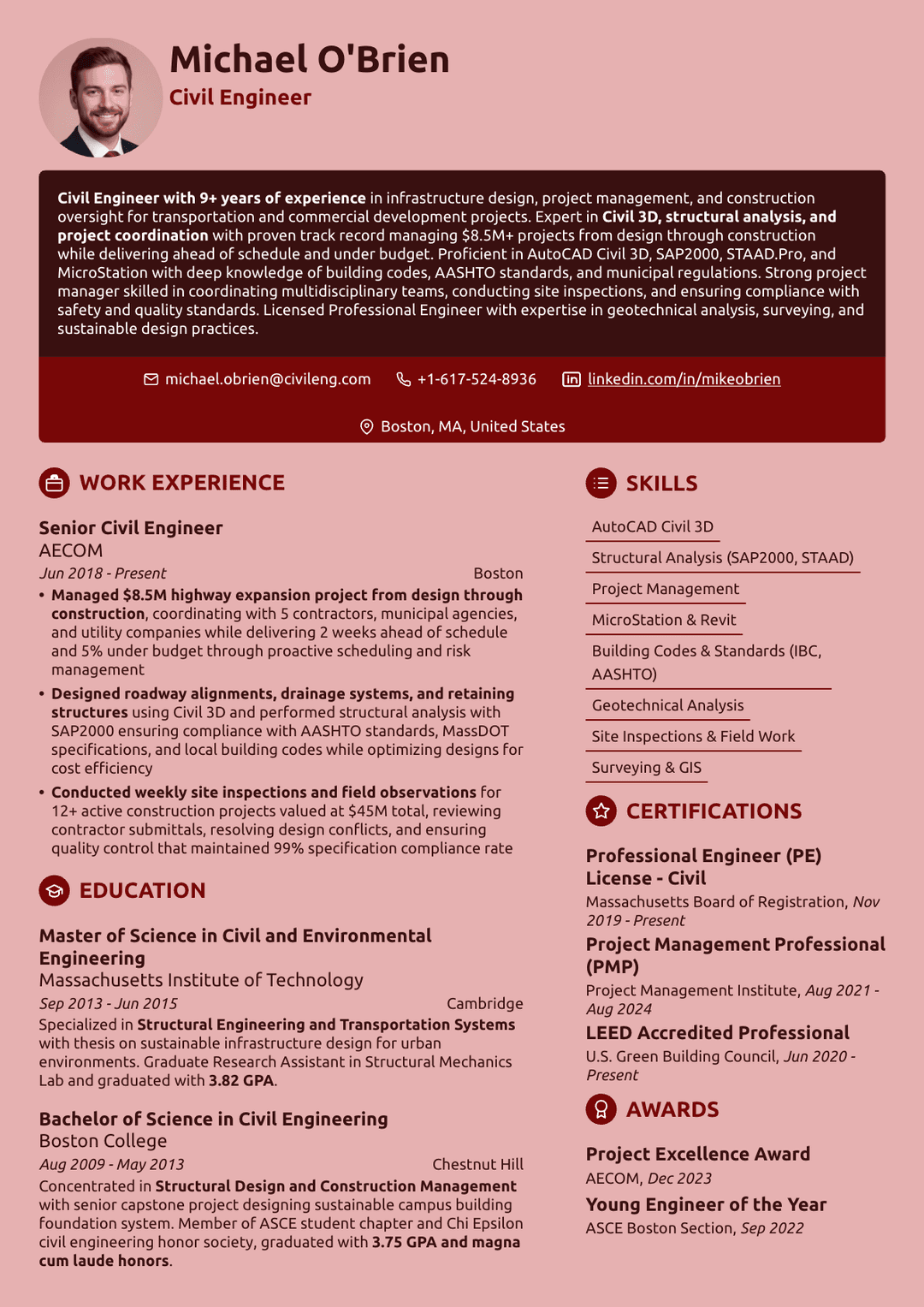
An engineering resume highlights technical skills, experience, education, and measurable achievements to match hiring needs across software, mechanical, and civil roles. The engineering job market is more competitive than you might expect. Even highly qualified candidates get filtered out by Applicant Tracking Systems (ATS) before a human ever reviews their application. The difference often comes down to how well you present your skills and qualifications.
In this guide, you'll learn exactly how to write your engineering resume for maximum impact, which sections to prioritize, how to beat ATS screening, and what makes engineering resumes different across specializations like mechanical, electrical, civil, and software engineering.
- Engineering resumes should emphasize technical skills, relevant projects, and measurable achievements with specific metrics.
- Reverse-chronological format works best for most engineering positions because it clearly demonstrates career progression.
- ATS optimization is critical—use standard section headers and avoid graphics or tables that confuse parsing systems.
- Include specific engineering software, tools, and methodologies you've mastered, using exact terminology from job descriptions.
- Quantify accomplishments with metrics like cost savings, efficiency improvements, and project scope to stand out.
- Tailor your resume for each engineering specialization and job application rather than using a generic version.
What Makes an Engineering Resume Different?
Engineering resumes differ from standard resumes in several ways. Understanding these differences helps you write a resume that works for both automated systems and human reviewers. Let’s see what those are:
- Emphasis on technical skills. You can't simply list "proficiency with design tools"—you need to specify SolidWorks, AutoCAD, CATIA, or Fusion 360. Employers in your field know these distinctions matter. This level of specificity applies to software skills, testing equipment, and methodologies you've used.
- Balance between technical depth and clarity. Your senior design project that optimized thermal efficiency needs to communicate value to multiple audiences, including the engineering manager who understands the technical complexity, the HR professional conducting the initial screen, and the executive approving the hire. Strong engineering resumes explain complex projects without drowning readers in jargon.
- Certifications and licenses carry weight. Professional credentials matter more in engineering than in many other fields. A Professional Engineer (PE) license often isn't just a bonus—it's a make-or-break requirement. The same applies to specialized certifications in Six Sigma, PMP, or industry-specific credentials. These qualifications deserve prominent placement on your resume.
- Importance of ATS optimization. Applicant Tracking Systems (ATS) present higher stakes for engineering candidates. Engineering positions typically attract large applicant pools, making automated screening more stringent. Poor formatting means your qualifications never reach human eyes, regardless of how impressive they are. Understanding resume formatting principles becomes essential, not optional.
- Sticking industry conventions. Employers expect a certain resume format when it comes to engineering. Deviation from these norms might signal you don't understand industry standards. Following established formatting practices demonstrates awareness of professional expectations in your field.
Engineering Resume Examples by Specialization
While all engineering resumes follow similar principles, each specialization has unique emphasis areas that employers expect to see. Let’s take a look at few resume examples:
Mechanical Engineering Resume Example


Electrical Engineering Resume Example


Civil Engineering Resume Example

Software Engineering Resume Example

Chemical Engineering Resume Example


Industrial/Manufacturing Engineering Resume Example


Essential Sections for an Engineering Resume
While all resumes share common sections, engineering resumes require specific approaches based on specialization. With 186,500 annual openings in architecture and engineering projected through 2034, it’s a blooming sector.
Given the growing job outlook, the way you present standard information on your engineering resume can mean all the difference in landing your dream job. That said, here are the essential sections for an engineering resume:
Contact Information
It might seem straightforward, but for engineering roles, the contact information section requires specific considerations. Like with every resume, make sure to include:
- Full name
- Professional email address
- Phone number with a professional voicemail
- Location (city and state)
However, for engineers, a LinkedIn profile is increasingly important. Many hiring managers check for recommendations and endorsements of your technical skills.
Software engineers should include their GitHub profile or portfolio website. If you have a Professional Engineer license or Engineer in Training certification, you can include "PE" or "EIT" right after your name in the resume header.
Professional Summary or Objective
The difference between a resume summary and an objective statement comes down to experience level. Experienced engineers should use a resume summary that highlights specialization, years of experience, key technical competencies, and major achievements.
For example:
Licensed Civil Engineer with 7+ years designing sustainable infrastructure projects. Expert in AutoCAD, Civil 3D, and structural analysis. Led $12M bridge rehabilitation project, delivering 3 months ahead of schedule and 8% under budget.
On the other hand, entry-level engineers benefit more from a resume objective that emphasizes education, relevant projects, internships, and career goals. It shows you understand what the role requires and how your background aligns, even without extensive professional experience.
Here’s a good example:
Recent Civil Engineering graduate from State University with hands-on experience in structural analysis through senior capstone project designing a pedestrian bridge. Completed summer internship at ABC Construction applying AutoCAD and performing site inspections. Seeking to apply technical knowledge and problem-solving skills to support infrastructure projects at [Company Name].
Technical Skills
This is the most important section for ATS optimization. Organize your technical skills by categories for maximum impact and scannability. For example:
- Software/Tools should list specific programs like CAD software (AutoCAD, SolidWorks, CATIA), simulation software (ANSYS, MATLAB, LabVIEW), and programming languages (Python, C++, Java).
- Methodologies include approaches like Agile, Six Sigma, Lean Manufacturing, and Design for Manufacturing (DFM).
- Technical competencies cover discipline-specific skills like circuit design, structural analysis, or systems integration.
- Certifications and licenses deserve prominent placement—Professional Engineer (PE), Engineer in Training (EIT), PMP, or specialized certifications.
Also, it’s important to match exact keywords from job descriptions. If a posting asks for "AutoCAD experience," don't just list "CAD software proficiency." ATS systems look for precise matches.
How to Format Your Engineering Resume: A Step-by-Step Guide
Your engineering resume formatting directly impacts both ATS compatibility and professional presentation. Get this wrong, and even exceptional qualifications might never reach human reviewers.
Let’s see how to format your engineering resume step by step:
Choose the Right Resume Format
You can choose from three main resume formats, including:
- Reverse-chronological format. It’s recommended for most engineers because it is most ATS-friendly. This format works best if you have a consistent work history in your engineering field, clearly demonstrating how you've advanced and taken on increasing responsibility.
- Functional format. This one emphasizes skills over work history, but many engineering employers view this format skeptically. It can appear like you're hiding something—employment gaps, frequent job changes, or lack of progressive experience. Only consider this for a significant career change.
- Combination/hybrid format. It blends skills emphasis with chronological work history. The format works well when transitioning between engineering specializations, e.g. from mechanical to aerospace engineering. This way, you emphasize transferable skills while still showing your work trajectory.
Design and Layout Best Practices
Engineering-specific design considerations require balancing technical content density with readability. The table below outlines what look out for when it comes to resume design and layout:
| Aspect | Recommendation | Reason |
|---|---|---|
1 page for entry-level (<5 years), 2 pages for 10+ years or extensive projects | Ensures readability; avoids overwhelming the recruiter with dense information | |
Font & Size | 11–12pt, professional fonts like Calibri, Arial, Times New Roman | Maintains a professional, clean appearance |
Design & Creativity | Avoid creative designs; focus on technical content | Resume is a technical document, not a portfolio; ensures ATS readability |
Resume Layout | Standard margins (0.5–1 inch), clear section headers, consistent formatting | Proper white space makes dense technical content easier to scan |
Graphics / Tables / Text Boxes | Avoid all; no photos unless required internationally | ATS systems often cannot read these, risking loss of key info |
File Format | Save as PDF unless otherwise specified | Preserves formatting across systems, ensuring recruiter sees your intended layout |
ATS Optimization for Engineering Resumes
ATS systems are especially common in engineering hiring due to high applicant volumes. Here’s how to format your engineering resume to pass ATS:
- Use standard section headers. For example, "Work Experience," "Education," and "Technical Skills." Creative alternatives like "Professional Journey" or "My Technical Toolkit" confuse ATS parsing algorithms, causing them to misfile or skip your information entirely.
- Include exact keywords from the job description. Do this throughout your resume, particularly in your technical skills section. If they ask for "MATLAB experience," don't just write "proficiency with mathematical computing software."
- Spell out acronyms at first use. Different companies and recruiters might search for either the full term or the acronym, so including both covers your bases.
- Avoid headers and footers for critical information. Your name and contact info should be in the main body of the document, not tucked into header space.
- Don't use tables or text boxes for key information. While tables might help organize skills or project details visually, ATS systems often can't parse them correctly, resulting in gibberish or missing data.
- Include both spelled-out and abbreviated certifications. "Professional Engineer (PE)" covers searches for either term.
How to Write the Work Experience Section on Your Engineering Resume
Writing your work experience section properly proves you can apply technical knowledge to real-world problems. This is where you transform your job duties into compelling evidence of your capabilities.
For each position, follow this format:
Then include 3-6 bullet points per position that mix responsibilities with accomplishments. Start with action verbs and include quantifiable achievements whenever possible.
Here's a good example:
Mechanical Engineer | ABC Manufacturing | Detroit, MI | June 2020 - Present
- Designed and implemented automated assembly line system, reducing production time by 23% and increasing output by 15,000 units annually
- Led cross-functional team of 6 engineers to develop new product line, generating $2.3M in first-year revenue
- Utilized SolidWorks and ANSYS to conduct finite element analysis, optimizing component designs and reducing material costs by $180K
- Collaborated with quality assurance to implement testing protocols that decreased defect rates from 3.2% to 0.8%
- Mentored 2 junior engineers in CAD software and design principles, both earning promotions within 18 months
How to Showcase Projects on Your Engineering Resume
Showcasing projects on your engineering resume is especially important for entry-level engineers and career changers who might lack extensive professional experience but have substantial project work to showcase.
Let’s see how to do it properly.
Academic Projects for Entry-Level Engineers
Capstone projects, senior design projects, and significant coursework deserve prominent placement on entry-level engineering resumes. Make sure to include:
- Project title and context (what type of project, what course or program)
- Team size if applicable and your specific role
- Technologies and methodologies used
- Problem you solved or objective you achieved
- Measurable outcomes or results
Here’s a good example:
Autonomous Delivery Robot | Senior Capstone Project
- Led 4-person team designing and building autonomous navigation system using ROS, Python, and Arduino
- Integrated LIDAR sensors and computer vision algorithms for obstacle detection and path planning
- Successfully demonstrated 95% delivery accuracy in campus environment with 0 collisions over 100+ test runs
- Presented findings to panel of industry professionals and received department's Outstanding Project Award
Professional Projects for Experienced Engineers
For experienced engineers, projects typically fit within job descriptions rather than in a separate section. However, a dedicated projects section makes sense if:
- Projects are highly relevant to your target position
- You're a consultant with a diverse project portfolio spanning multiple clients
- You want to highlight specific technical achievements that deserve more prominence than standard work history bullets allow
Let’s see an example of a properly formatted project section:
Smart Grid Integration System | Regional Power Authority
Senior Electrical Engineer | 18-month project | 2022-2023
- Designed and implemented IoT-based monitoring system across 50+ substations using Python, SCADA, and AWS
- Reduced power outage response time from 45 minutes to 12 minutes through real-time data analytics
- Managed $1.2M project budget and coordinated with 4 utility companies and 3 contractor teams
- System now monitors 200,000+ residential and commercial customers with 99.5% uptime
However, be careful not to disclose confidential information. When necessary, generalize company or client names while keeping technical and achievement details specific.
How to List Technical Skills on Your Engineering Resume
Listing your technical skills on an engineering resume properly is critical for both ATS screening and employer evaluation. This single section can make or break your resume's effectiveness.
Categorization improves readability and helps ATS systems parse your information correctly.
For example:
Software & Tools:
- CAD/CAM: AutoCAD, SolidWorks, CATIA, Inventor, Fusion 360
- Analysis: ANSYS, MATLAB, LabVIEW, Simulink
- Programming: Python, C++, Java, SQL, R
- Project Management: MS Project, Primavera P6, Jira
Engineering Disciplines:
- Structural analysis and design
- Circuit design and analysis
- Process optimization
- Quality assurance and control
- Systems integration
Methodologies:
- Lean Manufacturing
- Six Sigma (Green Belt)
- Agile/Scrum
- Design for Manufacturing (DFM)
This organization helps hiring managers quickly scan for relevant qualifications while ensuring ATS systems properly categorize your skills.
Which Skills to Include vs. Exclude
Knowing which skills to include vs. exclude helps you allocate resume space effectively. Here’s a short overview:
- Technical software and programming languages you use professionally
- Engineering-specific methodologies and approaches
- Industry certifications and licenses
- Specialized equipment operation
- Relevant technical competencies specific to your discipline
Exclude / Minimize
- Outdated technologies unless specifically required for the role
- Basic software like Microsoft Office (unless advanced skills in Excel VBA or Access)
- Soft skills—demonstrate these in work experience instead
- Technologies learned in class but never applied professionally
- Skills that every engineer in your field possesses—highlight differentiators
Education Section on Engineering Resumes
Education is required in engineering, but how you present it depends on your career stage. Placement and detail level should reflect your current professional standing.
Recent Graduates and Entry-Level Engineers
If you have no work experience in the field, you should place education near the top of your engineering resume, right after the objective. Include the following information:
- Degree type and major (Bachelor of Science in Electrical Engineering)
- University name and location
- Graduation date or expected graduation date
- GPA if 3.5+ or if you're within 2-3 years of graduation
- Relevant coursework (3-5 courses most applicable to target job)
- Academic honors and scholarships (Dean's List, scholarship recipient)
- Engineering student organizations and leadership roles (IEEE member, Robotics Club president)
Here’s a good example:
Bachelor of Science in Mechanical Engineering University of Michigan, Ann Arbor, MI Graduated: May 2024 | GPA: 3.7/4.0
Relevant Coursework: Thermodynamics, Fluid Mechanics, Machine Design, Manufacturing Processes, Control Systems
Honors: Dean's List (6 semesters), James B. Angell Scholar, ASME Scholarship Recipient
Activities: American Society of Mechanical Engineers (ASME) Treasurer, Formula SAE team member
Experienced Engineers
On the other hand, if you have significant professional experience, you should place education toward the bottom of your resume. Keep it concise:
- Degree, major, university, graduation year
- Advanced degrees more prominently featured than bachelor's
- Omit GPA entirely
- Omit coursework
- Focus instead on certifications and continuing education
If you hold a PE license or advanced certifications, these may warrant placement near the top in a dedicated credentials section rather than buried at the bottom with education.
5 Common Engineering Resume Mistakes to Avoid
Even experienced engineers make resume mistakes that cost them interviews. Here are five errors to watch out for in your engineering resume:
- Too much technical jargon. Technical accuracy is important, but your resume must be readable by HR professionals and executives who may not understand specialized terminology. Balance technical terms with clear explanations of impact and outcomes.
- Listing job duties instead of achievements. Many engineers describe what they were responsible for rather than what they accomplished. The key is to be specific and show impact. Anyone with that job title might be "responsible for designing"—but did you actually do it, and what resulted from your work?
- Ignoring ATS optimization. Qualified engineers never get past ATS because of formatting issues or missing keywords. Even with perfect qualifications, you won't get interviews if the system can't properly parse your resume. Understanding how ATS systems work is essential for modern job searches.
- Underselling soft skills. Engineers sometimes focus exclusively on technical skills, forgetting to demonstrate communication, leadership, teamwork, and project management abilities. These soft skills often differentiate equally qualified technical candidates.
- Generic resume for all applications. Using the same resume for every application significantly reduces success rates. Each job description has unique requirements and keywords. Maintain a master resume with all your experience, then customize by emphasizing the most relevant skills and projects for each application.
Engineering Resume Checklist
Before submitting your engineering resume, verify every element meets professional standards with our checklist:
Build Your ATS-Friendly Engineering Resume in Minutes With ResumeBuilder.so
ResumeBuilder.so’s AI-powered builder helps engineers create professional, ATS-friendly applications in minutes. With pre-designed resume templates tailored to entry-level, mid-career, and senior roles, you save hours of formatting while ensuring compatibility with applicant tracking systems.
Whether showcasing specialized engineering skills or building your cover letter, ResumeBuilder.so gives you a polished, professional foundation while highlighting your unique experience.
Final Thoughts
Creating an effective engineering resume requires balancing technical detail with readability. Also, ATS optimization isn't optional in today's job market. Even the most qualified candidates get filtered out if their resumes can't be properly parsed by applicant tracking systems. Following standard formatting conventions isn't about being boring—it's about being strategic.
Furthermore, tailoring your resume for each application significantly increases interview rates. It takes more time, but the investment pays off when you're landing interviews with companies you actually want to work for rather than sending hundreds of applications into the void. Plus, writing a strong cover letter that provides context for your technical accomplishments and career goals, makes your application even more compelling.
Engineering Resume FAQ
#1. Should I include my GPA on my engineering resume?
You should include your GPA on an engineering resume if you're a recent graduate (within 2-3 years) and your GPA is 3.5 or higher. Experienced engineers should omit GPA entirely and focus on professional accomplishments instead, unless asked.
#2. How do I write an engineering resume with no experience?
For an engineering resume with no experience, emphasize your education, relevant coursework, academic projects, internships, and engineering student organization involvement. Include lab skills, technical competencies developed through coursework, and hands-on projects demonstrating engineering principles.
#3. Should I use an engineering resume template?
Yes, professional engineering resume templates ensure ATS compatibility and proper formatting while saving significant time. Choose templates specifically designed for technical resumes with prominent skills sections and clean, scannable layouts. However, customize thoroughly to reflect your unique qualifications and experience.
#4. Do I need different resumes for different engineering jobs?
Yes, you should tailor your engineering resume for each application. Emphasize different projects, skills, and experiences based on specific job requirements. Customize your technical skills section to mirror job description keywords, which significantly improves ATS pass rates and demonstrates genuine interest in the specific position.
#5. What's the best format for an engineering resume?
The reverse-chronological format is the best format for an engineering resume in most cases, showcasing career progression clearly and meeting ATS compatibility requirements.
#6. Should I include my PE license on my resume?
Absolutely include your PE license on your resume. A Professional Engineer (PE) license is a significant credential in engineering fields. Include it prominently in your contact header, credentials section, or education/certifications section. List it as "Professional Engineer (PE)" to ensure ATS systems recognize both the full term and abbreviation.
#7. Can I use color on my engineering resume?
Minimal, professional color accents are acceptable for section headers or your name on an engineering resume, but maintain a conservative approach. Avoid bright colors or heavy use of color that may not print well or could interfere with ATS parsing. Professional black and navy are the safest choices that maintain readability across all platforms.

Chris Nolan is the go-to expert for turning cold connections into career-changing opportunities. He doesn’t just talk about networking—he teaches you how to actually do it without feeling awkward or spammy. From crafting the perfect LinkedIn message to leveraging your existing network for job referrals, Chris makes networking simple and strategic.