Banking Resume: How To Impress Recruiters With It
This complete guide with detailed explanations and expert tips will teach you how to write an acting resume in record time!
Edit this resume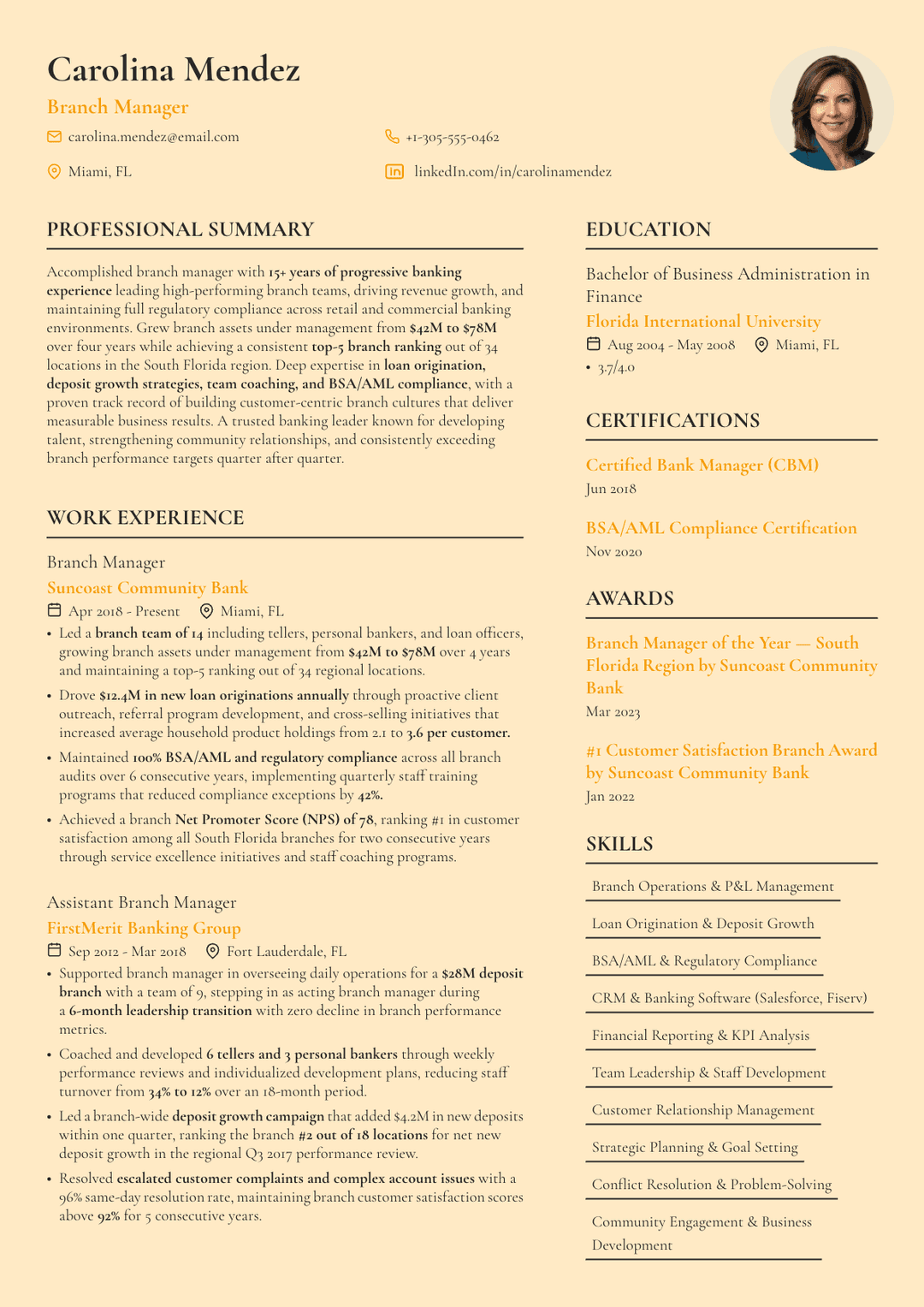
A banking resume is a job application document that mentions the most prominent skills, experience, qualifications, and achievements relevant to roles in the banking industry. With it, candidates show employers that they understand financial services, handle responsibilities with accuracy, and have the professional background for positions such as teller, banker, loan officer, or financial analyst.
Yet, most hiring managers and talent teams spend fewer than seven seconds on an initial resume scan. Without the right structure, relevant keywords, and specific achievements to emphasize, even strong candidates get filtered out, either by an applicant tracking system (ATS) before a human ever sees the document, or by a recruiter who simply moves on to the next file.
This guide walks you through exactly how to write a financial service resume that clears those ATS filters and gives hiring managers a reason to keep reading. Here, you'll find formatting advice, section-by-section guidance, role-specific examples, and practical tips; basically, everything you need to build a resume that actually works!
- A banking resume should be tailored to the financial services industry and highlight relevant skills, experience, certifications, and measurable achievements.
- The best banking resumes are ATS-friendly, use a clean reverse-chronological format, and avoid design elements that can confuse resume scanners.
- Strong work experience bullets should begin with action verbs and include numbers, percentages, or dollar amounts to show clear results.
- A complete banking resume should include contact information, a summary or objective, work history, education, skills, and certifications, with optional sections added only when relevant.
- To improve interview chances, candidates should customize each resume to the job description, keep it concise and error-free, and make sure LinkedIn matches the resume.
What Is a Banking Resume?
A banking resume is a professional document that presents your qualifications, experience, and skills specifically for roles within the financial services industry. It should feature finance-appropriate terminology, highlight regulatory knowledge and certifications, and ground every achievement in quantifiable metrics, as numbers speak loudly in a field built on precision.
It follows the same structural foundation as any professional resume (contact details, summary, work history, education, and skills), but the content is shaped by the expectations of banking recruiters and ATS systems used by financial institutions.
In other words, compliance language, specific field-related software proficiencies, and results framed in dollar values or percentage changes are what separate this type of resume from a generic document.
The term also covers a wide range of roles in the sector. Be it the role of a bank teller, personal banker, loan officer, financial analyst, branch manager, or compliance officer, the core principles of a strong banking resume remain consistent. Yet, the specifics, such as skills emphasized, certifications highlighted, or experience framed, shift depending on the position.
3 Professional Banking Resume Examples
Here are three role-specific examples to illustrate key differences in approach:
#1. Bank Teller Resume Example

#2. Investment Banking Resume Example

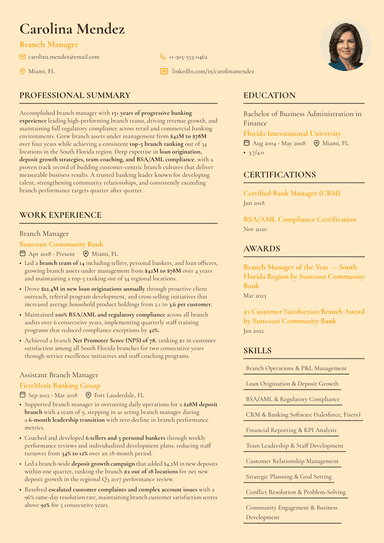
#3. Branch Manager Resume Example

Formatting a Banking Resume
Here are some tips that can help you start the resume writing process in the best way:
#1. Choose the Right Resume Format
For most banking candidates, the resume format of choice is reverse-chronological, with the most recent job listed first. It's the format recruiters expect, and the one ATS systems parse most reliably.
If, however, you're a career changer entering banking from another industry, or you have limited direct experience, a combination format can work well: it lets you stand out with a skills summary before presenting your work history.
Functional resumes (skills-only, no employment timeline) are generally not recommended in banking, where a verifiable track record matters.
#2. Set the Correct Length
When it comes to resume length, entry-level positions (bank teller, junior analyst, recent finance graduate) should target one page. On the other hand, senior roles like branch manager, VP of lending, or investment banking associate can justify two pages, but only if the second page carries its weight.
#3. Use an ATS-Friendly Design
You should avoid tables embedded within your resume content, graphics, text boxes, and anything placed in headers or footers since many ATS parsers skip those entirely. It’s recommended to stick to regular and clear section headings (Work Experience, Education, Skills) rather than creative alternatives.
#4. Pick a Professional Font and Layout
Stick to clean, universally supported typefaces; Arial, Calibri, or Garamond all work well for banking; additionally, you should keep body text at 10–12pt and maintain 1-inch margins. One consistent font throughout the document is the standard, while mixing typefaces makes a resume look unpolished.
What to Include in a Banking Resume: 7 Key Sections
Next, let’s see what sections you should include in your banking resume:
#1. Contact Information
Here, you should state your full name, phone number, email address (in the “firstname.lastname@domain.com” format, not a college nickname handle), city, and state. You don't need a full street address, a photo, or any other personal details.
It’s recommended to include your LinkedIn profile, too, but make sure it’s current and consistent with your resume; for fintech roles, a GitHub or portfolio link will do, too.
Here’s an example of a full contact information section:
Jessica Holloway
Dallas, TX
(214) 555-0187
jessica.holloway@email.com
linkedin.com/in/jessicaholloway123
#2. Resume Summary or Objective
A banking resume summary is a short statement at the top of your resume that gives hiring managers your professional identity at a glance. It should contain your title, years of experience, a standout achievement, and the value you would bring to a new team.
You should use a summary if you have two or more years of relevant banking experience. However, if you have less experience (if you're entry-level or making a career change into finance), it might be better to opt for a banking resume objective. Let’s see the difference; here’s a summary example:
Results-focused Investment Banking Analyst with 3+ years of experience at a mid-market M&A advisory firm. Built and maintained financial models for transactions totaling over $800M in deal value. Seeking to bring a rigorous, data-driven approach to a senior analyst position within a bulge-bracket environment.
And then there’s a resume objective example:
Detail-oriented recent graduate with a Bachelor's in Finance and 1 year of customer-facing banking experience. Eager to contribute strong cash handling accuracy and a 99.4% transaction error-free record to a high-volume retail branch environment.
#3. Work Experience
Next, there’s the work history section, which should contain a job title, company name, employment dates (month/year), and 3–5 bullet points with achievements for each role you held before. Every bullet should open with an action verb and close with a quantified result wherever possible, similar to this:
Work Experience
Senior Universal Banker
First Hatchins Bank, Dallas, TX
May 2021 – Present
- Managed daily branch transactions averaging $45,000+ in cash, checks, and deposits while maintaining 100% balancing accuracy on most monthly audits.
- Increased branch product referrals by 22% over 12 months by identifying customer needs and recommending appropriate banking solutions.
- Assisted customers with debit card disputes, online banking access, wire transfers, stop payments, and account maintenance requests.
- Verified documentation and processed account applications in compliance with KYC, CIP, AML, and bank policy requirements.
- Trained 4 new hires on branch procedures, teller operations, customer service standards, and compliance expectations.
Bank Teller
Comerica Bank, Irving, TX
January 2018 – April 2021
- Processed an average of 120+ customer transactions per day, including deposits, withdrawals, transfers, loan payments, and cashier’s checks.
- Promoted bank products such as savings accounts, overdraft protection, and credit cards, contributing to monthly referral goals in 9 consecutive quarters.
- Educated customers on mobile banking, online bill pay, and ATM services, reducing routine in-branch inquiries.
- Detected suspicious account activity and followed fraud prevention procedures to protect customer assets and reduce risk.
- Delivered professional front-line service in a high-volume environment while maintaining confidentiality and policy compliance.
#4. Education
This part of your resume should feature your highest degree, the institution that issued it, and graduation year, with finance, economics, accounting, and business degrees being the most relevant.
If your GPA was 3.5 or above, you should mention that, too, especially for entry-level and early-career roles. Fresh graduates can also list relevant coursework (Financial Modeling, Corporate Finance, Risk Management) to compensate for limited work experience.
You can do it like this:
Education
Bachelor of Business Administration in Finance
University of North Texas, Denton, TX
Graduated: 2016
- GPA: 3.5
#5. Banking Resume Skills Section
When listing your skills, it’s always best to divide them into hard and soft categories; recruiters scan this section quickly, so you should also keep it clean and relevant.
Let’s see what hard skills you should consider adding to your resume:
- Financial analysis and modeling (DCF, LBO, three-statement models)
- Credit evaluation and risk assessment
- Regulatory compliance: AML, KYC, BSA frameworks
- Bloomberg Terminal, Advanced Excel, SQL
- Loan processing and underwriting
- Investment research and portfolio analysis
Additionally, here are some soft skills that would complement the hard ones:
- Attention to detail (non-negotiable in a precision-driven field)
- Client relationship management
- Communication (written and verbal)
- Problem-solving under pressure
- Integrity and ethical judgment
Now, let’s check out an example of a well-formatted skills section:
Skills
Hard Skills
- Retail banking operations
- Cash handling and drawer balancing
- Account opening and maintenance
- Deposits, withdrawals, and transfers
- AML and KYC compliance
- Bank Secrecy Act (BSA) procedures
- Consumer banking products
- Fraud detection awareness
- Cross-selling and referrals
- Transaction reconciliation
- CRM and teller systems
- Online and mobile banking support
- Regulatory documentation review
Soft Skills
- Customer service
- Attention to detail
- Communication
- Time management
- Professional judgment
- Team collaboration
- Conflict resolution
- Adaptability
#6. Certifications and Licenses
Certifications are a genuine differentiator in banking. For many roles (especially in securities, compliance, and wealth management), they signal professional seriousness that a degree alone doesn't convey.
Key credentials in the field include CFA (Chartered Financial Analyst), Series 7 (General Securities Representative), Series 63, CPA, FRM, and CFP.
If you're pursuing a certification, list it as "In Progress" with an expected completion date — it still signals commitment. Otherwise, format each entry as: Certification Name | Issuing Organization | Year Obtained.
Here’s how:
Certifications
- Notary Public, State of Texas Secretary of State, 2023
- Anti-Money Laundering (AML) Training Certificate, American Bankers Association, 2024
- Bank Secrecy Act (BSA) Training, American Bankers Association, 2024
#7. Optional Sections
These aren't required, but they can add real value in the right context and may include:
- Languages (bilingual bankers are in strong demand in international and private banking)
- Volunteer experience (especially if it demonstrates financial literacy or leadership)
- Professional affiliations like CFA Institute membership or FINRA registration
- Publications or research for candidates targeting analytical or academic-adjacent roles
4 Expert Tips for Writing a Banking Resume
These habits separate the resumes that get interviews from the ones that get archived:
A generic resume is a polite rejection waiting to happen, so you should read each job posting carefully and mirror its language so that ATS can register the match.
Use the job title from the posting in your summary, and make sure you reference the specific type of banking (commercial, retail, investment) that the employer operates in. Five minutes of targeted customization could mean a lot when the competition is strong.
Every bullet should be able to answer the question: "So what?" Use percentages, dollar amounts, volume counts, and timeframes to give context and scale to your contributions. If exact figures are confidential, use ranges or approximations, as they still carry weight.
Typos on a resume are a significant red flag in a field where precision is the entire job. Proofread at least twice, use spell-check as a first pass (not a final one), and ask a second reader to review before you submit. A fresh pair of eyes catches things yours have learned to skip over.
Include your LinkedIn URL at the top of your resume and make sure that both tell a consistent story. Recruiters cross-reference them, and discrepancies in job titles, dates, or responsibilities are immediate red flags.
Final Thoughts
Writing a great banking resume isn't complicated, but it does require intention. It should be ATS-friendly, tailored to the specific role, grounded in quantified achievements, and formatted with the clean professionalism the industry
expects. Plus, every section should pull its weight, from a focused summary at the top to a certifications block that signals your commitment to the field.
If you're ready to build yours, ResumeBuilder.so's AI tools give you a professionally designed banking resume template, ATS-friendly formatting, and real-time suggestions, and all that without the blank-page frustration. You can also pair your new resume with a polished cover letter for applications that ask for one. This way, your chances of getting the job you want skyrocket!
Banking Resume FAQ
#1. What should I put on a banking resume?
A banking resume should include your contact information, a summary/objective, work experience with quantified results, education, a skills section, and a certifications block. It’s of utmost importance to tailor every section to the specific banking role you're targeting.
#2. How long should a banking resume be?
A banking resume should be one page long; it’s the standard for entry-level and early-career banking candidates. Two pages are acceptable for senior professionals with 10+ years of experience, but only if the additional content genuinely adds value.
#3. Do I need a cover letter for banking jobs?
Yes, you need a cover letter for banking jobs, especially for competitive roles in investment banking, compliance, or wealth management. This document gives you room to expand on your motivation, articulate why you're drawn to this specific institution, and highlight a key achievement that didn't fit neatly on the resume.
#4. Should I include a photo on my banking resume?
In the US, you shouldn’t include a photo on your banking resume since anti-discrimination norms make them unnecessary, and many hiring managers prefer not to see one. Yet, in some European countries, particularly Germany and Switzerland, a professional photo may be expected. When in doubt about the local convention, leave it out; your credentials should be doing the work.

Max Harper is the resume guru who actually makes job searching easier. With years of experience as a hiring manager, Max knows what makes a resume stand out in a pile of 200+ applications. From breaking down ATS myths to helping you craft bullet points that pop, Max shares easy-to-digest, no-BS resume advice.