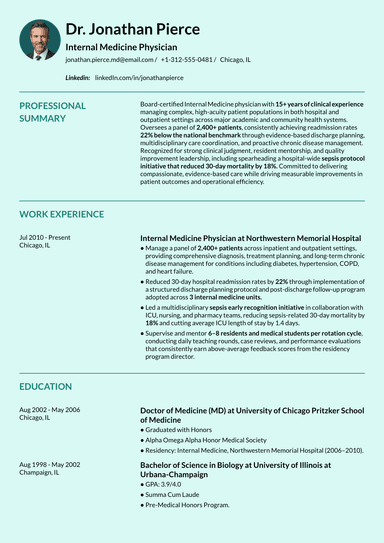
Doctor Resume: A Detailed Writing Guide + Real Examples
This complete guide with detailed explanations and expert tips will teach you how to write an acting resume in record time!
Edit this resume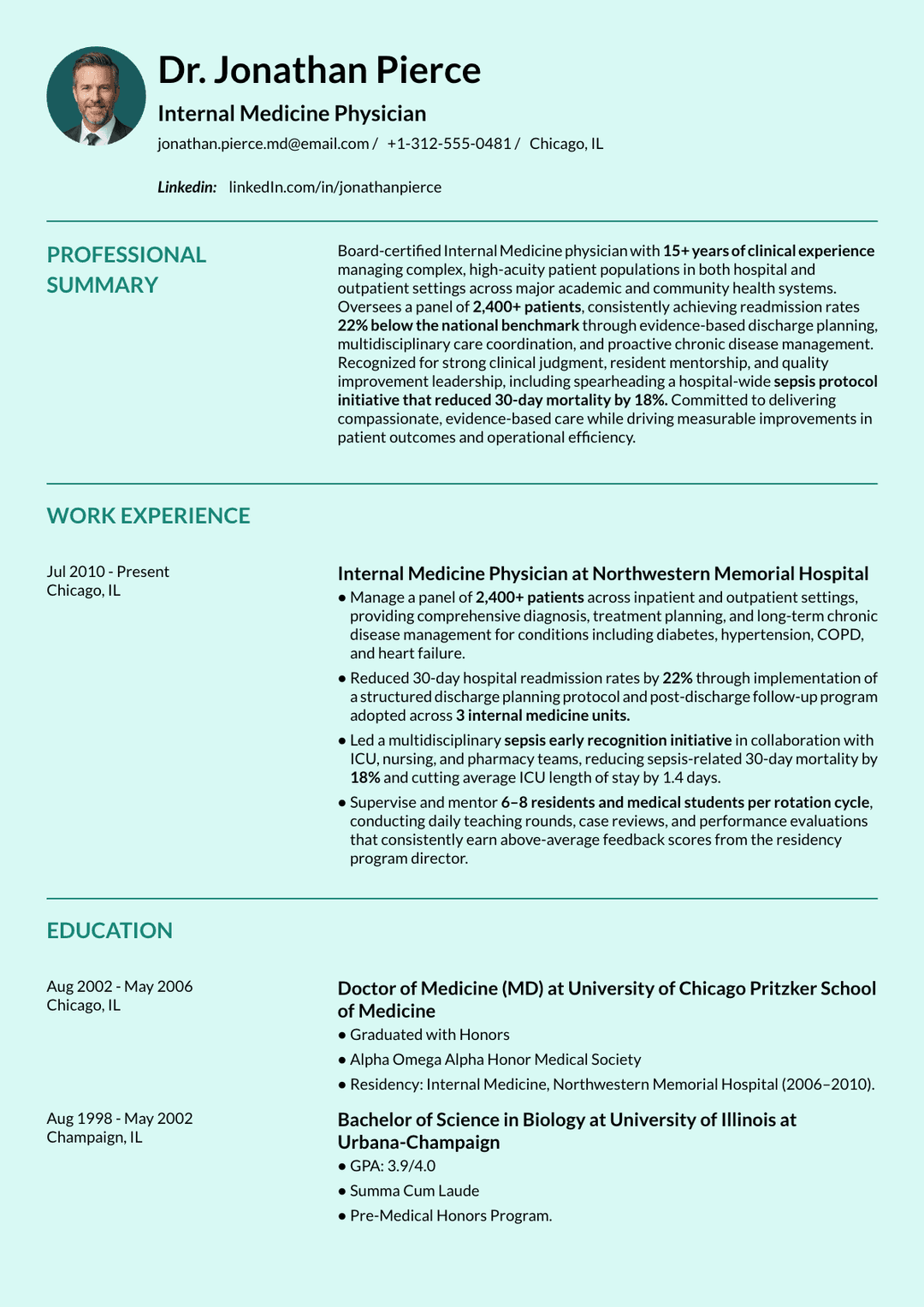
A doctor resume represents a structured snapshot of your clinical competence, decision-making ability, and professional credibility. Through it, employers assess how clearly you can present patient care experience, specializations, certifications, and your ability to operate under pressure, among other capabilities.
Today, we break down the process of organizing medical experience so it reads cleanly, explain which skills carry weight in hiring decisions, and show how to avoid missteps that can decrease your chances of getting hired. You’ll also get the gist of balancing technical detail with clarity and write a resume that will impress hiring managers, so read on!
- A doctor resume needs to clearly present clinical experience, certifications, and specialty expertise in a way that hiring committees can quickly assess.
- The reverse-chronological format is the standard because it highlights your most recent and relevant medical experience first.
- Key sections like licenses, board certification, and DEA registration are essential and must be easy to find, not buried.
- Strong resumes focus on measurable impact, using data like patient volume, outcomes, and efficiency improvements instead of vague duties.
- Tailoring your resume to each role and keeping it concise (one to two pages) significantly improves your chances of passing ATS filters and getting shortlisted.
What Is a Doctor Resume?
A doctor resume is a structured professional document that outlines a physician's clinical expertise, medical education, and skills to properly demonstrate a candidate’s qualifications. It's purpose-built to show hiring committees that you have the credentials, hands-on experience, and specialty knowledge the role requires, and that you can communicate all of that clearly.
Unlike a standard resume, a doctor resume goes well beyond job titles and responsibilities. Namely, recruiters and credentialing teams expect to see elements such as your board certification status, state medical license, DEA registration, relevant clinical sub-specialties, research contributions, CME hours, and more, depending on the position you’re after.
Some positions (particularly in academic medicine or clinical research) may require a full medical doctor CV instead of a resume, as you may need an open-ended record of every publication, presentation, and credential you've accumulated. Yet, for most clinical and hospital roles, though, a focused one- to two-page resume is what hiring managers want.
3 Doctor Resume Examples You Can Use as Inspiration
Now that we know what the essential components of a solid doctor resume are, let’s see what this document may look like in practice and for different roles:
#1. Experienced Medical Doctor (MD) Resume


#2. Attending Physician Resume


#3. Resident Physician Resume

How to Write a Doctor Resume: Best Practices
Writing a doctor resume well means more than listing credentials in order. Every section has to work together for your document to pass ATS filters, grab a recruiter's attention quickly, and ultimately persuade a hiring committee that you're the right fit.
Here's how to build each section the right way:
#1. Choose the Right Resume Format
Doctors should use the reverse-chronological resume format to present their previous roles because it highlights the most recent and relevant experience first. This is exactly what physician recruiters and hospital credentialing staff are interested in: your current or most recent position at the top of your work history, and then working backward.
This option is clean, fast to scan, and reliably ATS-friendly, so it’s no wonder it’s the default choice for most attending physicians, residents, and fellows.
On the other hand, the functional resume (which is organized around skill categories rather than chronology) can work for medical school graduates with limited direct clinical experience. It lets a candidate foreground relevant competencies they've built during rotations; however, for most practicing physicians, though, this resume format raises more questions than it answers.
#2. Disclose Your Contact Information in the Header
Firstly, you should craft a resume header that contains your basic contact details, which will allow recruiters to get in touch with you if they’re interested in interviewing you. This section should feature your full name, phone number, and a professional email address; you can also add your location (city and state are enough, no full address needed).
For medical roles, it can be useful to include your state medical license number if relevant, as well as a link to your American Medical Association profile or similar credential listing. A LinkedIn profile could work, too, but only if it’s properly maintained and consistent with your resume.
What matters is to keep the section minimal; details like date of birth, marital status, or a photo are unnecessary in the US and can make the resume look dated or unprofessional.
Here’s how to do it:
Dr. Marcus Bennett
(312) 555-7842
marcus.bennett.md@email.com
Chicago, IL
Illinois Medical License No: 036.145892
linkedin.com/in/marcusbennettmd
#3. Write a Compelling Resume Summary or Objective
A doctor resume summary consists of 2–3 sentences at the top of the resume that highlight your specialty, years of experience, and top clinical achievements. It acts as your elevator pitch since writing a good one is the best way to get noticed right off the bat and is the best choice for experienced physicians (3+ years out of residency).
However, new MDs, residents, and career changers are better served by a resume objective, which is quite similar to a summary but explains where you're headed rather than cataloging where you've been.
Whichever you opt for, make sure you tailor your summary to your specialty. The language that resonates with an emergency medicine physician differs significantly from that of a pediatrician or hospitalist. Meanwhile, generic summaries read as bland and they get treated that way.
An example of a good resume summary looks as follows:
Board-certified Internal Medicine physician with 8+ years of clinical experience in hospital and outpatient settings. Skilled in diagnosing and managing complex conditions, coordinating multidisciplinary care, and maintaining high standards of patient safety. Known for clear clinical judgment, efficient workflow management, and strong patient communication. Committed to evidence-based practice and continuous professional development.
#4. Detail Your Medical Work Experience
The work experience section on a physician resume should list clinical positions in reverse-chronological order, with bullet points highlighting patient volume, procedures performed, and measurable outcomes. Format each role consistently, following the “Job Title - Employer - Location - Dates” formula.
Furthermore, you should use strong action verbs to open each bullet and then pair them with specifics when possible. Residents and fellows could include clinical rotations here, as they count as real experience, and that time shouldn’t be unaccounted for.
Your work history could be presented this way:
Work Experience
Internal Medicine PhysicianScripps Memorial Hospital, San Diego, CAJune 2020 – Present
- Manage a panel of 2,000+ patients, providing preventive care, diagnosis, and long-term treatment plans
- Collaborate with specialists to coordinate care for patients with chronic and multi-system conditions
- Reduce hospital readmission rates by implementing improved discharge planning protocols
- Supervise residents and medical students during clinical rotations
- Maintain accurate and compliant electronic health records (EHR)
Resident Physician – Internal MedicineUCLA Medical Center, Los Angeles, CAJuly 2017 – May 2020
- Diagnosed and treated a wide range of acute and chronic conditions in high-volume clinical settings
- Conducted patient assessments, ordered diagnostic tests, and developed treatment plans
- Participated in ICU rotations, managing critically ill patients under supervision
- Presented case studies and contributed to departmental learning sessions
#5. List Your Medical Education
The education section on a doctor resume should feature your medical degree (MD or DO), the institution, graduation year, and any honors or distinctions (if applicable).
It’s best to order it the way the hiring committee expects: Medical school → Residency → Fellowship (if applicable). Your pre-med or undergraduate degree is secondary, and you shouldn’t lead with it; what matters is where you trained as a physician and in what specialty.
Include GPA only if it's genuinely strong, and if you graduated recently (within the past 3 to 4 years). For established physicians with meaningful clinical experience, this aspect is largely irrelevant.
An example looks like this:
Doctor of Medicine (MD)
University of California, San Francisco (UCSF)
2013 – 2017
Bachelor of Science in Biology
University of California, Berkeley
2009 – 2013
#6. Include Licenses, Certifications & Board Exams
Doctors must include their state medical license, DEA registration, and board certification status on their resume; these are non-negotiable requirements for most physician roles. Missing this part (or, worse, burying it at the bottom) is a fast way to get screened out.
Here's what belongs in this section:
- State medical license(s) (list every state where you hold an active license)
- DEA license number and expiration date
- USMLE/COMLEX scores (relevant for residents and recent graduates)
- Board certification status (verify through ABMS)
- BLS/ACLS/ATLS (whichever applies to your specialty)
- ECFMG certificate (required for international medical graduates)
Format each entry cleanly (Certification Name - Issuing Body - Expiration Date); don’t make recruiters hunt for this information.
Here’s what this part can look like:
- IL Medical License #36-123456 | Active through 2026
- DEA License #BC1234567 | Active through 2027
- Board Certified, ABIM Internal Medicine | 2015, Recertified 2025
- BLS, ACLS | Current
#7. Add a Doctor Resume Skills Section
A doctor resume skills section should include a mix of hard clinical skills, soft skills, and technical competencies relevant to your specialty and the role you are applying for. It also carries weight within the ATS since keyword matching happens here as much as anywhere else in the document.
Some hard skills you want to mention in your resume would be patient diagnosis, surgical procedures, specific EMR/EHR platforms, telemedicine, clinical research methodology, quality improvement frameworks, etc.
On the other hand, the soft skills you might benefit from are: communication, critical thinking, empathy, leadership, interdisciplinary collaboration, and similar. These aren't just filler; as a matter of fact, hospital systems hire for them actively, especially for attending and department lead roles.
Now, onto the example of the skill section:
Skills
Hard Skills
- Patient diagnosis and treatment planning
- Chronic disease management
- Electronic Health Records (EHR) systems
- Clinical documentation and reporting
- Preventive care and screenings
- Medical procedures (e.g., venipuncture, catheterization)
- Interpretation of lab results and imaging
- Evidence-based medicine application
Soft Skills
- Patient communication and empathy
- Critical thinking and clinical judgment
- Time management and prioritization
- Team collaboration in multidisciplinary settings
- Attention to detail
- Decision-making under pressure
- Adaptability in fast-paced environments
#8. Optional Sections You Can Add to Strengthen Your Doctor Resume
Once your core sections are solid, these additions can genuinely differentiate your application, especially for academic roles, research positions, or any setting where institutional culture or community ties matter:
- Publications & research: peer-reviewed articles in AMA or APA citation format
- Presentations & conferences: grand rounds talks, CME presentations, speaking engagements, and more
- Awards & honors: academic distinctions, hospital recognition programs, and departmental awards
- Languages: particularly valuable in underserved communities and multilingual clinical settings
- Volunteer/Global medicine: medical missions, free clinics, community health outreach, etc.
- Professional memberships: AMA, and specialty societies such as the ACC, ACS, AAP, or ACP. Membership in the AMA signals engagement with the profession beyond individual practice
5 Expert Tips for Writing a Doctor Resume
The following tips address the gaps that consistently show up in medical resumes and help you write a good one that increases the chances of landing an interview for your dream job:
Generic resumes rarely make it through ATS filters, and they rarely impress physician recruiters who review dozens of applications per week.
Because of this, you need to read each job description carefully and adjust your keywords, specialty emphasis, and skills section accordingly. A hospitalist role at a teaching hospital and an outpatient clinic position, for instance, call for different highlights, even if your underlying experience overlaps significantly.
For most clinical positions, a tight one- or two-page resume is the expected format. Reserve longer documents for academic appointments, research roles, or grant applications where a complete credential history is genuinely required.
If your resume is running long, trim older roles down to a line or two. Hiring managers care most about your last 5–7 years of experience; everything before that is just context.
Complicated graphics and unusual fonts frequently confuse ATS parsers. Having this in mind, it’s best to stick to standard section headings, a clear resume layout, and readable fonts like Calibri or Arial, and avoid images, tables, and other elements that don’t work well with ATS.
Numbers make your experience concrete in a way that general statements simply don't. So, whenever possible, mention specific ones when it comes to patient volume, procedure counts, satisfaction scores, readmission rates, efficiency metrics, and similar.
A single typo in a physician's resume can raise doubts that years of clinical experience won't quickly undo. To avoid this, run spellcheck, then read the entire document out loud; your ear may catch rhythm errors that your eyes miss. Additionally, have a colleague or mentor review the final version before you submit, since a fresh perspective catches the things you've stopped noticing.
Get a Head Start with Our Doctor Resume Template
Building your resume from a blank document doesn’t have to be the only option. To help you with the writing process, ResumeBuilder.so offers ATS-friendly resume templates designed for healthcare professionals that feature clean, well-structured layouts. This way, you can customize your job application to your specialty in minutes!
The builder walks you through each section, suggests relevant clinical skills, and lets you download your completed resume in PDF or Word format. Additionally, you can also explore our resume examples and compare specialty-specific formats, as well as understand what makes a physician resume visually compelling and what makes it look dated.
Final Thoughts
A strong doctor resume communicates three things clearly: your specialty, your clinical experience, and the measurable impact you've had as a physician. If you get those right, along with clean formatting and ATS-friendly structure, you're well ahead of most applicants.
The job market context matters here, too. According to the U.S. Bureau of Labor Statistics, physician employment is projected to grow steadily through the coming decade. That's good news for doctors, but it also means more competition for the most sought-after positions, so a polished, targeted resume is how you increase your chances of making the shortlist!
Doctor Resume FAQ
#1. What should a doctor put on a resume?
A doctor should include a resume summary, clinical work experience, medical education, licenses and certifications, key skills, and optional sections like publications or professional memberships on a resume. Every section should be tailored to the specific role and institution.
#2. How long should a doctor resume be?
A doctor resume should be one to two pages long for most clinical positions. Academic physicians and researchers applying for faculty appointments or grant positions may use a CV format instead of a traditional resume, but for the majority of hospital, outpatient, and telehealth roles, shorter is better.
#3. What is the difference between a doctor resume and a doctor CV?
A doctor resume is a concise one-page document tailored for a specific role, while a doctor CV (curriculum vitae) is a comprehensive record of all academic, research, and clinical achievements with no page limit. In the U.S., most physician job applications call for a resume; CV requirements are more common in academic medicine and international settings.
#4. Do doctors need a cover letter?
Yes, doctors may need a cover letter that explains their specialty focus, motivation for the role, and key qualifications. A well-written document like this complements the resume and gives hiring committees a sense of your communication style before they've met you.

Max Harper is the resume guru who actually makes job searching easier. With years of experience as a hiring manager, Max knows what makes a resume stand out in a pile of 200+ applications. From breaking down ATS myths to helping you craft bullet points that pop, Max shares easy-to-digest, no-BS resume advice.