Programmer Resume: Examples and Writing Guide for 2026
This complete guide with detailed explanations and expert tips will teach you how to write an acting resume in record time!
Edit this resume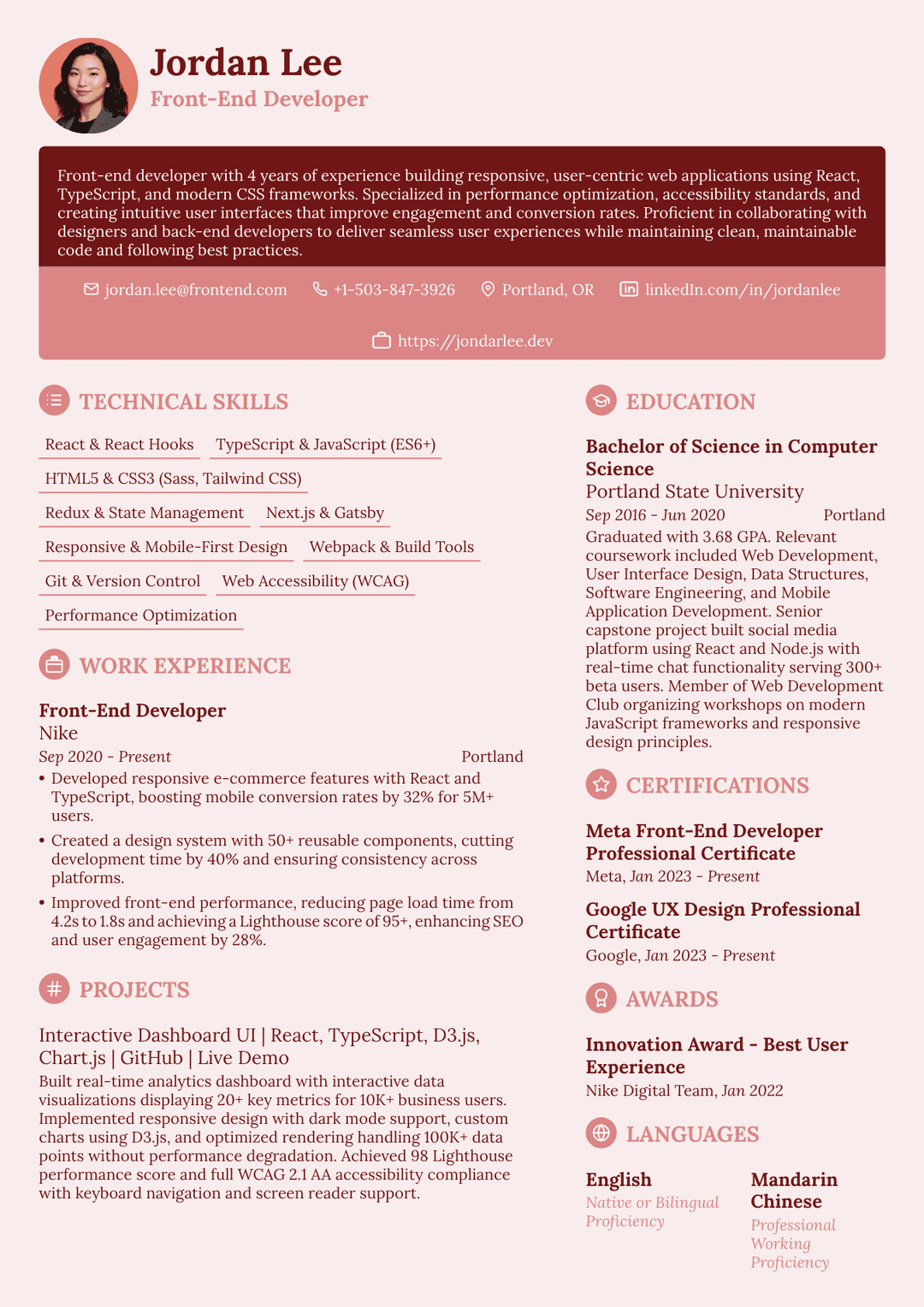
A programmer's resume is a document that summarizes technical skills, coding experience, projects, and achievements. Its main purpose is to show potential employers that you can write clean code, solve problems, and contribute to real products or systems. Given that recruiters and applicant tracking systems scan resumes quickly, if your resume is hard to read or too vague, it may be easily rejected.
To avoid this, we will show you how to write a programmer resume for 2026 that is easy to understand, ATS-friendly, and effective at getting interviews. You’ll learn how to highlight the programming languages you use, the projects you’ve completed, and the impact of your work. Let’s dive in!
- Programmer resumes prioritize technical skills and quantifiable achievements over soft skills, with portfolio integration through GitHub and live projects validating your coding abilities.
- Action verbs and metrics in work experience bullets demonstrate impact—highlight deployment improvements, performance optimizations, user scale, and cost reductions with specific numbers.
- ATS compatibility requires standard fonts, single-column layouts, conventional section headings, and avoiding tables, graphics, or special characters that confuse parsing algorithms.
- List only technologies you're genuinely proficient in and can discuss confidently during interviews; showcase 3-4 substantial projects with GitHub links and live demos.
- Tailor your resume for each application by adjusting keywords, emphasizing relevant technologies, and aligning experience with specific job requirements to increase interview invitations.
What Makes a Programmer Resume Different?
A programmer resume differs from traditional resumes because it must showcase both technical expertise and problem-solving capabilities in a format that passes Applicant Tracking Systems (ATS) and impresses human recruiters. That said, here are some key differentiators:
- Technical skills take center stage. While conventional resumes emphasize soft skills, programmer resumes prioritize hard, technical skills. Your proficiency in programming languages, frameworks, and development tools needs prominent placement—these are the keywords that get you noticed.
- Quantifiable achievements matter more. Your resume should demonstrate value through quantifiable achievements rather than generic responsibilities. Metrics like reducing load times by 40%, optimizing code efficiency by 30%, or deploying applications serving 100,000+ users provide concrete evidence of your contributions.
- Portfolio integration is essential. Programmers must go beyond listing experience by including a resume portfolio, such as GitHub repositories, live project links, or contributions to open-source projects. These tangible demonstrations of your work validate your technical claims and give employers immediate insight into your coding style and capabilities.
Given that the U.S. Bureau of Labor Statistics projects the overall employment for software developers to grow 15% over the next decade—much faster than average—your resume must efficiently communicate why you're the solution to employers' technical challenges through project-based experience and measurable impact.
Programmer Resume Examples by Experience Level and Role
Now that you know what makes a programmer resume different, let’s see a few different resume examples that you can use for inspiration in writing a resume on your own.
Junior Programmer Resume Example

Mid-Level Programmer Resume Example

Senior Programmer Resume Example

Lead / Principal Programmer Resume Example

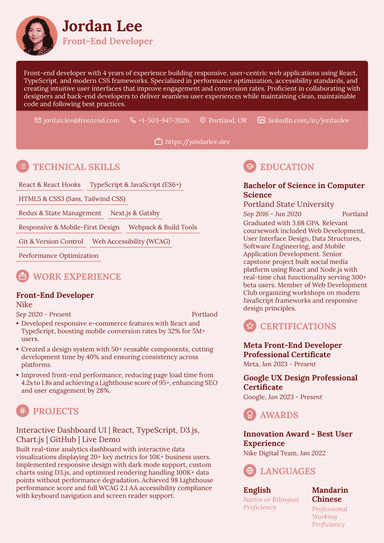
Front-End Developer Resume Example

Back-End Developer Resume Example

Full-Stack Developer Resume Example

How to Write a Programmer Resume: Essential Sections Explained
Writing a programmer resume means understanding which sections are mandatory and which ones actually help you stand out. Let's break down each section and what recruiters expect to see.
#1. Contact Information and Professional Links
Your resume header should be clean, scannable, and include the following information:
- Full name
- Phone number
- Professional email address (firstname.lastname@mail.com works)
- City and state
- GitHub profile URL
- LinkedIn profile
- Personal website or portfolio (if you have one)
- Stack Overflow profile (if you're active there)
Here’s how that might look in practice:
Michael Thompson
Austin, TX
(512) 555-0194
michael.thompson@email.com
GitHub: github.com/mthompsondev
LinkedIn: linkedin.com/in/michaelthompsondev
Portfolio: mthompson.dev
Stack Overflow: stackoverflow.com/users/8453921/michael-thompson
Your contact info should sit at the top in plain text, not tucked away in some creative sidebar that confuses ATS systems. Also, make sure all your links work before you send your resume.
#2. Professional Summary or Objective
You've got about 7.4 seconds to hook a recruiter, so your professional summary needs to pack a punch in 3-4 sentences that showcase who you are and what you bring to the table.
If you’re an experienced programmer, write a resume summary highlighting your years in the field, your specializations, and your biggest wins. Something like:
Full-stack developer with 6 years building scalable web applications using React and Node.js. Led development of e-commerce platform serving 100K+ daily users, improving checkout conversion by 34%. Specialize in performance optimization and clean, maintainable code architecture.
On the other hand, if you’re an entry-level developer or career changer, you should use a resume objective. Focus on your skills, relevant projects, and what you're looking to achieve:
Recent bootcamp graduate with a passion for building intuitive front-end experiences. Completed 5 full-stack projects including a task management app with 500+ GitHub stars. Seeking junior developer role to contribute JavaScript and React skills while learning from experienced engineers.
#3. Skills Section
This section separates programmer resumes from everyone else's—and it's where you need to be honest. Recruiters will test your claimed skills and qualifications during interviews, so inflating your abilities backfires spectacularly.
Organize your technical skills by category for maximum readability:
- Programming Languages: Python, Java, JavaScript, TypeScript, C++, Ruby
- Frameworks & Libraries: React, Vue.js, Angular, Django, Flask, Spring Boot, Node.js, Express
- Tools & Platforms: Git, Docker, Kubernetes, Jenkins, AWS, Azure, Google Cloud Platform
- Databases: PostgreSQL, MySQL, MongoDB, Redis, DynamoDB
- Other: RESTful APIs, GraphQL, Agile/Scrum, CI/CD, Test-Driven Development
Consider adding proficiency levels if you're comfortable with it—"Expert," "Proficient," "Familiar"—but only if you're honest about what those mean. Also, include technologies you're currently learning, especially if they appear in job descriptions you're targeting. Just label them clearly: "Currently learning: Rust, Go, TensorFlow."
#4. Professional Experience
Your work experience section needs to tell the story of what you've built, the problems you've solved, and the impact you've made—not just where you've clocked in.
Format each position consistently, including:
- Position/job title
- Company name and address
- Date of employment
Then add 3-5 achievements as bullet points, using action verbs and metrics wherever possible. Here’s a good example:
Senior Software Engineer
TechCorp, San Francisco, CA
June 2020 – Present
- Architected microservices infrastructure using Docker and Kubernetes, reducing deployment time from 2 hours to 15 minutes
- Developed RESTful APIs serving 2M+ requests daily with 99.9% uptime
- Implemented automated testing framework that caught 85% of bugs before production
- Mentored 3 junior developers, improving team code quality scores by 40%
- Optimized database queries, improving page load times by 60% and reducing server costs by $12K annually
If you’re a career changer or bootcamp grad, emphasize the technical projects you completed and any freelance or internship work. The experience doesn't need to be traditional employment—contributing to open source, building client websites, or completing substantial bootcamp projects all count.
#5. Projects
If you're entry-level, fresh from a bootcamp, or self-taught, your projects section might matter more than your work experience. Even experienced developers benefit from showcasing side projects that demonstrate passion and initiative beyond their day job.
Include 3-4 significant projects where you solved real problems, worked with complex data, or built something users actually use. Also, open-source contributions count. If you've contributed pull requests to established projects, mention them. Even fixing documentation or small bugs shows you can collaborate, read existing codebases, and follow contribution guidelines.
Now let’s see how you might list projects on your programmer resume:
E-Commerce Platform | React, Node.js, PostgreSQL | GitHubBuilt full-stack online store with a shopping cart, payment processing via Stripe, and an admin dashboard. Implemented JWT authentication and responsive design. Deployed on AWS with an automated CI/CD pipeline.
Weather Forecast App | Python, Django, REST APIs | Live DemoIntegrated OpenWeather API to provide 7-day forecasts with location search. Implemented caching to reduce API calls by 75%. Mobile-responsive design with dark mode support.
#6. Education
Where you place your education depends on where you are in your career. Recent grads should put this near the top; experienced developers can tuck it toward the bottom.
Here’s how you can list your education on a resume:
B.S. in Computer Science
University of Technology, Graduated May 2023
GPA: 3.8/4.0
Relevant coursework: Data Structures, Algorithms, Database Systems, Machine Learning
Self-taught programmers shouldn't stress about the lack of formal education. Your projects, GitHub contributions, and demonstrable skills matter more than a degree. Just be ready to talk about how you learned and what resources you used.
#7. Certifications and Additional Sections
Technical certifications carry weight in the programming world, especially for cloud platforms and specialized technologies.
Cloud Certifications:
- AWS Certified Solutions Architect
- Google Cloud Professional Cloud Architect
- Microsoft Azure Developer Associate
Programming Certifications:
- Oracle Certified Professional, Java SE Programmer
- Python Institute PCEP/PCAP
- MongoDB Certified Developer
Security Certifications:
- CompTIA Security+
- Certified Ethical Hacker (CEH)
Here’s how you can format your certifications:
Full-Stack Web Development Certificate
Coding Bootcamp, Completed December 2023
Technologies: JavaScript, React, Node.js, MongoDB, Express
To strengthen your programmer resume, you can include other optional sections, such as:
- Publications. If you've written technical blog posts, contributed to documentation, or published research, mention it.
- Conference presentations. Speaking at meetups, conferences, or hackathons shows leadership and expertise.
- Hackathon wins. Placing in competitive programming events demonstrates problem-solving under pressure.
- Technical blog. Link to a Medium, Dev.to, or personal blog where you write about programming concepts.
- Awards and recognition. Employee of the month, team awards, scholarship recognitions—anything that validates your work.
- Professional memberships. IEEE, ACM, or other relevant professional organizations.
However, don't force sections you don't have. If you've never attended a conference or written a blog post, skip those.
How to Format Your Programmer Resume
Resume format matters more than you think. A well-written programmer resume becomes worthless if the ATS can't read it or the design makes recruiters' eyes glaze over. Here’s what to watch out for:
- Formatting. Use standard fonts like Arial, Calibri, or Helvetica in 10-12 point sizes. Stick with black text on a white background unless you're applying to a design-heavy role where a subtle color accent makes sense.
- Resume length. Entry-level programmers with less than 5 years of experience should stick to one page. Senior developers with extensive project histories can expand to two pages—but only if every line adds value.
- ATS compatibility. Avoid tables and text boxes (they confuse parsing algorithms), headers and footers containing critical information, graphics, images, photos, or logos, unusual fonts or special characters, and multiple columns (stick to single-column layouts). Also, use standard section headings that ATS systems recognize: "Work Experience," "Education," "Skills," "Technical Skills," "Projects."
- White space. Leave adequate margins (at least 0.5 inches, preferably 1 inch), use line spacing of 1.15 or 1.5, and add space between sections.
- File format. Most companies accept PDFs, which preserve your formatting across different systems. Some specifically request Word documents (.docx). When in doubt, submit both formats if the application allows it, or default to PDF.
5 Common Programmer Resume Mistakes to Avoid
Even experienced developers make resume mistakes that tank their chances. Here are the five biggest errors and how to fix them:
| Mistake | Why It's a Problem | How to Fix It |
|---|---|---|
Listing Every Technology You've Ever Touched | Makes you look unfocused or dishonest; recruiters will test your claimed skills | Focus on technologies you're genuinely proficient in; create separate "Currently Learning" section for newer skills |
Generic Job Descriptions Without Metrics | Tells recruiters nothing about your actual impact or capabilities | Include specific numbers, scale, improvements, and technologies used |
Ignoring ATS Optimization | Your resume gets rejected before human eyes see it | Use standard technology names, spell out acronyms, use conventional section headings, avoid fancy graphics/tables |
No GitHub or Portfolio Links | Raises red flags about your actual coding ability and passion | Include active GitHub with well-documented projects and regular commits; add live portfolio demos for front-end/full-stack roles |
Outdated or Irrelevant Experience | Wastes valuable resume space on technologies and roles that don't matter in 2026 | Focus on recent, relevant technologies; briefly summarize old non-programming work |
Build Your ATS-Optimized Programmer Resume in Minutes
ResumeBuilder.so eliminates the technical friction of resume creation. Our resume builder lets you add projects, GitHub links, and technology stacks with automatic clean formatting.
Complete a polished resume in under 45 minutes with our ATS-optimized resume templates instead of spending hours debugging Word documents.
Need a cover letter as well? Our cover letter builder matches your resume design and helps you explain what excites you about the role and company culture.
Final Thoughts
Writing a good programmer resume comes down to showcasing technical skills clearly, proving impact with quantifiable achievements, and passing ATS gatekeepers. Your GitHub profile and portfolio often matter more than work history—code speaks louder than descriptions.
Tailor each application by adjusting keywords and emphasizing relevant technologies, and keep your resume current as the programming landscape evolves. Also, to maximize your chances, pair your resume with a compelling cover letter explaining your passion for the technology.
Programmer Resume FAQs
#1. Should I include all programming languages I know on my resume?
Only include programming languages you're proficient in and can confidently discuss in an interview. Group them by proficiency level (Expert, Proficient, Familiar) to set clear expectations. Quality and honesty matter more than listing every language you've briefly encountered.
#2. Do I need a cover letter with my programmer resume?
While not always required, a cover letter helps you stand out, especially when explaining career transitions, gaps in employment, or specific interest in a company. Use it to showcase your passion for technology and explain why you're a great cultural and technical fit.
#3. How do I make my programmer resume ATS-friendly?
Use standard formatting without tables or text boxes, include exact technology names from job descriptions, use conventional section headings, and save as PDF or .docx. Avoid graphics, images, or unusual fonts that applicant tracking systems cannot parse correctly. Test your resume through ATS checkers before submitting to catch formatting problems and missing keywords.
#4. Should I include my GitHub profile on my resume?
Absolutely. Your GitHub profile is essential for demonstrating coding ability, showing active learning, and providing proof of your skills. Include it prominently in your contact information section. Ensure your GitHub has well-documented projects and regular activity before linking it.
#5. What's the best resume format for programmers?
The reverse-chronological format works best for most programmers, showcasing your most recent and relevant experience first. However, career changers or bootcamp graduates may benefit from a combination format that emphasizes skills and projects over traditional work history.
#6. Should I include soft skills on my programmer resume?
You should include soft skills on your programmer resume, but integrate them naturally into your experience descriptions rather than listing them separately. Show how you collaborated with teams, communicated technical concepts to non-technical stakeholders, or led projects.
#7. How often should I update my programmer resume?
Update your programmer resume whenever you complete a significant project, learn a new technology, earn a certification, or change roles. At a minimum, review and refresh it quarterly to ensure all information is current and reflects your latest technical skills and achievements. The tech industry moves fast—your resume should reflect that you're keeping pace.
#8. Do I need to include my GPA on a programmer resume?
Include your GPA only if you're a recent graduate (within 2-3 years) and it's above 3.5. For experienced developers, your professional accomplishments and project portfolio matter more than academic performance.
#9. How do I explain coding bootcamp experience on my resume?
List your coding bootcamp in the education section with the program name, institution, completion date, and technologies learned. Emphasize projects completed during the bootcamp in your projects section, and highlight any relevant pre-bootcamp experience that demonstrates your commitment to programming.

Emily Foster knows how nerve-wracking it can be to land your first job—she’s been there. As a mentor for young professionals, she shares exactly what hiring managers want from entry-level candidates. From internship hacks to interview confidence tips, Emily helps students and recent grads navigate the job search with ease.