CV vs. Resume: Main Differences and When to Use Each One

The main CV vs. resume difference is that the former is a comprehensive, detailed record of your entire professional life, while the latter is a short, targeted snapshot tailored to a specific role. One focuses on depth, the other on relevance, and knowing which to use can make or break your job application.
In this guide, you’ll get a clear breakdown of when to use a CV and when a resume is the better choice, how their formats differ, and what employers expect in each case. You'll also learn what mistakes you should avoid when writing any of these and how their meanings change depending on the geographic area.
- A CV is a comprehensive, multi-page record of your entire academic and professional history, while a resume is a concise, targeted summary tailored to a specific job.
- CVs emphasize academic achievements, research output, and complete career documentation, whereas resumes highlight relevant accomplishments, results, and skills.
- Geographic norms influence which document to use: the US and Canada prefer resumes, while the UK, Europe, and many global markets commonly use CVs.
- CVs and resumes differ in length, content focus, and industry expectations, with academic and medical fields relying on CVs and business sectors preferring resumes.
- Common pitfalls include cluttered, outdated, or poorly organized CVs, as well as overly long, generic, or weakly written resumes that lack quantified results.
What Is a CV?
A CV, short for curriculum vitae (Latin for "course of life"), is a comprehensive job application document that details your complete academic and professional history. Unlike resumes, CVs don't have strict length limitations; they expand as your career grows, often reaching 5-15 pages for experienced professionals.
CVs are fundamentally different from resumes because they're designed to showcase depth rather than relevance. Every research project, publication, conference presentation, teaching experience, and academic achievement gets documented. This comprehensive approach makes sense in academic and research contexts where your complete body of work matters more than fitting everything onto two pages.
The academic focus of CVs means they emphasize educational background, research experience, publications, grants, fellowships, and teaching positions. Professional experience is included, but it's often secondary to academic achievements. This priority system reflects the values of academic and research institutions where scholarly output drives career advancement.
Finally, CVs are most commonly used in academic settings, research positions, medical fields, and international job markets. If you're applying for a professorship, research position, or medical residency, hiring committees expect to see your complete academic journey documented in CV format.
The components of a proper CV should include the following:
- Personal information and contact details form the foundation of your CV, typically including your full name, professional address, phone number, email, and sometimes your professional website or LinkedIn profile. In some countries, CVs may also include personal details like date of birth or nationality, though this varies by location and legal requirements.
- Academic qualifications and education receive prominent placement and detailed treatment. You'll list all degrees chronologically, including institution names, degree types, graduation dates, thesis titles, dissertation topics, and relevant coursework. Also, graduate-level education often includes advisor names and research focus areas.
- Research experience and publications represent the heart of most academic CVs. This section documents your scholarly contributions through peer-reviewed publications, conference presentations, research projects, grants received, and ongoing research initiatives. Each publication typically includes full citation information and your role in collaborative work.
- Professional experience covers both academic and non-academic positions, with emphasis on roles that demonstrate relevant skills and expertise. Teaching experience, administrative positions, consulting work, and industry experience all contribute to this comprehensive career overview.
- Skills and competencies encompass technical abilities, language proficiencies, specialized software knowledge, and research methodologies. Academic CVs often include laboratory techniques, analytical methods, and field-specific competencies that demonstrate your capability to contribute to research and teaching environments.
What Is a Resume?
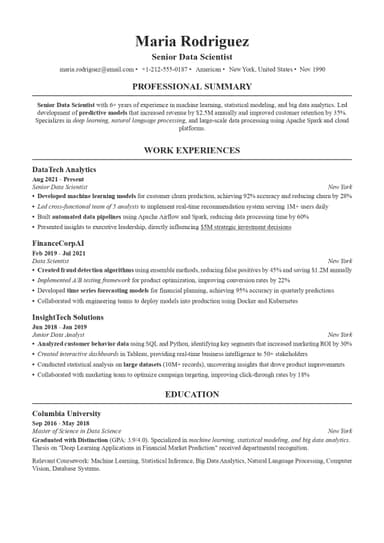
A resume is a targeted marketing document that presents your most relevant qualifications for a specific position. The word "resume" comes from the French résumé, meaning "summary", and that's exactly what it is: a strategic summary designed to get you an interview, not tell your life story.
Resumes operate under strict length constraints because they're designed for busy hiring managers who might spend only a few seconds on initial review. This time pressure means every word needs to earn its place on the page; you're not documenting everything you've done; you're curating the most compelling evidence that you can succeed in the target role.
The professional focus of resumes means they emphasize achievements, results, and skills that directly relate to the job you're seeking. Instead of listing every position you've held, you strategically select experiences that demonstrate your ability to deliver results in similar roles. This targeted approach makes resumes powerful tools for career advancement and industry transitions.
Resumes are preferred in most US and Canadian business environments, including corporate, technology, marketing, sales, and entrepreneurial sectors. They're also becoming more common globally as international companies adopt American hiring practices.
The key components a resume should contain are:
- Contact information. This section stays clean and professional—your name, phone number, professional email address, city and state, and LinkedIn profile. Skip outdated elements like full addresses, references, or personal photos unless specifically required by the employer or geographic region.
- Resume summary or objective. Both provide a 2-4 line snapshot of your value proposition. Modern resumes favor summaries over objectives because they focus on what you can deliver rather than what you want from the position. This section should immediately communicate why you're qualified for the specific role.
- Work experience. It forms the core of most resumes, typically organized in reverse chronological order. Each position includes company name, job title, employment dates, and 3-5 bullet points highlighting quantified achievements rather than job duties.
- Education. This part covers your formal qualifications, usually listed after work experience, unless you're a recent graduate. Include degree type, institution, graduation date, and relevant honors or achievements. For experienced professionals, this section can be quite brief unless educational credentials are particularly relevant to the target role.
- Skills encompass both technical and soft skills relevant to your target position. Many modern resumes organize skills by category (Technical Skills, Languages, Certifications) to improve readability and ATS compatibility. Avoid rating your skills with stars or percentages, as these systems don't translate well across different contexts.
- Additional relevant sections might include certifications, volunteer work, professional associations, or projects, depending on your industry and career level. Each additional section should directly support your candidacy for the target role.
CV vs. Resume: Key Differences Breakdown
The differences between CVs and resumes represent fundamentally different approaches to presenting your professional story. Let’s see what they are:
CV vs. Resume: Length Requirements
CV length allows for 2-10+ pages depending on your career stage and accomplishments. Entry-level academic CVs might span 2-3 pages, while senior researchers often maintain 8-15-page documents. There's no artificial length constraint because the goal is comprehensive documentation rather than a concise summary.
Academic careers accumulate content over time, so each publication, grant, conference presentation, and teaching assignment adds to your CV. A professor with 20 years of experience might have dozens of publications, hundreds of conference presentations, and extensive teaching records that require substantial documentation space.
Meanwhile, resume length constraints demand 1-2 pages maximum, regardless of your experience level. This limitation forces prioritization and strategic thinking about which experiences best demonstrate your qualifications. Here, for example, senior executives with 20+ years of experience still need to condense their achievements into 1-2 pages of the most relevant, impactful content.
The length constraint makes resumes more challenging to write than CVs. Anyone can list everything they've done; it takes skill to identify and articulate the most compelling evidence of your capabilities within strict space limitations.
CV vs. Resume: Content Focus
Academic achievements versus professional accomplishments represent the core philosophical difference between these formats. CVs celebrate scholarly contributions; your research advances the field, your publications contribute to knowledge, and your academic service builds institutions. Success metrics include citation counts, research funding, and peer recognition.
On the other hand, research versus results orientation shapes how you describe your work. CV descriptions might focus on methodology, theoretical frameworks, and contributions to academic knowledge. Resume descriptions emphasize business impact, quantified results, and practical outcomes that deliver value to employers.
So, in conclusion, CVs value comprehensive documentation of your intellectual journey, while resumes value strategic presentation of your professional capabilities. This difference affects everything from section organization to the language you use to describe your work.
CV vs. Resume: Geographic Preferences
The US and Canada resume preference dominates across almost all industries except academia, research, and medicine. American hiring culture values efficiency and results-oriented communication, which aligns perfectly with the resume format.
Canadian practices closely mirror American standards, with resumes being the default for business, technology, government, and most other sectors. The only major exceptions involve academic positions at universities and research institutions.
However, the UK and Europe CV preference reflects different cultural approaches to professional documentation. European hiring practices often involve more detailed application processes, and CVs provide the comprehensive information that fits this cultural context. Even business positions in the UK typically request CVs rather than resumes.
European CVs may also include personal information that would be inappropriate, or illegal (in terms of discrimination) on US resumes, such as date of birth, marital status, or nationality. These cultural differences make geographic awareness crucial when choosing your format.
CV vs. Resume: Industry Standards
Academic and research fields prefer CVs because comprehensive documentation serves their hiring needs. When evaluating candidates for research positions, hiring committees need to assess:
- Publication records and citation impact
- Grant funding history and research methodology experience
- Teaching capabilities and student mentoring experience
- Collaborative research projects and institutional service
- Conference presentations and professional recognition
Meanwhile, the medical field uses CVs to document:
- Extensive education
- Residency training
- Board certifications
- Continuing education
- Research contributions
- Clinical experience
Finally, business, technology, marketing, and corporate sectors prefer resumes because they value efficiency and results-oriented communication. These industries move quickly, and hiring managers need to assess candidate fit rapidly. Additionally, the resume format provides focused, relevant information that supports fast decision-making processes.
Common Mistakes to Avoid When Writing a CV or a Resume
Knowing what some common CV and resume mistakes are can help you avoid application pitfalls that could eliminate your candidacy before your qualifications receive proper consideration.
Common CV errors that can derail academic applications include:
- Including irrelevant personal information that distracts from professional qualifications or creates legal complications
- Poor organization of academic achievements that makes CVs difficult to navigate and obscures impressive qualifications
- Neglecting to update publications and research activities regularly, resulting in outdated documentation
- Inconsistent formatting across sections that creates an unprofessional presentation
- Missing critical academic components like complete citation information or research methodology details
Critical resume errors that eliminate candidates include:
- Exceeding length limits that signal poor business communication or an inability to prioritize information effectively
- Including outdated information about obsolete technologies, irrelevant early career positions, or expired certifications
- Generic objective statements that waste prime real estate without providing useful value propositions
- Poor ATS optimization that prevents resume parsing and keyword recognition
- Weak achievement descriptions that focus on duties rather than quantified results and business impact
Use ResumeBuilder.so for a Rock-Solid CV or Resume
Creating professional CVs and resumes becomes significantly easier with ResumeBuilder.so. Rather than starting from scratch, you can leverage our proven examples for inspiration.
Aside from this, our resume builder offers some valuable AI help! ResumeBuilder.so guides you through the entire creation process and lets you pick a suitable template for your CV or resume. This eliminates the technical complexity of document creation while ensuring professional results.
Final Thoughts
Choosing between CV and resume format ultimately comes down to understanding your target audience and their expectations. Geographic location, industry culture, and role requirements determine which format will serve you best, and using the wrong one can eliminate your candidacy regardless of your qualifications.
Both formats can effectively showcase your qualifications when used appropriately. CVs excel at documenting comprehensive academic and research achievements, while resumes efficiently communicate professional value and business impact. Neither format is inherently superior; they're tools designed for different purposes and audiences, and all you should do is choose strategically based on your career goals, target opportunities, and market requirements.
CV vs Resume FAQ

Daniel Carter is the salary negotiation coach you wish you had before accepting that lowball job offer. With years of HR experience, he knows all the employer tactics—and how to counter them. His posts break down negotiation strategies, industry salary trends, and scripts you can actually use in real conversations.