Architecture Cover Letter: Examples + Writing Guide for 2026
This complete guide with expert tips and real examples will teach you how to write a compelling cover letter — fast and stress-free!
Edit this cover letter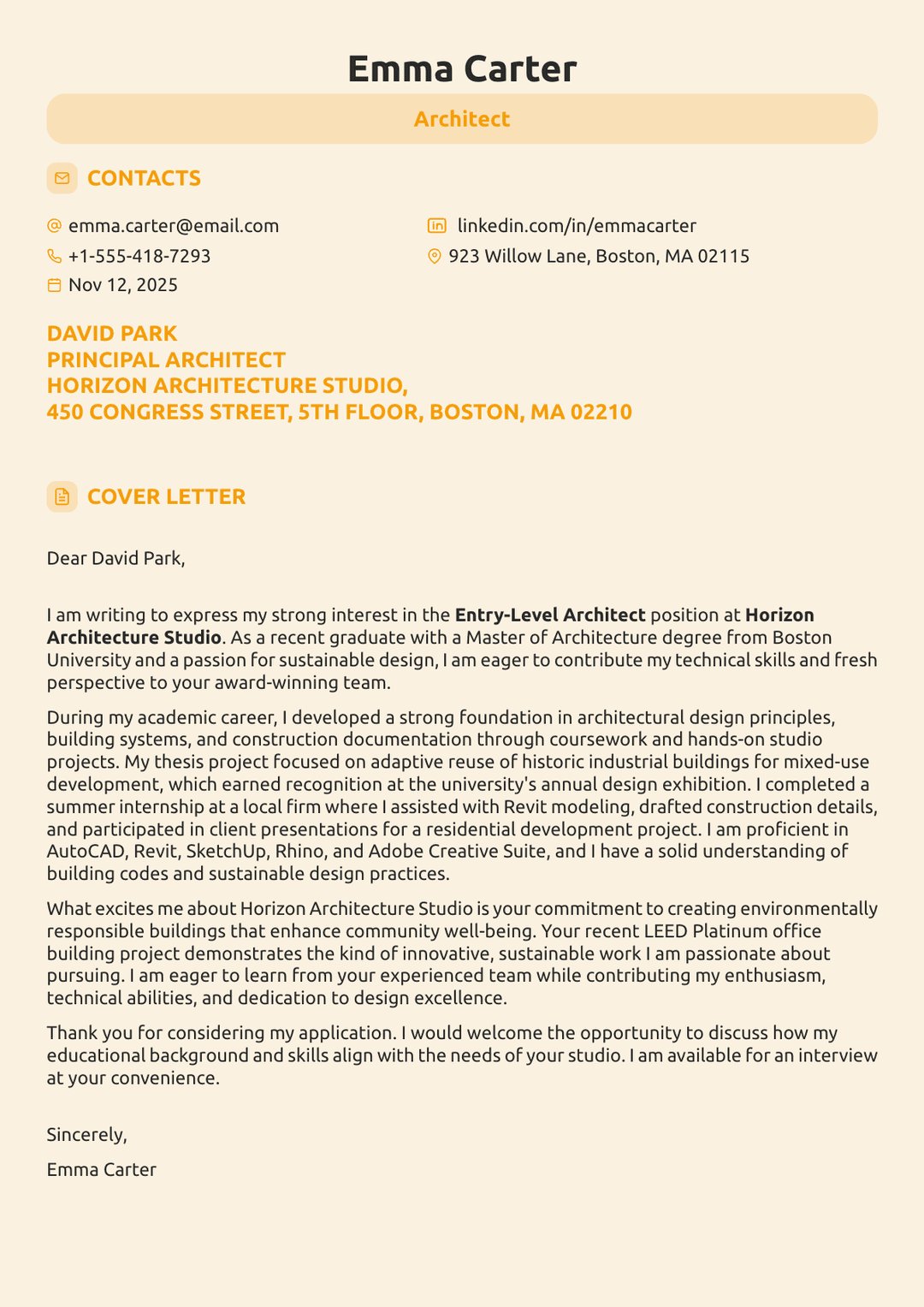
An architecture cover letter is a professional document that explains how your design skills, technical knowledge, and project experience make you a strong fit for a specific role or firm.
Writing one means connecting your portfolio, education, and hands-on work to the employer’s needs, not by repeating your resume, but by adding context, motivation, and proof of how you think and solve design challenges. A strong letter shows that you understand both aesthetics and function, as well as deadlines, collaboration, and client expectations.
In this article, you’ll learn how to structure an architecture cover letter and what hiring managers want to see. We’ll also cover common mistakes, tone, and tailoring strategies so your letter feels focused, professional, and aligned with the role you’re targeting.
- An effective architecture cover letter is highly personalized and demonstrates clear knowledge of the specific firm’s work, values, and design philosophy.
- Strong cover letters balance technical competence with evidence of design thinking, collaboration, and real project impact.
- Project examples and portfolio references are the primary proof of professional credibility and must be integrated throughout the letter.
- Quantified results and clearly defined project roles strengthen claims of experience and differentiate candidates.
- Generic, template-based letters significantly reduce credibility and are a major reason applications are rejected.
7 Essential Elements of a Winning Architecture Cover Letter
Creating an effective architecture cover letter requires attention to specific elements that resonate with design professionals and demonstrate your understanding of the industry's unique requirements. Here are the main components it should include:
#1. Professional Header and Contact Information
Your cover letter header should include:
- Your full name
- Phone number
- Email address
- Portfolio website URL
- LinkedIn profile
- Date
- Potential employer’s details (recruiter’s name, name of the company, and address)
If you have an online architectural portfolio, make sure the URL is professional and easy to remember. Consider using your name as the domain if possible, and avoid generic hosting platforms that create unwieldy URLs; they look unprofessional and are hard for hiring managers to remember.
Also, don’t forget to include your city and state, but full addresses aren't necessary. Many architecture firms work with remote consultants or are willing to relocate exceptional candidates, so you shouldn’t let geography limit your applications.
Let’s see an example:
Avery Calderon
412 West Fulton Street, Apt 5B
Chicago, IL 60607
(312) 555-9034
avery.calderon@email.com
February 3, 2026
Tiffany Hopkins
Hiring Manager
Horizon Urban Design Studio
155 North Wacker Drive, Suite 2400
Chicago, IL 60606
#2. Targeted Salutation
Research the hiring manager's name whenever possible rather than using generic greetings. Check the firm's website staff directory, LinkedIn, or call the office directly to ask for the appropriate contact person.
When you can't find a specific name, "Dear Hiring Manager" or "Dear [Firm Name] Design Team" works better than outdated phrases like "To Whom It May Concern." For smaller firms, addressing your letter to the principal architect by name shows initiative and attention to detail.
#3. Compelling Opening Paragraph
Your opening should immediately establish why you're writing and what makes you uniquely qualified. Reference the specific position and include a notable achievement or project that aligns with the firm's work.
As an architect passionate about sustainable design with five years of experience in mixed-use developments, I'm excited to apply for the Project Architect position at GreenSpace Design. My recent LEED Platinum certification project, a 200-unit affordable housing complex, aligns perfectly with your firm's commitment to environmentally conscious urban development.
#4. Technical Skills and Software Proficiency
Architecture firms need to know you can hit the ground running with their existing workflows. Therefore, you should highlight relevant software experience, including AutoCAD, Revit, SketchUp, Adobe Creative Suite, and any other specialized tools and technical skills the firm may mention in their job posting.
However, don't just list software; explain how you've used these tools to achieve results. Here’s how you can do so:
I bring advanced proficiency in AutoCAD, Revit, SketchUp, and Adobe Creative Suite, supported by hands-on experience delivering technically accurate design documentation. In my current role, I produced detailed construction drawings and 3D models for more than 15 residential and mixed-use projects, reducing revision requests by 20% through improved drawing precision and coordination with engineering teams.
I have also used Revit-based BIM workflows to streamline documentation, reducing turnaround time by approximately 25%. My technical background includes material specification, code-compliant detailing, and preparing permit-ready drawing sets, ensuring projects move efficiently from concept through construction.
#5. Project Experience and Achievements
This section should be the core of your architecture cover letter, where you’ll share 2-3 specific project examples that demonstrate relevant skills, always including quantifiable results when possible.
Focus on projects that align with the firm's specialties. For instance, if they're known for educational buildings, highlight your school design experience; if they focus on high-end residential work, discuss your custom home projects. Additionally, make sure you always include details about project scale, budget, timeline, and your specific role in the process.
This paragraph can look like this:
In my previous role, I worked on projects closely aligned with your firm’s high-end residential focus. I served as Project Designer for a 4,800 sq ft custom waterfront home with a $2.1M budget, leading space planning, Revit modeling, and permit-ready drawings, which helped secure approvals on first submission and kept documentation two weeks ahead of schedule. I also contributed to a 12-unit luxury townhouse development (approx. 18,000 sq ft), coordinating with consultants to resolve technical clashes early and reduce change orders by about 15%.
#6. Cultural Fit and Firm Knowledge
Demonstrating that you understand the firm's values, culture, design philosophy, and recent work shows you're genuinely interested in this specific opportunity rather than just mass-applying to every firm in town.
Mention specific aspects of their portfolio that resonate with you, or explain how your design approach aligns with their stated values. This research-based personalization significantly increases your chances of getting noticed and landing an interview.
I’m particularly drawn to your firm’s emphasis on context-driven design and the way your recent projects balance modern form with sensitivity to their surroundings. Your work demonstrates a clear commitment to sustainability, thoughtful material selection, and creating spaces that feel both functional and human-centered, which closely reflects my own design approach.
I’m particularly drawn to your firm’s emphasis on context-driven design and the way your recent projects balance modern form with sensitivity to their surroundings. Your work demonstrates a clear commitment to sustainability, thoughtful material selection, and creating spaces that feel both functional and human-centered, which closely reflects my own design approach.
#7. Strong Call-to-Action Closing
End your cover letter with confidence and clarity about next steps by expressing enthusiasm for discussing your qualifications further and mentioning your portfolio again. Furthermore, include a specific timeline for following up.
Professional closing phrases like "Sincerely" or "Best regards" work well, followed by your typed name; if submitting a hard copy, you should leave space for your handwritten signature.
Here’s an example of a solid sign-off:
I would welcome the opportunity to discuss how my technical background, project experience, and design approach can contribute to your team’s work. I am available at your convenience for an interview and can provide additional portfolio materials upon request.
Sincerely,
Avery Calderon
3 Architecture Cover Letter Examples by Career Level
Now that we know what every architecture cover letter should consist of, let’s see a few examples based on three career levels: entry-level, mid-level, and senior.
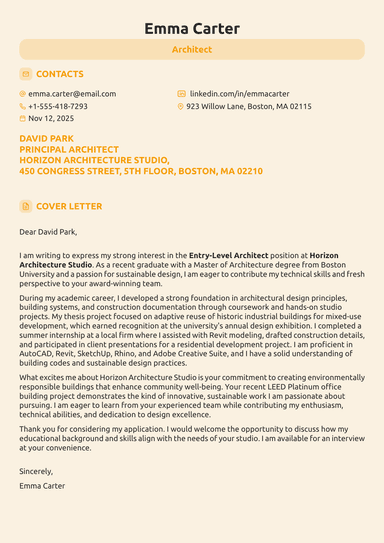
Entry-Level Architect Cover Letter Example

Mid-Level Architect Cover Letter Example

Senior Architect Cover Letter Example

3 Common Architecture Cover Letter Mistakes to Avoid
Let’s see which common cover letter mistakes can reduce the positive effect of your application and immediately disqualify you from consideration:
The biggest mistake architects make is sending identical, generic cover letters to multiple firms without customization. Architecture is a deeply personal and philosophical field, where companies want to know why you specifically want to work with them.
Each firm has a unique design philosophy, project focus, and culture. Therefore, your cover letter should reflect genuine knowledge of their work and explain why their approach resonates with you. This doesn't mean writing completely new letters for every application, but rather customizing key paragraphs to reflect firm-specific research.
Also, generic applications are obvious to hiring managers and immediately signal that you're not seriously committed to their particular opportunity. Take the time to research each firm, its recent projects, awards, and stated values, then connect your experience to their specific needs and interests.
While technical proficiency is important, architecture cover letters that only list software skills miss the bigger picture. Firms want to understand your design thinking, problem-solving approach, and how you collaborate with others.
Balance technical qualifications with examples that demonstrate creativity, leadership, and communication skills. Explain how you've used technical tools to achieve design goals, rather than simply listing programs you know, as this approach shows you understand that technology serves design, not the other way around.
Finally, include some soft skills like client management, team leadership, or presentation abilities. Architecture is ultimately about people, both the clients you serve and the colleagues you work with, so hiring managers need confidence that you can contribute to project success beyond just producing drawings.
Your portfolio is your most important professional asset as an architect, yet many candidates fail to properly integrate it into their cover letters. Don't treat it as an afterthought; use your letter to create anticipation and guide readers to your best work.
Reference specific portfolio projects by name and page number when relevant to the position. Additionally, explain how particular projects demonstrate skills the firm needs, and make sure your portfolio URL is prominently displayed and easily accessible.
It’s also important to consider your cover letter and portfolio as two parts of a cohesive presentation, along with your architect resume. Your letter and resume should make hiring managers excited to explore your visual work, while your portfolio should reinforce the qualities and capabilities you've described in writing.
4 Handy Tips to Consider When Writing Your Architecture Cover Letter
Creating an effective architecture cover letter requires a systematic approach that ensures you cover all essential elements while maintaining a compelling narrative flow. The following handy tips can make the process much simpler for you:
Thorough research forms the foundation of any successful architecture cover letter. Start by exploring the firm's website, paying particular attention to their project portfolio, stated philosophy, and recent news or awards.
Plus, look beyond the website to find additional insights by checking architectural publications like Architectural Record for features about the firm. Make sure you review their social media presence to understand their culture and current projects; LinkedIn profiles, for example, can provide valuable information about the team you'd potentially join.
Finally, research the specific position requirements carefully. Architecture job postings often include subtle clues about firm priorities, e.g., whether they emphasize sustainable design, cutting-edge technology, or community engagement. Use this information to guide how you present your qualifications.
Professional formatting demonstrates attention to detail, which is a crucial skill for architects. Your cover letter should complement your resume and portfolio design while remaining highly readable.
Use clean, modern typography that reflects current design sensibilities without being overly trendy. It also helps to stick to standard business letter formats with appropriate margins, fonts, and spacing, as well as avoid overly creative formatting that might interfere with applicant tracking systems (ATS). While creativity is valued in architecture, your cover letter needs to be functional first and aesthetically pleasing second.
Your opening paragraph should immediately hook the person who’s reading it and establish your qualifications and enthusiasm for the specific opportunity. Therefore, you need to start your cover letter with a strong statement that combines your experience level, relevant specialization, and genuine interest in the firm.
Hook strategies that work well for architects include referencing a specific project the firm has completed, mentioning a shared design philosophy, or highlighting a unique achievement that directly addresses their stated needs. Meanwhile, you should avoid generic openings that could apply to any firm.
Select 2-3 projects that best demonstrate your fit for the specific position, focusing on experiences that align with the firm's project types and values. For each project, include specific details about scope, budget, timeline, and your role.
For this, you can use the STAR method (Situation, Task, Action, Result) and structure your project descriptions. This approach ensures you provide context, explain your contributions, and highlight measurable outcomes. Also, as previously mentioned, you should quantify results whenever possible, be it budget savings, timeline improvements, or awards received.
Make Your Architect Cover Letter Seamless With ResumeBuilder.so!
Professional help can significantly streamline your writing process and ensure your materials meet industry standards. ResumeBuilder.so offers an AI-powered cover letter builder which enables you to incorporate industry-appropriate formatting, professional typography, and layouts that complement architectural portfolios.
Our collection of cover letter templates includes options for different experience levels and firm types. Each one of them is fully customizable to match your personal brand and the specific firm you're targeting.
Besides that, we offer a vast number of cover letter examples, as well as some resume examples that can serve as inspiration and improve the quality of your architecture job application.
Final Thoughts
Creating an effective architecture cover letter requires more than just good writing; it demands a deep understanding of how design firms evaluate candidates and what they value most in potential team members. Your letter serves as both an introduction to your qualifications and a demonstration of your communication skills, making it a critical component of your job search strategy.
Since architecture firms receive dozens of applications for each position, generic approaches simply won't cut through the noise. Therefore, make sure to invest time in researching each firm's philosophy, recent projects, and cultural values, then craft a letter that demonstrates genuine understanding and enthusiasm!
Architecture Cover Letter FAQs
#1. What should I include in an architecture cover letter?
An architecture cover letter should include technical skills, specific project examples, portfolio references, and a demonstration of cultural fit with the firm. Focus on 2-3 relevant projects that showcase skills aligned with the position, mention specific software proficiencies, and research the firm's work to show genuine interest.
#2. How long should an architecture cover letter be?
An architecture cover letter should be one page long, typically consisting of 3-4 paragraphs that focus on your most relevant qualifications and achievements. Hiring managers review hundreds of applications, so concise, impactful content performs better than lengthy, detailed descriptions of every project you've worked on.
#3. How do I write a cover letter with no architecture experience?
You can write an architecture cover letter with no experience by emphasizing transferable skills from related fields, academic projects, internships, and a genuine passion for architecture. Plus, highlight relevant coursework, design competitions, volunteer work, or construction experience that demonstrates your commitment to the field and ability to contribute immediately.
#4. Should I use the same cover letter for different firms?
You should never use the same cover letter for different architecture firms, as each letter should be customized to the specific firm, position, and project types. It’s best to research each firm's philosophy, recent work, publications on platforms such as Architectural Record, and values, then tailor your content to demonstrate why you're interested in that particular opportunity.
#5. How important is my portfolio in the cover letter?
Your portfolio is critical to your cover letter, so you should always reference specific projects and prominently include your portfolio URL in your contact information. Use your cover letter to guide readers to relevant portfolio sections and explain how featured projects demonstrate skills the firm needs.

Max Harper is the resume guru who actually makes job searching easier. With years of experience as a hiring manager, Max knows what makes a resume stand out in a pile of 200+ applications. From breaking down ATS myths to helping you craft bullet points that pop, Max shares easy-to-digest, no-BS resume advice.