Freelance Resume: How To Write One That Gets You Hired
This complete guide with detailed explanations and expert tips will teach you how to write an acting resume in record time!
Edit this resume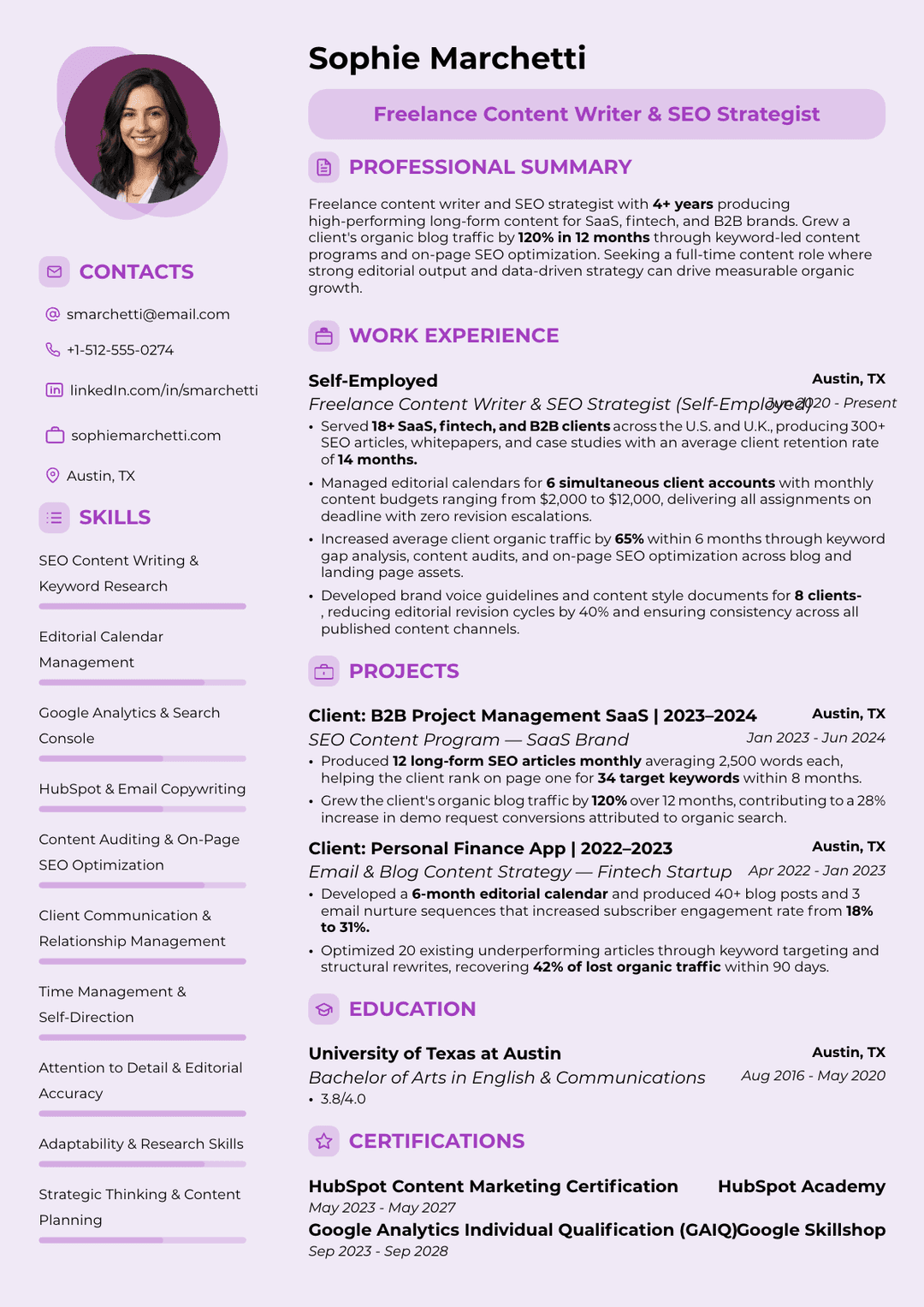
A freelance resume is a resume that summarizes your self-employed, contract, or project-based work for clients rather than traditional full-time employment. It needs to prove more than job stability because freelance experience is often built around separate projects, varied clients, and changing responsibilities.
That means your resume should make your value clear quickly by highlighting the services you offer, the results you’ve delivered, and the skills that help you work independently.
This article explains how to write one that presents your experience in a clear, professional way, even if your background includes short-term contracts, multiple clients, or gaps between projects. You’ll learn what to include, how to list freelance work on a resume, which skills to feature, and how to make everything look credible.
- A freelance resume should present self-employed, contract, and project-based work as formal professional experience, using clear titles, dates, client details, and measurable results.
- You should include gig work when it is relevant to the target role, helps explain an employment gap, or proves valuable skills, but avoid listing every small gig if it adds clutter.
- The best format depends on your background.
- A strong resume for freelancers needs a portfolio link, a focused summary, achievement-driven bullet points, and skills that match the job description.
- To make your resume ATS-friendly, use simple formatting, standard section headings, job posting keywords, and avoid tables, columns, headers, footers, and unnecessary design elements.
What Is a Freelance Resume?
A freelance resume is a professional document that presents self-employment, contract work, and gig work as formal career experience. It follows the same core structure as any resume, but requires a few deliberate adjustments to make independent work read clearly to recruiters and applicant tracking systems.
There are really two scenarios here. First, you might be building a resume entirely around freelance work, perhaps pitching for a large contract or new clients who want proof of your professional track record.
Second, and more commonly, you're a freelancer transitioning to full-time employment who needs to weave contract experience alongside (or instead of) traditional roles.
Both cases require the same core skill: framing. Hiring managers have been trained to look for company names, titles, and employment dates. When those elements are absent or unconventional, some will hesitate. So, your job here is to use structure, specificity, and metrics to make your freelance background just as readable as any corporate role.
The gig economy's growth adds context here. According to the U.S. Bureau of Labor Statistics, 6.9 million workers, or 4.3% of U.S. workers, held contingent jobs as their sole or main job in July 2023.
Additionally, freelance work is becoming more common on resumes as more companies rely on independent talent for specialized, project-based support.
Upwork’s 2023 Freelance Forward report found that 38% of the U.S. workforce, or 64 million Americans, performed freelance work in 2023. Hiring managers increasingly expect to see freelance experience on resumes, and they just want it presented professionally.
3 Solid Freelance Resume Examples
Looking at real freelance resume examples is one of the fastest ways to understand what works. The same principles apply across all freelance disciplines, in terms of structure, specificity, and metrics, but the emphasis shifts depending on your field.
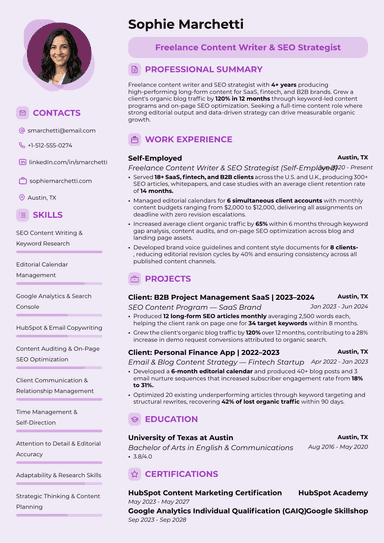
Freelance Writer Resume Example

Freelance Designer Resume Example

Freelance Consultant/Independent Contractor Resume Example

Should You Include Freelance Work on Your Resume?
You should include freelance work on your resume when it is relevant to the role you're applying for or when it fills a gap in your employment history. That second condition is worth sitting with. Even loosely related freelance work can serve a strategic purpose if the alternative is an unexplained gap, but the goal should always be relevance first.
Include it when:
- It mirrors the skills, tools, or industry mentioned in the job description
- It covers an employment gap and gives you legitimate, dated experience to list
- It demonstrates entrepreneurial initiative that sets you apart from other candidates
- The scope of your projects (client size, deliverables, outcomes) is genuinely impressive
Consider leaving it out (or at least minimizing it) when:
- It's completely unrelated to the target role and adds noise without value
- Listing dozens of small, unrelated gigs creates clutter that buries your stronger experience
- The work was so brief or informal that it raises more questions than it answers
How to Write a Resume as a Freelancer: Step-by-Step
Writing a resume for freelancers follows the same general rules as any professional resume, with a few important adjustments for self-employed experience. The structure is familiar; the framing is where the work happens.
Step 1: Choose the Right Format for Freelancers
You should choose a resume format based on how much freelance experience you have and whether you're transitioning to full-time work. The format is the skeleton, and everything else depends on getting this right.
Here's how each option plays out in practice:
| Format | Best For |
|---|---|
Long, consistent client history; 3+ years of regular freelance work. Lists your most recent client or project first and works backward, which is a familiar territory for recruiters. | |
New freelancers or career changers with limited client history. Groups your experience by skill theme rather than timeline. | |
Mixed background, both freelance and traditional employment. Features a skills summary at the top, followed by a chronological work history below. |
Step 2: Add Your Contact Information and Portfolio Link
When it comes to contact information, you should start with the basics: your full name, phone number, email address, and city/state.
What sets a freelance resume apart is the portfolio link. Unlike a traditional employee whose work lives inside a company, your work is yours, and you can show it.
Link to a personal website, Behance profile, GitHub, Contently portfolio, LinkedIn, or anywhere your work samples live publicly. This replaces (or supplements) the reference list that traditional resumes often lean on, and it gives hiring managers something concrete to evaluate before they even read the first bullet point.
Another thing is to make sure your email address is professional. Your freelance brand name might be playful, but the resume version of you should use the firstname.lastname@gmail.com formula or a custom domain if you have one.
Megan Carter
Austin, TX
megan.carter@email.com
512-555-0194
linkedin.com/in/megancarter123
megancarterportfolio.com
Step 3: Write a Strong Resume Summary
A resume summary for freelancers is a short statement at the top of your resume that highlights your most relevant skills, experience, and results. It represents the opening argument of your case that is concise, confident, and specific enough to make a recruiter want to keep reading.
A summary (for experienced freelancers) emphasizes what you've done and what you bring. An objective, which is more common for entry-level or career changers, focuses on where you're headed.
Your summary should include:
- Your niche or specialty
- A key achievement with a concrete metric
- A forward-looking statement about the value you bring to an employer or client
Here's the difference in practice:
Weak
"Experienced freelance writer looking for opportunities."
"Results-driven freelance content strategist with 5+ years creating SEO content for SaaS brands. Grew a client’s organic traffic by 120% in 12 months through keyword-led content programs. Seeking a full-time content role where I can scale editorial output and drive measurable growth."
Step 4: List Your Freelance Work Experience
You should list freelance work experience the same way you list any job: with a title, dates, and bullet points showing your key contributions and results. The specifics depend on how your freelance history is structured.
There are three approaches to listing your gig work on a resume, and you may use more than one on the same document:
Approach 1: Individual client entries (best when you have a few substantial, named clients)
Senior Copywriter (Contract)
Acme SaaS Inc. (Remote)
Jan 2022 – Dec 2023
- Wrote 12+ long-form SEO articles/month, averaging 4,000+ words each
- Increased the client's blog organic traffic by 85% over 18 months
- Collaborated with the product team to develop messaging for two major feature launches
Approach 2: Consolidated umbrella entry (best for many smaller clients or ongoing gig work)
Freelance Content Strategist (Self-Employed)
2020 – Present
- Served 15+ SaaS and e-commerce clients across the U.S. and U.K.
- Produced 200+ SEO articles, increasing average client traffic by 40%
- Managed editorial calendars for clients with monthly budgets up to $10,000
Approach 3: Separate freelance projects section (best when freelance work supplements full-time roles)
Here, you can add a standalone section titled "Freelance Projects" or "Contract Work" below your main experience. This keeps your traditional roles prominent while still crediting the independent work.
Always label entries clearly with "(Freelance)" or "(Contract)" to avoid ambiguity about employment type; hiring managers appreciate the transparency.
Local Fitness Studio SEO Refresh
Client: Independent fitness studio | 2024
- Optimized service pages, class descriptions, and local SEO elements to improve search visibility.
- Increased organic traffic by 61% in five months and helped the studio rank on page one for 12 local keywords.
- Rewrote calls to action across the website, contributing to a 28% increase in trial class sign-ups.
E-Commerce Email Marketing Campaign
Client: Natural skincare brand | 2023
- Built a welcome email sequence, abandoned cart flow, and product education campaign in Mailchimp.
- Increased email-driven revenue by 36% over one quarter.
- Improved abandoned cart recovery rate by 18% through revised messaging and targeted customer segmentation.
SaaS Blog Content Strategy
Client: B2B software startup | 2022
- Created a six-month SEO content roadmap based on buyer pain points, competitor gaps, and keyword opportunities.
- Produced article briefs for 40+ blog posts and optimized 25 existing articles.
- Helped increase qualified organic leads by 24% within six months.
You should quantify your freelance achievements by using numbers, percentages, and outcomes that show the real impact of your work. This is where most freelance resumes fall flat, and where yours can stand out.
Pull numbers from wherever you have them, be it:
- Traffic growth
- Revenue generated
- Client retention rate
- Project turnaround time
- Number of clients served
- Word volume
- Satisfaction scores
Even estimates work when they're honest and framed clearly.
Step 5: Add a Skills Section
A skills section on a self-employed resume does two things: it helps ATS software identify your qualifications, and it gives recruiters a fast visual scan of what you bring.
Hard skills are your job-specific technical abilities, and may include:
- SEO
- Figma
- Python
- Copywriting
- Google Analytics
- HubSpot
- AWS
- Video editing
On the other hand, the soft skills you can benefit from here would be:
- Client communication
- Time management
- Project management
- Problem-solving
The catch is that generic soft skill lists don't do much. You should weave them into your bullet points where you can, or mention them in your summary, rather than dumping them in a standalone list.
Step 6: Include Education, Certifications, and Training
For freelancers, the placement of a degree or a diploma matters. If you're early in your career, education goes near the top; if, however, you have substantial experience, it moves toward the bottom.
Furthermore, certifications carry extra weight for freelancers, too. When you don't have a traditional employer backing your expertise, the following can give hiring managers something concrete to anchor their confidence in you:
- Google Analytics certification
- HubSpot Content Marketing credential
- AWS certification
- Coursera specialization
- Relevant training, workshops, or bootcamps
Here’s an example:
Education
Bachelor of Arts in Marketing
University of Texas at Austin | Austin, TX
Graduated: 2015
Certifications
Google Analytics Certification
Google Skillshop | Expires: 2028
Google Ads Search Certification
Google Skillshop | Expires: 2028
HubSpot Content Marketing Certification
HubSpot Academy | Expires: 2027
Meta Certified Digital Marketing Associate
Meta Blueprint | Expires: 2027
How to Make a Freelance Resume ATS-Friendly
You can make an ATS-friendly freelance resume by using regular formatting, including keywords from the job posting, and avoiding graphics or similar elements. For freelancers specifically, the stakes are slightly higher, as a non-standard work history already creates some parsing ambiguity, so the formatting needs to be bulletproof.
Here's what ATS-friendly looks like in practice:
- Stick to normal, clear section headers, such as "Work Experience," "Skills," or "Education." Everything that’s different from this may confuse parsing algorithms.
- Replicate the exact phrases from the job description, without using synonyms.
- Avoid columns, text boxes, and tables; these look clean to the human eye but often get skipped entirely by ATS software.
- Keep contact information in the main document body; don’t put these details in headers or footers, where some ATS systems can’t reach them.
- Save as .docx or PDF; check the job posting's preference, and when in doubt, .docx is safer for older ATS systems.
ResumeBuilder.so can craft a fully customized, ATS-friendly resume for you by following professional templates that were made with applicant system trackers in mind. Besides that, you can also find some good resume examples on our platform and see what a document that passes ATS checks looks like.
5 Common Mistakes to Avoid on a Freelance Resume
The most common resume mistakes freelancers make include the following:
Common Mistake
Listing every gig you've ever taken
Being vague about your role
Leaving employment gaps unexplained
Using a one-size-fits-all resume
Skipping the portfolio link
Curate ruthlessly; include only work relevant to the target role.
Specify what you did, for whom, at what scale, with what result.
Freelance work is a legitimate gap-filler, so own it with clear dates and output.
Tailor every application, or at least update the summary and top bullets.
Your work is your proof; link to it directly in your contact section.
Final Thoughts
Freelance work is increasingly valued by employers, as this shift has been real and ongoing. For many industries, the gig economy is the preferred pipeline for proven talent. So, the key here is presenting your experience with the same structure and specificity as traditional employment.
Once you’re ready to put it all together, use ResumeBuilder.so's AI tool to turn your freelance experience into a polished, submission-ready document in minutes. With our help, your job application will reach the recruiters and won’t get buried during the process!
Freelance Resume FAQ
#1. Should I put 'self-employed' on my resume?
Yes, you should put ‘self-employed’ on your resume if you worked as a freelancer. Use it as your employer entry under a job title like "Freelance Graphic Designer (Self-Employed)." This is completely standard and immediately clear to recruiters, and it’s much better than leaving the employer field blank, which creates more confusion than it resolves.
#2. What format is best for a freelance resume?
The best format for a freelance resume depends on your experience. If you have a long, consistent client history, reverse-chronological works well, but if you're new to freelancing or changing careers, a functional format is more effective. Meanwhile, a hybrid format works best when you have both freelance and traditional employment to show.
#3. Is freelance work considered employment on a resume?
Yes, freelance work is considered employment on a resume; self-employed, contract, and gig work all count as professional experience. The key is formatting it clearly: use a job title, an employer entry (your business name or "Self-Employed"), accurate dates, and achievement-driven bullet points.
#4. How do I cover employment gaps with freelance work?
You can cover employment gaps with freelance work by listing your freelance projects in your work experience section with accurate dates. Be honest about the nature of the work, as most hiring managers respond well to freelance experience, especially when it's framed with results and skills relevant to the target role.

Max Harper is the resume guru who actually makes job searching easier. With years of experience as a hiring manager, Max knows what makes a resume stand out in a pile of 200+ applications. From breaking down ATS myths to helping you craft bullet points that pop, Max shares easy-to-digest, no-BS resume advice.