How to Write a Solid Interior Design Resume With No Hassle
This complete guide with detailed explanations and expert tips will teach you how to write an acting resume in record time!
Edit this resume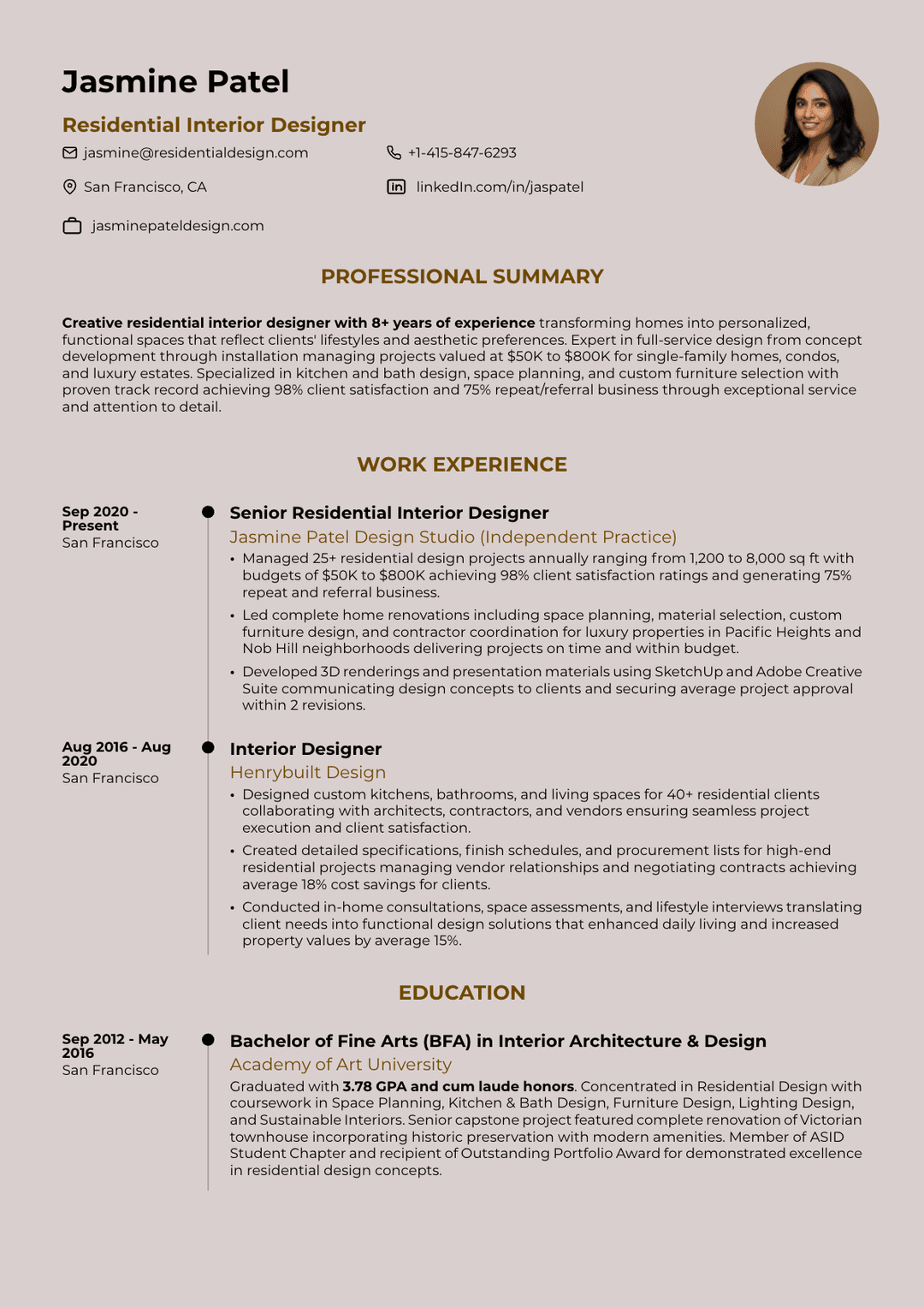
An interior design resume is a professional document that translates your creative vision into clear, measurable value for employers. It outlines your design experience, technical expertise, and project outcomes, helping hiring managers understand not just what you design, but how you work.
This matters even after an interview because decision-makers often return to resumes to compare candidates side by side. If yours doesn’t clearly connect the sense of aesthetics and functionality, as well as the results a good interior designer needs to boast, it can quietly undermine an otherwise strong impression.
This article walks you through how to build an interior designer resume that supports your portfolio and strengthens your application. You’ll learn what to include, how to showcase your abilities effectively, and what mistakes you should avoid.
- An interior design resume must bridge creativity and execution, proving not just aesthetic sense but measurable project results, budgets, and impact.
- Your portfolio link is non-negotiable—it’s the visual proof that validates everything your resume claims.
- Reverse-chronological formatting is usually the safest choice, allowing hiring managers and ATS to quickly understand your career progression.
- The strongest resumes quantify design work with metrics like project value, square footage, cost savings, timelines, and certifications.
- The most damaging mistakes are missing portfolio access, decorative formatting that breaks ATS, generic content, and duty-based bullet points instead of achievements.
What Is an Interior Design Resume?
An interior design resume is a job application document that showcases your design expertise, technical skills, creative projects, and relevant experience in the field.
What makes interior design resumes different from other industries is that you're not just listing job duties, but demonstrating both artistic vision and practical execution. Here, space planning, budget management, client relationships, material selection, and code compliance all matter as much as your aesthetic sense.
Also, your resume differs from your interior design portfolio in an important way. The portfolio shows detailed work samples, mood boards, renderings, and finished projects, while a resume summarizes your professional story, highlights key achievements, and proves you have the skills to back up those beautiful images. One's a summary, the other's the proof.
Interior Design Resume Examples
Entry-Level Interior Designer Resume Example

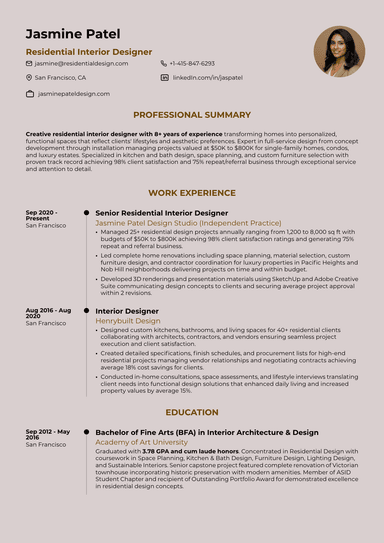
Residential Interior Designer Resume Example


Commercial Interior Design Resume Example


Interior Design Resume Format
The three main resume format options for an interior design resume are as follows:
- The reverse-chronological format lists your most recent position first and works backward. It's the best choice for interior designers with consistent work history because it clearly demonstrates career progression and project evolution. Most hiring managers prefer this format, and ATS systems handle it best.
- The functional format emphasizes skills over work history. It works for career changers or those with employment gaps, but many hiring managers view it skeptically because it obscures your actual experience timeline.
- The combination (hybrid) format merges both approaches: skills sections up front with detailed chronological experience following. It's ideal for showcasing both capabilities and progressive experience, though it requires careful organization to avoid redundancy.
For most interior designers, the reverse-chronological one is the best option, as it's ATS-friendly, familiar to recruiters, and lets your career story unfold naturally.
If you're uncertain about choosing the right resume format, consider your specific situation: consistent work history usually means chronological, while career transitions might benefit from combination formats.
5 Essential Sections of an Interior Design Resume
Every interior design resume needs certain core sections, regardless of whether you're applying for residential, commercial, or specialized design roles. Let's break down what goes where and why it matters:
#1. Contact Information and Portfolio Link
Your resume header should include your full name, phone number, professional email address, city and state, as well as your LinkedIn profile.
Besides this, there’s another non-negotiable element for interior designers: your portfolio link. Place it prominently within your contact section, be it a personal website, Behance profile, or PDF portfolio. Without portfolio access, hiring managers can't evaluate your most important qualification: your design work.
Make your portfolio URL clickable if submitting digitally, and keep it short and professional. Something like yourname.com or yourname.portfoliobox.net works better than a lengthy, complicated URL that's hard to type.
Here’s an example of a properly written contact information section:
Elara Whitmore
Interior Designer
Brooklyn, NY
elara.whitmore@email.com
(917) 555-4382
linkedin.com/in/elarawhitmore
www.elarawhitmorestudio.com
#2. Professional Summary or Objective
A resume summary or objective is a 2- or 3-sentence pitch that appears right below your contact information and sets the tone for everything that follows.
If you've got experience, write a resume summary highlighting your design philosophy, specialization, years of experience, and key achievements. However, if you’re new to the field, you should create a resume objective instead, focusing on your education, relevant skills, and career goals.
This part should include your years of experience and specialization, design philosophy or approach, notable achievements with specific metrics, and relevant certifications. If it’s an objective, it should focus on the abilities you possess and your career expectations.
The example of a resume objective looks like this:
Recent interior design graduate from SCAD with a strong foundation in AutoCAD, SketchUp, and sustainable design principles. Completed 15+ academic projects, including an award-winning senior thesis on adaptive reuse design. Passionate about creating functional, beautiful spaces that enhance daily living while minimizing environmental impact.
Meanwhile, a resume summary can be written this way:
Strategic commercial interior designer with 12+ years leading large-scale corporate, retail, and hospitality projects valued at $15M+. NCIDQ-certified with proven expertise in space planning, team leadership, and client relationship management. Excel at translating brand identity into physical environments that drive business results and enhance user experience.
#3. Work Experience
The work experience section showcases your professional journey, but it's not just about listing where you've worked; it should prove what you've accomplished.
List positions in reverse-chronological order with company name, location, job title, and dates clearly indicated. Then use 4-6 bullet points per position, each starting with a strong action verb and including quantifiable results whenever possible.
Here's what strong interior design bullet points look like:
Work Experience
Interior Designer
Hearthline Studio, New York, NY
April 2019 – Present
- Led space planning for 50,000 sq ft corporate office renovation, optimizing workflow efficiency and reducing operational costs by 20% through strategic furniture and technology placement.
- Collaborated with architects and contractors on 8 commercial projects valued at $3M+, delivering all projects on time and within budget despite supply chain challenges.
- Developed material specifications and finish schedules for a 6-story boutique hotel, sourcing sustainable and locally-produced materials that achieved LEED Silver certification.
- Managed vendor relationships and procurement for high-end residential projects, negotiating contracts that saved clients an average of 15% on furniture and fixtures.
Quantify everything possible, including square footage, budget sizes, number of projects, timeline improvements, client satisfaction rates, and cost savings. Numbers grab attention and provide concrete evidence of your impact, so you definitely shouldn’t skip them.
#4. Education
How you present educational credentials depends on your career stage, but the basics remain consistent.
List degrees with school name, degree type (BFA, BA, MFA in Interior Design or Interior Architecture), and graduation year. Recent graduates can include GPA if it's above 3.5, relevant coursework that demonstrates specific skills and qualifications, and any academic honors or design awards.
Recent graduates should position education first, right after the summary, letting academic achievements and relevant coursework shine. Meanwhile, experienced professionals should place it after work experience, allowing projects and professional accomplishments to lead.
The section looks like this:
Education
Bachelor of Fine Arts (BFA) in Interior Design
Savannah College of Art and Design (SCAD), Savannah, GA
2013 – 2017
#5. Skills Section
Creating a comprehensive skills section requires strategic organization.
It’s best to divide your interior design skills for a resume into three clear categories that speak to different aspects of the job: technical/design software skills, core design competencies, and soft skills.
The technical skills (also known as hard skills) you can include in your document include:
- Industry-standard tools, such as AutoCAD, Revit, SketchUp, 3ds Max, and Rhino, for 3D modeling and technical drawings
- Adobe Creative Suite (Photoshop, Illustrator, InDesign) for presentations and graphics
- Rendering software like V-Ray, Lumion, or Enscape for photorealistic visualizations
- Specification software, such as Studio Designer or Design Manager, for project management and documentation.
Meanwhile, core design skills demonstrate your creative and technical design knowledge, which means they encompass:
- Space planning and layout optimization
- Color theory and psychology
- Material and finish selection
- Lighting design (both natural and artificial)
- Furniture design and selection
- Sustainable and green design practices
- Accessibility and universal design principles
- Building code compliance and ADA requirements
- Historic preservation expertise
Finally, you can also add some soft skills to your resume, and these can be:
- Client consultation and needs assessment
- Creative problem-solving abilities
- Presentation and communication skills
- Attention to detail
- Collaboration
- Teamwork in multidisciplinary environments
Here’s an example:
Hard Skills
- AutoCAD
- Photoshop
- V-Ray
- Studio Designer
Core Design Skills
- Space planning & layout design
- Material & finish selection
- Client presentations
- Furniture & lighting specification
Soft Skills
- Visual problem-solving
- Client communication
- Time management
- Creative collaboration
#6. Certifications
Professional certifications carry significant weight in interior design.
For example, NCIDQ certification should be prominently displayed, as it's recognized across the United States and many international markets as the standard for professional competence. LEED AP credentials also matter increasingly as sustainable design becomes standard practice rather than a specialty.
Furthermore, certifications from ASID, IIDA, or specialized areas like kitchen and bath design (NKBA), lighting (LC), or universal design demonstrate ongoing professional development.
Don't forget continuing education; list relevant workshops, seminars, or courses that keep your skills current. This will show commitment to staying updated with industry trends, new materials, and evolving technologies.
6 Common Mistakes to Avoid on Interior Design Resumes
Recognizing the most common resume mistakes helps you avoid them in your own document, so let’s see what they are when it comes to interior design job applications:
- Forgetting to include portfolio links. Some designers create otherwise excellent resumes and simply forget to add portfolio access. Your portfolio provides visual proof of your capabilities, and without it, hiring managers can't evaluate your most important qualification. Always include your portfolio URL in your contact section, and consider adding it to your email signature and cover letter, too.
- Using overly decorative formatting. Complex layouts with multiple columns, elaborate graphics, unusual resume fonts, or heavy color usage often confuse ATS systems and distract from your actual content. Therefore, keep resume formatting clean, organized, and professional.
- Listing duties instead of achievements creates generic, forgettable resumes. Instead, transform those duty-based descriptions into achievement-focused statements.
- Generic, non-tailored content. Each job posting emphasizes different skills and experiences. Customize your resume for each application, adjusting your resume summary, highlighting relevant projects, and emphasizing applicable skills.
- Neglecting keywords from job descriptions. Applicant tracking systems scan for specific terms, skills, and qualifications. If the posting mentions "AutoCAD proficiency," "client relationship management," and "budget management," those exact phrases should appear naturally in your resume where applicable. Don't keyword stuff, as forcing irrelevant terms damages readability.
- Including irrelevant experience. Focus on design-related roles, projects, and experiences that support your interior design career goals. Everything on your resume should answer the question: "Why does this make me a strong interior design candidate?"
Ace Interior Design Resume Writing With Our Tool
Making a creative resume for interior designers from scratch can feel overwhelming, especially when you're trying to balance content, formatting, ATS compatibility, and visual appeal. That's where ResumeBuilder.so’s professional templates and AI-powered tools make life easier.
Our interior design resume templates save time while ensuring you don't accidentally overlook important sections or create formatting that confuses ATS systems. They offer starting points that you can customize to reflect your personal style; just open our tool, enter the required details, and let us create a fully customized document for you!
Additionally, we also provide industry-specific resume examples you can review and get the gist of how you should write yours.
Final Thoughts
According to the Bureau of Labor Statistics information from 2024, the interior design field remains steady with a 3% job outlook and 87,100 positions opened in total. The competition can be rather big, so you should showcase your competencies in the best possible way.
To create a solid interior design resume, you need to juggle multiple priorities. This means showcasing creativity while maintaining professionalism and proving technical skills while demonstrating soft capabilities. Though it can seem difficult, it's definitely achievable once you understand what hiring managers need to see.
Interior Design Resume FAQ
#1. How long should an interior design resume be?
An interior design resume should typically be one page for candidates with less than five years of experience. Meanwhile, two pages work for established designers with extensive project portfolios and significant achievements.
#2. Should I include a portfolio link in my interior design resume?
Yes, you should include a portfolio link in your interior design resume because hiring managers need to see your actual work. Place it prominently in your contact information section, ensure it's clickable in digital submissions, and consider adding a "Featured Projects" section that links to specific portfolio pages showcasing your strongest work.
#3. How do I make my interior design resume ATS-friendly?
You can make your interior design resume ATS-friendly by using standard section headings like "Work Experience" and "Education" rather than creative alternatives. Also, you should incorporate keywords from job descriptions naturally, avoid complex visuals, use standard fonts, and maintain clear formatting with proper heading hierarchy and consistent spacing.
#4. Do I need a different resume for residential vs. commercial interior design?
Yes, you need a different resume for residential vs. commercial interior design roles. Residential resumes should emphasize client relationships, personal style interpretation, and residential-scale projects. On the other hand, commercial ones need to highlight large-scale projects, code compliance, team collaboration, and corporate or institutional work.

Max Harper is the resume guru who actually makes job searching easier. With years of experience as a hiring manager, Max knows what makes a resume stand out in a pile of 200+ applications. From breaking down ATS myths to helping you craft bullet points that pop, Max shares easy-to-digest, no-BS resume advice.