Stay-at-Home Mom Resume: Re-Entering the Workforce
This complete guide with detailed explanations and expert tips will teach you how to write an acting resume in record time!
Edit this resume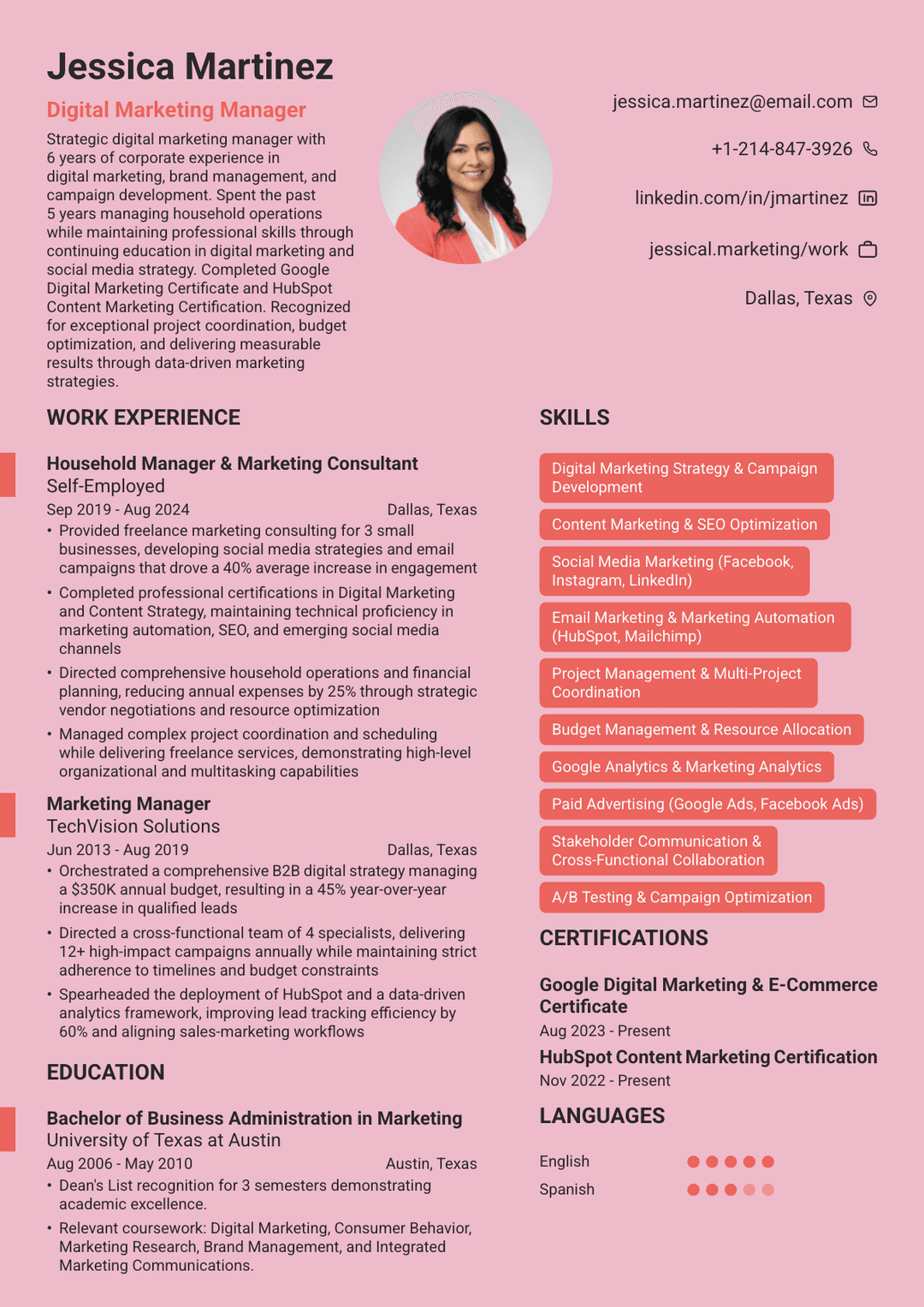
A stay-at-home mom resume is a job application document that highlights the transferable skills, experience, and achievements gained during time spent managing a household and caring for children.
Creating one means reframing responsibilities (such as budgeting, scheduling, problem-solving, and multitasking) into skills that employers value in the workplace. It may also include previous work experience, volunteer roles, freelance projects, or continued education completed during a career break. The key is presenting your time away from traditional employment with clarity and confidence.
Here, you’ll learn how to structure a stay-at-home parent resume after maternity leave, address employment gaps professionally, and showcase relevant skills in a way that aligns with today’s job market. We’ll also cover formatting tips, examples, and strategies to help you return to work after kids with a strong application.
- A stay-at-home mom resume reframes household management, caregiving, and volunteer work into transferable, employer-valued skills like project coordination, budgeting, leadership, and communication.
- The combination (hybrid) format works best because it highlights skills upfront while still presenting prior professional experience clearly and honestly.
- Career gaps should be addressed confidently—through a professional title (e.g., Household Manager), continued education, volunteer leadership, or freelance work—never hidden or apologized for.
- Strong summaries, measurable achievements, and business-focused language shift the narrative from “employment gap” to “capability growth.”
- Avoid apologetic tone, vague descriptions, irrelevant details, and ATS-unfriendly formatting; clarity, relevance, and keyword alignment are essential for a successful return to the workforce.
What Is a Stay-at-Home Mom Resume?
A stay-at-home mom resume is a professional document designed for parents re-entering the workforce after taking time off to raise children. It strategically addresses employment gaps while highlighting the transferable skills for stay-at-home parents you gained during your absence.
Such resumes focus on relevant competencies rather than just chronological work history because a simple list of your responsibilities doesn't capture the complexity of what you actually did. Skills like organization, time management, budget management, conflict resolution, and multitasking carry tremendous value for employers, regardless of the context where you developed them.
The term "stay-at-home mom resume" commonly references mothers, but these strategies apply to any parent returning to work after a career break. The goal remains consistent: present your career break as a deliberate choice that enhanced your professional capabilities.
How to Format Your Stay-at-Home Mom Resume
Choosing the right format for your homemaker resume makes a tremendous difference in how employers perceive your career break. The three main options you’ll see here each serve different situations:
Chronological Resume Format
The chronological format lists your work history in reverse order, starting with your most recent position. This approach works great for professionals with consistent employment histories and clear career progression.
However, it's less ideal for career gaps because it immediately draws attention to the timeline interruption. However, if your gap is relatively brief (under two years) and you've maintained some professional engagement through freelancing or consulting, this format can still work.
Functional Resume Format
Unlike the first one, the functional format emphasizes abilities over chronological work history. It features a prominent skills section at the top, followed by detailed examples of your capabilities, with your employment history condensed into a simple list near the bottom.
This format minimizes attention on employment dates while maximizing focus on what you can do.
The downside is that some recruiters view functional resumes skeptically, suspecting candidates are hiding problematic work histories. Additionally, many applicant tracking systems (ATS) struggle to parse functional formats correctly, which might hurt your chances of getting past initial screening.
Combination/Hybrid Resume Format (Recommended)
Finally, there’s the combination format, which blends the strengths of both approaches. It opens with a compelling resume summary, followed by a prominent skills section, and then provides detailed work experience in chronological order. Such a structure lets you highlight transferable skills upfront while still demonstrating your career trajectory.
For moms returning to the workforce, this format offers the ideal balance. You're not hiding your gap but choosing to lead with what you can contribute rather than when you last contributed. The format acknowledges your work history while giving equal weight to the skills gained while staying home.
Must-Have Sections on Your Stay-at-Home Mom Resume
Here are the sections every stay-at-home mom should include in her re-entry resume:
#1. Contact Information
The contact information section should be clear, professional, and placed at the very top of your resume. Include your full name, phone number, professional email address, and your city and state in it; you do not need to add your full home address. If relevant, you can also attach a LinkedIn profile or portfolio link, especially if you’re returning to a professional field.
Avoid casual email addresses and double-check that your phone number is accurate and the voicemail message sounds professional. This section may seem simple, but mistakes here can cost you interview opportunities before your experience is even considered.
This section could follow an example like this:
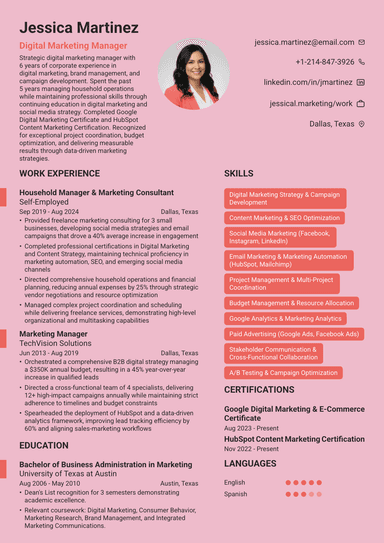
Jessica Martinez
Dallas, TX
(214) 555-0387
jessica.martinez@email.com
linkedin.com/in/jessica.ann.martinez
#2. Resume Summary
Your resume summary sits at the top of your resume layout and serves as your elevator pitch. This 3-4 sentence section must capture attention immediately while addressing your career transition head-on.
The strong example of this part of your resume acknowledges the gap without apologizing, quantifies previous experience, shows continued engagement, and immediately establishes relevant capabilities. In fact, you're framing the narrative before the hiring manager can create their own by:
- Leading with your professional identity and previous experience
- Briefly acknowledging your career break with active language ("managed," "developed," "maintained")
- Highlight relevant achievements or skills from your time at home
- Close with your strongest transferable competencies
It should look like the following sample:
Strategic operations professional with 6 years of corporate experience in project management and budget optimization. Spent the past 4 years managing complex household operations while maintaining professional skills through continuing education. Recognized for exceptional organizational abilities, stakeholder management, and delivering results under resource constraints.
Avoid phrases like "looking to re-enter the workforce" or "hoping to restart my career", as these suggest uncertainty. Instead, use confident language that positions your return as a strategic decision rather than a desperate plea.
#3. Skills Section
Your skills section carries enormous weight on a stay-at-home mom resume because it establishes your capabilities before employers even reach your work experience section. This isn't a simple list of buzzwords—it's where you demonstrate how parenting developed marketable competencies.
Parenting develops professional-caliber skills, though you might not recognize them without the right lens. The challenge isn't that you lack relevant experience; it's that you've been describing your capabilities in parenting language rather than business terminology. Once you make that translation, employers can see what you've been building all along.
You can organize your skills into categories that align with your target positions, such as:
- Project management and organization abilities, like:
- Multi-project coordination and timeline management
- Budget development and resource allocation
- Stakeholder communication and expectation management
- Event planning and logistics coordination
- Multitasking
- Communication and leadership, which may include:
- Conflict resolution and mediation
- Cross-functional collaboration
- Written and verbal communication
- Training and mentoring
- Financial management abilities, e.g.:
- Budget analysis and optimization
- Cost reduction strategies
- Financial reporting and tracking
- Resource maximization
- Technical proficiencies, including:
- Microsoft Office Suite (Word, Excel, PowerPoint)
- Project management tools (Asana, Trello, Monday.com)
- Communication platforms (Zoom, Slack, Teams)
- Industry-specific software knowledge relevant to your target role
Let’s see what it should look like on a resume of a stay-at-home mom who’s a teacher and wants to go back to the workforce:
SKILLS
Classroom Management & Organization
- Lesson planning and structured curriculum delivery
- Multi-task coordination in fast-paced learning environments
- Schedule development and time management
- Classroom behavior management and positive reinforcement strategies
Communication & Student Development
- Clear written and verbal communication
- Conflict resolution and mediation
- Parent-teacher communication and expectation management
- Individualized support and differentiated instruction
Leadership & Collaboration
- Training and mentoring students in academic and social development
- Cross-functional collaboration with faculty and parents
- Group facilitation and team-based learning support
Technical Proficiency
- Microsoft Office Suite (Word, PowerPoint, Excel)
- Google Workspace for Education
- Zoom and Microsoft Teams
- Learning management systems (LMS)
#4. Work History Section
The work history section of a stay-at-home mom resume should focus on relevance, structure, and measurable value.
If you have previous professional experience, list it first in reverse chronological order, just like any traditional resume. Use clear job titles, company names, dates of employment, and achievement-driven bullet points. If you took a career break, you can briefly address it in your summary or cover letter; there’s no need to explain a gap in employment too much.
If your recent experience includes freelance work, volunteer roles, substitute teaching, tutoring, PTA leadership, or project-based work, include those as legitimate positions. What matters is how you present them: by focusing on outcomes, leadership, organization, communication, and measurable impact.
It should be similar to this:
Substitute Teacher
Dallas Independent School District, Dallas, TX
2021 – 2024
- Delivered lesson plans across K–5 classrooms, maintaining instructional continuity
- Managed classroom behavior for groups of 20–25 students
- Adapted teaching methods to accommodate diverse learning needs
- Collaborated with faculty to support curriculum objectives
Also, here’s how you can present the volunteering positions or any other projects you have participated in before, as follows:
Volunteer Coordinator
Community Food Bank, Dallas, TX
2020 – 2023
- Managed volunteer recruitment, screening, and scheduling for 50+ weekly volunteers
- Implemented a new training program that reduced volunteer turnover 40%
- Coordinated logistics for monthly distribution events serving 300+ families
- Collaborated with community partners to expand service reach 25%
When deciding which volunteer experiences to include, prioritize:
- Leadership roles (board positions, committee chairs, project leads)
- Experiences directly relevant to your target job
- Activities that demonstrate transferable skills for stay-at-home parents
- Volunteer work that required sustained commitment
#5. Education and Certifications
Your education takes on renewed importance when you're addressing a career gap. This is where you demonstrate continued learning and professional development during your time away from traditional employment.
Formal Education
List your degrees starting with the most recent/important one:
EDUCATION
Bachelor of Science in Business Administration
University of Michigan
- Relevant coursework: Project Management, Financial Analysis, Marketing Strategy
- Dean's List
If your degree is older, you can omit the graduation year to avoid potential hiring discrimination, though this strategy has tradeoffs. Recent graduates should include relevant coursework, honors, and academic achievements, while established professionals can simply list the degree and institution.
Continuing Education During Your Career Break
This section proves you didn't let your skills stagnate and should include specific courses and certifications you obtained while you were out of the workforce. You should mostly focus on:
- Industry-recognized certifications
- Courses from respected institutions
- Training directly relevant to your target positions
- Programs that required significant time investment or testing
If you took courses through platforms like LinkedIn Learning, Coursera, or edX, prioritize those from recognized universities or industry-specific programs.
Certain fields require or strongly prefer specific certification, such as follows:
- Teaching: state teaching licenses, ESL certifications
- Healthcare: CNA, CMA, or other clinical certifications
- Technology: coding bootcamp certificates, specific programming certifications
- Finance: series licenses, CFP, or CFA credentials
- Human Resources: SHRM-CP, PHR certifications
In case you maintained or renewed professional licenses during your career break, absolutely include these since they demonstrate a serious commitment to your field.
Now, let’s see how you can do this:
COURSES AND CERTIFICATIONS
- Project Management Professional (PMP) Certification | 2022
- Digital Marketing Certificate, Cornell University Online | 2021
- Advanced Excel for Business, Coursera | 2020
How To Address a Career Gap on a Resume: 3 Strategies
There are several strategies you can use to address a career gap on your resume more efficiently, such as:
#1. Creating a Position Title
Rather than leaving a blank space, create a professional job title for your time at home. This can be formatted as follows:
Household Manager
2019 – 2024
- Managed comprehensive household operations, including budgeting, scheduling, and project coordination
- Reduced household expenses 25% through strategic planning and vendor negotiations
- Coordinated educational programming and developmental activities for three children
- Maintained professional networks and completed continuing education in marketing
#2. Using Years Instead of Months
If your gap is relatively brief or bookended by longer employment periods, using years only rather than month-year dates minimizes the visual impact.
It’s enough to insert [Career break for family care] between positions; this approach is honest while reducing the prominence of the gap. Still, be prepared to discuss dates if asked during interviews.
#3. Highlighting Continued Professional Development
What really matters is to show that you remained professionally engaged. The worst approach you can take is to hide the gap entirely or be vague about dates. Background checks will reveal the truth, and dishonesty derails candidacies faster than career breaks ever could.
Therefore, make sure you include the career development steps you took during your absence.
For this, you can follow this template:
Professional Development | 2019-2024
- Completed [Certification Name] in [Year]
- Maintained industry knowledge through [specific methods]
- Served in [volunteer leadership role]
- Freelanced/consulted on [specific projects]
Stay-at-Home Mom Resume Examples for Different Situations
Real examples of a career break resume for parents help you see these principles in action, so here are three scenarios with different approaches:
Marketing Professional (5-Year Gap)

Administrative Professional (10-Year Gap)

Career Changer from Teacher to Corporate Training

Common Stay-at-Home Mom Resume Mistakes to Avoid
Finally, before we wrap up this guide, let’s also pay attention to some frequent resume mistakes stay-at-home moms make:
- Apologetic language. This signals insecurity; you're not asking permission to return but offering valuable skills to employers who need them.
- Vague descriptions. Specificity sells, so numbers, percentages, and concrete examples prove capabilities better than generic statements ever could.
- Overloading irrelevant information. Your resume isn't your autobiography; every line should serve a purpose in demonstrating your qualifications for your target role. That means you should skip:
- High school information, if you have a college degree
- Jobs from 20+ years ago, unless directly relevant
- Irrelevant volunteer activity (use just the significant ones)
- Hobbies and interests, unless they're directly related to your target position
- Length issues. For most returning professionals, one page is ideal. You might stretch to two pages if you have extensive relevant experience or significant achievements to highlight. Anything above that is excessive unless you're applying for senior executive or academic positions.
- Ignoring ATS optimization. Many companies use ATS to screen resumes before human eyes ever see them. To get past these systems, you need to:
- Use standard section headings (Experience, Education, Skills)
- Incorporate keywords from the job description naturally
- Save your resume as a .docx file unless a PDF is specifically requested
- Avoid headers/footers, text boxes, tables, and complex formatting
- Spell out acronyms the first time (e.g., "Project Management Professional (PMP)")
An ATS-friendly resume that passes initial screening beats a beautifully designed resume that never reaches human reviewers.
Create a Resume That Shows Your Real Skills and Experience
To create a standout resume, you should use ResumeBuilder.so because it offers a perfect way to streamline the entire resume-writing process. The tool allows you to:
- Pick an industry-specific, expert-made resume template from our library
- Input your work history, including professional titles for your time at home
- Receive AI optimization suggestions and review the
- Strengthen your resume content by incorporating the right keywords
- Customize the document for each new application and adjust it to match specific job requirements
- Export your polished resume in the format employers prefer
Besides this, ResumeBuilder.so also offers:
- Resume examples from professionals in various industries, which can inspire you
- Cover letter templates that help you craft compelling narratives
- Guidance on specific resume sections and strategies
Final Thoughts
Your stay-at-home mom resume isn't about hiding a gap at all costs but about showcasing growth. It's also about positioning your career break as a deliberate choice that enhanced your capabilities rather than a liability that diminished them.
The strategies in this guide work because they help you present an authentic experience in professional terms. They work because they acknowledge reality while highlighting value and position you as a solution to employer problems, not as someone asking for special consideration.
Our platform's AI-powered tools and professional templates will help you create a professional resume that opens doors rather than raises doubts. You've already done the hard work of developing valuable skills; now it's time to show employers what you've built!
Stay-at-Home Mom Resume FAQ
#1. Should I include my stay-at-home experience on my resume?
Yes, you should absolutely include your stay-at-home experience on your resume, but frame it professionally. Create a position title like "Household Manager" or "Family Care Manager" and list relevant responsibilities and achievements using business terminology. Alternatively, focus on volunteer work, freelance projects, or consulting you did during this time. The worst approach is leaving a blank space, without an employment gap explanation.
#2. How do I explain a 10-year employment gap?
You should explain a 10-year employment gap honestly and briefly. Acknowledge you took time to focus on family, highlight any professional activities you maintained (volunteering, consulting, education), and emphasize the relevant skills you developed. In your cover letter and interviews, spend minimal time on the gap itself, and then pivot to the value you bring.
#3. Can volunteer work count as professional experience?
Yes, volunteer work counts as professional experience, especially when you've been out of the traditional workforce. If your volunteer role involved substantial responsibilities, leadership, or skills relevant to your target job, list it in your main experience section rather than segregating it.
#4. How far back should my resume go?
Your resume should typically cover the past 10-15 years of relevant experience, or include your last 3-5 positions. If you have extensive experience before your career break, you can list earlier roles briefly under an "Additional Experience" section without detailed descriptions.
#5. Should I use "homemaker" as a job title?
You can use "homemaker" as a job title, as it’s honest, but more dynamic titles like "Household Manager," "Family Care Manager," or "Home Operations Manager" are a much better option. These sound more professional and better reflect the business-like responsibilities you handled; plus, they help employers see the connection between your activities and workplace skills.

Max Harper is the resume guru who actually makes job searching easier. With years of experience as a hiring manager, Max knows what makes a resume stand out in a pile of 200+ applications. From breaking down ATS myths to helping you craft bullet points that pop, Max shares easy-to-digest, no-BS resume advice.